
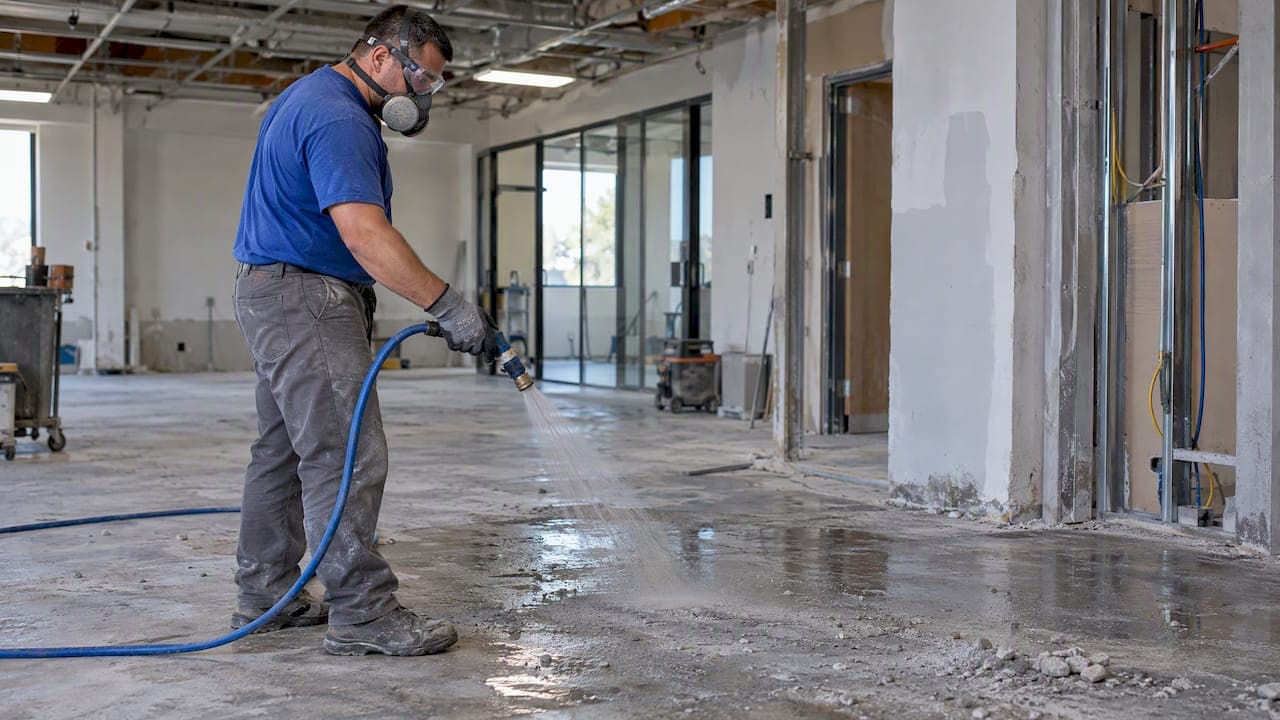
Under OSHA 29 CFR 1926.1153, employers must clean up silica dust with wet methods, HEPA-filtered vacuums, or another method that minimizes exposure, not dry sweeping or compressed air, except in narrow, documented cases. The standard sets a permissible exposure limit of 50 µg/m³ and an action level of 25 µg/m³, both as 8-hour time-weighted averages, and requires a written exposure control plan with a named competent person overseeing it.
TL;DR:
- Use wet methods for settled dust and HEPA vacuums for crevices, equipment, and enclosed spaces; OSHA defines HEPA filtration as 99.97% efficient at 0.3 microns.
- Fully implemented Table 1 controls, including required airflow and filter specifications, eliminate the need for a separate exposure assessment for that task.
- If a task falls outside Table 1 or controls are incomplete, employers must verify exposure through monitoring or objective data and document infeasibility claims.
- Workers required to wear respirators for at least 30 days per year need medical surveillance, including a baseline exam and examinations every three years.
- Seal collected dust, used filters, and contaminated protective gear in heavy duty bags or containers; clean vacuum filters only by the manufacturer's low emission procedure.
Table of Contents
- What OSHA requires: housekeeping rules and legal basics
- Acceptable cleaning methods: wet methods, HEPA vacuums, and sweeping compounds
- Table 1 controls and when they satisfy the standard
- OSHA-aligned cleanup sequence: a field checklist for removing silica dust
- Vacuum and filter maintenance, PPE handling, and disposal
- Program elements: written plan, competent person, training, and medical surveillance
- Verification, exposure assessment, and recordkeeping
- Special situations: enclosed cabs, demolition, and HVAC systems
- Publisher perspective: how we approach OSHA-compliant silica cleanup
- How we can help with OSHA-compliant silica cleanup
- FAQ
- Sources
What OSHA requires: housekeeping rules and legal basics
The respirable crystalline silica standard for construction, 29 CFR 1926.1153, does more than cap exposure. Section (f) of the rule directly governs how cleanup happens on a jobsite, because cleaning the wrong way can create the exact exposure the standard tries to prevent.
Dry sweeping and dry brushing are prohibited whenever they could contribute to respirable crystalline silica exposure, unless wet sweeping, HEPA vacuuming, or another effective method is not feasible for that task. Compressed air used to clean clothing or surfaces carries a similar restriction: it is allowed only when paired with a ventilation system that captures the dust cloud it creates, or when no other method works.
Two numbers anchor every compliance decision under this rule:
- The permissible exposure limit is 50 µg/m³ of respirable crystalline silica, averaged over an 8-hour shift.
- The action level, which triggers certain monitoring and medical surveillance duties, is 25 µg/m³ over the same 8-hour period.
These thresholds come directly from 29 CFR 1926.1153 and apply across virtually every silica-generating construction task, cleanup included.
Employers have two paths to compliance. The first is following Table 1 of the standard, which pairs specific tasks with specific engineering and work-practice controls. Implement those controls fully and operate the equipment as the manufacturer specifies, and a separate exposure assessment is not required for that task. The second path is building a custom control plan and verifying it works through objective data or periodic exposure monitoring. Table 1 is faster to document; an alternative approach demands more record-keeping but offers flexibility when a listed task does not match the actual work.
Acceptable cleaning methods: wet methods, HEPA vacuums, and sweeping compounds
Three methods carry OSHA's approval for routine silica housekeeping, each suited to different surfaces and dust conditions.
Wet methods apply water continuously to the work surface or settled dust before and during cleanup, turning airborne particles into a slurry that stays on the ground instead of in the air. The method only works when water flow matches the task: too little water leaves dry patches that re-aerosolize, and a slurry left to dry on a slab can crack, generating a new dust hazard during removal. Crews should follow equipment and plan-specific flow rate instructions and remove slurry before it dries.
HEPA-filtered vacuums are defined by OSHA as units with filters rated at 99.97% efficiency at 0.3 microns, the standard measure for capturing the finest, most dangerous respirable particles. They work best on:
- Settled dust on horizontal surfaces, ledges, and equipment.
- Holes, crevices, and tool bases where wet methods are impractical.
- HVAC interiors and enclosed equipment between cleaning passes.
Sweeping compounds, whether grit, non-grit, oil, wax, or water-based, are acceptable when used according to the manufacturer's instructions and when the employer can show they do not add exposure. OSHA does not endorse any specific product, and a compound is not an automatic substitute for wet methods or HEPA vacuuming on every surface. Match the compound to the surface and verify it actually suppresses dust rather than just moving it.
Compressed air keeps a narrow, conditional role. It is permitted only when paired with ventilation that captures the resulting dust cloud, or when the employer documents that no other method is feasible for that specific task.
Pro Tip: Keep a one-page record of why a method was chosen for each surface type; it becomes your defense if an inspector questions the approach later.
Table 1 controls and when they satisfy the standard
Table 1 lists common construction tasks alongside the engineering and work-practice controls that, when fully implemented, relieve the employer from a separate exposure assessment for that task. For cleanup-adjacent work, the relevant entries typically specify:
- Tool-mounted dust collection systems matched to the tool's airflow requirements.
- Integrated water delivery systems built into saws and grinders.
- Shrouds or cowlings connected to dust collectors with filters rated at 99% efficiency or higher.
- HEPA vacuuming between passes inside enclosed areas.
Partial implementation does not count. If a crew skips the water delivery system on a saw or runs a dust collector with an undersized filter, the Table 1 exemption from exposure assessment no longer applies, and the employer falls back to demonstrating compliance another way.
Equipment specifications matter as much as the method itself. Filters on Table 1 dust collection systems must meet at least 99% efficiency, and many tool types carry specific airflow requirements, such as 25 cubic feet per minute for every inch of wheel diameter on grinders, according to OSHA's small entity compliance guide. Filter-cleaning mechanisms, hose integrity, and water nozzle condition all factor into whether the control is actually performing as designed, not just present on paper.
This is also where cleanup overlaps with active work-practice controls documented in Table 1 guidance, available in OSHA's exposure table. A dust collector that was correctly specified when purchased but never had its filter changed no longer meets the standard it was bought to satisfy.
OSHA-aligned cleanup sequence: a field checklist for removing silica dust
Once dusty work wraps up, the cleanup itself needs structure. A rushed, disorganized pass with a shop vac and a push broom can generate more exposure than the original task. This sequence keeps crews, and anyone nearby, protected.
- Stop and isolate. End the dust-generating activity and restrict access to the area with signage or barriers before anyone begins cleanup.
- Let dust settle or ventilate. Give airborne particles time to settle, or use local exhaust ventilation to clear the air before cleaning starts.
- Clean top down. Work from higher surfaces to lower ones using HEPA-filtered vacuuming or wet methods; skip dry sweeping and compressed air unless the limited exceptions in the standard apply.
- Bag and seal. Place collected dust, spent filters, and disposable contaminated PPE into heavy-duty bags or sealed containers, labeled and staged for proper disposal.
- Verify before reopening. A visual check confirms the surface is clean, and for higher-risk tasks, the competent person should confirm readiness before access restrictions are lifted.
This sequence mirrors the approach outlined in our guide to concrete dust cleanup after construction, which walks through site-level coordination in more detail.
Pro Tip: Brief any cleaning subcontractor on the site's exposure control plan and task-specific restrictions before they step onto the floor, not after they've already pulled out a broom.
Vacuum and filter maintenance, PPE handling, and disposal
Filter maintenance is where many otherwise compliant cleanup programs quietly break down. Knocking dust from a filter or blowing it clean with compressed air can release a concentrated cloud that undoes everything the vacuum was meant to prevent.
- Avoid compressed-air filter cleaning unless it is used with an exhaust-ventilation system that actually captures the resulting dust cloud.
- Use the vacuum manufacturer's low-emission cleaning procedure or a built-in filter-cleaning mechanism instead.
- Empty collected dust into sealed containers or heavy-duty bags, minimizing shaking or manual agitation that could re-aerosolize particles.
- Treat every filter change as its own silica exposure task, with the same controls applied to any other dusty activity.
Filter maintenance can create exposures on its own, and OSHA guidance specifically cautions against compressed-air cleaning that would aerosolize silica during this step.
OSHA does not mandate one universal disposal method for silica-contaminated waste, only that handling minimize exposure throughout the process. Check with local waste authorities on disposal requirements for contaminated filters and bagged dust, since rules vary by jurisdiction and facility type.
Program elements: written plan, competent person, training, and medical surveillance
Cleanup methods only work inside a functioning compliance program. 29 CFR 1926.1153(g) requires a written exposure control plan covering:
- Tasks that generate silica exposure and the specific engineering controls and work practices used for each.
- Housekeeping measures, including which cleaning method applies to which surface or task.
- Procedures to restrict access to areas where exposures could exceed the PEL.
- The name of the designated competent person responsible for implementing the plan.
The plan should be reviewed and updated when tasks, equipment, or site conditions change. A competent person is not a title given lightly: this is the individual who conducts frequent inspections, has the authority to correct deficiencies on the spot, and makes the call on whether a cleaning method is actually working as planned.
Training must cover health effects, specific tasks that generate exposure, and the controls assigned to each. Medical surveillance kicks in for any worker required by the standard to wear a respirator for 30 or more days per year. Those workers get a baseline exam and follow-up exams every three years, including a chest X-ray and lung-function testing. Our construction cleaning safety guide covers how site managers typically assign and document these responsibilities.
Verification, exposure assessment, and recordkeeping
Following Table 1's controls to the letter removes the need for a separate exposure assessment on that task. Step outside Table 1, whether because the task isn't listed or the controls weren't fully implemented, and the employer must verify exposure levels through periodic monitoring or other objective data showing exposures stay below the PEL.
- When air monitoring is conducted, notify affected employees of the results and check the applicable OSHA requirements for the notification deadline.
- If results show exposure above the PEL, the notification must also describe the corrective action being taken.
- Employees or their representatives have the right to observe monitoring as it happens.
- Any claim that wet methods or HEPA vacuuming were infeasible for a task needs a documented rationale, not a general note about inconvenience, according to OSHA's standard interpretation on the topic.
A visually clean surface is not proof that breathing-zone exposure stayed under control. Monitoring data, equipment maintenance logs, and the written plan together build the record an inspector or auditor will want to see.
Special situations: enclosed cabs, demolition, and HVAC systems
Certain scenarios carry higher stakes and need extra attention beyond standard housekeeping.
Enclosed cabs on heavy equipment rely on filtration, not just a sealed door. NIOSH research found that effective protection depends on intake filters rated around 95% efficiency for particles in the 0.3 to 10.0 micron range, positive pressure inside the cab, intact seals, and working recirculation filtration. A quick pre-shift check of door seals, filter condition, and pressurization catches problems before a full shift of exposure.
Demolition, crushing, and other large-scale dusty tasks call for water sprays, dust suppression systems, or enclosed and filtered cabs, paired with close-capture hoods on rig-mounted equipment wherever Table 1 specifies them for that machine type.
HVAC systems and ductwork often collect construction dust that gets missed in a standard cleanup. Coordinate duct cleaning or filter changes with HVAC technicians so dust settled during construction doesn't become airborne again once the system restarts. Our guide to HVAC system cleaning after construction and this partner resource on removing pollutants from HVAC systems both cover the mechanics of that handoff.

Pro Tip: Schedule HVAC filter changes and duct inspections as a distinct line item in the post-construction cleanup plan, not an afterthought once the floors look clean.
Publisher perspective: how we approach OSHA-compliant silica cleanup
We follow OSHA-aligned procedures for post-construction silica cleanup, and that starts before a crew ever shows up on site. We coordinate site-specific exposure control plans directly with general contractors so cleaning crews know which method applies to which surface.
If you're writing a cleaning scope into a contract, three items are worth requiring up front: written receipt of the site-specific exposure control plan, documented proof that vacuum and dust collection equipment has been inspected and meets filter specifications, and a final walkthrough with the competent person before the area reopens. These three items catch most compliance gaps before they become a problem.
— Sales
How we can help with OSHA-compliant silica cleanup
We offer post-construction cleaning, environmental services, and facility services for property managers and contractors who need silica cleanup. Before a job starts, we review the site's exposure control plan and confirm which cleaning method fits each surface.
- We coordinate pre-job planning directly with general contractors so cleaning crews know task-specific restrictions before they arrive.
- We follow site exposure control plans rather than defaulting to a one-size-fits-all cleaning routine.

If you manage a post-construction site or a building that needs compliant cleanup, request a site visit and quote and ask us to show proof of HEPA equipment and written plan compliance before work begins. We also serve properties through our local teams.
FAQ
What are the OSHA requirements for dust collection?
OSHA's Table 1 in 29 CFR 1926.1153 specifies dust collection controls for many construction tasks, including tool-mounted systems with filters rated at 99% efficiency or higher and airflow matched to the tool's size. Fully implementing these controls removes the need for a separate exposure assessment on that task.
What are the top 5 OSHA violations?
This article does not cover OSHA's overall top violation categories across all industries, since that list changes and spans far beyond silica housekeeping. For silica-specific compliance, the most common gaps involve dry sweeping, uncontrolled compressed air use, and incomplete Table 1 implementation.
Which activities require dust collection methods under Table 1?
Table 1 of the respirable crystalline silica standard calls for dust collection on tasks like grinding, tuckpointing, and cutting with handheld or stationary saws, pairing each with equipment specifications such as filter efficiency and airflow rates. Full details on task-specific controls are listed directly in the standard itself.
What is considered nuisance dust?
Nuisance dust generally refers to particulate that is not classified as toxic or carrying a specific exposure limit under OSHA's silica standard, unlike respirable crystalline silica. Even so, construction dust frequently contains silica, so visual dust alone should never be used to judge whether a surface or area is actually safe from a silica exposure standpoint.
Does our cleaning service follow OSHA silica cleanup methods?
Yes, we follow OSHA-aligned wet methods and HEPA vacuuming procedures for post-construction silica cleanup, and we coordinate on site-specific exposure control plans before work begins. Pricing for post-construction cleaning depends on property size and scope, available after a site visit through our services page.
Sources
- 1926.1153 - Respirable crystalline silica. | Occupational Safety and Health Administration
- Protecting Machine Operators from Silica Dust: Enclosed Cabs | NIOSH Science Bulletin | CDC