
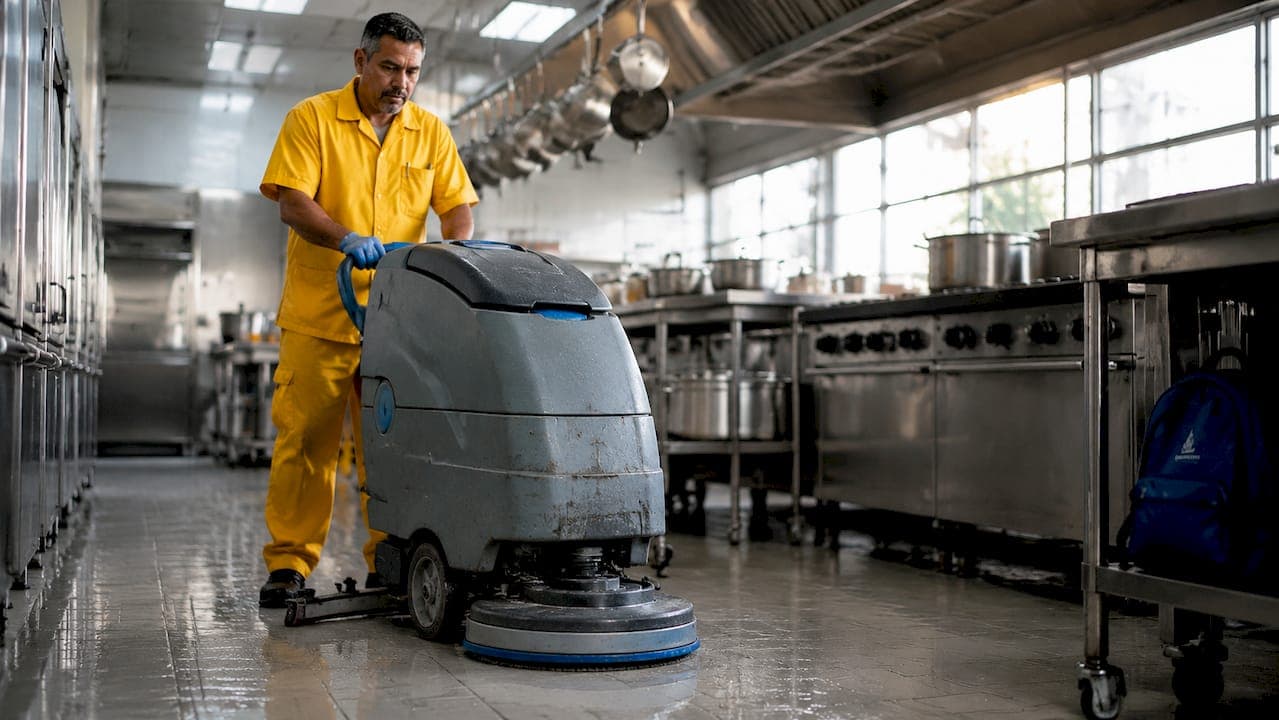
Floor maintenance is the ongoing program of cleaning, protecting, and restoring commercial floors to preserve building appearance, reduce safety risks, and extend flooring lifespan. For property managers and facility directors, understanding the role of floor maintenance means recognizing it as a structured operational discipline, not a reactive cleaning task. Buildings magazine and Opora Supply both document that preventive maintenance programs outperform reactive approaches in cost control and safety outcomes. The difference between a floor that lasts 15 years and one that needs replacement in 7 often comes down to documented procedures, consistent execution, and the right treatments applied at the right intervals.
What is the role of floor maintenance in facility programs?
Preventive floor maintenance is defined by consistent, planned, documented, and monitored activities rather than cleaning frequency alone. That distinction matters because many facility teams log daily mopping as a maintenance program when it is actually just reactive cleaning. A true preventive program assigns defined responsibilities across five activity tiers: routine cleaning, interim maintenance, deep cleaning cycles, inspections, and corrective actions.
Routine cleaning covers daily dust mopping, spot removal, and entrance mat management. Interim maintenance includes scrubbing and recoating finish layers before visible wear sets in. Deep cleaning, which Reliable Floor Care describes as stripping, grinding, or sanding, is more complex and costly than maintenance. Scheduling deep cleaning less frequently by staying ahead with interim care is the financial argument for preventive programs.
Inspections and corrective actions close the loop. Without them, small problems like finish delamination or grout erosion go unaddressed until they become expensive repairs. Documented inspections also create an audit trail that protects facility managers during liability reviews.
- Routine cleaning: Daily dust mopping, spot treatment, and entrance mat rotation
- Interim maintenance: Scrub and recoat cycles to restore finish before wear becomes visible
- Deep cleaning: Strip, grind, or sand when finish is fully degraded
- Inspections: Scheduled walkthroughs to catch surface defects early
- Corrective actions: Documented responses to identified deficiencies
Pro Tip: Prioritize consistency over frequency. A floor scrubbed on schedule every 90 days outperforms one scrubbed reactively four times a year because the intervals are planned around actual wear patterns, not visible damage.
How do floor types and traffic levels affect best practices?
Floor type and traffic intensity are the two variables that determine every maintenance decision. Applying the wrong protocol to the wrong substrate is one of the fastest ways to void a manufacturer warranty and accelerate surface degradation.

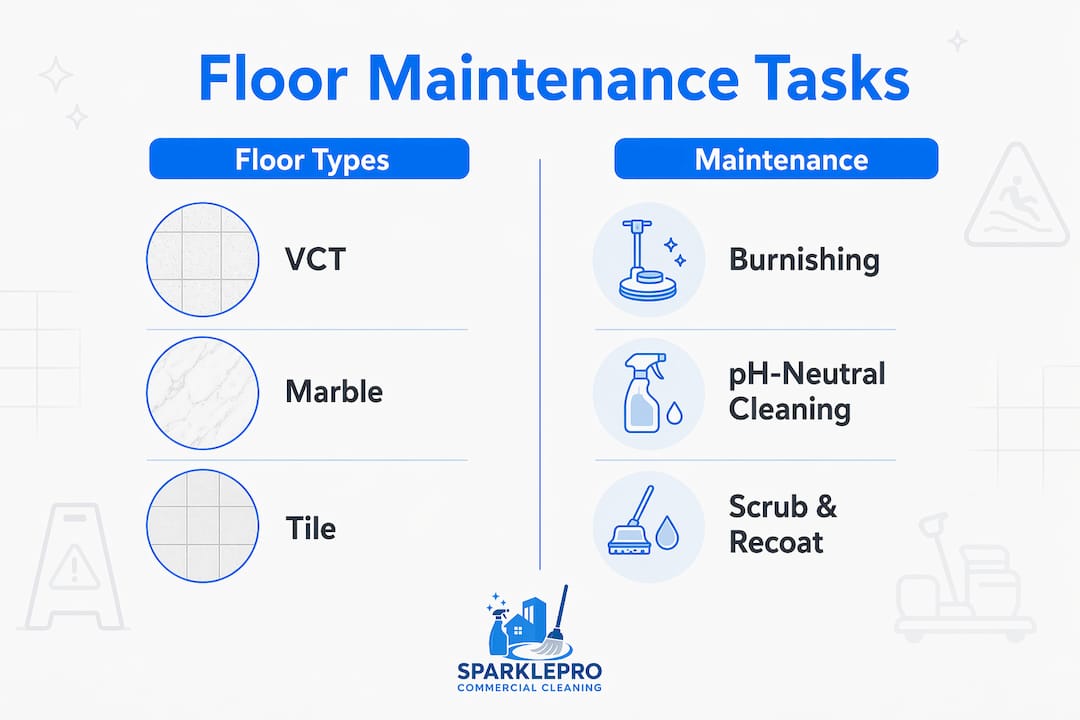
Vinyl Composition Tile (VCT) is the most common substrate in commercial buildings and the one with the most specific care requirements. For high-traffic VCT, burnishing 2–3 times per week at 1,500–2,000 RPM restores gloss without additional chemicals, while scrub-and-recoat occurs every 3–6 months. Skipping those intervals leads to accelerated finish degradation and higher restoration costs. Burnishing is not just cosmetic. It restores traction between deeper maintenance cycles, which directly affects slip resistance.
The risk of over-burnishing is equally real. Exceeding recommended frequencies and speeds abrades finish layers prematurely, increasing the frequency of costly strip-and-recoat cycles. The goal is a calibrated schedule, not maximum shine at any cost.
Marble and natural stone require pH-neutral cleaners and manufacturer maintenance specs to avoid etching. Tile finishes vary widely by glaze type, and choosing the right protocol for each finish prevents premature wear and warranty voidance. Carpet in commercial settings needs interim extraction every 3–6 months in addition to daily vacuuming, with full hot-water extraction annually.
| Floor Type | Traffic Class | Key Maintenance Task | Recommended Frequency |
|---|---|---|---|
| VCT | High | Burnishing at 1,500–2,000 RPM | 2–3 times per week |
| VCT | High | Scrub and recoat | Every 3–6 months |
| Marble / Natural Stone | Moderate | pH-neutral cleaning, polish | Monthly or per spec |
| Ceramic / Porcelain Tile | High | Grout cleaning, surface scrub | Monthly |
| Commercial Carpet | Moderate | Interim extraction | Every 3–6 months |
| Commercial Carpet | High | Hot-water extraction | Annually |
Pro Tip: Request the manufacturer's maintenance specification sheet before finalizing your care schedule. Deviating from it, even with good intentions, can void the warranty and leave you absorbing full replacement costs.
What safety and health impacts does floor maintenance have?
Effective floor maintenance directly reduces slip and fall incidents, which are among the most common causes of workplace injury claims in commercial buildings. Preventive programs embed slip resistance into daily tasks through moisture control, residue management, and drying time protocols. This treats safety as a built-in operational standard rather than a separate initiative.
Moisture left on hard floors after cleaning is the primary slip hazard. Residue from over-diluted or incompatible cleaning chemicals creates a film that reduces traction even when the floor appears dry. Spill response protocols, including defined response times and wet floor signage requirements, belong in every floor maintenance SOP.
Indoor air quality is the less visible but equally serious health dimension. Improper cleaning can redistribute allergens and moisture, increasing odor and contaminant risks in indoor environments. Vacuuming carpet with low-filtration equipment, for example, pulls debris from the surface and reintroduces fine particles into the air. HEPA-filtered equipment and microfiber mopping systems reduce this risk significantly.
- Moisture control: Establish maximum drying times and use fans or air movers in high-humidity areas
- Residue management: Verify chemical dilution ratios and rinse floors after applying cleaning solutions
- Spill response: Define response time standards and post wet floor signage immediately
- Equipment filtration: Use HEPA-filtered vacuums on carpet and microfiber mops on hard surfaces
- Allergen reduction: Schedule carpet extraction during low-occupancy hours to minimize exposure
The liability protection argument for consistent floor care is straightforward. Documented maintenance logs showing scheduled inspections, completed tasks, and corrective actions provide evidence of due diligence in the event of an injury claim. Facilities without that documentation face a much harder defense.
What operational and compliance factors matter for facility managers?
Running a floor maintenance program at scale requires more than a task checklist. Consistent execution across shifts and documentation are the pillars that separate programs that hold up under audit from those that collapse under scrutiny.
The compliance layer starts with chemicals. OSHA 29 CFR 1910.1200 requires that Safety Data Sheets (SDS) be accessible for every chemical used by maintenance staff. Floor care SOPs must align with these standards to ensure both regulatory compliance and staff safety. Training staff on SDS interpretation, proper dilution, and chemical storage is not optional. It is a legal requirement.
Here is a practical framework for building a compliant, operational floor care program:
- Document every procedure. Write SOPs for each floor type in your facility, including chemical names, dilution ratios, equipment settings, and task frequencies.
- Train staff before deployment. Cover SDS access, chemical handling, equipment operation, and emergency spill response before any staff member works unsupervised.
- Schedule inspections on a fixed calendar. Weekly walkthroughs for high-traffic areas, monthly for lower-traffic zones. Log findings and assign corrective actions with deadlines.
- Audit program execution quarterly. Compare completed task logs against the SOP schedule. Identify gaps and retrain where needed.
- Align with manufacturer specs. Pull specification sheets for every flooring product in your facility and cross-reference your SOPs against them annually.
Pro Tip: Treat your floor maintenance log as a legal document. Date every entry, record the name of the staff member who completed each task, and store logs for a minimum of three years. This record becomes your primary defense in any slip-and-fall liability review.
Skipping interim scrub-and-recoat cycles while continuing daily mopping is one of the most common and costly mistakes in facility management. Facilities that skip interim maintenance inadvertently shorten floor life and increase restoration frequency. The math is simple: one skipped scrub-and-recoat cycle can add a full strip-and-refinish cycle to your annual budget.
Integrating floor care into your broader facility maintenance strategy ensures it receives the scheduling priority and budget allocation it requires. Floors that are treated as a standalone cleaning task rather than a managed asset consistently underperform on both longevity and safety metrics.
Key takeaways
Effective floor maintenance requires documented procedures, substrate-specific protocols, and integrated safety practices to protect both flooring assets and building occupants.
| Point | Details |
|---|---|
| Preventive over reactive | Documented, scheduled programs reduce restoration costs and extend floor life significantly. |
| Substrate-specific protocols | VCT, marble, tile, and carpet each require distinct cleaning methods and frequencies to preserve warranties. |
| Safety is built in | Moisture control, residue management, and spill response belong in every floor maintenance SOP. |
| Compliance is non-negotiable | OSHA 29 CFR 1910.1200 requires SDS access and staff training for all cleaning chemicals used on-site. |
| Documentation protects you | Maintenance logs with dates, tasks, and staff names are your primary defense in liability reviews. |
What i've learned after years of watching floor programs fail
The most common failure I see is not neglect. It is misclassification. Facility teams genuinely believe they have a maintenance program because staff mop every day and burnish every Friday. What they actually have is a cleaning schedule with no interim maintenance, no inspections, and no corrective action loop. When the floor finish fails at month 14 instead of month 36, they are surprised.
The second pattern is over-reliance on a single vendor's product line without cross-referencing manufacturer specs. A cleaning chemical that works well on ceramic tile can etch a marble surface or strip a VCT finish coat. I have seen facilities spend more on emergency restoration in one quarter than they would have spent on a full year of compliant preventive care.
The facilities that get this right treat their floors as managed assets, the same way they treat HVAC systems or elevators. They assign ownership, schedule interventions, document outcomes, and review performance quarterly. They also recognize when the scope exceeds internal capacity and bring in professional floor care services to handle deep restoration cycles or specialized substrates.
The data-driven approach is not complicated. It requires a floor inventory, a maintenance matrix matched to each substrate and traffic class, and a documentation system that survives staff turnover. Start there, and the rest of the program builds naturally.
— Sales
How Sparkleprocommercialcleaning supports your floor care program
Sparkleprocommercialcleaning delivers commercial floor maintenance services built around the same preventive principles this article covers. Every engagement starts with a site assessment to map floor types, traffic patterns, and current condition before a single task is scheduled.
From routine janitorial services to interim scrub-and-recoat cycles and deep restoration, Sparkleprocommercialcleaning builds customized maintenance plans that match your substrate requirements and compliance obligations. Service teams are trained on SDS protocols, manufacturer specifications, and documentation standards. Property managers in Delaware, New Jersey, and Wisconsin can request a consultation to receive a floor care plan tailored to their facility's specific needs. Contact Sparkleprocommercialcleaning to schedule your site visit today.
FAQ
What is the role of floor maintenance in commercial buildings?
Floor maintenance preserves building appearance, reduces slip and fall risks, and extends the lifespan of flooring materials through scheduled cleaning, protective treatments, and periodic restoration. It functions as a preventive asset management program rather than a reactive cleaning task.
How often should commercial floors be scrubbed and recoated?
High-traffic VCT floors require scrub-and-recoat cycles every 3–6 months, with burnishing 2–3 times per week to maintain gloss and traction between deeper cycles. Other substrates follow manufacturer-specified intervals based on traffic class.
What compliance requirements apply to floor maintenance programs?
OSHA 29 CFR 1910.1200 requires that Safety Data Sheets be accessible for every cleaning chemical used on-site, and staff must be trained on safe handling before working with those products. SOPs should also align with flooring manufacturer specifications to maintain warranty coverage.
How does floor maintenance affect indoor air quality?
Improper floor cleaning can redistribute allergens, moisture, and contaminants into the indoor environment, particularly when low-filtration equipment is used on carpet. HEPA-filtered vacuums and microfiber systems reduce particle reintroduction and support healthier indoor air.
What documentation should a floor maintenance program include?
Every program should log completed tasks by date and staff member, record inspection findings with assigned corrective actions, and store chemical SDS documentation on-site. Logs should be retained for a minimum of three years to support liability defense if needed.