
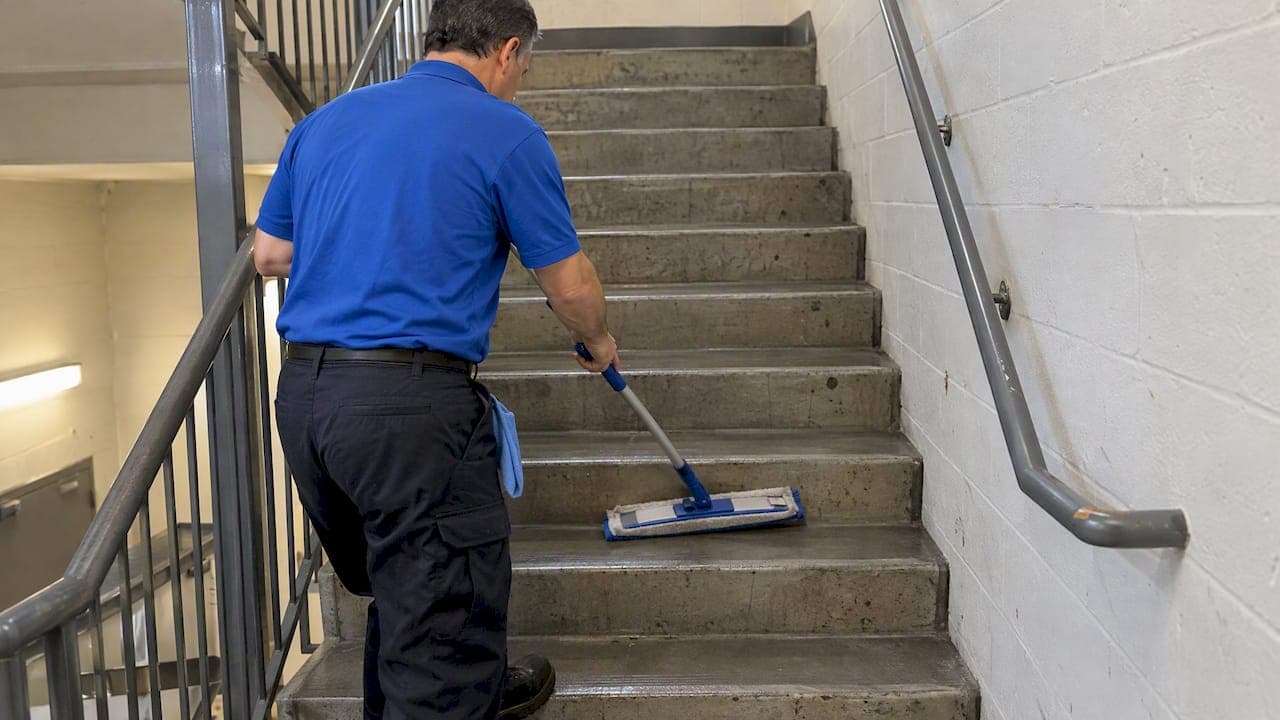
Maintaining a stairwell starts with one rule: clean high-touch surfaces like handrails every day, follow CDC guidance to remove visible soil before disinfecting, and keep treads, nosings, and widths compliant with OSHA stairway requirements. Layer in periodic deep cleans and documented inspections, and you meet the baseline that regulators and insurers expect.
TL;DR:
- Vacuum carpeted treads daily, extract stains within hours, and schedule hot water extraction every 6 to 12 months; clean wood with a light mist.
- Clean full treads weekly, detail vertical surfaces monthly, and schedule deep cleaning quarterly or annually; daily passes take 10 to 15 minutes per flight.
- After removing visible soil, keep surfaces wet with an EPA registered disinfectant for its label contact time, often 1 to 10 minutes.
- OSHA requires at least 22 inches between vertical barriers, while accessibility guidance calls for about 2 inch visual contrast nosings and continuous handrails.
- For spills, block off the step, absorb liquid without spreading it, and keep barriers until dry; record the time, photo, and product used.
Table of Contents
- Material-specific maintenance for stairs
- The daily-to-annual stairwell cleaning sequence
- OSHA, ADA, and GSA standards that shape stair maintenance
- Disinfectant selection, contact time, and chemical safety
- Inspection checklists and quality control for stairwells
- Common stairwell contaminants and how we approach them
- Emergency spill and stain response procedures
- Training and certification for stairwell cleaning staff
- Cleaning stairwell lighting and ventilation elements
- Priority actions for busy facility teams
- Getting stairwell cleaning handled by our team
- FAQ
- Sources
Material-specific maintenance for stairs
Stair surfaces age differently, and the wrong product or tool shortens their life while raising slip risk. A written plan should name the material, the method, and the cadence for each flight in your portfolio.
- Carpet: vacuum high-traffic treads daily, run spot extraction on stains within hours, and schedule full hot-water extraction every 6 to 12 months; replace runners once backing shows through pile.
- Wood: dust or dry-mop first, then use a wood-safe cleaner in a light mist rather than a saturating mop; refinish on a multi-year cycle and watch humidity, which warps treads and loosens nosings.
- Concrete and painted metal: match degreaser strength to soil load, reserve pressure washing for exterior or industrial stairs with proper drainage, and reapply anti-slip coatings before they wear smooth.
- Tile, grout, and glass: reseal grout on a set schedule to block mold, use low-abrasion cleaners on glazed surfaces, and avoid ammonia-based products on acrylic or laminated glass panels, which cloud and scratch under harsh chemistry.
Skipping the material check is the most common cause of premature stair replacement. A degreaser strong enough for a loading-dock stairwell can strip the finish off an interior hardwood flight in a single pass, and a pressure washer aimed at old grout lines can blow out the sealant entirely.
The daily-to-annual stairwell cleaning sequence
A consistent sequence keeps results predictable regardless of who is on shift. The order matters: debris removal always comes before disinfection, because CDC guidance treats pre-cleaning as a precondition for any disinfectant to work as labeled.
- Remove loose debris and trash from treads and landings.
- Sweep or vacuum the full flight, working top to bottom.
- Spot-clean visible stains or spills before general wiping.
- Clean all surfaces, including risers, nosings, and vertical rails.
- Disinfect high-touch points such as handrails and push plates where required.
A simple frequency tier keeps staffing realistic: daily attention to handrails and landings, weekly full-tread cleaning, monthly work on vertical surfaces and glass, and a quarterly or annual deep clean for carpet extraction and floor stripping. Microfiber cloths and HEPA-filtered vacuums cut airborne dust, and cleaning from the top of a flight down, moving away from the building entrance, stops re-soiling the sections you just finished. Our five-step high-traffic cleaning plan breaks this down further for lobbies and connecting stairwells. Budget roughly 10 to 15 minutes per flight for a thorough daily pass, more for landings with glass or metal detailing.
Pro Tip: Place walk-off mats at every stairwell entrance; they cut tracked-in soil before it ever reaches the treads.
OSHA, ADA, and GSA standards that shape stair maintenance
Cleaning crews need to know the dimensional and safety rules before they touch a mop, because some cleaning choices can put a stairwell out of compliance.
- OSHA's 1910.25 stairway standard sets a minimum width of at least the minimum width required between vertical barriers, with uniform riser and tread dimensions and required handrails or guards. That 22-inch figure is measured between vertical barriers, and a 2024 OSHA interpretation confirms handrails themselves don't count as obstructions against that minimum.
- Access Board ABA guidance calls for uniform tread and riser dimensions, visual-contrast nosings of about two inches on top and bottom steps, and continuous handrails with a grip-friendly profile.
- The GSA National Custodial Specification requires a written cleaning plan and sets sample cadences, including daily policing and bi-weekly or monthly detailed cleaning depending on traffic.
In practice, this means never applying a coating or wax that dulls handrail grip, keeping nosings visible rather than buried under worn paint or grime, and letting these dimensional rules set your inspection checklist rather than treating them as a one-time construction concern.
Disinfectant selection, contact time, and chemical safety
Effective disinfection depends on the product, the surface prep, and the time you let it sit. CDC guidance calls for cleaning visible soil first, then applying an EPA-registered disinfectant and keeping the surface visibly wet for the label's full contact time, often somewhere between 1 and 10 minutes depending on the product.
- Choose EPA List N disinfectants and check the label before using them on stone, wood, or specialty metal finishes that can discolor or corrode.
- Train staff on dilution ratios, required PPE, and ventilation, since concentrated disinfectants used in an enclosed stairwell can irritate eyes and lungs.
- For porous surfaces like carpeted treads, clean or launder removable material rather than relying on disinfectant spray alone.
- Call in environmental services after a biohazard event or heavy, caked-on soiling, and keep a log of the product, date, and contact time used for every disinfection pass.
A hard surface cleaner formulated for commercial stair treads and handrails is one option worth checking against your material list before standardizing on a single product across a portfolio.
Pro Tip: Keep a laminated copy of each disinfectant's label contact time posted near the chemical storage closet so no crew member has to guess.
Inspection checklists and quality control for stairwells
A checklist turns stairwell cleaning from a guess into a measurable standard.
- Check tread and landing cleanliness, nosing visibility, and handrail soil daily.
- Walk the full stairwell weekly, checking lighting function and slip hazards.
- Run a documented monthly audit with photos and timestamps for your records.
- Track pass rate, corrective-action turnaround, and completed deep cleans as vendor KPIs.
- Escalate to specialized cleaning for paint removal, post-construction debris, or biohazard cleanup when standard crews can't safely handle it.
Our commercial cleaning standards guide walks through how to build these checkpoints into a written quality-control plan.
Common stairwell contaminants and how we approach them
Stairwells collect a specific mix of grime that differs from open-floor areas: tracked-in grit from shoes, dust that settles on ledges and light fixtures, handrail oils from repeated grip contact, and spills that pool on landings rather than draining. Enclosed stairwells with poor airflow also trap odors and mold spores faster than ventilated hallways.
This mix is why a generic janitorial pass often misses stairwells. Grit abrades flooring finishes over time, oils on handrails build into a sticky film that standard glass cleaner won't cut, and landing spills seep into grout lines or carpet backing if they sit too long. Treating a stairwell like an extension of the lobby, rather than its own contamination zone, is the most common gap we see in cleaning plans.
A plan that accounts for these sources sets smarter cleaning cadences: more frequent attention near entry-adjacent stairwells where grit load is heaviest, and closer monitoring of enclosed or poorly ventilated stairwells where mold and odor develop faster.
Emergency spill and stain response procedures
A spill on a stairwell is a safety hazard first and a cleaning task second. Treads and landings concentrate foot traffic in a narrow path, so a wet or oily patch there carries more fall risk than the same spill on an open floor.
Respond in this order: block off the affected step or landing with a cone or barrier, then absorb liquid with an appropriate material rather than spreading it with a mop head. Grease and oil need an absorbent plus a degreaser matched to the stair surface; blood or bodily fluids require PPE and an EPA-registered disinfectant after absorption, following the same clean-before-disinfect sequence used in routine work. Dry the area fully before removing barriers, since a damp tread can look clean while remaining slick.

Document the incident with a photo, time, and the product used, both for your own quality records and in case of a liability claim. Stains that set before cleanup, like rust from metal fixtures or ground-in dye from mats, often need a specialized stain-removal pass rather than routine chemistry, which is a good trigger for calling in a deep-clean or environmental services visit rather than letting a crew improvise.
Training and certification for stairwell cleaning staff
Stairwell work carries more fall and chemical-exposure risk than flat-floor cleaning, which makes targeted training worth the time it takes. Staff should know the clean-before-disinfect sequence, correct dilution ratios for each product in use, and the PPE required for the chemicals on their cart, not just a general orientation to mopping and dusting.
Ladder and lighting work inside a stairwell adds another layer: anyone cleaning overhead fixtures or changing bulbs needs training on stable ladder placement on stair treads, which are rarely level in the way a hallway floor is. Crews should also know the building's specific stair dimensions and handrail materials well enough to flag anything that looks out of spec, like a loose handrail bracket or a worn nosing, during routine cleaning rather than waiting for a formal inspection.
Many commercial cleaning operations build this into onboarding rather than treating it as a separate certification track: a documented walkthrough of chemical labels, PPE use, and stairwell-specific hazards before a new hire works a flight unsupervised. Refreshers tied to any change in product line or a near-miss incident keep the training current without turning it into a bureaucratic exercise.

Cleaning stairwell lighting and ventilation elements
Lighting and airflow do as much for stairwell safety as the cleaning itself, since a dim or stuffy stairwell hides the slip hazards your crew is trying to prevent. Dust and grime build up on light fixtures faster than most managers expect, cutting output well before a bulb actually fails.
Wipe light covers and exposed bulbs on a monthly rotation using a dry or lightly damp cloth, never a wet one on live fixtures, and confirm emergency lighting activates correctly during the same pass. Ventilation grilles and intake vents collect the same dust and lint that settles on landings, so include them in your monthly detail cleaning rather than leaving them for an annual HVAC service visit.
Enclosed stairwells with limited airflow are also where mold and musty odors develop first, particularly near ground-level entries exposed to moisture. A quick visual check for discoloration around vents or light housings during routine cleaning catches this early, before it becomes a specialized remediation job. Treating lighting and ventilation as part of the stairwell cleaning checklist, rather than a separate building-systems task, keeps both safety and air quality on the same maintenance calendar.
Priority actions for busy facility teams
If you can only fix one thing this quarter, fix handrail and nosing cleanliness: they carry the most liability and the least staff time. Build a traffic-based schedule rather than a flat calendar, and document every pass with a photo and checklist entry.
Small investments, a box of microfiber cloths, a simple visual audit routine, and a committed quarterly deep clean, tend to cut complaints and reduce liability exposure faster than a full program overhaul.
— Sales
Getting stairwell cleaning handled by our team
We follow a four-step process for stairwell cleaning: you request a quote, we schedule a site visit to assess materials and traffic, we complete the scheduled cleaning, and you sign off before the engagement continues.
- Janitorial services for daily and weekly stairwell policing.
- Deep cleans for carpet extraction, floor stripping, and detailed vertical surfaces.
- Disinfecting services for high-touch handrails and landings.
- Post-construction cleanouts for stairwells after a build or renovation.
- Day porter services for buildings that need someone on-site handling stairwells continuously.
Request a quote through our main services page or check our New Jersey location page if you need a state-specific contact.
FAQ
How do you clean a staircase?
Remove loose debris, sweep or vacuum from top to bottom, spot-clean stains, then wipe down all surfaces including risers and handrails. Disinfect high-touch points like handrails with an EPA-registered product after the surface is visibly clean, following CDC pre-clean guidance.
What are the different levels of cleanliness?
Cleaning standards generally run from daily high-touch policing (handrails, landings) to weekly full-tread cleaning, monthly detailed work on vertical surfaces, and quarterly or annual deep cleaning such as carpet extraction. Each tier targets a different soil type and traffic level rather than a single fixed definition of "clean."
What is the OSHA minimum required width for stairways?
OSHA's 1910.25 standard sets a minimum width between vertical barriers for standard stairs as specified in the standard. A 2024 OSHA interpretation clarifies that handrails are not counted as vertical barriers against that minimum.
What is the 7 to 11 rule for stairs?
Definitions vary by jurisdiction, but the Access Board's ABA stairway guidance recommends uniform riser heights and tread depths aimed at keeping stair proportions safe and consistent. Check your local building code or the guidance for the exact figures that apply to your property.
Sources
- 1910.25 - Stairways. | Occupational Safety and Health Administration
- When and how to clean and disinfect a facility | CDC
- Chapter 5: Stairways | Guide to the ABA Accessibility Standards