
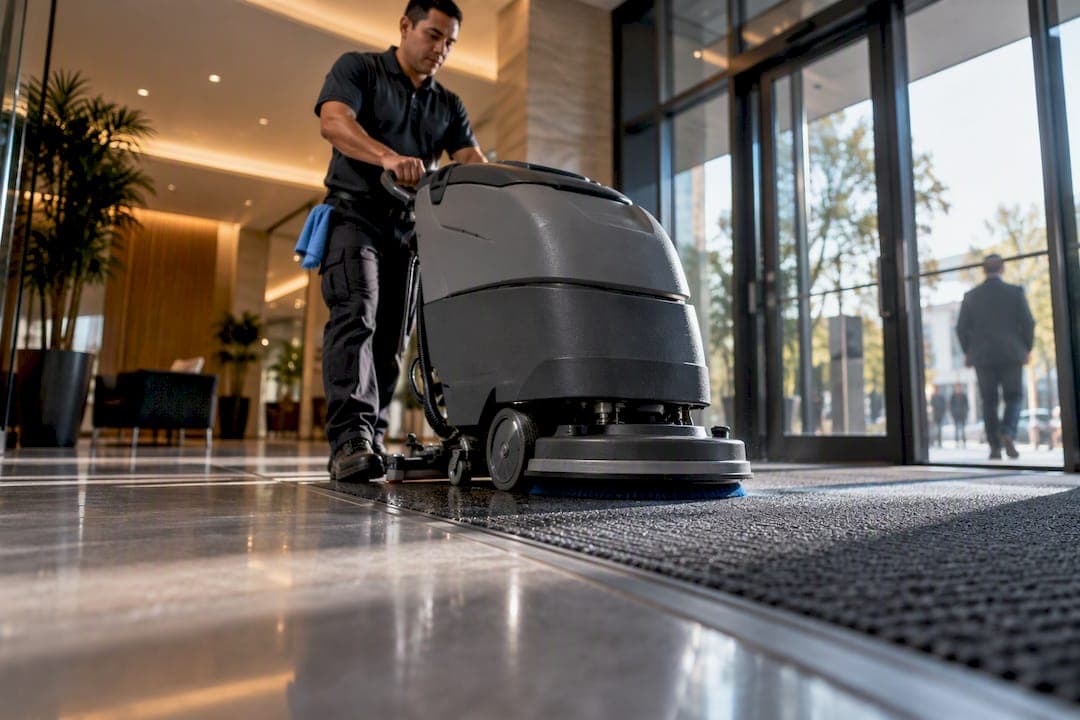
The fastest way to keep busy commercial spaces clean and safe is a zone-based, prevention-first program: control soil at entrances, clean high-touch surfaces frequently, and disinfect according to label instructions. This approach follows CDC cleaning guidance and OSHA's walking-working surfaces rule. Janitorial contracts are often built around this same logic. Start by mapping your zones, then set a prioritized schedule.
TL;DR:
- Focusing cleaning efforts on entrances, elevators, restrooms, and high-traffic corridors reduces soil buildup and infection risk more effectively than uniform schedules.
- Using long, maintained entrance mats, microfiber tools, and extractors can prevent soil spread and lessen overall cleaning loads in busy commercial spaces.
- High-touch surfaces require at least daily disinfection, with frequency increasing during peak times, visible soiling, or illness outbreaks.
- Scheduling cleaning based on zone risk, with more frequent service for high-traffic, high-occupancy areas, optimizes labor and safety outcomes.
- Proper disinfectant use depends on maintaining surface wetness for the full contact time and choosing products appropriate for each material type.
Table of Contents
- How to identify and map high-traffic zones in your property
- Why high-traffic areas need different treatment
- Durable tools, entrance controls, and materials that reduce cleaning load
- Safe, effective cleaning techniques for high-touch surfaces and floors
- Zone-based scheduling: set frequencies and allocate labor by risk
- Choosing and using disinfectants correctly: EPA List N and contact time rules
- OSHA expectations and slip/trip prevention tied to cleaning operations
- A compact checklist and sample service plan you can use now
- Practitioner perspective from a commercial cleaning provider
- What most advice on this topic gets backwards
- How Sparkle Pro puts this program into practice
- Sources
- FAQ
How to identify and map high-traffic zones in your property
High traffic area cleaning starts with knowing exactly where people walk, gather, and touch surfaces most. Some zones are obvious, others get missed until complaints or safety incidents force attention.
Watch these areas first:
- Entrances, lobbies, and vestibules where outdoor soil enters the building
- Corridors and stairwells connecting high-occupancy spaces
- Elevators and elevator lobbies, especially buttons and rails
- Restrooms, with fixtures and door hardware as top concerns
- Check-in counters, reception desks, and shared equipment
Footfall, touch frequency, and visible soiling are better indicators than square footage alone. A quiet back hallway needs far less attention than a lobby with constant foot traffic. Short walkthrough audits, tenant or staff reports, and even a week of informal footfall logging at entry points can reveal patterns that a fixed schedule misses. Peak times matter too: a retail entrance on a weekend afternoon behaves nothing like the same space at 7 a.m.
Why high-traffic areas need different treatment
Concentrated foot traffic changes the physics and biology of cleaning. Soil, moisture, and touch all accumulate faster in a handful of predictable spots, which is why uniform, one-size-fits-all schedules tend to underserve the areas that matter most.
- Soil accumulates faster, wearing down floor finishes and shortening the life of carpet and resilient flooring
- Waste and odor loads rise in concentrated zones like restrooms and break areas
- Tracked moisture and spills raise slip and trip risk, a concern OSHA addresses directly in its walking-working surfaces standard
- More touchpoints mean infection control depends on cleaning frequency, not just cleaning quality
Treating a busy lobby the same way you treat a rarely used storage corridor wastes labor in one place and leaves risk unaddressed in the other.
Durable tools, entrance controls, and materials that reduce cleaning load
Stopping soil before it spreads is cheaper than removing it after the fact. Entrance matting is the single most effective control: mats need to be long enough to capture multiple footsteps and vacuumed or serviced frequently enough that they do not become a soil reservoir themselves, a point CDC floor-care guidance supports by framing prevention as the starting point for traffic-lane maintenance.
Beyond matting, equipment choice matters:
- Microfiber mops and cloths lift soil rather than pushing it around
- High-efficiency vacuums with strong filtration handle carpeted lobbies and corridors
- Commercial walk-off mats at every exterior entrance, not just the main door
- Extractors for carpet traffic lanes that dust-mopping alone cannot fix
Foam cleaners and hot-water extraction suit carpets with embedded soil or staining, while daily traffic lanes usually respond well to vacuuming and periodic extraction. Green cleaning products work well for most daily tasks and matter most where occupants have sensitivities or where a property targets LEED credentials.
Pro Tip: Service entrance mats on the same schedule as your highest-traffic floor zone, not on a separate calendar. Both are set by the same soil load.

Safe, effective cleaning techniques for high-touch surfaces and floors
Technique determines whether a cleaning task actually reduces risk or just moves soil around. Facility guidance from CDC and the American Hospital Association lays out a sequence that applies well beyond healthcare settings.
- Work top to bottom and clean to dirty, so debris from upper surfaces does not resettle on already cleaned areas
- Save restrooms for last on any circuit through shared building spaces
- Rotate and change microfiber cloths often, since a saturated cloth spreads soil instead of removing it
- Use dedicated cloths or tools for isolated or higher-risk areas rather than moving one cloth building-wide
- Match wipe versus spray application to the product label, since either method only works if the surface stays wet for the full contact time
- Respond to spills by containing the area, cleaning it, drying it fully, then placing a barrier or wet-floor sign until the surface is safe
Cleaning high-touch surfaces at least once daily is the CDC baseline, with more frequent service required wherever occupancy, visible soil, or illness call for it. That baseline is a floor, not a ceiling, for busy entrances and restrooms.
Zone-based scheduling: set frequencies and allocate labor by risk
Mapping your zones only pays off once it drives an actual schedule. The logic is straightforward: combine touch frequency, visible soil, and occupancy to assign each zone a frequency band, then staff accordingly.
- High-touch, high-occupancy zones (entrance doors, elevator buttons, restroom fixtures) get multiple cleanings per shift
- Moderate zones (corridors, break rooms) get one thorough cleaning per shift plus spot checks
- Low-traffic zones (storage, rarely used offices) can run on a weekly or biweekly cycle
- Day porters cover continuous touchpoint cleaning during business hours, while a scheduled overnight or off-hours crew handles floor care and deep cleaning
- Simple KPIs, like checklist sign-offs, supervisor spot checks, and complaint tracking, confirm the schedule is holding up in practice
This structure keeps labor concentrated where it earns the most safety and appearance return, rather than spread evenly across a floor plan that does not use every space equally.
Choosing and using disinfectants correctly: EPA List N and contact time rules
Picking a disinfectant is not a brand decision, it is a label decision. The EPA's List N explains that contact time, the length of time a surface must stay visibly wet, varies by product and must be followed for the disinfectant to work as intended.
- Match the product to the surface: hard nonporous surfaces, porous materials, and food-contact areas often require different formulations
- Plan the application so the surface stays wet for the full labeled contact time, not just a quick wipe
- Verify dilution, ventilation, and rinsing instructions before crews start, since skipping any one step undermines the others
A step-by-step verification guide can help confirm a product is both List N listed and appropriate for your surfaces, while detailed dwell time guidance covers the most common ways crews shorten contact time without realizing it.
| Surface type | Contact time consideration | Common application error |
|---|---|---|
| Hard nonporous (counters, handrails) | Must stay visibly wet per label | Wiping dry before time elapses |
| Porous (some fabrics, upholstery) | Product must be labeled for porous use | Using a nonporous-rated product |
| High-touch electronics (touchpads) | Requires product compatible with the device | Over-saturating and damaging equipment |
OSHA expectations and slip/trip prevention tied to cleaning operations
OSHA's walking-working surfaces standard, 29 CFR 1910.22, requires that surfaces be kept clean, orderly, and as dry as feasible. That last phrase matters: it acknowledges that some conditions, like heavy weather tracking moisture through an entrance, demand more than the routine schedule.
- Clean one side of a corridor at a time so a path stays open and dry
- Keep lighting adequate and handrails maintained along stairs and ramps, a point reinforced in OSHA's hospital housekeeping eTool
- Place spill barriers and signage immediately, not after the next scheduled round
- Treat rainy or snowy days as a trigger for extra entrance servicing, not a reason to skip it
Coordinating cleaning sweeps with building access control schedules also helps avoid blocked corridors during shift changes.
A compact checklist and sample service plan you can use now
A workable scope of work turns all of the above into something you can hand to a vendor or use to audit your own crew.
- Daily: service entrance mats, wipe high-touch points, check and restock restrooms
- Daily: spot-clean spills immediately with barrier signage until dry
- Weekly: carpet extraction on traffic lanes, resilient-floor deep cleaning
- Monthly: full walkthrough audit against a written checklist
- Ongoing: require checklists, site-visit reports, and stated response times from any vendor
A full office cleaning checklist with sign-off fields is useful for building this into an RFP or vendor brief.
Practitioner perspective from a commercial cleaning provider
Contracts that work in the field usually pair a day porter for continuous high-touch coverage with a nightly team for floor care and deep cleaning, backed by site visits and written checklists rather than verbal assurances.
A schedule only holds up if someone checks it. Sign-off sheets and periodic site visits catch the gaps a calendar alone will not.
What most advice on this topic gets backwards
Most cleaning guidance treats frequency as the whole answer: clean more often and the problem goes away. That misses the point. A high-touch surface wiped ten times a day with a dry cloth or a disinfectant applied for half its labeled contact time accomplishes less than a surface cleaned correctly three times.

The conventional advice also underrates entrance control. Property managers spend heavily on interior cleaning while treating matting as an afterthought, even though most soil enters through a handful of doors. Fixing that one variable reduces labor everywhere else in the building.
What should come first is not a bigger cleaning budget, it is a zone map. Knowing exactly which five or six spots carry most of the touch and soil load lets you assign the right frequency and the right technique to each one, instead of spreading effort evenly across space that does not carry equal risk.
— Sales
How Sparkle Pro puts this program into practice
Recurring janitorial contracts, day porter coverage, disinfecting services, and post-construction cleanouts each map directly onto the zones and frequencies described here. The process typically starts with a site visit and quote, so the resulting scope reflects actual traffic patterns rather than a generic template.
- Request a site visit to identify your property's specific high-traffic zones
- Get a written quote scoped to daily, weekly, and monthly tasks
- Use a sample checklist to compare against your current vendor's performance
Visit Sparkle Pro's service page to start a quote, or check how local crews and response times are described on the New Jersey service page as one example.
Pro Tip: Ask any vendor, including Sparkle Pro, to show you their checklist and sign-off format before signing a contract.
Sources
- 1910.22 - General requirements. | Occupational Safety and Health Administration
- I have a question about a word or phrase on the List N website. | US EPA
FAQ
How often should high-touch surfaces be cleaned?
High-touch surfaces like door handles, elevator buttons, and counters should be cleaned at least once daily, according to CDC guidance. That frequency should increase when occupancy is high, soiling is visible, or illness is present in the facility.
What does OSHA require for floor cleaning in busy areas?
OSHA's 29 CFR 1910.22 requires walking-working surfaces to be kept clean, orderly, and as dry as feasible, including prompt attention to weather-tracked moisture. It does not set a specific cleaning frequency but ties compliance to keeping the surface safe to walk on at all times.
How do I know if a disinfectant is working correctly?
A disinfectant works correctly only when the surface stays visibly wet for the full contact time listed on its EPA List N label. Wiping a surface dry before that time elapses is one of the most common reasons disinfection fails despite regular cleaning.
What is the difference between routine cleaning and deep cleaning for high-traffic floors?
Routine cleaning covers daily tasks like vacuuming, mopping, and matting service in traffic lanes. Deep cleaning refers to periodic carpet extraction or resilient-floor stripping and refinishing that removes embedded soil routine methods cannot reach.
Should I hire a day porter or a scheduled cleaning crew for a high-traffic building?
Many facilities benefit from both: a day porter handles continuous high-touch cleaning and spot response during business hours, while a scheduled crew handles floor care and deep cleaning during off-peak hours. The right mix depends on your building's occupancy pattern and the specific zones identified in a site walkthrough.