

Routine cleaning keeps a building presentable. Building deep cleaning techniques keep it genuinely sanitary, structurally sound, and compliant with the standards that matter in commercial environments. Most cleaning teams already know how to mop a floor or wipe down a surface. The real challenge is executing a thorough, repeatable deep clean across thousands of square feet without missing contamination zones, skipping dwell times, or letting inconsistent technique undo the work. This article breaks down the professional-grade methods, equipment choices, and protocol decisions that separate effective deep cleaning from the kind that just looks done.
Table of Contents
- Key takeaways
- 1. Building deep cleaning techniques: the foundational framework
- 2. Deep floor scrubbing and restorative maintenance
- 3. Targeting hidden contamination zones
- 4. High dusting and ceiling maintenance
- 5. Equipment comparison: choosing the right tools
- 6. Implementing deep clean procedures: what to document
- 7. Degreasing in high-soil commercial areas
- 8. Tailoring techniques by facility type
- My take on deep cleaning discipline
- How Sparkleprocommercialcleaning supports your deep cleaning program
- FAQ
Key takeaways
| Point | Details |
|---|---|
| Sequence matters | Always clean top-to-bottom and dirtiest-to-cleanest to avoid cross-contaminating areas you've already cleaned. |
| Dwell time is non-negotiable | Disinfectants need contact time of 1 to 10 minutes to work; wiping too early leaves pathogens behind. |
| Equipment selection drives results | Auto-scrubbers, HEPA vacuums, and pressure washers outperform traditional tools in large commercial spaces. |
| SOPs reduce quality variation | Documented procedures with product specs and inspection checkpoints create consistency across cleaning teams. |
| Facility type shapes your approach | Warehouses, medical facilities, and offices each require distinct deep clean procedures and product choices. |
1. Building deep cleaning techniques: the foundational framework
Before any mop hits the floor, the most effective building deep cleaning techniques start with a planning phase that most teams skip or rush. Defining the scope of work by separating daily, weekly, and monthly tasks prevents critical steps from being lumped together or forgotten entirely.
Product and equipment selection must match the surface type and contamination level. Multi-surface cleaners differ from glass or wood cleaners, and floors like VCT, hardwood, and tile each require distinct care. Using the wrong product on the wrong surface does not just reduce effectiveness. It can cause permanent damage.
Sequencing is where most large-facility deep cleans break down. Work top-to-bottom so dust and debris fall to areas not yet cleaned. Planning supplies, PPE, and ventilation before starting reduces errors and keeps the team moving without interruptions.
Pro Tip: Schedule deep cleaning in zones rather than trying to complete an entire floor in one pass. Zone-based scheduling lets you maintain quality control and makes it easier to audit completed areas before moving on.
Disinfectant contact time is another planning variable that gets ignored under time pressure. Contact times range from 1 to 10 minutes depending on the product and target pathogen. A surface that looks clean but was wiped before the dwell time elapsed is not disinfected. Build contact time into your workflow as a structural step, not an afterthought.
2. Deep floor scrubbing and restorative maintenance
Floors take the most abuse in any commercial building, and standard mopping does not reach embedded soil. Deep floor scrubbing schedules are optimized around soil recovery times and focus on contamination reservoirs to prevent rapid re-soiling and pest attraction.
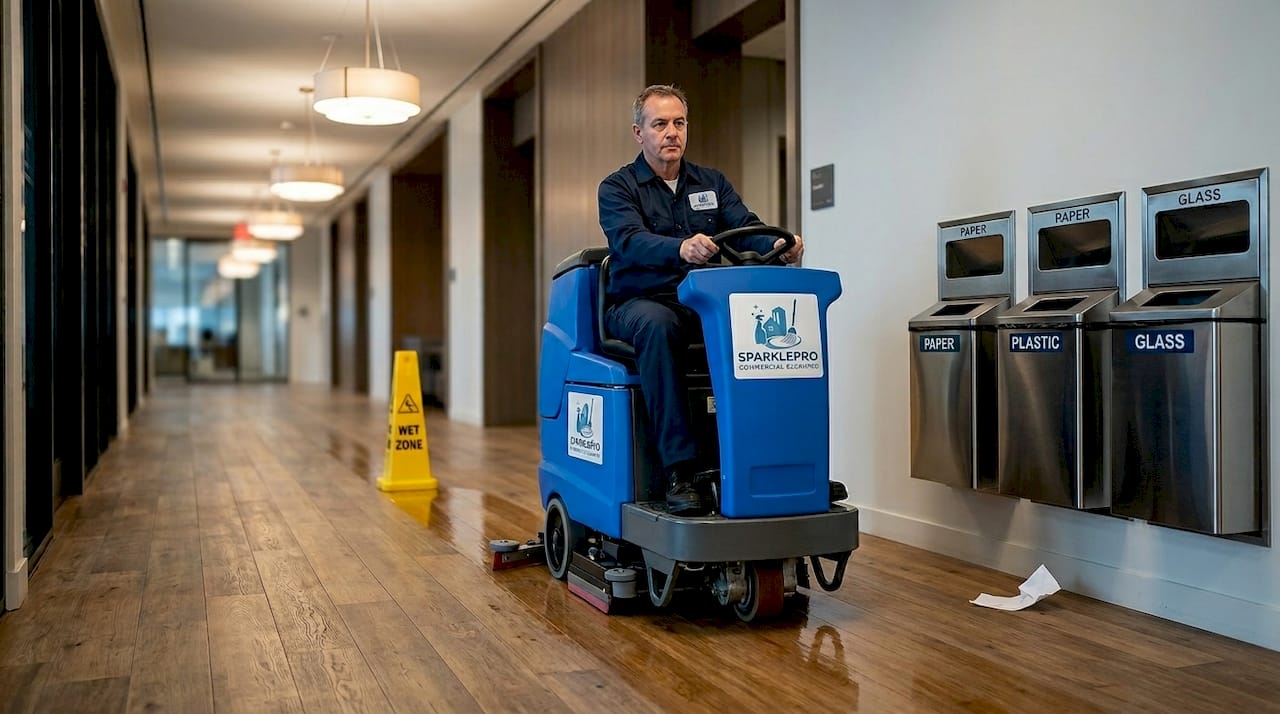
Restorative floor maintenance goes beyond scrubbing. It includes stripping old finish layers, re-coating with appropriate sealants, and addressing grout lines in tile floors that trap bacteria and organic matter. For commercial floor cleaning, the difference between a maintained floor and a neglected one is visible within weeks.
High-traffic transition zones, loading areas, and restroom thresholds accumulate the densest soil loads and need the most frequent attention within any deep clean cycle. Mark these as priority zones in your schedule and allocate extra dwell time for chemical pre-treatment before mechanical scrubbing begins.
3. Targeting hidden contamination zones
The areas that never get cleaned are the ones that drive re-soiling, pest activity, and failed inspections. Embedded dirt under racks, corners, and behind equipment accumulates steadily and becomes a contamination reservoir that undermines the rest of your cleaning effort.
Cleaning teams need a documented map of every hard-to-reach zone in the facility. This includes the undersides of shelving units, the backs of kitchen or break room equipment, floor drains, and wall-floor junctions. These spots are not difficult to clean once you identify them. The problem is that most teams simply do not have a system that forces attention to these areas on a regular cycle.
Pro Tip: During your initial facility walkthrough, photograph every hidden contamination zone and attach those images to your SOP. Visual references make it far easier for new staff to identify and clean these spots without needing supervision.
Drainage inspection belongs in every deep clean procedure for commercial buildings. Blocked or dirty floor drains create odor, harbor bacteria, and can cause water damage if left unaddressed. Assign drain inspection and treatment as a standalone checklist item, not an optional add-on.
4. High dusting and ceiling maintenance
Most cleaning strategies for large spaces stop at eye level. That is a significant gap. Neglected high-dust areas such as behind machinery and ceiling fixtures lead to dust accumulation, airborne contamination, and in some industrial environments, fire risk from combustible dust buildup.
High dusting covers ceiling beams, light fixtures, HVAC vents, sprinkler heads, and the tops of tall storage units or partitions. This work requires extension tools, proper PPE, and scheduling coordination so that dust dislodged from above does not settle on surfaces that have already been cleaned below.
HVAC vent cleaning deserves particular attention. Vents that distribute contaminated air through a building undermine every other sanitation effort you make at floor level. Include vent grille removal and cleaning in your quarterly deep clean rotation at minimum.
5. Equipment comparison: choosing the right tools
Selecting the right equipment is one of the highest-leverage decisions in any effective deep cleaning program. The table below compares the most common tools used in commercial building deep cleaning.
| Equipment | Best use case | Key advantage | Limitation |
|---|---|---|---|
| Auto-scrubber | Large hard floors | Scrubs and dries in one pass | Requires operator training |
| Industrial vacuum (HEPA) | Carpets, vents, debris | Captures fine particles and allergens | Slower on large open floors |
| Pressure washer | Exterior surfaces, loading docks | Removes heavy grease and grime fast | Not suitable for indoor use without drainage |
| Microfiber mop system | Restrooms, offices, smaller areas | Low chemical usage, high surface contact | Not effective on heavy soil loads |
| Industrial degreaser + scrub brush | Kitchen areas, grease traps | Breaks down organic buildup chemically | Labor-intensive without mechanical assist |
Specialized equipment like auto-scrubbers and pressure washers increase efficiency and cleaning quality significantly, but only when maintained properly. Pre-use inspections of equipment are not optional. A malfunctioning auto-scrubber that leaves water behind creates slip hazards and re-soiling.
HEPA vacuums are non-negotiable in healthcare and educational settings where airborne particle control directly affects occupant health. Traditional vacuums redistribute fine particles rather than capturing them. The upgrade cost pays back quickly in reduced complaints and better inspection outcomes.
6. Implementing deep clean procedures: what to document
Documented cleaning SOPs with defined tasks, product specs, and dwell times improve consistency and reduce quality variation across teams. Without documentation, deep cleaning quality depends entirely on individual memory and motivation. Neither scales.
Here is what every effective SOP for building deep cleaning should include:
- Task-level procedures with step-by-step instructions for each area or surface type
- Product specifications listing exact dilution ratios and approved substitutes
- Contact time requirements for every disinfectant product in use
- Visual quality standards with reference photos showing acceptable versus unacceptable results
- Inspection checkpoints at defined intervals so supervisors can catch errors before they compound
- PPE requirements listed per task, not just as a general reminder at the top of the document
Training staff with documented procedures and visual standards reduces quality failures and improves performance, particularly for multilingual teams where simple, visual SOPs outperform text-heavy instruction sheets.
Pro Tip: Run a quarterly SOP audit where a supervisor follows a team member through a full deep clean and notes every deviation from the documented procedure. This single practice catches more quality issues than any post-clean inspection.
The most common protocol mistakes are skipping dwell times under time pressure, using the wrong product on a surface because the correct one ran out, and leaving hard-to-reach zones for "next time." All three are SOP failures, not individual failures. Fix the system and the behavior follows.
7. Degreasing in high-soil commercial areas
Loading docks, commercial kitchens, mechanical rooms, and manufacturing floors accumulate grease and organic buildup that standard cleaning products cannot address. Effective degreasing requires a two-step approach: chemical pre-treatment to break down the grease matrix, followed by mechanical removal with a scrubber or pressure washer.
Surface compatibility and pathogen kill spectrum are critical when selecting degreasers and disinfectants for these zones. Bleach-based products may have longer contact times but offer broader kill spectra. Hydrogen peroxide formulations are often better tolerated by staff in enclosed spaces with limited ventilation.
Never apply a disinfectant over a greasy surface and expect it to work. Grease acts as a physical barrier that prevents the active ingredient from reaching the surface. Degrease first, rinse, then disinfect. This sequence is not optional in high-soil areas.
8. Tailoring techniques by facility type
A warehouse deep clean looks nothing like a medical office deep clean, and treating them the same way produces poor results in both. Facility-specific factors like square footage, surface types, and client requirements directly influence SOP content and should drive every protocol decision.
Key considerations by facility type:
- Warehouses and industrial spaces: Prioritize floor scrubbing, high dusting, loading dock degreasing, and drainage maintenance. Traffic levels and forklift activity determine cleaning frequency.
- Office buildings: Focus on restroom sanitation, HVAC vent cleaning, carpet extraction, and high-touch surface disinfection. Open-plan layouts require zone-based scheduling to avoid disrupting occupants.
- Healthcare facilities: HEPA vacuuming, strict disinfectant contact time compliance, and terminal cleaning protocols for patient areas are non-negotiable. Infection control standards govern every product choice.
- Educational facilities: High-touch surface frequency, restroom deep cleaning, and gymnasium floor maintenance drive the schedule. Outbreak response protocols need to be pre-planned, not improvised.
- Retail centers: Focus on entrance matting, restroom sanitation, floor appearance, and fitting room deep cleaning. Customer perception is tied directly to visible cleanliness standards.
Inspection and audit routines enhance quality and identify gaps in cleaning SOPs for continuous improvement. Adjust your protocols based on what the data shows, not what feels like it should be working.
My take on deep cleaning discipline
I've spent years working with commercial cleaning teams across facility types, and the single most consistent finding is this: the facilities with the best sanitation outcomes are not the ones with the biggest budgets or the newest equipment. They are the ones where someone actually enforces the SOPs.
I've watched teams with top-tier auto-scrubbers produce mediocre results because no one tracked whether dwell times were being observed. I've also seen a small team with basic equipment outperform them because their supervisor ran tight inspection routines and corrected deviations immediately. The technology helps. The discipline is what makes it work.
What I've learned is that disinfection contact time compliance has to be built into the workflow structurally. If your process depends on individuals remembering to wait, it will fail under time pressure. Design the sequence so that by the time a team member finishes the next task, the dwell time has elapsed. That is process design, not wishful thinking.
The facilities that continually improve are the ones treating their SOPs as living documents. They audit, they find gaps, and they update the procedure. That cycle, done consistently, is what separates professional-grade cleaning from cleaning that just looks professional.
— Sales
How Sparkleprocommercialcleaning supports your deep cleaning program
If your facility requires a deep cleaning program that actually holds up under inspection, Sparkleprocommercialcleaning delivers the commercial cleaning methods, trained crews, and documented protocols to get it done right. The company serves commercial properties across Massachusetts, Delaware, New Jersey, Washington, and South Carolina, with expertise across office buildings, industrial facilities, healthcare environments, and retail centers.
Sparkleprocommercialcleaning brings fully licensed and insured crews with facility-specific SOPs, advanced equipment, and a four-step engagement process that moves from quote to completed clean without the back-and-forth that wastes your time. Whether you need a one-time restorative deep clean or a recurring building sanitation program, the team has the scope and the systems to deliver consistent results at scale.
FAQ
What is the correct sequence for building deep cleaning?
Start at the top of the space and work downward, and tackle the dirtiest zones before moving to cleaner areas. This prevents debris and contaminants from falling onto surfaces you have already cleaned.
How long should disinfectants sit before wiping?
Contact times range from 1 to 10 minutes depending on the product and pathogen target. Always check the product label and build that wait time into your workflow before wiping.
What equipment is most effective for large commercial floor cleaning?
Auto-scrubbers are the top choice for large hard-floor areas because they scrub and dry in a single pass. HEPA vacuums are preferred for carpeted areas and anywhere airborne particle control matters.
How often should a commercial building be deep cleaned?
Frequency depends on facility type, traffic volume, and contamination risk. Most commercial buildings benefit from a full deep clean quarterly, with high-traffic or high-risk areas addressed monthly.
Why do deep cleaning results vary so much between teams?
Inconsistent results almost always trace back to missing or unenforced SOPs. Documented procedures with product specs and inspection checkpoints are what create repeatable quality across different crews and shift times.