

Industry cleaning regulations are mandatory safety and health standards that govern how commercial properties must be cleaned, disinfected, and maintained to protect workers, occupants, and the public. For property managers and business owners, understanding why follow industry cleaning regulations matters is not optional. Regulatory bodies like OSHA and the EPA enforce these standards with real consequences for non-compliance. Getting this right protects your people, your property, and your bottom line.
Why follow industry cleaning regulations in commercial settings
Cleaning regulations in commercial settings fall under two primary federal frameworks: OSHA's Hazard Communication Standard (HazCom) and the EPA's Federal Insecticide, Fungicide, and Rodenticide Act (FIFRA). Together, these frameworks define how hazardous chemicals must be handled, labeled, and communicated to workers, and which disinfectant products are legally approved for use in regulated environments.
OSHA's HazCom standard requires every workplace using hazardous chemicals to maintain a written hazard communication program, provide Safety Data Sheets (SDS) for each chemical, label all containers correctly, and train employees on chemical hazards. The 2026 Federal Register extended key HazCom compliance deadlines through 2026 to 2028, meaning updates to chemical handling protocols are active requirements right now, not future obligations.
The EPA's FIFRA framework governs disinfectants. Any product making public health antimicrobial claims must be EPA registered under FIFRA, with efficacy backed by approved label language. Using an unregistered product in a regulated environment creates a direct compliance gap, regardless of how clean the space looks afterward.
Here are the core regulatory requirements property managers and business owners must address:
- Written HazCom program: A site-specific document covering all hazardous chemicals on the property, not a generic binder copied from another facility
- SDS access: Safety Data Sheets must be immediately accessible to employees during every work shift
- Container labeling: All chemical containers require GHS-compliant labels with hazard pictograms and signal words
- Employee training: Workers must be trained on chemical hazards before first exposure and whenever new chemicals are introduced
- EPA-registered disinfectants: Only products with approved label claims may be used for regulated disinfection tasks
- Documentation: Training records, inspection logs, and program updates must be maintained and available for audits
Pro Tip: Review your written HazCom program against your current chemical inventory at least once per year. Regulators specifically look for site-specific documentation that reflects actual on-site hazards, not generic templates.
How does compliance benefit property managers and business owners?
The benefits of compliance extend well beyond avoiding fines. When your cleaning protocols meet OSHA and EPA standards, you create a measurable chain of positive outcomes across safety, operations, and reputation.
-
Reduced workplace hazards. Proper chemical handling and labeling directly cut the risk of chemical exposure incidents. OSHA's HazCom framework is designed as a closed-loop safety mechanism that manages hazards before worker exposure occurs, not after an incident forces a response.
-
Lower legal and financial risk. Audit failures, fines, and operational downtime are documented consequences of non-compliance. California's 2026 janitorial production rate cap is one example of how evolving labor and cleaning laws create new compliance requirements that carry real financial penalties when ignored.
-
Reduced pathogen transmission. In healthcare and high-traffic commercial settings, standardized cleaning schedules correlate directly with reduced environmental contamination from pathogens. An ICU study found that rigorous cleaning protocols reduced contamination from carbapenem-resistant Acinetobacter baumannii (CRAB), a finding with direct implications for any facility managing high-occupancy or vulnerable populations.
-
Stronger employee morale and retention. Workers who see documented safety protocols and proper chemical handling take their employer's commitment to safety seriously. That trust reduces turnover and increases accountability on the cleaning team.
-
Client and tenant confidence. Audit-ready cleaning documentation signals professionalism to tenants, clients, and inspectors. For property managers competing for commercial tenants, a verifiable compliance record is a concrete differentiator.
"Compliance is not a cost center. It is the operational foundation that keeps your property running without interruption, legal exposure, or reputational damage."
What are the consequences of ignoring cleaning regulations?
Non-compliance with cleaning regulations produces consequences across three categories: financial, operational, and reputational. Understanding the specific risks in each category helps you prioritize where to focus your compliance efforts.
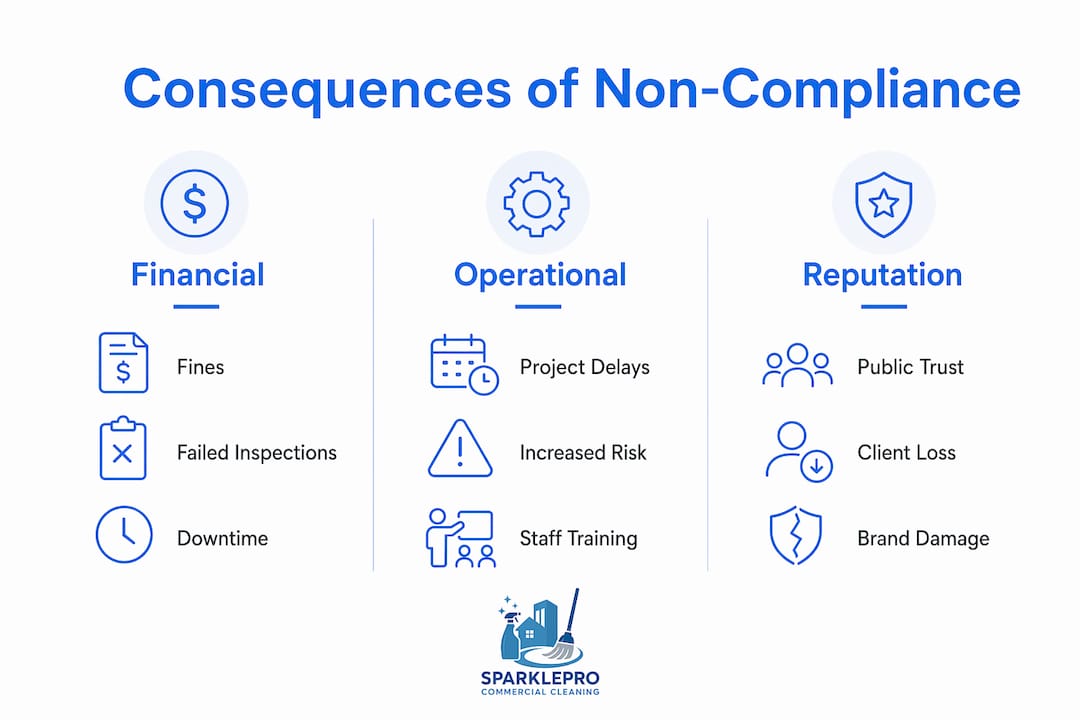
| Risk category | Specific consequence | Regulatory trigger |
|---|---|---|
| Financial | OSHA fines per violation, per day | Missing SDS, unlabeled containers, no written HazCom program |
| Operational | Failed inspections, project delays, downtime | Unregistered disinfectants, inadequate training records |
| Reputational | Loss of tenant trust, contract termination | Repeated violations, public enforcement actions |
| Environmental | Pathogen spread, contaminated surfaces | Incorrect disinfectant use, missed contact times |
| Legal | Litigation from worker chemical exposure | Failure to train, failure to provide SDS access |
The operational risks deserve particular attention. Property managers dealing with compliance failures and project delays know that a single failed inspection can cascade into weeks of downtime and renegotiated contracts. That cost far exceeds the investment required to maintain compliant cleaning protocols from the start.
Disinfectant non-compliance carries a specific and often overlooked risk. Using products whose label claims do not cover all required pathogens, or misunderstanding required contact times, creates real-world infection control failures even when the space appears clean. The surface looks sanitized. The pathogens remain. That gap is where liability lives.
Pro Tip: When selecting disinfectants, check the EPA registration number and the specific pathogen kill claims on the label. Matching disinfectants to pathogens is a regulatory requirement, not just a best practice.
How to implement and maintain compliance in your property
Building a compliance-ready cleaning program requires four interconnected components: documentation, training, product selection, and monitoring. Each one reinforces the others.
Documentation comes first. Your written HazCom program must be site-specific. Generic programs copied from industry templates fail regulatory inspections because they do not reflect the actual chemicals present at your location. List every hazardous cleaning chemical used on your property, assign SDS access points for each work area, and update the program whenever your chemical inventory changes. Review the property manager's guide to commercial cleaning standards for a structured framework on documentation requirements.
Training must be ongoing, not one-time. OSHA requires training before first exposure and whenever new chemicals are introduced. Training records must document what was covered, who attended, and when. Sporadic or undocumented training is one of the most common HazCom compliance failures identified during inspections.
Product selection requires label discipline. Every disinfectant used in your facility must carry an EPA registration number. Beyond registration, verify that the product's label claims cover the specific pathogens relevant to your environment. Contact time matters too. A disinfectant that requires four minutes of wet contact time applied for thirty seconds provides no meaningful protection and creates a compliance gap.
Here is a practical compliance checklist for ongoing monitoring:
- Conduct quarterly audits of your chemical inventory against your written HazCom program
- Verify SDS availability for every chemical at every work area during each audit
- Confirm all container labels are intact, legible, and GHS-compliant
- Review training records to identify gaps before regulatory inspections do
- Check EPA registration numbers for all disinfectants annually, as registrations can change
- Log inspection results and corrective actions with dates and responsible parties
Environmental factors also affect cleaning outcomes. Research shows that regulating temperature and humidity in the range of 22.5 to 25.5°C and 30 to 60% humidity reduces pathogen contamination risks. For property managers overseeing HVAC systems alongside cleaning programs, this connection between environmental control and cleaning effectiveness is worth building into your facility management protocols.
For facilities requiring specialized disinfecting services, the guide for facilities on disinfecting services covers EPA and FIFRA guidelines in detail and helps you evaluate service providers against regulatory requirements.
Key takeaways
Following industry cleaning regulations protects commercial properties from financial penalties, operational failures, and pathogen risks that no amount of reactive cleaning can undo.
| Point | Details |
|---|---|
| OSHA HazCom compliance | Requires site-specific written programs, SDS access, GHS labeling, and documented employee training. |
| EPA-registered disinfectants | Only products with approved label claims and correct pathogen coverage meet FIFRA compliance standards. |
| Non-compliance costs | Fines, failed inspections, downtime, and reputational damage all exceed the cost of proactive compliance. |
| Documentation is the foundation | Generic or outdated HazCom materials are the most common cause of regulatory inspection failures. |
| Environmental control matters | Temperature and humidity management combined with cleaning protocols reduces pathogen contamination risk. |
The compliance gap most property managers don't see until it's too late
After working with commercial properties across a wide range of facility types, the pattern I see most often is not willful neglect of cleaning regulations. It is a quiet drift. A property manager inherits a written HazCom program from a previous vendor, assumes it is current, and never revisits it. A cleaning crew switches to a new disinfectant product because it was cheaper, without checking whether the EPA registration covers the pathogens relevant to the facility. These are not dramatic failures. They are small gaps that compound over time.
What makes this particularly frustrating is that the fix is not complicated. The regulations are not designed to trap you. OSHA's HazCom framework and EPA's FIFRA requirements are built around a straightforward logic: know what chemicals you are using, communicate the hazards clearly, train your people, and use products that actually do what you claim they do. The problem is that most compliance failures I see come from treating these requirements as a one-time setup rather than an ongoing operational discipline.
The 2026 updates to HazCom compliance deadlines are a real opportunity to reset. If your written program has not been reviewed in the past twelve months, treat this as the trigger to do it now. Pull your chemical inventory, cross-reference your SDS files, and check every disinfectant label against your current pathogen concerns. The property managers who do this proactively are the ones who pass inspections without scrambling and retain tenants who trust that their space is genuinely safe.
— Sales
How Sparkleprocommercialcleaning supports your compliance goals
Meeting cleaning regulations requires more than good intentions. It requires trained professionals, documented protocols, and products that meet OSHA and EPA standards every time. Sparkleprocommercialcleaning delivers exactly that across commercial properties nationwide, from routine janitorial services to specialized disinfecting programs built around EPA-registered products and OSHA-compliant chemical handling. Every service is fully licensed and insured, with audit-ready documentation that gives property managers and business owners the paper trail they need when inspections happen. Whether you manage an office building in Delaware or a retail center in New Jersey, Sparkleprocommercialcleaning brings the compliance expertise your facility demands.
FAQ
What does OSHA require for cleaning chemical compliance?
OSHA's Hazard Communication Standard requires a written HazCom program, Safety Data Sheets for all hazardous chemicals, GHS-compliant container labels, and documented employee training before first chemical exposure.
Why must disinfectants be EPA registered?
Any disinfectant making public health antimicrobial claims must be EPA registered under FIFRA, with efficacy verified by approved label language. Using unregistered products creates a direct compliance gap in regulated environments.
What are the financial risks of ignoring cleaning regulations?
Non-compliance with OSHA and EPA standards can result in per-violation fines, failed inspections, operational downtime, and contract losses. These costs consistently exceed the investment required for proactive compliance.
How often should a written HazCom program be updated?
A written HazCom program must be updated whenever new hazardous chemicals are introduced to the workplace. Annual reviews are a cleaning best practice to catch inventory changes and documentation gaps before regulatory inspections.
Does cleaning compliance apply to all commercial property types?
Cleaning regulations apply to any commercial environment where hazardous chemicals are used or where disinfection is required, including office buildings, retail centers, healthcare facilities, and industrial spaces.