
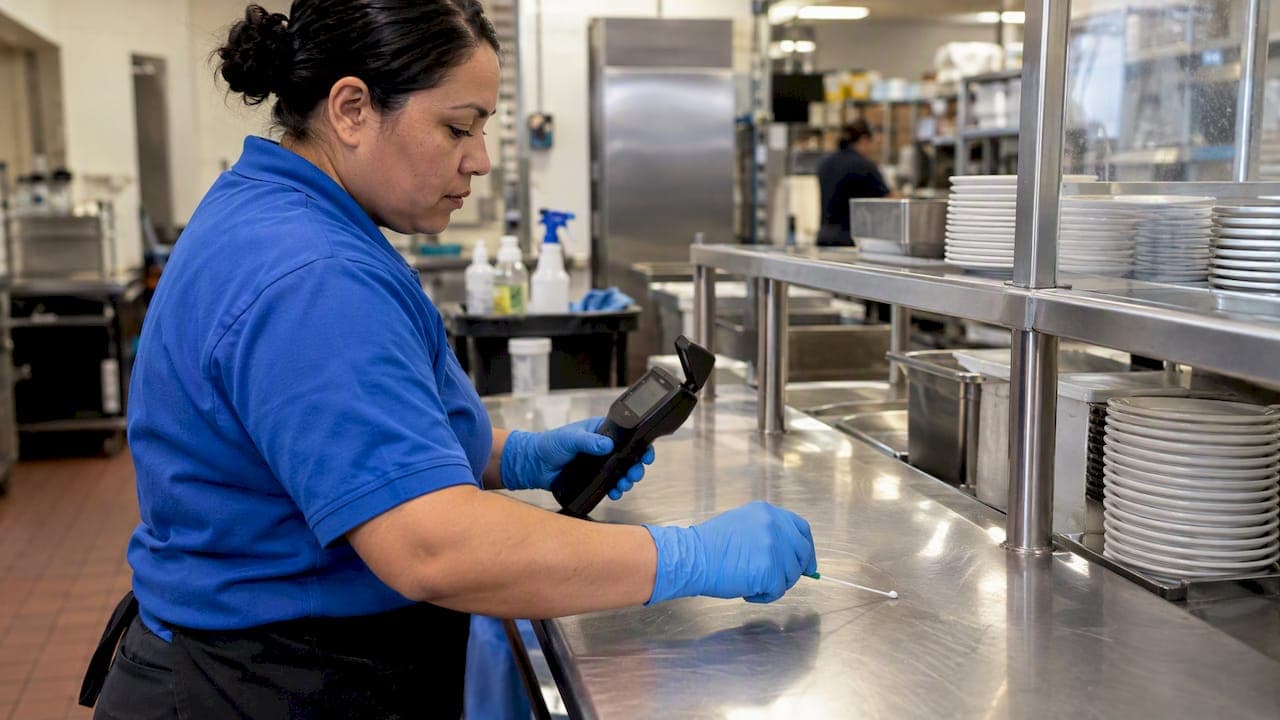
ATP testing detects residual organic material on a surface within seconds and gives facility teams an objective number where visual inspection only offers a guess. It is a verification and operational-feedback tool, not proof that a surface is disinfected or free of pathogens. Used inside a documented program, with baselines, site-specific thresholds, and a corrective-action plan it turns cleaning from a checklist into a measurable process.
TL;DR:
- ATP testing provides rapid, objective measurements of organic residue on surfaces, supporting real-time corrective actions to improve cleaning effectiveness.
- Building site-specific thresholds from baseline readings ensures accurate pass/fail criteria, especially when comparing porous and non-porous surfaces.
- Regular, risk-based sampling of high-touch, difficult-to-clean, and critical contact points enhances monitoring reliability and leads to meaningful trend analysis.
- ATP results indicate organic presence but do not confirm pathogen elimination, requiring microbial testing for high-stakes disinfection validation.
- Implementing an organized program with documented procedures, trend tracking, and predefined response plans guarantees accountability and regulatory compliance.
Table of Contents
- Why ATP testing matters in hygiene and cleaning programs
- How ATP testing works and a stepwise workflow for cleaning verification
- Setting baselines and pass/fail thresholds (site-specific approach)
- Designing a sampling plan: what to test, how often, and where
- Devices, swabs, and practical selection criteria
- Interpreting ATP results and known limitations (chemistry interference and what ATP cannot prove)
- Putting ATP into an ongoing quality program: corrective actions, trending, and governance
- How Sparklepro Commercial Cleaning operationalizes ATP verification
- Practical next steps from a cleaning-operations lead
- How Sparklepro Commercial Cleaning can implement ATP programs for you
- Sources
- FAQ
Why ATP testing matters in hygiene and cleaning programs
Visual inspection tells you whether a surface looks clean. It says nothing about the biological residue left behind after a wipe-down, and that gap is where ATP testing earns its place in a hygiene program. A luminometer reading gives a number in under a minute, which means a crew lead can catch a missed step before a shift ends rather than after a complaint or an audit finding.
That speed changes how corrective action works. Instead of waiting for a monthly inspection report, a supervisor can retrain a technician or re-clean a surface the same day a reading fails. The CDC's environmental cleaning toolkit documents this pattern directly: a hospital program that tested multiple high-touch points against a pass criterion of 45 RLU or lower reached a high average weekly pass score once baseline testing and routine monitoring were in place.
ATP monitoring shows up across several settings, each with its own reason for adopting it:
- Food processing facilities use it to support HACCP and FSMA-aligned sanitation verification between production runs.
- Hospitals and clinics use it to check high-touch surfaces between patient turnovers and terminal cleans.
- Hotels and hospitality operators use it to standardize room-turnover quality across properties and shifts.
- Post-construction and retail handoff teams use it to document that a space meets an agreed cleanliness standard before a tenant or customer takes possession.
The common thread is objectivity. A number on a screen is harder to argue with than an opinion about whether a countertop "looks fine," and that objectivity is what makes ATP data useful for trending, training, and client sign-off.
How ATP testing works and a stepwise workflow for cleaning verification
ATP testing relies on a straightforward chemical reaction. A swab collects residue from a surface, and the sample is mixed with a reagent containing the enzyme luciferase and its substrate luciferin. Any adenosine triphosphate, the energy molecule present in living cells and organic material, triggers a light-producing reaction. The luminometer reads that light and reports it as relative light units, or RLUs. A lower reading after cleaning generally means less detectable organic residue remains, which is why the CDC toolkit frames RLU tracking as a practical, standardized way to verify cleaning across many sites.
Before collecting a single sample, standardize the equipment and the people using it. Every technician should use the same luminometer and swab system, follow the same swabbing motion over the same defined area, and process the sample immediately rather than letting it sit.
A repeatable workflow looks like this:
- Establish a baseline by testing key sites before any new protocol or threshold takes effect.
- Identify representative, high-risk sites rather than testing at random.
- Train every sampler on the same swabbing technique and area size.
- Swab the defined surface area using the manufacturer's specified method.
- Insert the swab into the luminometer immediately and record the RLU reading.
- Compare the result against the site-specific threshold.
- Document the outcome, then re-clean and retest, or log and trend, according to the SOP.
Timing matters as much as technique. For a two-step clean-then-sanitize process, sample after the cleaning step and before the sanitizer is applied, since testing after sanitizing can mask whether the cleaning step itself removed the organic soil, a distinction the hospital pilot study highlights when explaining recontamination patterns.
Pro Tip: Keep a spare, charged luminometer and a backup box of swabs on every site visit. A dead battery mid-shift turns a five-minute verification into a missed data point.
Setting baselines and pass/fail thresholds (site-specific approach)
A pass threshold copied from a vendor brochure rarely fits a real facility. Surfaces differ in material, texture, and use, and a single default RLU cutoff applied everywhere tends to either pass dirty surfaces or fail clean ones. The more reliable approach is to build thresholds from your own data.

Start by collecting a batch of readings, both before and after cleaning, across each surface type you plan to monitor. A study covering 27 schools and four surface types recorded 6,480 ATP measurements this way, and found post-cleaning readings typically an order of magnitude lower than pre-cleaning ones, a pattern that supports building practice-based ranges per surface rather than a single universal number.
A few practical points for building defensible thresholds:
- Calculate a percent-reduction figure (pre-clean RLU versus post-clean RLU) alongside a flat pass number, since reduction shows whether cleaning is working even when a surface starts dirtier than usual.
- Convert to RLU per square centimeter when comparing surfaces of different sizes or shapes, which improves correlation with microbial testing.
- Set separate thresholds for porous versus non-porous surfaces, since porous materials tend to read higher even when properly cleaned.
- Recalibrate thresholds if you change devices, swabs, or cleaning chemistry, since RLU values are not always comparable across systems.
- Validate a proposed threshold against a short pilot period before rolling it out facility-wide.
Industry handbooks commonly describe default pass ranges in the low hundreds, with a marginal band above that and a fail zone beyond it, but they consistently recommend site calibration over blind adoption of those defaults. The safest path is treating any published range as a starting hypothesis, not a finished standard.
Designing a sampling plan: what to test, how often, and where
A sampling plan built on convenience, whatever surface is nearby, produces data nobody trusts. A risk-based plan built on where contamination is likely and consequential produces data that actually changes behavior.
Start site selection with four categories: high-touch surfaces (door handles, light switches, elevator buttons), product-contact or patient-contact surfaces, hard-to-clean geometry (grout lines, equipment seams, vents), and harborage points where moisture or debris tend to collect. These categories overlap with the sites recommended in guidance on high-touch surface cleaning, and they should form the backbone of any recurring test list.
Frequency should track risk and process complexity rather than a fixed calendar:
- Daily spot checks for the highest-risk surfaces in healthcare or food-contact environments.
- Weekly rotation across a broader set of high-touch and representative sites in office or retail settings.
- Per-project verification for post-construction cleanouts and tenant turnovers, tied to the handoff date.
- Random unannounced checks layered on top of the scheduled plan to catch drift between routine tests.
Recordkeeping turns individual readings into a program. A facility map with numbered site IDs, a standardized sampling log capturing date, technician, RLU reading, and pass/fail status, and a simple dashboard tracking trends over time are the three documents that separate a real ATP program from occasional spot testing. For construction and renovation handoffs specifically, mapping these sites against a cleaning standards guide for new commercial builds keeps the sampling plan aligned with what the incoming tenant or owner will inspect.
Devices, swabs, and practical selection criteria
Choosing an ATP system is less about brand and more about whether the device fits how your team actually works. A few specs matter more than the marketing copy.
- RLU range and sensitivity: confirm the device can distinguish meaningfully between a clean and a dirty surface at the levels your facility typically sees.
- Data export and software: a device that dumps readings into a spreadsheet or dashboard automatically saves hours of manual logging compared with one that only displays a number on screen.
- Connectivity: Bluetooth or Wi-Fi syncing lets multiple technicians feed one central log instead of maintaining separate paper records.
- Swab chemistry compatibility: some swab formulations react unpredictably with certain cleaning chemistries, so confirm compatibility with the products your crews actually use.
- Supply logistics: swabs have a shelf life and need cold storage in some cases, which matters for multi-site operations ordering in bulk.
When evaluating a vendor's claims, ask for a live demonstration sampling on your own surfaces rather than relying on published specifications alone. Request a sample data export and a blank sampling log template before committing, since those two items reveal more about day-to-day usability than any spec sheet.
Interpreting ATP results and known limitations (chemistry interference and what ATP cannot prove)
A low RLU reading means less detectable organic residue. It does not mean the surface is free of pathogens, and it does not mean a disinfectant achieved the contact time or kill rate needed for sanitation. This distinction gets lost often enough that it is worth stating plainly.
ATP testing is useful for measuring cleaning performance and training, but it does not reliably measure disinfectant effectiveness or the presence or absence of viable pathogens.
That summary reflects the position laid out in Infection Control Today's review of ATP in health care, which also flags a specific technical problem: cleaning chemistries containing quaternary ammonium compounds or hydrogen peroxide can interfere with the luciferase reaction itself, sometimes enhancing the signal, sometimes suppressing it, with no consistent direction. A facility switching sanitizers without re-validating its ATP thresholds risks reading chemistry interference as a cleaning failure or, worse, a false pass.
Agreement between ATP and microbial testing was 75.1% in a study of a tofu processing facility, a figure from research pairing ATP with microbial enumeration, meaning roughly one in four samples showed a mismatch between the two methods. That level of agreement supports using ATP as an operational and trending tool, but it is not strong enough to treat a single ATP pass as a stand-in for a microbial validation when the stakes are high, such as verifying a disinfection step in a healthcare isolation room. When results matter for regulatory or clinical decisions, culturing remains the reference method.
Putting ATP into an ongoing quality program: corrective actions, trending, and governance
A single ATP reading is a data point. A program is what happens after that reading, and the difference shows up in whether failures actually get fixed or just get recorded.
A workable corrective-action ladder looks like this:
- A failed reading triggers an immediate re-clean of that specific site.
- A retest confirms the re-clean brought the surface under threshold.
- A pattern of repeat failures at the same site triggers retraining for the assigned technician.
- Persistent failures despite retraining trigger an investigation into equipment, chemistry, or process design.
- Sites tied to a health or regulatory risk escalate to microbial culturing rather than relying on ATP alone.
This structure lines up with guidance from the FDA's environmental sampling program, which stresses that environmental monitoring only produces value when there is a predefined plan for interpreting results and taking corrective steps. A number without a documented response plan is just a number.
Set a few simple KPIs to track over time: a weekly pass-rate target, a trend line for repeat-failure sites, and a reporting cadence that puts summary data in front of both operations and quality stakeholders on a fixed schedule, weekly or monthly depending on facility risk. Ownership matters too: someone needs to be accountable for maintaining the sampling log, updating thresholds when chemistry or equipment changes, and keeping the audit trail intact for inspections or client reviews.
Pro Tip: Review the corrective-action log in the same meeting where you review the pass-rate trend. Numbers without a paper trail of what was done about them tend to lose credibility fast during an audit.
How Sparklepro Commercial Cleaning operationalizes ATP verification
A standard four-step process for an ATP program includes establishing baseline readings and sampling sites during a quote and visit, executing the cleaning protocol, confirming results with ATP verification, and closing the loop with customer approval and documented reporting. Clients can request a site map, a sampling log template, and a corrective-action form as part of that process, giving property managers a paper trail alongside the cleaning itself.
Practical next steps from a cleaning-operations lead
Start small: baseline your highest-risk sites, set thresholds specific to those surfaces, and run a 30 to 60 day trend before making sweeping changes. ATP data only works when operations, environmental services, and quality teams read it together rather than in separate silos. If you want a second set of eyes on your sampling plan or a site visit to establish baselines, that conversation is worth having before you buy equipment.
— Sales
How Sparklepro Commercial Cleaning can implement ATP programs for you
Building an ATP program from scratch means buying equipment, writing SOPs, training staff, and troubleshooting chemistry interference on your own timeline. A managed service alternative includes local crews, site visits to establish baselines, cleaning execution, and documented verification and reporting incorporated into a standard four-step process.
For facility teams managing offices, healthcare spaces, retail centers, or post-construction handoffs, that means a documented cleaning standard without adding a testing program to your own staff's workload. Request a quote and site visit to see how it fits your properties, or check regional availability if you need a crew closer to home.
Sources
The CDC's environmental cleaning toolkit documents workflow and threshold examples from real hospital programs. The hospital pilot study shows how ATP readings shift across cleaning and recontamination. The tofu facility study quantifies agreement between ATP and microbial testing. The FDA's sampling guidance frames monitoring within a documented action plan, and Infection Control Today outlines ATP's limits in clinical settings. Facility teams designing an audit process can also consult an operations audit consultancy for broader quality-assurance frameworks.
- CDC toolkit: evaluating environmental cleaning
- Hospital pilot: ATP reductions and recontamination patterns (PMC)
- ATP testing in health care: what it can and cannot tell us (Infection Control Today)
- FDA environmental sampling guidance
FAQ
How much does an ATP test cost?
Sparklepro Commercial Cleaning does not publish a standalone price for ATP testing since it is typically bundled into a cleaning service agreement rather than sold separately. Cost depends on the device, swab volume, and whether testing is a one-time verification or part of an ongoing monitoring contract.
What does an ATP test do?
An ATP test measures organic residue left on a surface after cleaning by detecting adenosine triphosphate through a light-producing chemical reaction, reported as relative light units. A lower reading generally indicates less residue, which makes it useful for verifying that a cleaning step was effective, according to the CDC's toolkit.
What does ATP stand for in cleaning?
ATP stands for adenosine triphosphate, the energy-carrying molecule found in living cells and organic material. In cleaning verification, its presence on a swabbed surface signals residual soil, food debris, or biological matter that a cleaning step may have missed.
Is ATP testing accurate?
ATP testing is accurate for detecting organic residue but is not a direct measure of pathogen presence or disinfection success. Agreement with microbial testing has been measured at 75.1% in one facility study, and chemistry interference from certain cleaning products can further affect readings.