

Nationwide cleaning services are centralized, multi-location cleaning solutions that give property owners and facility managers consistent quality, standardized procedures, and unified oversight across every building in their portfolio. The core benefits of nationwide cleaning services include reduced administrative overhead, measurable health and safety improvements, and the kind of operational scalability that local or fragmented providers simply cannot match. Industry bodies like ISSA and platforms like CleanLog have documented how evidence-based cleaning management transforms large commercial portfolios from reactive maintenance into proactive, data-driven operations. For facility managers overseeing office buildings, retail centers, healthcare facilities, or industrial spaces across multiple states, the difference between a patchwork of local vendors and a single nationwide provider is the difference between managing chaos and managing outcomes.
What operational advantages do nationwide cleaning services deliver?
Centralized management is the defining operational advantage of nationwide commercial cleaning. When you consolidate scheduling, quality control, and invoicing under one provider, you eliminate the coordination drag that multiplies with every additional location. Multi-site operations require standardized SOPs, digital quality control tools, and ongoing recruitment pipelines to scale beyond 25 sites without breaking down. That threshold matters because it marks the point where people-driven management must give way to systems-driven management.
Digital quality control workflows are a specific example of where nationwide providers outperform local alternatives. Supervisory audits with digital tools take minutes rather than hours, delivering reliable real-time data instead of subjective spot checks. Photo verification and digital checklists create an audit trail that manual systems cannot replicate, which protects you from disputes and gives you hard evidence of service delivery.
Billing consolidation is another underrated advantage. Manual billing across locations causes administrative drag and errors that compound across a large portfolio. A nationwide provider replaces a stack of invoices from a dozen vendors with a single, itemized statement. For a facility manager responsible for 15 or 30 locations, that alone recovers hours of administrative time each month.
Pro Tip: Before signing with any nationwide provider, ask specifically how they handle new-site onboarding. Operational failures in multi-site cleaning most often occur at onboarding, shift changes, and when experienced workers leave. A provider without a documented onboarding SOP is a liability at scale.
| Manual / Fragmented System | Nationwide Centralized System |
|---|---|
| Separate invoices per location | Single consolidated invoice |
| Inconsistent cleaning procedures | Standardized SOPs across all sites |
| Manual spot checks for quality | Digital checklists and photo verification |
| Ad hoc staff replacement | Continuous recruitment pipeline |
| No cross-site performance data | Real-time reporting dashboard |
How do nationwide services improve health, safety, and sustainability?
Centralized, evidence-based cleaning systems improve indoor air quality, reduce chemical exposures, and minimize infection risks across entire building portfolios. This is not a minor operational detail. Poor cleaning design contributes directly to occupant health hazards, and those hazards carry liability exposure for property owners. The ISSA Cleaning Center of Excellence framework measures performance beyond superficial task completion, tracking exposure-reduction indicators and audit results that give facility managers defensible data.
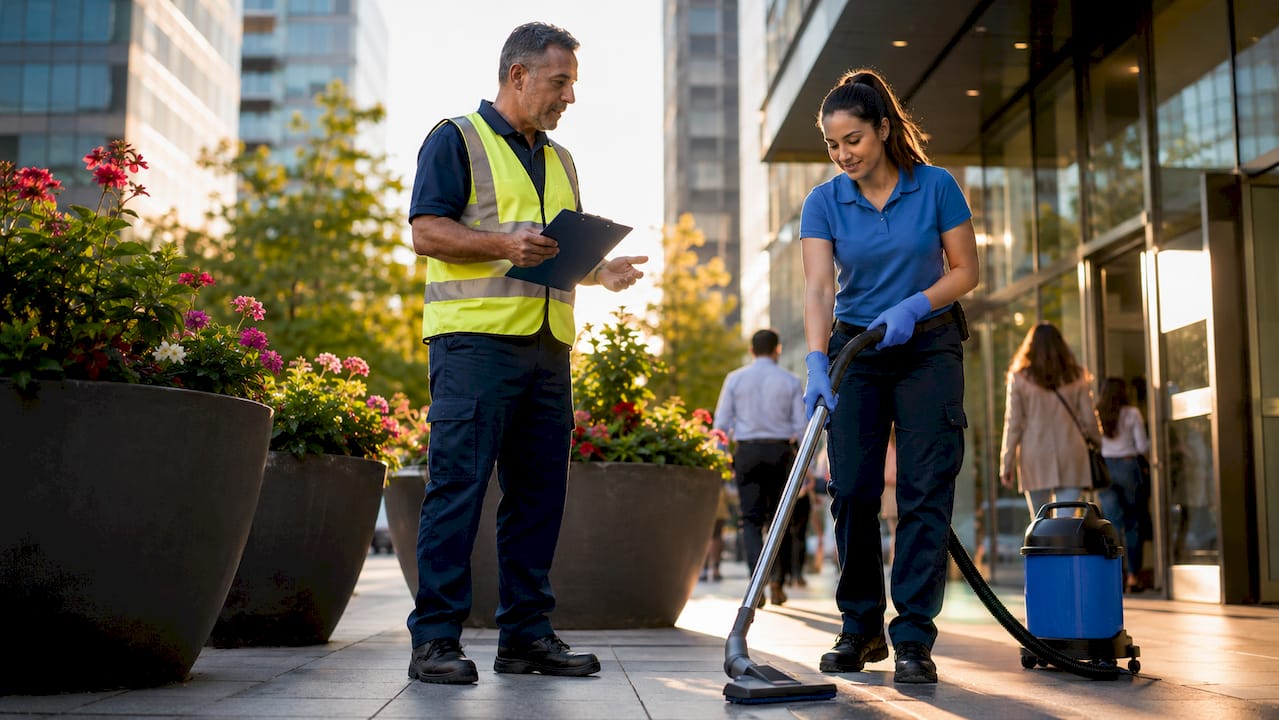
Workforce quality is inseparable from health outcomes. Trained cleaning-for-health workers earning $25 to $30 per hour reduce turnover and onboarding expenses, which directly translates to more consistent cleaning quality. A well-trained custodian using the correct dilution ratios and dwell times for a disinfectant is not interchangeable with an undertrained replacement. The difference shows up in pathogen counts, not just visual cleanliness.
Sustainability integration is where nationwide providers add a layer of value that local vendors rarely deliver. Centralized procurement means chemical selection, equipment standards, and waste disposal protocols are consistent across every site. That consistency prevents the unintended consequences that arise when individual site managers make independent product choices, such as mixing incompatible chemicals or using high-VOC products in poorly ventilated spaces.
Pro Tip: Ask your nationwide provider for their chemical management protocol. Specifically, request documentation on how they select products for sensitive environments like healthcare facilities or spaces with high occupancy. This single question separates providers with genuine health-focused programs from those with marketing language.
Key health, safety, and environmental benefits of nationwide cleaning coverage include:
- Reduced transmission of infectious diseases through standardized disinfection protocols
- Lower chemical exposure for building occupants due to centralized product selection
- Improved indoor air quality from consistent equipment maintenance and filter replacement
- Worker safety compliance enforced uniformly across all locations
- Documented audit trails supporting regulatory and insurance requirements
- Reduced environmental impact through bulk procurement and controlled chemical use
What challenges do property owners face managing multi-site cleaning?
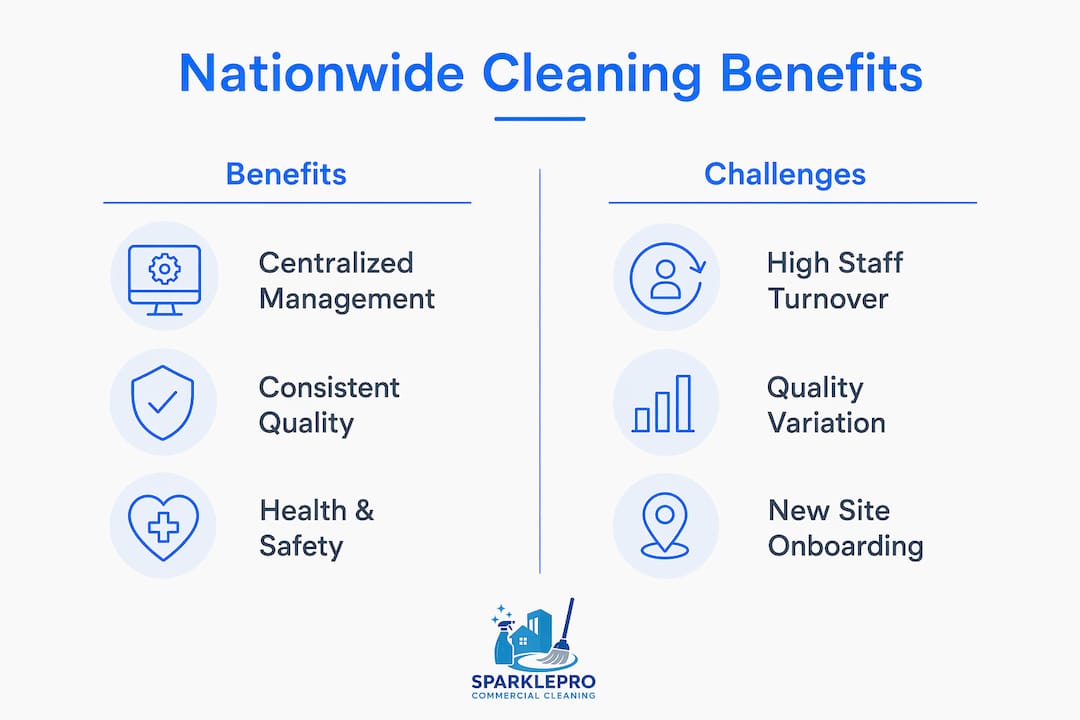
High labor turnover is the most expensive structural problem in commercial cleaning operations. Annual labor turnover in commercial cleaning runs approximately 200%, far above national averages across industries. Replacing a single worker costs between $1,000 and $5,000 when you account for recruiting, onboarding, and the productivity gap during transition. Multiply that across 20 or 30 locations and turnover becomes a significant line item, not a background inconvenience.
Quality variation is the second major challenge. Without standardized procedures, cleaning quality depends entirely on the individual worker or local supervisor on any given shift. A retail center in one city may be spotless while a sister property two states away fails a health inspection. The root cause is almost always the absence of documented SOPs and a system to verify their execution.
Scaling itself creates new failure points. Operational failures in multi-site cleaning most often occur at new-site onboarding, shift changes, and when experienced workers leave. These are predictable, recurring events. A nationwide provider treats them as system design problems with documented solutions rather than one-off crises to manage reactively.
The table below maps the most common multi-site challenges against the solutions nationwide providers deliver.
| Challenge | Nationwide cleaning solution |
|---|---|
| 200% annual labor turnover | Continuous recruitment pipeline and trained replacement staff |
| Quality variation across sites | Standardized SOPs enforced through digital audits |
| Onboarding failures at new sites | Documented onboarding protocols with supervisor oversight |
| Administrative burden of multiple vendors | Centralized billing and single point of contact |
| No cross-site performance visibility | Real-time reporting portals with site-level data |
Understanding large-scale facility cleaning as a systems problem rather than a staffing problem is the mindset shift that separates effective facility managers from those perpetually fighting fires.
Why choose nationwide cleaning services over local providers?
The case for choosing nationwide cleaning companies over local or fragmented providers comes down to three factors: consistency, accountability, and total cost of ownership. Local providers may deliver excellent service at a single location, but they lack the infrastructure to replicate that performance across 10, 20, or 50 sites simultaneously. Consistency requires systems, and systems require investment that most local operators have not made.
Facility managers benefit from consolidated, real-time cleaning reports and digital workforce management, which increases transparency and responsiveness in ways that manual reporting cannot. When an issue arises at a specific location, a nationwide provider with a client portal can document, escalate, and resolve it within a defined SLA. A local vendor typically relies on a phone call and a promise.
Certified custodial staff lower error rates and rework, enhancing client satisfaction and retention. This is the ROI argument that facility managers can bring to ownership: investing in a nationwide provider with trained staff reduces the cost of rework, complaints, and vendor replacement cycles. The business case for well-trained, fairly paid cleaning workers demonstrates measurable ROI through operational and risk mitigation benefits.
Advantages of nationwide cleaning services over fragmented local providers include:
- Single point of accountability for all locations, eliminating vendor management overhead
- Standardized service metrics that allow direct performance comparison across sites
- Centralized billing that simplifies accounts payable and budget forecasting
- Faster response to service failures through established escalation protocols
- Access to specialized services such as post-construction cleanouts and disinfecting without sourcing additional vendors
- Reduced reputational risk from consistent, documented cleaning standards
For property managers overseeing commercial property cleaning, the shift from multiple local vendors to a single nationwide provider typically reduces the time spent on vendor management by a measurable margin, freeing capacity for higher-value facility management work.
Key takeaways
Nationwide cleaning services deliver measurable advantages over fragmented local providers by combining centralized management, standardized SOPs, and evidence-based quality control into a single, scalable system.
| Point | Details |
|---|---|
| Centralized management reduces overhead | Single invoicing, scheduling, and reporting eliminate multi-vendor administrative drag. |
| Standardized SOPs prevent quality variation | Documented procedures enforced through digital audits maintain consistent results across all sites. |
| Turnover costs are a structural risk | At 200% annual turnover, nationwide providers with recruitment pipelines protect operational continuity. |
| Health outcomes require trained staff | Cleaning-for-health workers reduce chemical exposure, infection risk, and liability across portfolios. |
| Systems replace people at scale | Beyond 25 sites, operational success depends on digital tools and SOPs, not individual supervisors. |
What I've learned managing nationwide cleaning at scale
The most common mistake I see property managers make is treating a nationwide cleaning contract as a commodity purchase. They compare line-item prices, choose the lowest bid, and then spend the next 12 months managing complaints, re-bids, and quality failures. The price on the contract is rarely the total cost of the relationship.
What actually drives value is the provider's investment in systems before you sign. Ask to see their SOP library. Ask how they handle a shift change at a site they have never cleaned before. Ask what their quality control workflow looks like at 2 a.m. on a Saturday. Providers who have built genuine infrastructure answer these questions immediately and specifically. Providers who are scaling on promises give you generalities.
The health and safety dimension is where I see the most underestimation. Facility managers focus on visual cleanliness because that is what tenants and building owners notice. But centralized cleaning metrics that go beyond task completion to include exposure-reduction indicators are what actually protect you from liability. A building that looks clean but has inadequate disinfection protocols is a risk that does not show up until something goes wrong.
My honest recommendation: weight your vendor selection toward documented systems and trained workforce over price. The ROI on a nationwide provider with genuine infrastructure shows up in reduced turnover costs, fewer service failures, and the time you get back from not managing a dozen vendor relationships simultaneously.
— Sales
How Sparkleprocommercialcleaning delivers nationwide cleaning benefits
Sparkleprocommercialcleaning operates as a fully licensed and insured nationwide commercial cleaning provider built specifically for property managers and facility directors overseeing large, complex portfolios. The company delivers centralized scheduling, consolidated billing, and real-time reporting across office buildings, retail centers, healthcare facilities, and industrial spaces throughout the United States. Every engagement follows a structured four-step process covering quotes, site visits, scheduled cleaning, and client approval, so you know exactly what to expect before work begins.
For property managers in the Northeast, Sparkleprocommercialcleaning's Massachusetts commercial cleaning services combine local operational knowledge with nationwide quality standards, covering post-construction cleanouts, routine janitorial services, tenant move-out cleaning, and specialized disinfecting. If you manage properties in the Pacific Northwest, the Washington state cleaning services page details regional coverage with the same centralized management infrastructure. Contact Sparkleprocommercialcleaning to request a quote and see how nationwide coverage translates into measurable operational results for your portfolio.
FAQ
What are the main benefits of nationwide cleaning services?
Nationwide cleaning services deliver consistent quality across all locations through standardized SOPs, centralized billing, and digital quality control. They also reduce administrative overhead and provide a single point of accountability for property managers overseeing multiple sites.
Why choose nationwide cleaning companies over local vendors?
Nationwide cleaning companies offer infrastructure that local vendors cannot replicate at scale, including recruitment pipelines to manage high turnover, real-time reporting portals, and documented onboarding protocols for new sites. The total cost of ownership is typically lower once you account for reduced vendor management time and fewer service failures.
How do nationwide cleaning services handle high staff turnover?
Annual labor turnover in commercial cleaning runs approximately 200%, so nationwide providers build continuous recruitment and training pipelines as core operational assets. This means a qualified replacement is available without the $1,000 to $5,000 cost and productivity gap that property managers absorb when managing turnover independently.
What role does technology play in nationwide cleaning quality control?
Digital checklists, photo verification, and client reporting portals replace manual spot checks with real-time, documented audit trails. Supervisory audits using digital tools take minutes rather than hours, giving facility managers reliable performance data across every location in their portfolio.
How do nationwide cleaning services support health and safety compliance?
Centralized chemical management, standardized disinfection protocols, and trained custodial staff reduce chemical exposures, infection risks, and indoor air quality problems across entire building portfolios. ISSA's Cleaning Center of Excellence framework provides the evidence-based metrics that nationwide providers use to document compliance and protect clients from liability.