

A cleaning Service Level Agreement (SLA) is a binding contract that defines measurable cleaning standards, task frequencies, and compliance requirements to guarantee consistent, verifiable outcomes. Facility managers and property owners who understand what are cleaning SLAs gain a direct tool for eliminating subjective disputes and holding service providers accountable. Facilities using formal cleaning SLAs report 73% fewer service disputes and spend 66% less time resolving cleaning issues monthly. That translates to roughly 4 hours saved per manager, per month. The ISSA Clean Standard S100 and structured audit frameworks give these agreements measurable teeth, turning cleaning from a gut-feel judgment into a documented, enforceable standard.
What are cleaning SLAs and what must they include?
A cleaning SLA is defined as a formal service agreement that specifies exactly what gets cleaned, how often, to what standard, and what happens when those standards are not met. Without that structure, cleaning remains subjective, and subjectivity breeds disputes. A well-built SLA converts service delivery into objective, verifiable outcomes that both facility managers and cleaning contractors can rely on.
A complete cleaning SLA contains seven core elements: zone-based task matrices, measurable performance standards, response times, an audit framework, escalation procedures, staffing requirements, and compliance obligations. Each element closes a specific enforcement gap. Remove any one of them and you create room for disagreement.
The seven core components
- Zone-based task matrix: Maps specific cleaning tasks to defined areas, such as restrooms, lobbies, server rooms, and break rooms, each with its own frequency schedule.
- Performance standards and KPIs: Defines measurable targets like audit pass scores, missed task rates, deficiency rates per inspection, and re-clean response times.
- Inspection and audit framework: Establishes how often audits occur, who conducts them, what scoring system applies, and how results are documented.
- Escalation procedures: Outlines the exact steps taken when a standard is missed, including timeframes for correction and penalty or bonus triggers.
- Staffing requirements: Specifies minimum staff qualifications, supervision ratios, and training standards.
- Compliance obligations: Requires that all chemical products listed in the SLA carry current Safety Data Sheets and comply with COSHH or applicable regional equivalents. This protects against legal liability.
- Variation clause: Allows scope adjustments during the contract term without triggering hidden fees or disputes.
The variation clause is the most overlooked element. A missing variation clause often prevents mid-contract scope adjustments, causing hidden fees or conflicts during renovations or tenant changes. Build it in from day one.
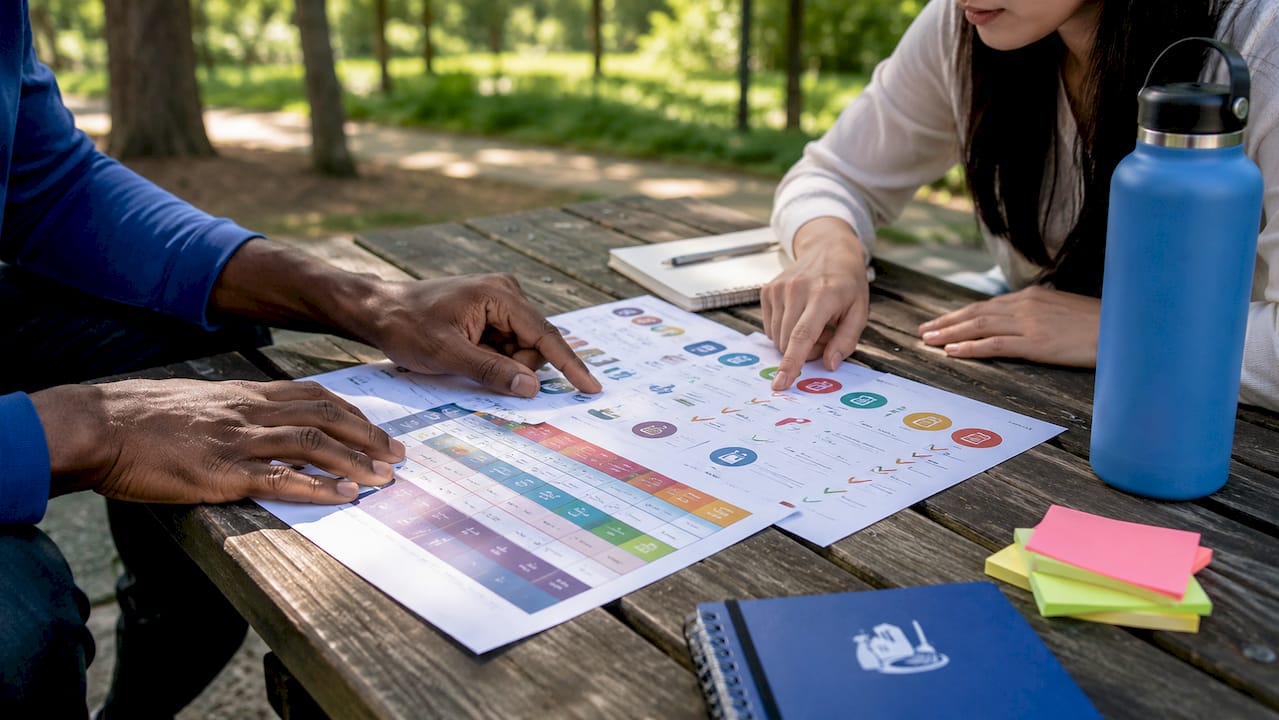
Pro Tip: Attach a frequency matrix as an appendix to your SLA. List every task, the zone it applies to, and its schedule (daily, 3x weekly, monthly). This single document eliminates most "we didn't know that was included" disputes.
How do cleaning SLAs improve service quality and reduce costs?
The financial case for cleaning service SLAs is direct. Without documented SLAs, service quality disputes cost businesses an average of $12,400 annually from lost management time and operational interruptions. That figure does not include the indirect costs of tenant dissatisfaction or failed health inspections.
Measurable standards create accountability, and accountability drives improvement. Implementing specific, measurable cleaning SLAs reduced client complaints by 38% within the first year and 68% overall in commercial buildings. The mechanism is simple: when cleaners know exactly what gets measured and what triggers a penalty, performance improves.
SLA impact: with vs. without formal agreements
| Metric | Without SLA | With SLA |
|---|---|---|
| Monthly dispute resolution time | 6.2 hours | 2.1 hours |
| Annual dispute-related costs | ~$12,400 | Significantly reduced |
| Client complaint reduction | Baseline | Up to 68% lower |
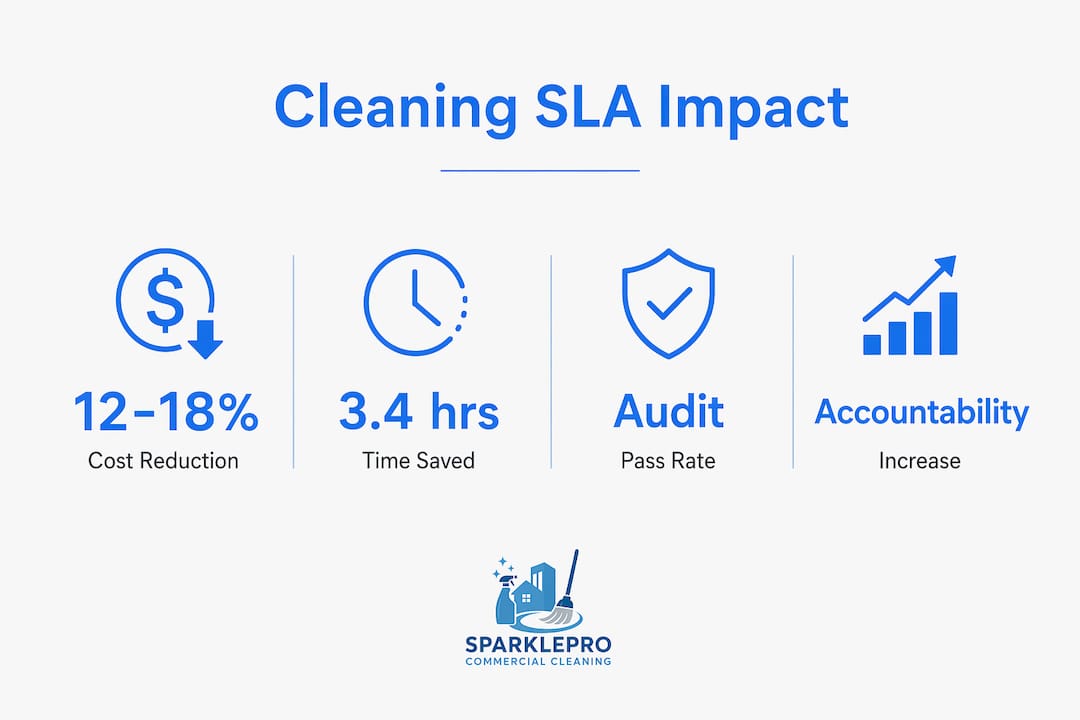
| Cleaning cost per sq ft | Baseline | 12–18% lower |
Performance-based cleaning contracts reduce total cleaning costs per square foot by 12–18%. That reduction comes from eliminating redundant tasks, tightening schedules, and removing the cost of re-cleaning work that was never specified correctly in the first place.
The time savings matter just as much as the dollar savings. Managers who previously spent 6.2 hours monthly resolving cleaning disputes drop to 2.1 hours with a formal SLA in place. That recovered time goes back into facility operations, not conflict resolution.
What KPIs and measurable standards belong in a cleaning SLA?
Poorly defined metrics and vague SLA language are the primary reasons SLAs fail. The fix is specific, objective KPIs that leave no room for interpretation. Every KPI in a cleaning SLA should connect directly to a contract consequence, whether that is a re-clean requirement, a financial penalty, or a performance bonus.
The most effective facility cleaning KPIs fall into four categories:
- Audit performance: Minimum pass score per inspection (commonly 85% or above), deficiency rate per zone, and trend tracking across consecutive audits.
- Task completion: Missed task rate per shift, percentage of scheduled tasks completed on time, and consumable replenishment frequency.
- Response times: Re-clean response time after a failed inspection (typically 2–4 hours for high-traffic zones), escalation trigger thresholds, and supervisor notification windows.
- Compliance metrics: Percentage of staff with current training certifications, SDS documentation currency, and chemical usage logs.
ISSA Clean Standard S100 provides measurable benchmarks for office cleaning frequencies, requiring daily cleaning of high-traffic areas, 3–5 times weekly cleaning of workstations, and defined restroom sanitation levels. Use S100 as your baseline and adjust upward for healthcare, food service, or industrial environments.
Tracking KPIs such as audit pass scores, missed tasks, and re-clean response times directly correlates with maintaining SLA compliance and service consistency. Link every KPI to a defined review cycle so performance data drives contract decisions, not just conversations.
Pro Tip: Require photo documentation for every failed inspection. A timestamped photo of a deficiency is objective evidence that removes all ambiguity from escalation decisions and protects both parties.
How to implement and maintain cleaning SLAs effectively
A cleaning SLA is not a document you sign once and file away. Treat it as a living agreement that adapts to your facility's changing needs. The most effective facility managers build review cycles directly into the contract language.
- Conduct a baseline audit before signing. Walk every zone with the cleaning contractor, document current conditions, and agree on starting benchmarks. This prevents disputes about pre-existing deficiencies.
- Establish a 30-60-90 day review schedule. Review performance data at 30 days to catch early gaps, at 60 days to assess trend direction, and at 90 days to make formal scope adjustments using the variation clause.
- Build a transparent reporting dashboard. Require the cleaning contractor to submit weekly digital reports covering task completion rates, audit scores, and any escalations triggered. Transparency removes the need for adversarial oversight.
- Train facility staff on SLA standards. Your own team needs to understand what the SLA requires so they can identify deficiencies and report them through the correct escalation channel.
- Integrate health and safety compliance checks into every audit. Verify SDS documentation currency, chemical storage compliance, and staff certification status during each scheduled inspection. Contractor compliance requirements apply to cleaning contractors just as they do to construction teams.
- Revise the SLA at each major facility change. Tenant turnover, renovation work, or a change in building use all trigger scope changes. A variation clause makes these adjustments formal and cost-transparent.
Pro Tip: Use digital audit checklists rather than paper forms. Digital tools timestamp every entry, attach photos automatically, and generate trend reports that make quarterly SLA reviews faster and more objective.
Reviewing commercial cleaning standards alongside your SLA at each review cycle keeps your contract aligned with current industry benchmarks rather than the standards that existed when you first signed.
Key Takeaways
A cleaning SLA is the single most effective tool facility managers have for converting subjective service delivery into measurable, enforceable outcomes that reduce costs and disputes.
| Point | Details |
|---|---|
| Define all seven core elements | Zone tasks, KPIs, audit framework, escalation, staffing, compliance, and variation clauses must all be present. |
| Use ISSA S100 as your baseline | ISSA Clean Standard S100 sets measurable frequency benchmarks for office, healthcare, and commercial environments. |
| Link every KPI to a consequence | Audit scores, missed task rates, and response times only drive performance when tied to penalties or bonuses. |
| Build in variation clauses | Mid-contract scope changes without a variation clause create hidden costs and disputes during renovations. |
| Review on a 30-60-90 day cycle | Scheduled reviews catch performance gaps early and keep the SLA aligned with current facility needs. |
Why most cleaning SLAs fail before the first audit
The most common SLA failure I see is not a missing clause or a wrong KPI. It is vague language that both parties interpret differently until the first dispute forces a definition. Phrases like "clean to a satisfactory standard" or "as required" are not standards. They are invitations to argue.
The fix is not complicated. Every task in the SLA needs a defined outcome. "Restrooms cleaned daily" becomes "restrooms cleaned daily to an audit score of 90% or above, with re-clean completed within 2 hours of any failed inspection." That sentence is enforceable. The first version is not.
The second trap is skipping the escalation procedure. Facility managers often assume that a penalty clause is enough. It is not. Without a clear escalation path, including who gets notified, in what timeframe, and what the correction window is, penalty clauses sit unused because no one wants to trigger a formal dispute. A good escalation procedure makes correction the default response, not confrontation.
Electronic audit tools and photo documentation change the dynamic entirely. When both parties know that every inspection produces a timestamped, photographic record, the conversation shifts from "did this happen" to "how do we fix it." That shift alone reduces dispute resolution time significantly. Why documentation matters in cleaning services is not abstract. It is the difference between an enforceable SLA and a piece of paper.
The best cleaning SLAs I have worked with share one trait: they were written with the assumption that the relationship would eventually be tested. Build your SLA for the hard conversation, not the easy one.
— Sales
Sparkleprocommercialcleaning delivers SLA-backed cleaning you can measure
Facility managers need more than a cleaning crew. They need a contractor who understands measurable standards, audit frameworks, and compliance requirements from day one.
Sparkleprocommercialcleaning builds every engagement around a tailored SLA framework adapted to your facility's specific zones, frequencies, and compliance requirements. Whether you manage an office building, a retail center, or an industrial space, the contract defines exactly what gets done, when, and to what standard. Sparkleprocommercialcleaning's Delaware commercial cleaning services and New Jersey facilities teams operate under the same transparent, performance-tracked model. Contact Sparkleprocommercialcleaning to get a site-specific SLA proposal for your facility.
FAQ
What is a cleaning SLA in simple terms?
A cleaning SLA is a formal contract between a facility manager and a cleaning provider that defines specific tasks, frequencies, performance standards, and consequences for non-compliance. It converts subjective cleaning expectations into measurable, enforceable obligations.
How many KPIs should a cleaning SLA include?
A cleaning SLA should include KPIs across four categories: audit pass scores, task completion rates, re-clean response times, and compliance metrics. Linking each KPI to a defined contract consequence is what makes them effective.
What is the ISSA Clean Standard S100?
The ISSA Clean Standard S100 is an industry benchmark that specifies cleaning frequencies for commercial environments, including daily cleaning of high-traffic areas and 3–5 times weekly cleaning of workstations. Facility managers use it as a baseline when writing SLA frequency matrices.
How often should a cleaning SLA be reviewed?
A cleaning SLA should be reviewed at 30, 60, and 90 days after signing, then at each major facility change such as renovation or tenant turnover. Regular reviews keep performance standards aligned with current operational needs.
What happens if a cleaning contractor misses an SLA standard?
The escalation procedure in the SLA defines the exact response: who gets notified, the correction timeframe, and whether a financial penalty applies. Without a documented escalation path, missed standards rarely trigger formal correction.