
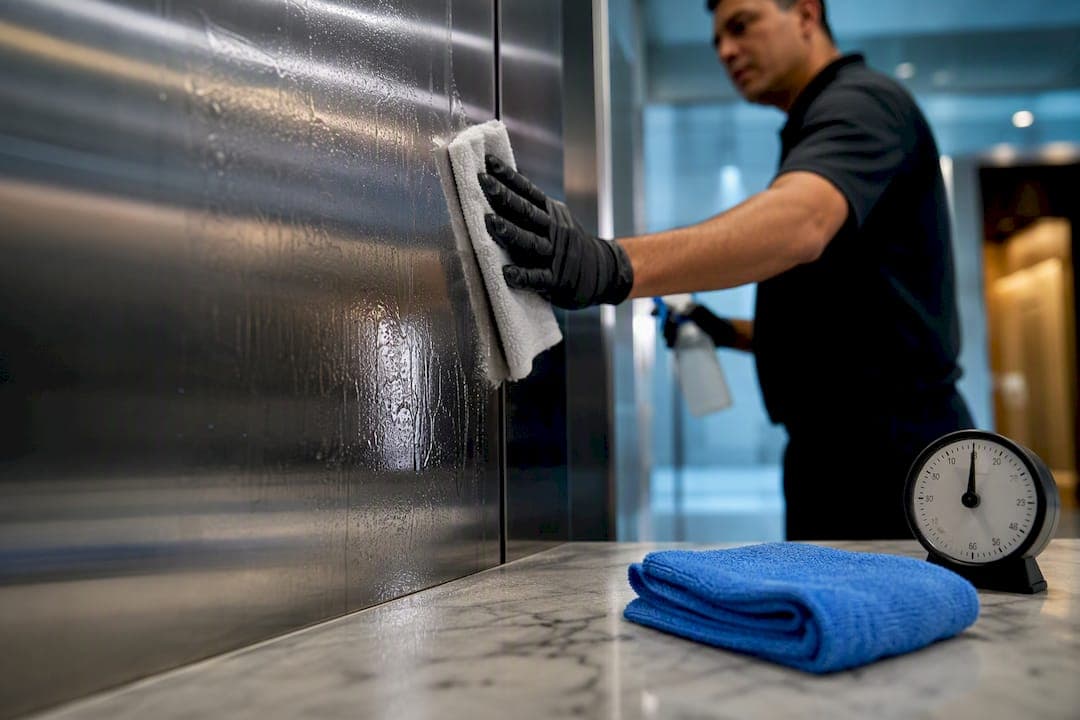
Disinfectant dwell time is the minimum period a surface must stay visibly wet for the product to kill the pathogens named on its label. The action for facility managers is simple: check the label's contact time, apply enough product to keep the surface wet for that full duration, and reapply immediately if it dries early. Skip this step and the disinfectant hasn't done its job, regardless of what chemical you used.
TL;DR:
- Disinfectant must stay visibly wet on surfaces for the exact contact time listed on the label, or pathogens may not be fully killed.
- Contact times vary widely by chemistry and targeted organism, with bleach often needing 1 to 10 minutes and spores requiring much longer periods.
- Always verify contact time in the "Directions for Use" and record it for audit purposes, especially for higher-risk environments like healthcare.
- Re-wet surfaces immediately if drying occurs before the specified dwell time, using appropriate application methods to ensure consistent coverage.
- Repeated contact with certain chemicals, such as bleach, can damage surfaces over time, requiring surface-specific guidance before disinfecting.
Table of Contents
- What Is Disinfectant Contact Time and Why Does It Matter?
- How Long Should Disinfectant Sit? Typical Ranges by Chemistry
- How Do You Confirm the Correct Contact Time on a Label?
- Practical Steps to Keep Surfaces Wet for the Full Dwell Time
- Will Disinfectants Damage Surfaces Over Time?
- Facility Manager's Quick Checklist for Dwell Time Compliance
- What Our Field Teams Learned About Dwell Time Compliance
- Get Dwell-Time Compliance Handled by Trained Teams
- Where to Verify Contact Time Information Yourself
- Sources
What Is Disinfectant Contact Time and Why Does It Matter?
Dwell time and contact time mean the same thing, and you'll see both terms used interchangeably on labels, Safety Data Sheets, and in EPA guidance. The EPA doesn't estimate these numbers. It sets them after lab testing verifies how long a specific formula needs to sit on a surface to knock out the exact organisms listed on the label, and that number is a floor, not a target you can round down from.
This is where a lot of facility teams get tripped up. A label's stated time applies only to the organisms tested against it. A product effective on influenza A in one minute might need ten minutes for norovirus, and disinfection is not sterilization. Sterilization destroys all microbial life; disinfection reduces pathogens to a level considered safe, which is why AJIC researchers describe contact time as a rigid performance threshold rather than a flexible guideline.
Three things determine whether your disinfection actually works:
- The product chemistry matches the pathogen you're targeting
- The surface stays visibly wet for the labeled duration
- The label's specific claim, not a general assumption, governs your timing
How Long Should Disinfectant Sit? Typical Ranges by Chemistry
Contact times swing widely depending on the active ingredient and the organism in question, so there's no single number that applies everywhere. Some virus claims on quaternary ammonium (quats) products call for as little as 30 seconds to one minute. Bleach-based disinfectants commonly land in the 1 to 10 minute range for bacteria and viruses. Accelerated hydrogen peroxide products often fall somewhere in that same window, though specific formulations vary by manufacturer.
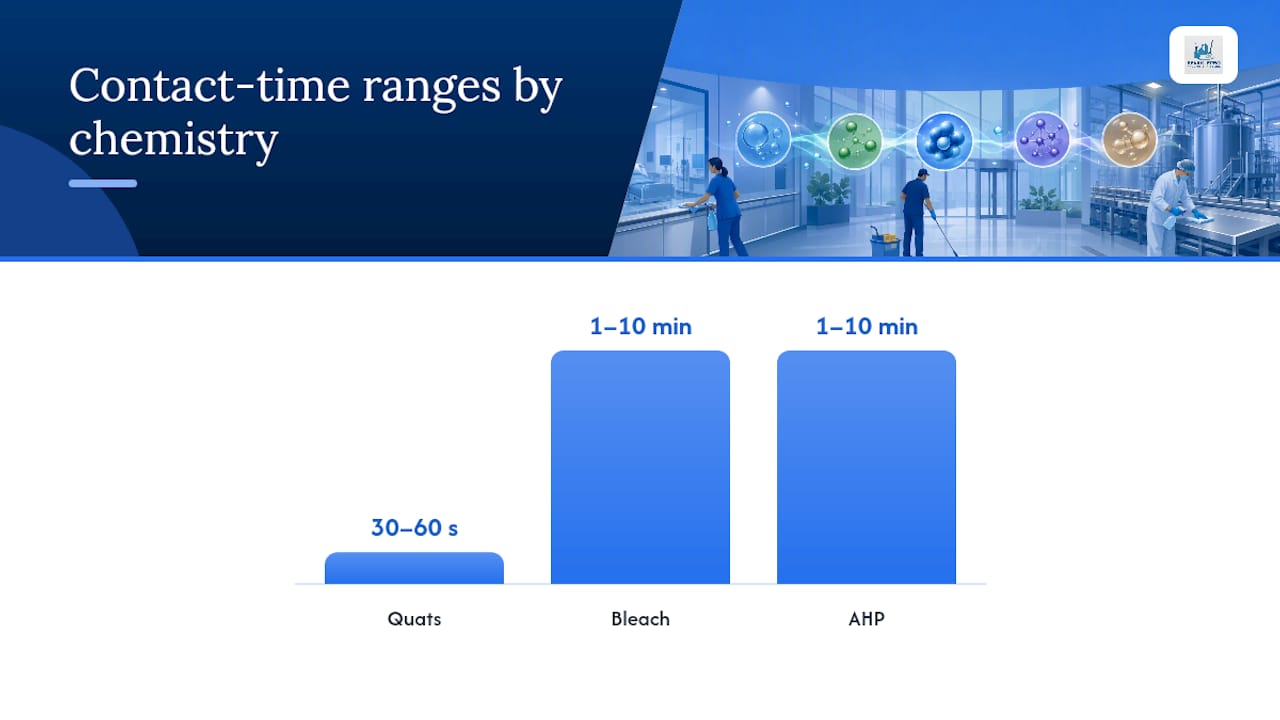
Spore-forming organisms like Clostridioides difficile are the outlier. High-level disinfectants targeting spores can require extended immersion or wet contact periods, sometimes far beyond what a routine wipe-down provides.
A few practical patterns worth knowing:
- Labels frequently list separate contact times for different pathogens on the same product
- When multiple times appear, default to the longest one relevant to your facility's risk profile
- Healthcare and food-service environments should treat that longest listed time as the baseline, not the exception
- Quats tend to run shorter dwell times than bleach or peroxide formulas, but always verify against the specific label
None of this replaces reading your own product's directions. Chemistry family is a rough guide, not a substitute for the number printed on the bottle.
How Do You Confirm the Correct Contact Time on a Label?
Contact time isn't buried in fine print. It's usually stated plainly under "Directions for Use," often paired with language like "let stand for X minutes" or "surface must remain wet for X minutes." The Safety Data Sheet repeats this figure and sometimes adds application detail the front label skips.
- Locate the "Directions for Use" section on the product label and look for the exact wet time stated per pathogen.
- Cross-check the same figure in the SDS, since some distributors update SDS documents more frequently than printed labels.
- If the label language is ambiguous or the general disinfectant time isn't listed, search the EPA Pesticide Product and Label System (PPLS) using the EPA registration number printed on the container.
- When no general time is listed, default to the contact time tested against Staphylococcus aureus, Salmonella enterica, and Pseudomonas aeruginosa, which is the standard EPA uses to establish a general-disinfectant claim.
- Record the EPA registration number and confirmed contact time in your facility's product log for audit purposes.
This step matters more than most cleaning staff realize. The CDC's facility guidance is blunt about it: the surface has to stay wet for the entire contact time listed in the directions or SDS, full stop, or the germs aren't confirmed dead.
Practical Steps to Keep Surfaces Wet for the Full Dwell Time
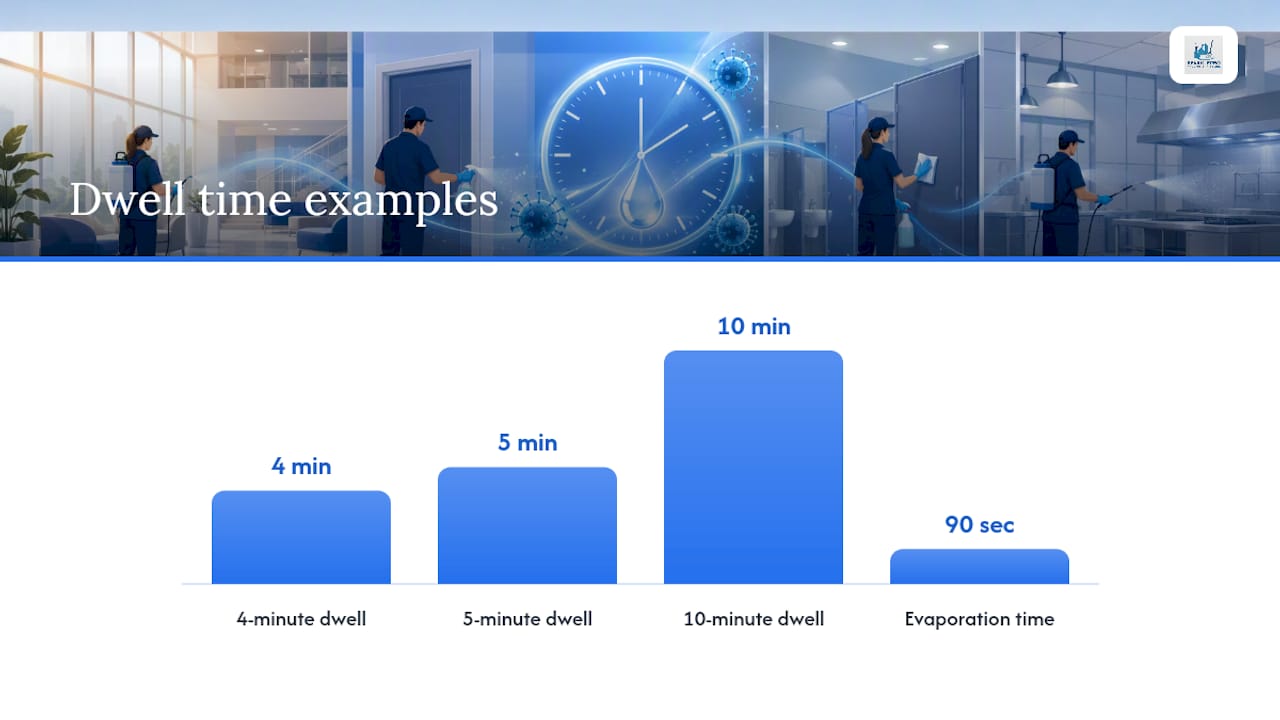
Getting a surface wet is easy. Keeping it wet for four, five, or ten minutes in a dry office with the HVAC running is the actual challenge. Apply enough product to leave a continuous, glistening wet film, not a light mist that beads up and evaporates in ninety seconds. Trigger sprayers work fine for small zones like doorknobs and light switches, but for larger surfaces, a pump-up sprayer or an electrostatic unit distributes product more evenly and holds moisture longer across counters and equipment.
Watch for early evaporation. Techs who catch a surface starting to haze or dry before the timer's up should re-wet that spot immediately rather than wiping it off and calling it done, then note the event in the service log.
- Increase application volume in rooms with strong airflow, low humidity, or warmer temperatures
- Set a visible timer or checkpoint schedule during longer dwell periods (5+ minutes)
- Use high-touch surface protocols to prioritize which zones need the closest monitoring
- Log product name, EPA registration number, and confirmed dwell time for every disinfection round
Pro Tip: In dry, high-traffic lobbies or break rooms with strong HVAC airflow, don't just reapply once. Cut your work area into smaller zones so you can treat and monitor each one before the previous zone dries out.
Will Disinfectants Damage Surfaces Over Time?
Meeting contact time and protecting your client's assets aren't automatically in conflict, but they can be if you're not paying attention to what the surface is made of. Repeated wet contact with bleach-based products can pit stainless steel, dull finished wood, or etch natural stone like marble and limestone over months of daily use. Quats and peroxide formulas are generally gentler, but "generally" isn't a guarantee across every finish.
Check the SDS and label for surface compatibility warnings before you commit to a product for a given zone, not after you've already discolored a countertop. A few situations call for a different approach entirely:
- Sensitive stone, brass, or specialty finishes may need a lower-contact chemistry or a barrier method instead
- High-value equipment areas sometimes justify contactless disinfection over prolonged wet contact
- Any deviation from the standard protocol should be documented with the reason and the alternative method used
Facility Manager's Quick Checklist for Dwell Time Compliance
Before your team starts a shift, confirm three things: the right product is stocked, PPE is available, and someone has actually read the label's contact time out loud, not assumed it from memory.
- Pre-shift: Verify product inventory, confirm PPE, and read the current label's contact time and EPA registration number.
- During application: Apply to visible wetness, monitor for early drying, and re-wet any spot that hazes before time is up.
- Verification: Record start and end times for contact periods longer than five minutes, especially in healthcare or food-service zones.
- Post-shift: Log the product used, lot number, and confirmed dwell time; flag any surface compatibility issues to a supervisor.
- Follow-up: Schedule a review if a product consistently dries before its labeled time in a specific room or zone.
What Our Field Teams Learned About Dwell Time Compliance
We once had a crew in a high-airflow lobby watch a five-minute product haze over in under two minutes. The fix wasn't a different chemical. It was splitting the space into smaller zones and re-wetting on a schedule, then logging it. Across the accounts Sparkleprocommercialcleaning services nationwide, that kind of small procedural fix, backed by a written log, is usually what separates compliant disinfection from a surface that just looks clean.
— Sales
Get Dwell-Time Compliance Handled by Trained Teams
Reading a label correctly is one thing. Proving your facility did it, every shift, across every zone, is another. Sparkleprocommercialcleaning sends trained teams who verify product labels and EPA registration details before they start, monitor wet contact time on-site, and hand you audit-ready logs instead of a vague promise that "it got disinfected."
If you're managing a healthcare facility, multifamily property, or office building where documentation actually matters during an inspection or a tenant complaint, that paper trail is the difference between defending your protocol and guessing at it. Our disinfecting services guide breaks down what to expect when you bring in a contractor for this work. Facilities in Delaware can request a quote or site visit here to see how a documented dwell-time program looks in practice.
Where to Verify Contact Time Information Yourself
Always confirm dwell time against the product's own label and SDS first. For broader reference, the EPA's selected disinfectants list, the CDC's facility disinfection guidance, Washington State's contact-time chart template, and peer-reviewed AJIC research all offer solid grounding.
Sources
- Selected EPA-Registered Disinfectants | US EPA
- When and how to clean and disinfect a facility | CDC
- Wet contact time directly impacts antimicrobial efficacy of Environmental Protection Agency–registered disinfectants - AJIC
- ContactTimeChartFillable — Washington State Department of Health
- How to Determine Contact Time for EPA Registered Disinfectants | NC DPH