

Hire a commercial disinfecting service that uses EPA-registered disinfectants, enforces dwell time on every visit, and hands you documented SOPs before the first crew walks in. That is the short answer. Scheduled programs consistently outperform one-off deep cleans at reducing workplace illness because they target high-touch surfaces before transmission chains form, rather than after someone calls in sick.
Before your first vendor call, ask for three things:
- Proof of EPA-registered products (product name, EPA registration number, and SDS)
- Training records showing staff are hazcom/OSHA-trained and product-certified
- A sample scope of work and SLA with dwell-time verification language
The rest of this article expands those three asks into a full evaluation checklist, a breakdown of cost drivers, scheduling templates, and a look at how Sparkleprocommercialcleaning structures its office disinfecting programs.
Table of Contents
- What do the best disinfecting services for offices actually include?
- When should you schedule office disinfection services?
- Which disinfectants and application methods are safe for office use?
- How do you evaluate and choose an office disinfecting vendor?
- What drives the cost of office disinfecting services?
- How Sparkleprocommercialcleaning delivers office disinfecting programs
- Key Takeaways
- Why documented SOPs matter more than product claims
- Get a quote for office disinfecting services from Sparkleprocommercialcleaning
- Authoritative sources used in this article
What do the best disinfecting services for offices actually include?
Scope is where most facility managers get burned. A vendor quotes a low per-visit rate, then the scope turns out to cover only restrooms and trash. Before comparing prices, nail down exactly what is and is not in the service.
Core scope items every commercial disinfecting program should cover:
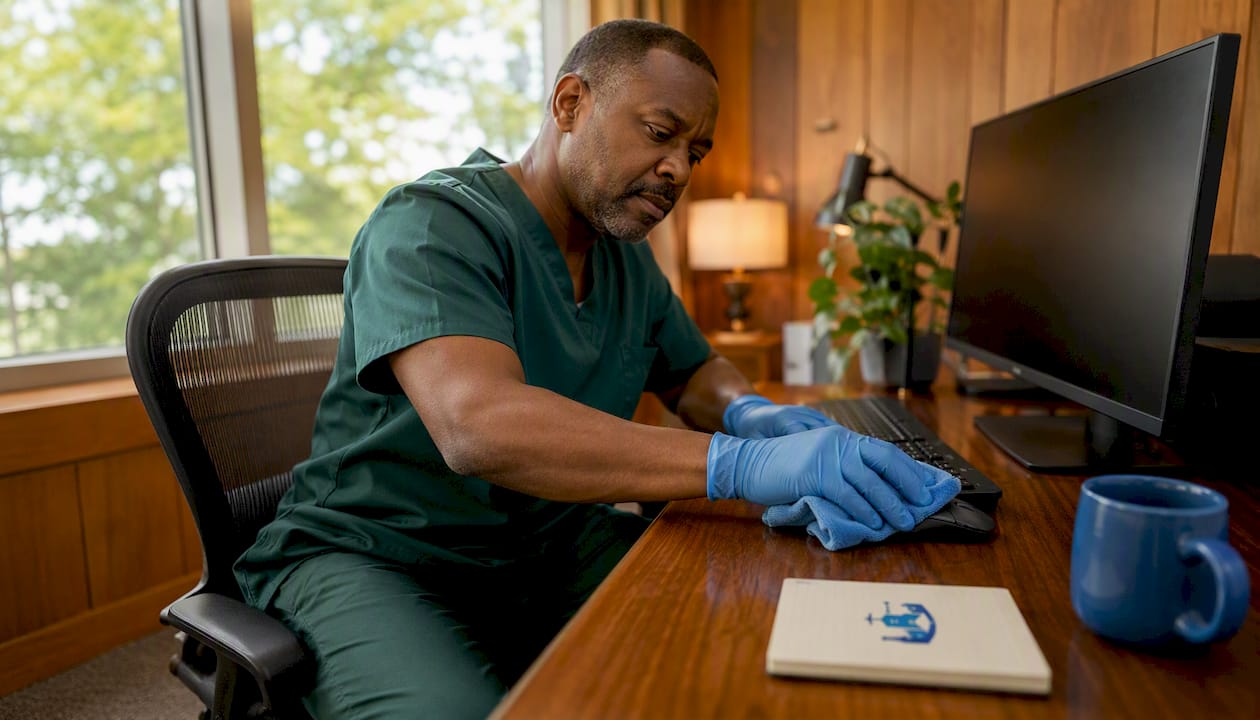
- High-touch surfaces: desks, keyboards, phones, door hardware, light switches, elevator buttons
- Restrooms: fixtures, partitions, dispensers, and floor drains
- Break rooms: countertops, appliance handles, coffee stations, sink faucets
- Conference rooms: table surfaces, shared AV equipment, chair arms
- Common areas: reception desks, lobby seating, shared copiers and printers
Beyond the core, high-risk zones like break rooms, copy rooms, and elevators generate disproportionate transmission risk because of traffic density and shared contact points. A good vendor maps these zones during the site visit and weights disinfection frequency there.
Specialized scope items that affect cost and outcomes:
- HVAC filter checks and air-treatment coordination
- Carpet and upholstered seating: most disinfectants are formulated for hard, nonporous surfaces, so soft materials often require laundering or EPA-listed products approved for porous surfaces
- Post-incident deep cleans following a confirmed illness case
- Shared electronics (headsets, tablets, shared workstations)
Application methods matter too. Manual wipe-downs with microfiber cloths are the baseline for high-touch surfaces. Electrostatic spraying extends coverage to irregular surfaces and is widely used for wide-area treatment. Controlled fogging or ULV application can reach difficult spaces, but CDC guidance is clear that fogging should not be the primary method unless the product label explicitly permits it. UV-C light is a useful supplement in HVAC systems and specific room treatments, but it does not replace surface disinfection.
Every visit should produce a before/after checklist, dwell-time verification notes, and a service log. Require SDS availability on-site for every product used.
Pro Tip: Map your office by usage patterns before the first vendor walk-through. Mark zones by daily headcount and shared-surface density. Break rooms and elevator lobbies in a 200-person office need daily attention; a private executive suite used twice a week does not. That map becomes your scope document and prevents you from paying for uniform coverage across unequal-risk zones.
When should you schedule office disinfection services?
Choose a recurring program calibrated to occupancy and traffic. One-time deep cleans belong in incident response, not as your primary infection control strategy. CDC guidance supports routine, scheduled disinfection of high-touch surfaces as the more effective approach to reducing communicable disease spread.
Recommended cadences by zone type:
- High-touch, high-occupancy zones (lobbies, break rooms, restrooms): daily
- Medium-traffic shared spaces (conference rooms, copy areas): 2–3 times per week
- Low-traffic private offices and storage areas: weekly to monthly, with targeted touchpoint cleaning
Incident response timing is a separate question. When a confirmed illness case occurs, enhanced cleaning SOPs recommend waiting 24–48 hours before non-urgent work in the affected area. Targeted cleaning of the contaminated zone should happen sooner, with appropriate PPE, once the area is vacated.
A practical 30-day starter cadence:
- Week 1: Full-scope deep clean plus vendor walk-through, SOP sign-off, and staff notification
- Weeks 2–4: Recurring touchpoint program at agreed frequency by zone
- End of month 1: Formal audit, punchlist review, and cadence adjustment based on observed traffic
Align disinfecting visits with your existing janitorial schedule and after-hours windows. A vendor that coordinates with your daily commercial cleaning routines avoids duplication, reduces disruption, and keeps total facility costs lower than running two separate programs.
Which disinfectants and application methods are safe for office use?
Require EPA-registered disinfectants matched to the target pathogen and surface type, and verify that the label use directions and contact time are being followed on every visit. That single requirement eliminates most underperforming vendors.
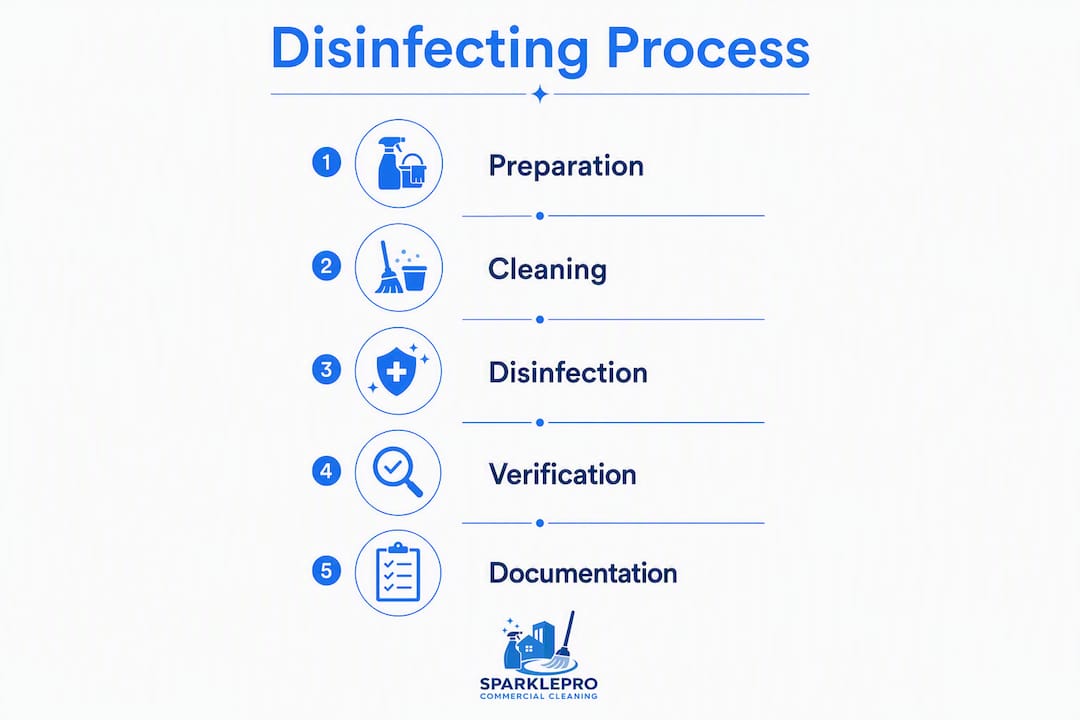
The two-step protocol is non-optional. Visible soil and organic matter deactivate disinfectants before they can work, so cleaning with soap or detergent must precede disinfection. Skipping the cleaning step is the most common reason a disinfection program fails to deliver results.
Dwell time is where programs most often fall short. EPA-registered products commonly require surfaces to remain visibly wet for 1–10 minutes to achieve the labeled kill claim. A technician who wipes a surface dry after 30 seconds has not disinfected it. Written SOPs and supervisor spot-checks are the only reliable way to enforce this.
Safety requirements for applicators and occupants:
- Applicators must wear PPE appropriate to the product label (gloves, eye protection, respirator where required)
- Adequate ventilation during and after application, with re-entry times per the product SDS
- SDS copies available on-site for every product in use
- Occupants should not re-enter treated areas until re-entry conditions on the label are met
When EPA-registered products are unavailable, EPA reopening guidance permits diluted bleach (1/3 cup per gallon of water) or 70% alcohol solutions as alternatives on compatible surfaces. For metallic hardware where bleach is unsuitable, 70% alcohol is the practical fallback.
Contact time is the most under-enforced requirement in commercial disinfecting. Surfaces must remain visibly wet for the full 1–10 minute dwell period specified on the product label. A surface wiped dry in under a minute has not been disinfected, regardless of the product used.
How do you evaluate and choose an office disinfecting vendor?
Prioritize proof before price. A vendor who cannot produce EPA product labels, SDS copies, and training records in the first conversation is not ready to run a compliant program in your facility.
Vendor evaluation checklist:
- Active general liability insurance and bonding (request certificates)
- EPA-registered product list with registration numbers
- SDS and label copies for every product used
- Staff training records: hazcom/OSHA and product-specific certifications
- Written SOPs with explicit dwell-time procedures
- Sample visit reports with photos and checklists
- SLA terms: response times, remediation commitments, audit windows
- References from office clients of similar size and industry
Ten questions to ask on the first vendor call:
- What disinfectants do you use, and can you provide the EPA registration numbers?
- Can you share SDS and label copies before the site visit?
- How do you verify dwell time on every visit?
- What PPE do your technicians wear, and how is ventilation managed?
- How do you document each service visit?
- What training do your staff hold, and how often is it renewed?
- Are you licensed and insured in our state?
- How do you handle soft surfaces like upholstered chairs and carpet?
- What is your incident response protocol if a confirmed case occurs in our facility?
- Can you provide references from office clients with similar square footage?
Red flags to walk away from: vague answers about product names, refusal to share SDS or labels, no proof of insurance, no client references, or a pitch that positions fogging as the sole or primary method. CDC guidance explicitly cautions against wide-area application as a primary strategy unless the product label permits it.
At onboarding, require a signed scope document, a walk-through with the lead technician, and a formal 30/60-day audit period with a written punchlist. Best-practice providers maintain SDS files on-site, keep written dwell-time SOPs, and run regular competency checks. These are low-cost contract requirements that materially reduce execution risk.
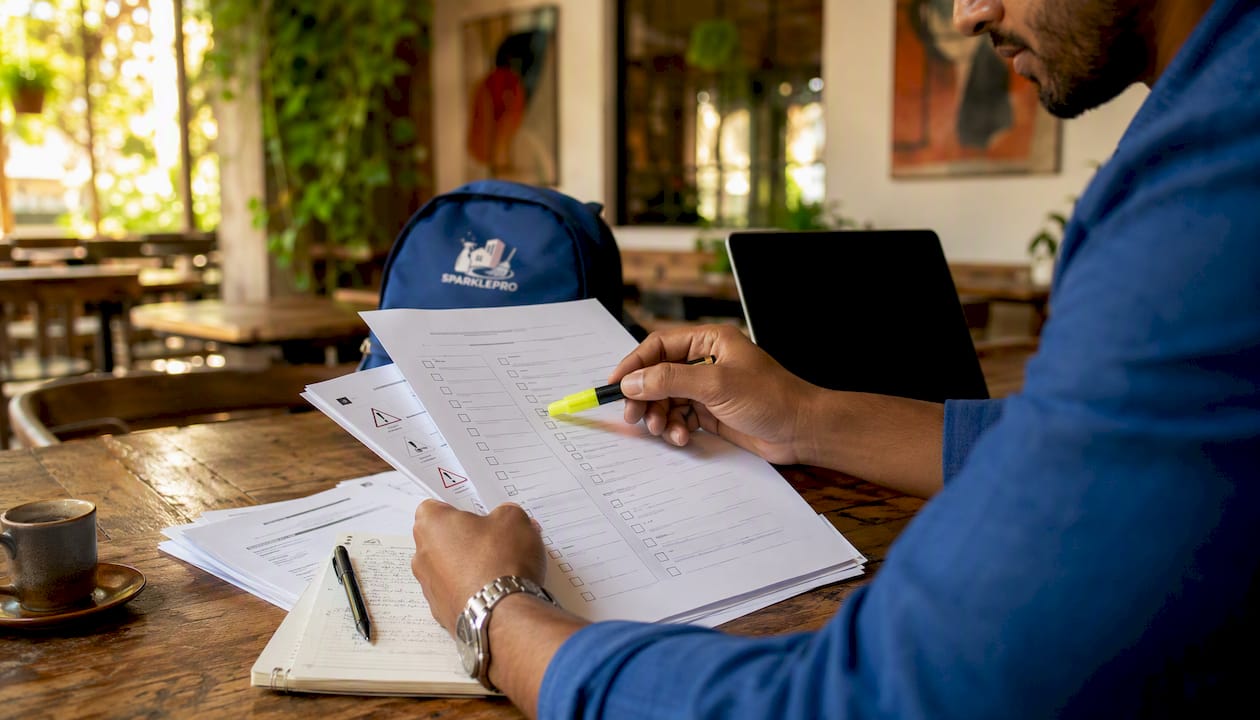
Pro Tip: Ask the vendor to walk you through one complete service visit, step by step, before you sign. A provider who can describe the two-step clean-then-disinfect sequence, name the dwell time for each product, and explain their documentation process is operating at a different level than one who talks about "hospital-grade products" without specifics.
For a deeper look at the disinfecting services evaluation framework for facilities, the linked guide covers procurement language and contract terms in more detail.
What drives the cost of office disinfecting services?
Price depends less on a single per-square-foot rate and more on scope detail, frequency, access windows, and chosen application method. Two quotes for the same building can differ by a wide margin if one covers high-touch detail and the other covers only surface wipe-downs.
| Cost Driver | Typical Price Impact |
|---|---|
| Square footage | Moderate — scales linearly but not the dominant variable |
| Frequency (daily vs. weekly) | High — recurring visits are the largest cost lever |
| Scope detail (high-touch vs. general surfaces) | High — granular touchpoint work adds significant labor |
| Application method (manual vs. electrostatic) | Moderate — electrostatic adds equipment cost but speeds coverage |
| Specialty services (HVAC, upholstery, post-incident) | High — these are typically add-on line items |
| After-hours or weekend scheduling | Moderate — labor premiums apply |
| PPE and waste handling requirements | Low to moderate — varies by product and local regulations |
| Service documentation and reporting | Low — but absence of it should be a red flag, not a cost savings |
Procurement tips that actually save money:
- Request line-item quotes broken out by scope category, not a single bundled rate
- Compare total contract cost over 12 months, not per-visit price
- Negotiate a pilot period (30–60 days) before committing to a full recurring contract
- Ask whether integrating disinfecting with existing janitorial services reduces total cost
After-hours scheduling adds a labor premium but often pays for itself in reduced occupant disruption and faster re-entry. Offices that run disinfecting during business hours lose productive time to ventilation windows and re-entry delays.
How Sparkleprocommercialcleaning delivers office disinfecting programs
Sparkleprocommercialcleaning uses EPA-registered products, enforces dwell-time adherence through written SOPs, and provides documented visit reports with client sign-off after every service. That is the baseline. What sets the program apart is how it integrates with your existing facility operations rather than running as a separate, disconnected service.
The four-step engagement process:
- Site visit and quote: A walk-through to map high-risk zones, confirm square footage, and agree on scope before any pricing is finalized
- Agreed SOP and start date: A signed scope document with product list, dwell-time procedures, and SLA terms before the first crew arrives
- Scheduled visits with documentation: Each visit produces a checklist, dwell-time verification notes, and photos for your records
- Client approval and ongoing audits: Formal 30/60-day audit windows with a written punchlist and SLA performance review
Trust signals available on request:
- General liability insurance and bonding certificates
- Staff training records (hazcom/OSHA and product-specific)
- SDS and EPA label copies for every product used
- Client references from office accounts of comparable size
- Sample visit reports and service logs
Sparkleprocommercialcleaning integrates disinfecting visits with regular janitorial schedules so disinfection is not an isolated event but part of a coordinated facility maintenance plan. That coordination eliminates duplication, reduces total cost, and means your facility is never left with a gap between cleaning and disinfection cycles.
Sparkleprocommercialcleaning also handles open-plan office environments where shared surfaces and high density make standard cadences insufficient. The site visit is where those specifics get mapped.
Pro Tip: When you request a quote, bring your zone map from the scope-planning step. A vendor who adjusts their proposal based on your actual traffic patterns is doing the job correctly. One who quotes the same program for every office regardless of layout is not.
Key Takeaways
The most effective office disinfecting program combines EPA-registered products, enforced dwell times, documented SOPs, and a recurring schedule calibrated to your office's actual traffic and risk zones.
| Point | Details |
|---|---|
| Require EPA-registered products | Ask for product names, EPA registration numbers, and SDS copies before signing any contract. |
| Enforce dwell time | Surfaces must stay visibly wet for the full contact time as specified in the product label instructions; written SOPs are the only reliable enforcement mechanism. |
| Choose recurring over one-time | Scheduled programs reduce workplace illness more effectively than reactive deep cleans; calibrate frequency by zone traffic. |
| Verify training and insurance | Request hazcom/OSHA training records and current insurance certificates at onboarding, not after an incident. |
| Sparkleprocommercialcleaning | Provides EPA-registered products, documented dwell-time SOPs, visit reports, and integrated janitorial coordination for offices nationwide. |
Why documented SOPs matter more than product claims
Most vendors lead with product names. "Hospital-grade," "kills 99.9%," "EPA-approved" — these phrases appear in nearly every pitch, and none of them tell you whether the product is being applied correctly. The actual differentiator is whether a provider has written procedures that enforce dwell time, mandate the two-step clean-then-disinfect sequence, and require documentation on every visit.
A facility that runs a disinfecting program without dwell-time SOPs is essentially paying for the appearance of safety. The product may be excellent. If it is wiped off in 30 seconds, it has not disinfected anything. That gap between what a vendor promises and what actually happens at the surface level is where most office disinfecting programs underperform.
The recommendation here is straightforward: treat SOPs and training records as non-negotiable contract requirements, not nice-to-haves. A provider who resists providing them is telling you something important about how their program actually runs.
Get a quote for office disinfecting services from Sparkleprocommercialcleaning
Fewer sick days, cleaner air, and a facility your team trusts to be safe: that is what a properly run disinfecting program delivers. Sparkleprocommercialcleaning offers office disinfecting contracts across the United States, with site visits, documented SOPs, and EPA-registered products built into every engagement.
The process starts with a site visit. Bring your zone map, your current janitorial schedule, and the vendor checklist from this article. Sparkleprocommercialcleaning will walk the space, confirm scope, and return a line-item quote within a defined turnaround window.
Request a quote for your state directly: Massachusetts office disinfecting services or Washington commercial cleaning. For all other locations, visit sparkleprocommercialcleaning.com to connect with your regional team.
Authoritative sources used in this article
The claims and procedures in this article draw from the following primary and institutional sources:
- When and How to Clean and Disinfect a Facility (CDC): The primary federal guidance on cleaning protocols, dwell time, product selection, and application method safety for commercial facilities.
- EPA Guidance for Cleaning and Disinfecting Public Spaces, Workplaces, and Businesses: Framework for the clean-then-disinfect sequence, soft surface handling, and alternative product formulas when EPA-registered products are unavailable.
- Enhanced Cleaning Work Instructions for Office Environments (SMU): Institutional SOP model covering PPE requirements, incident response timing, and staff training standards for office disinfection.
- Office Space Routine Cleaning Guidance (University of South Carolina EHS): Practical checklist covering the two-step protocol, dwell time adherence, and reusable cloth handling to prevent cross-contamination.
- Office Building Disinfection (Disinfection Technologies Group): Industry-level overview of electrostatic application methods, high-touch hotspot identification, and after-hours scheduling practices.
- How to Disinfect Office Space (Clorox): Practical consumer-level guidance on prioritizing hard nonporous surfaces and shared equipment in office disinfection routines.
- Disinfection vs. pest control: what you need to know: Useful context for facilities that need to coordinate disinfection services alongside pest remediation events.