
EPA List N is the agency's official, searchable roster of disinfectant products expected to work against SARS-CoV-2 when used exactly as the label instructs. To confirm a specific product qualifies, match the first two sets of numbers in its EPA Reg. No. against the List N tool, then follow the label's contact time. That's the entire verification process, and skipping the contact time step is where most facilities go wrong.
TL;DR:
- Confirm the EPA registration number’s first two sets of digits match the current List N database before purchasing or application.
- Recognize that inclusion on List N verifies a product’s efficacy against SARS-CoV-2 only when used as the label specifies, not overall quality or safety.
- Understand that different formulations under the same brand can have separate registration numbers, so verify each SKU individually rather than assuming brand-wide approval.
- Ensure contact time, surface compatibility, and use site are confirmed on the label and match operational needs, especially when switching between products with different contact times.
- Recheck the List N regularly because product registrations update or change, and a product listed last year might no longer qualify today.
Table of Contents
- What Is EPA List N and What Does Inclusion Mean?
- How Do Products Qualify for EPA List N?
- How Do I Search the List N Tool and Verify a Product?
- Operational Checklist for Using List N Products Correctly
- Where Does List N Fit Among Other EPA Lists?
- Environmental and Disposal Guidelines for Disinfectant Materials
- Common Misconceptions About EPA List N Disinfectants
- Bookmark These Official Resources
- How Sparklepro Applies List N Guidance in Real Contracts
- Get a Disinfecting Quote Backed by List N Verification
- Sources
- FAQ
What Is EPA List N and What Does Inclusion Mean?
List N is not a marketing badge. It's a regulatory tool the EPA maintains to help buyers identify antimicrobial pesticide products expected to be effective against SARS-CoV-2 when used according to the label. The list is active and gets updated regularly as new products earn qualifying data or existing registrations change.
That update cadence matters more than most procurement teams realize. A product that appeared on List N last year could be reformulated, relabeled, or pulled if its registration changes. If you're buying in bulk or locking into a annual supply contract, check the list again close to your purchase date rather than relying on a screenshot from months ago. Facilities that stock disinfectant six months ahead of a seasonal push sometimes discover their go-to brand's registration number no longer matches what's listed, usually because the manufacturer switched active ingredient concentrations without changing the product name on the shelf label.
Here's the part that trips people up: being on List N is not an EPA endorsement of the product's overall quality, scent, or price. It's a narrower statement. The EPA is saying this specific formulation, sold under this specific registration number, has data supporting a kill claim against SARS-CoV-2 or an accepted proxy, provided you use it the way the label describes. Nothing more.
A few things List N inclusion does not guarantee:
- That the product works on porous surfaces, fabric, or food contact surfaces unless the label explicitly says so
- That every product sold under the same brand name carries the same registration number or qualifies
- That the product will still be on the list next quarter without you rechecking
- That faster or slower contact times than the label states will still produce the claimed result
Property managers overseeing multiple sites often assume that once a disinfectant is "on the EPA list," any variant of it is safe to standardize across buildings. That's a costly assumption. A gallon concentrate and a ready-to-use spray from the same manufacturer frequently carry different EPA registration numbers, and only one might actually be List N qualified. Treat each SKU as its own verification task, not a brand-level approval.
How Do Products Qualify for EPA List N?
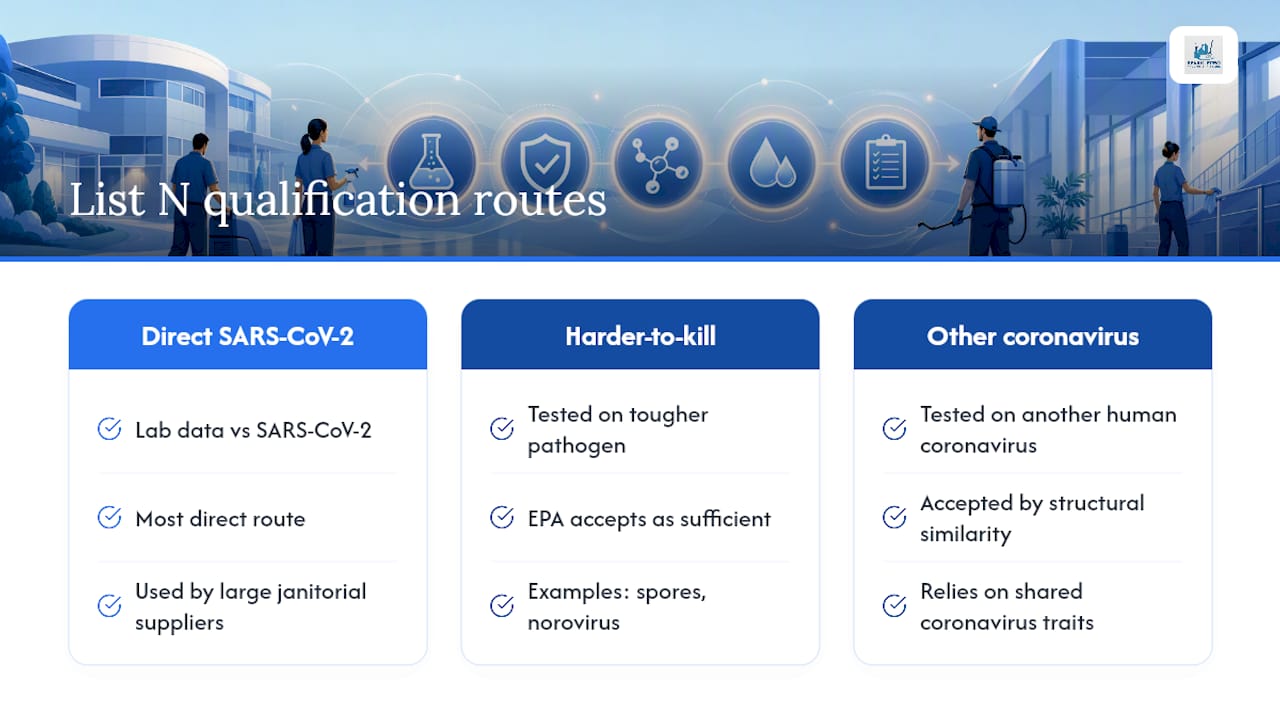
Products earn a spot on List N through one of three accepted evidence routes, and knowing which route a product used can tell you something about how confident you should be in its real-world performance. The EPA explains these three qualifying pathways directly on its site.
Direct efficacy testing against SARS-CoV-2. The manufacturer submitted lab data showing the product kills the actual virus that causes COVID-19 under the tested conditions. This is the most direct route and the one most large janitorial suppliers now pursue for flagship products.
The "harder to kill" pathway. Some products qualify because they demonstrate efficacy against a pathogen that's tougher to eliminate than SARS-CoV-2, which is actually a relatively fragile, enveloped virus compared to bacterial spores or non-enveloped viruses like norovirus. If a product kills something harder to kill, the EPA accepts that as sufficient evidence it'll handle SARS-CoV-2 too.
Efficacy against a similar human coronavirus. Because coronaviruses share structural similarities, data showing effectiveness against another human coronavirus can support a List N claim without a SARS-CoV-2-specific test.
None of these pathways are inferior to each other in terms of regulatory acceptance. All three earn a legitimate spot on the list. What differs is the label language, and that's where reading matters more than brand reputation.
Pro Tip: Two products can carry the exact same active ingredient and percentage, yet one lists a 30-second contact time and the other lists 10 minutes, because they were tested under different protocols or concentrations. Never assume "same chemical" means "same contact time."
Reading the registration number correctly is where most verification mistakes happen. An EPA Reg. No. looks something like 12345-67-89. The first number identifies the primary registrant (the company that owns the base registration). The second number identifies the specific product formulation under that registrant. The third number, when present, identifies a supplemental distributor, meaning the exact same formulation sold under a different brand name.
That third number is why verification has to be registration-driven rather than brand-driven. A big-box store's private-label disinfectant wipe might be chemically identical to a national brand, sold under the same primary and product numbers with only the distributor digit different. You only need to match the first two number sets against the List N tool. If those match, the product is covered, regardless of what name is printed on the bottle.
How Do I Search the List N Tool and Verify a Product?
The List N advanced search page is the working interface most facility managers should bookmark, not the general list overview. The legacy advanced search still functions and includes filters that make it far more useful for procurement decisions than scrolling a static list.
Here's the exact workflow to confirm a product before you buy or before you approve a vendor's product substitution:
- Find the EPA Reg. No. on the product label. It's usually near the ingredient statement or on the back panel, formatted as numbers separated by hyphens.
- Extract only the first two number sets. Ignore anything after the second hyphen. That third segment identifies a distributor, not a different formulation.
- Enter those two numbers into the List N tool's search field. A match confirms the base formulation is qualified.
- Cross-check the product name that appears in the results against what's printed on your label. Names can vary slightly between the registrant's listing and the retail package, which is normal and not a red flag as long as the numbers match.
- Open the product's label link inside the tool (when available) to confirm the contact time, surfaces, and use sites match what your facility needs.
The advanced search filters are where the tool earns its keep for facility work. You can narrow results by formulation type (wipe, spray, concentrate, aerosol), by contact time, by surface type, and by use site (healthcare, food service, general commercial). That last filter matters more than people expect. A product approved for hard surfaces in a hospital setting might carry restrictions or different directions for a retail lobby, and the use site filter surfaces that distinction before you order a drum of the wrong product.
The most common pitfall is searching by brand name instead of registration number. Search tools built around brand names will return nothing, or worse, return a similarly named product that isn't actually the one on your shelf. Another frequent mistake is stopping at the first two digits of the registration number without checking the second set, which can produce a false match if a registrant has multiple product lines.
A simple label-verification checklist before any purchase order goes out:
- EPA Reg. No. first two sets confirmed against the List N tool
- Contact time noted and compared against realistic staff workflow
- Surface type confirmed compatible with your facility's materials
- Use site listed on the label matches your building type
Operational Checklist for Using List N Products Correctly
Buying the right product solves half the problem. The other half is executing it correctly on-site, and this is where most compliance failures actually happen. The EPA is explicit that a listed product only performs as claimed when the surface stays visibly wet for the full stated contact time. Wipe it on, wipe it off in five seconds, and you've applied a cleaner, not a disinfectant, regardless of what the label promised.
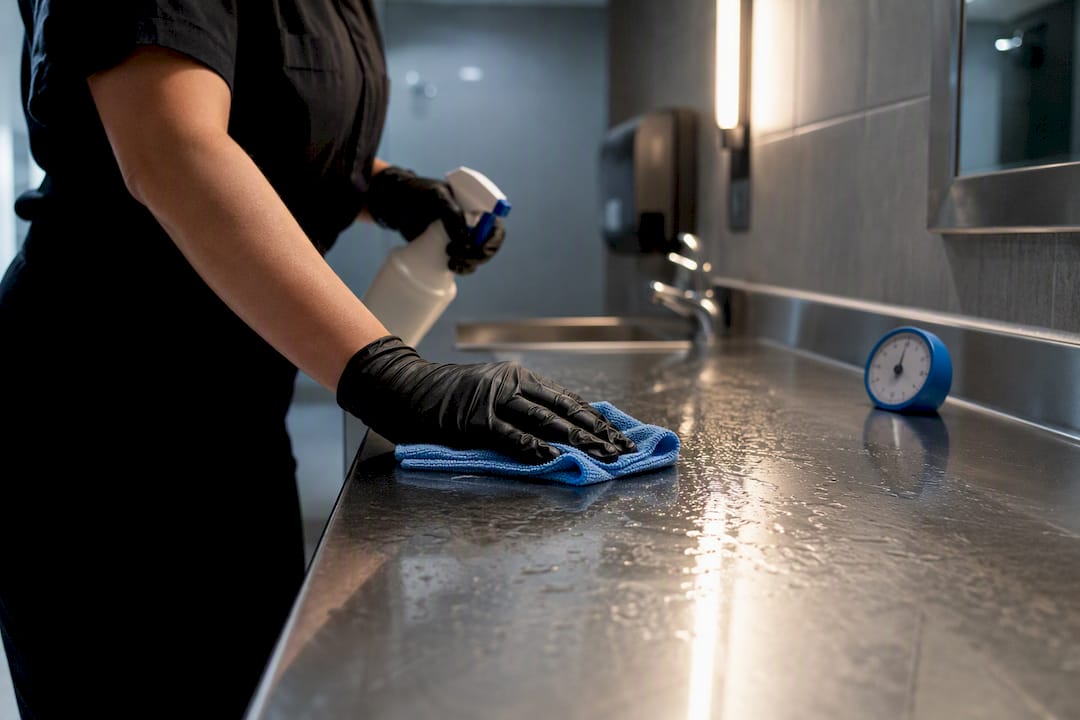
Contact time is the single most common failure mode in commercial cleaning operations, and it's almost always a training and staffing problem rather than a product problem. A janitorial team under time pressure to turn over ten restrooms in an hour will naturally rush past a 10-minute dwell requirement. Facilities that enforce contact time consistently tend to use visible timers, pre-measured spray volumes, or two-person verification on high-risk areas like patient rooms or shared equipment rather than relying on staff memory. Our own dwell time guidance for facility managers covers the logistics of building this into a cleaning schedule without blowing up labor hours. Professional-grade dwell time practices generally converge on the same principle: the timer starts when the surface is fully wet, not when the spray trigger is pulled.
Surface compatibility is the second big constraint. Most List N products are labeled for hard, non-porous surfaces, things like countertops, stainless steel, sealed tile, and plastic. Fabric, unsealed wood, carpet, and certain electronics are frequently excluded or require a different product entirely. Applying a hard-surface disinfectant to porous material doesn't just fail to disinfect. It can also degrade the material or leave residue that's difficult to remove.
Pro Tip: When switching to a shorter-contact-time product to speed up turnover between rooms, test it on an inconspicuous section of your actual surface material first. A product with a fast kill time might use a higher concentration of active ingredient that discolors certain finishes over repeated use.
Application method should match your labor model, not just your budget:
- Wipes are efficient for spot cleaning and small high-touch areas but dry out fast, which can cut effective contact time short.
- Spray-and-wipe systems work well for counters and fixtures but require the trigger discipline to fully saturate the surface.
- Dilutable concentrates cost less per application but introduce mixing-error risk if staff aren't trained on exact ratios.
- Electrostatic sprayers cover irregular surfaces and large rooms quickly, but only with products specifically labeled for electrostatic application, and they carry their own airflow and PPE considerations covered in our electrostatic disinfection guidance.
PPE requirements are label-specific, not universal. Some products require gloves only; others call for eye protection or respiratory precautions in enclosed spaces. When disinfecting occupied buildings, CDC guidance on cleaning and disinfecting facilities recommends scheduling higher-concentration applications during low-occupancy windows and ventilating treated areas before staff or tenants return, particularly with aerosolized or electrostatic methods.
Recordkeeping closes the loop and protects you if a compliance question ever comes up. At minimum, log the product name, its EPA Reg. No., the lot number and application date, the contact time actually observed, and who performed the application. This isn't bureaucratic overhead. It's the paper trail that proves due diligence if a tenant, health inspector, or insurance auditor asks how a space was disinfected.
Where Does List N Fit Among Other EPA Lists?
List N is one entry in a broader family of EPA antimicrobial product lists, and confusing them is a genuine risk if your facility deals with more than viral disinfection. The EPA maintains separate lists for different target organisms, and a product's presence on one list says nothing about its performance against a pathogen covered by a different list.
A few examples worth knowing by name:
- List B covers products effective against Mycobacterium tuberculosis.
- List G targets HIV-1 and Hepatitis B in healthcare settings.
- List K addresses Clostridioides difficile spores, a notoriously hard-to-kill organism that most everyday disinfectants, including many List N products, do not touch.
- List P identifies products meeting EPA's criteria as emerging viral pathogen claims, a category List N itself grew out of.
- List Q covers products with efficacy against a broad range of pathogens under an EPA registered claim structure distinct from List N's coronavirus-specific scope.
The practical takeaway: if your facility has had a norovirus outbreak, a C. diff concern in a healthcare setting, or needs a true sterilant for medical equipment, List N is the wrong reference point entirely. Pull the label and confirm the specific claim you need, whether that's List K for spores or a sterilant registration for surgical instruments. List N solves for one virus. Don't stretch it to cover pathogens it was never tested against.
Environmental and Disposal Guidelines for Disinfectant Materials
Used disinfectant wipes, empty concentrate containers, and spent spray bottles generally qualify as regular solid waste once the product has been used as directed, but the label itself is the final word. Some concentrated formulations, particularly those with quaternary ammonium compounds or higher percentages of active chlorine, carry specific disposal instructions on the label that override general assumptions.
Never pour unused concentrate down a drain unless the label explicitly permits it. Many commercial disinfectants require diluted disposal only, and dumping full-strength product into wastewater systems can violate local water treatment regulations, not just EPA guidance. Empty containers should be triple-rinsed if the label calls for it before recycling or disposal, and rinse water typically needs to go down the drain rather than into a storm system.
For facilities generating high volumes of disinfectant waste, particularly healthcare or industrial sites, check with your municipal waste authority about whether spent containers count as hazardous waste under local rules. This varies by jurisdiction and by the specific active ingredient, so a blanket national answer doesn't exist. When in doubt, the safest operational rule is simple: follow the label's disposal section first, and treat anything ambiguous as a question for your waste hauler or local environmental office rather than a guess.
Common Misconceptions About EPA List N Disinfectants
The biggest misconception is that List N membership means universal effectiveness. It doesn't. A product qualifies for specific surfaces, specific contact times, and specific use sites, and stepping outside any of those parameters voids the claim in practice even if the bottle still says "EPA List N."
A second misconception involves resistance. Some facility managers worry that repeated use of the same disinfectant will let SARS-CoV-2 build resistance the way bacteria develop antibiotic resistance. Viruses don't develop resistance to disinfectant chemistry the way bacteria adapt to antibiotics; the concern with rotating products is more about material compatibility and odor fatigue among staff than viral resistance.
A third misconception treats "disinfectant" and "sanitizer" as interchangeable. Sanitizers reduce microbial load to a safer level, generally with shorter contact times and lower kill-rate requirements. Disinfectants make a stronger claim against specific pathogens and require longer, stricter contact times. Buying a sanitizer because it's cheaper, when your protocol calls for a disinfectant, quietly undermines the entire program.
— Sales
Bookmark These Official Resources
A short list of sources is worth keeping open in a browser tab rather than searching fresh every time.
The List N advanced search tool is where actual verification happens, filters and all. The About List N page explains the list's official status and update process in the EPA's own language, useful if you need to justify a procurement decision to leadership or a client. The EPA's explanation of how products qualify breaks down the three evidence pathways in more technical detail than most guides cover. The Selected EPA-Registered Disinfectants page is the jumping-off point for List B, G, K, P, and Q when a pathogen other than SARS-CoV-2 is the concern.
For occupancy and ventilation policy during active disinfecting operations, CDC's facility cleaning and disinfecting guidance fills the gap the EPA's product-focused pages don't cover. Between these five, most verification and policy questions a facility manager runs into have a direct, sourced answer.
How Sparklepro Applies List N Guidance in Real Contracts
Verification isn't a one-time task. It's a step baked into how we quote and staff every disinfecting engagement. During the site visit phase of our process, before a single product gets scheduled, we confirm EPA Reg. No. numbers against the current List N tool and pull the actual label for the surfaces and use sites specific to that property. A healthcare corridor and a retail lobby rarely call for the same formulation, even within the same building portfolio.
The harder part isn't picking the right product. It's making sure contact time gets honored on every single application, across every shift, at every site in a multi-location contract. We build that into training checklists and post-job approval steps rather than trusting memory, an approach that lines up with our own dwell time enforcement guidance written for facility managers running their own in-house teams.
Documentation follows the same logic as the recordkeeping checklist earlier in this guide: product name, registration number, lot and date, observed contact time, and the technician who applied it. For properties coming out of construction or major renovation, that documentation gets layered onto our construction cleaning safety protocols, since new-build environments introduce dust and surface conditions that change how a disinfectant performs. None of this is complicated. It's just consistent, and consistency is the part most in-house programs struggle to maintain once the initial urgency of a COVID-era protocol fades.
Get a Disinfecting Quote Backed by List N Verification
Our service offers property managers an alternative to piecing together disinfecting protocols in-house without the label-checking and contact-time enforcement most facilities lack the bandwidth to police shift after shift.
Our process generally starts with a quote based on your property's size and use, followed by a site visit to confirm appropriate List N products for the surfaces and occupancy patterns, then a scheduled cleaning built around correct contact times, and a final customer approval step before completion. Verification of registration numbers and enforcement of dwell time on every visit can help reduce compliance exposure related to tenant complaints, inspection findings, or liability questions after incidents.
If you're evaluating disinfecting vendors more broadly, our guide to choosing the right disinfecting service covers what to ask before signing a contract. Ready to move forward? Request a quote for commercial disinfecting services in Delaware, Massachusetts, or Washington, and we'll schedule a site visit to match the right List N products to your property.
This article is general information, not a substitute for advice from a qualified doctor. Consult a qualified healthcare professional about your own circumstances before acting on anything here.
Sources
FAQ
Which disinfectants are EPA registered?
Any product with a valid EPA Reg. No. printed on its label is EPA registered as a pesticide product. Being registered is separate from being on List N, which specifically confirms expected efficacy against SARS-CoV-2.
What is EPA's list of lists?
The EPA maintains a family of pathogen-specific product lists, including Lists A, B, G, K, N, P, and Q, each covering different target organisms and claim types. List N is the one specific to SARS-CoV-2.
Are disinfecting wipes an EPA registered disinfectant?
Many commercial disinfecting wipe brands carry EPA registration and some formulations appear on List N, but this varies by specific product line and formulation. Check the exact EPA Reg. No. on your product's label against the List N tool rather than assuming based on the brand name alone.
What are the top disinfectant brands facility managers use?
There's no official EPA ranking of brands, since qualification is registration-number specific rather than brand-wide. The safest approach is choosing products by verified EPA Reg. No. match on List N and confirming the contact time fits your operational workflow, not by brand reputation alone.
Does a product stay on List N permanently once added?
No. The EPA updates List N regularly, and products can be added or removed as registrations change or new data comes in. Recheck the List N tool periodically rather than relying on a one-time check from months earlier.