
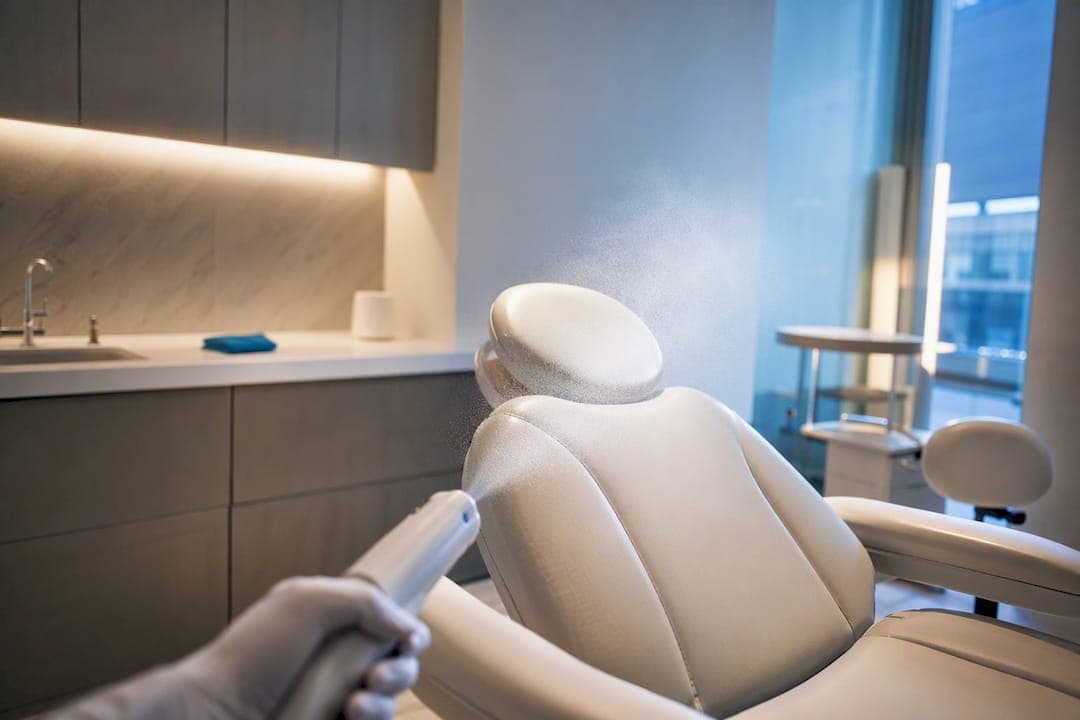
The technology charges disinfectant droplets so they cling to surfaces more evenly, cutting labor time on chairs, railings, and equipment. It fails when operators skip pre-cleaning, use unapproved chemicals, or rush past wet contact time. Trained staff, proper PPE, and a vacated space are non-negotiable.
TL;DR:
- Effective electrostatic spraying requires achieving a charge to mass ratio of about 0.8 to 1.0 mC/kg and a droplet size of at least 40 microns for surface application.
- The wrap-around disinfectant coverage is modest and varies by device, with only some units meeting the recommended charge levels, and it does not fully encapsulate objects.
- Proper application depends on thorough pre-cleaning, correct spray distance, contact time verification, and strict adherence to safety protocols, including ventilation and PPE.
- Electrostatic sprayers do not kill germs themselves; they efficiently deliver disinfectants, which must be compatible with the application method and used on properly cleaned surfaces.
- Choosing EPA-registered disinfectants explicitly approved for electrostatic application and following manufacturer guidance is essential to ensure safety and effectiveness.
Table of Contents
- What Is Electrostatic Disinfection and How Does It Work?
- Does Electrostatic Disinfection Actually Kill Germs?
- What Safety Rules Apply to Electrostatic Sprayers?
- When Should You Use Electrostatic Disinfection vs Fogging or Wipes?
- How Do You Implement Electrostatic Disinfection the Right Way?
- How Do You Choose an Approved Disinfectant for Electrostatic Application?
- What Should Be on Your Electrostatic Disinfection Checklist?
- How Sparkleprocommercialcleaning Handles Electrostatic Disinfection Projects
- The Real Question Isn't "Does It Work?" It's "Will Your Crew Do It Right?"
- Get Professional Electrostatic Disinfection Without the Guesswork
- Where to Verify Electrostatic Disinfection Claims
- Sources
What Is Electrostatic Disinfection and How Does It Work?
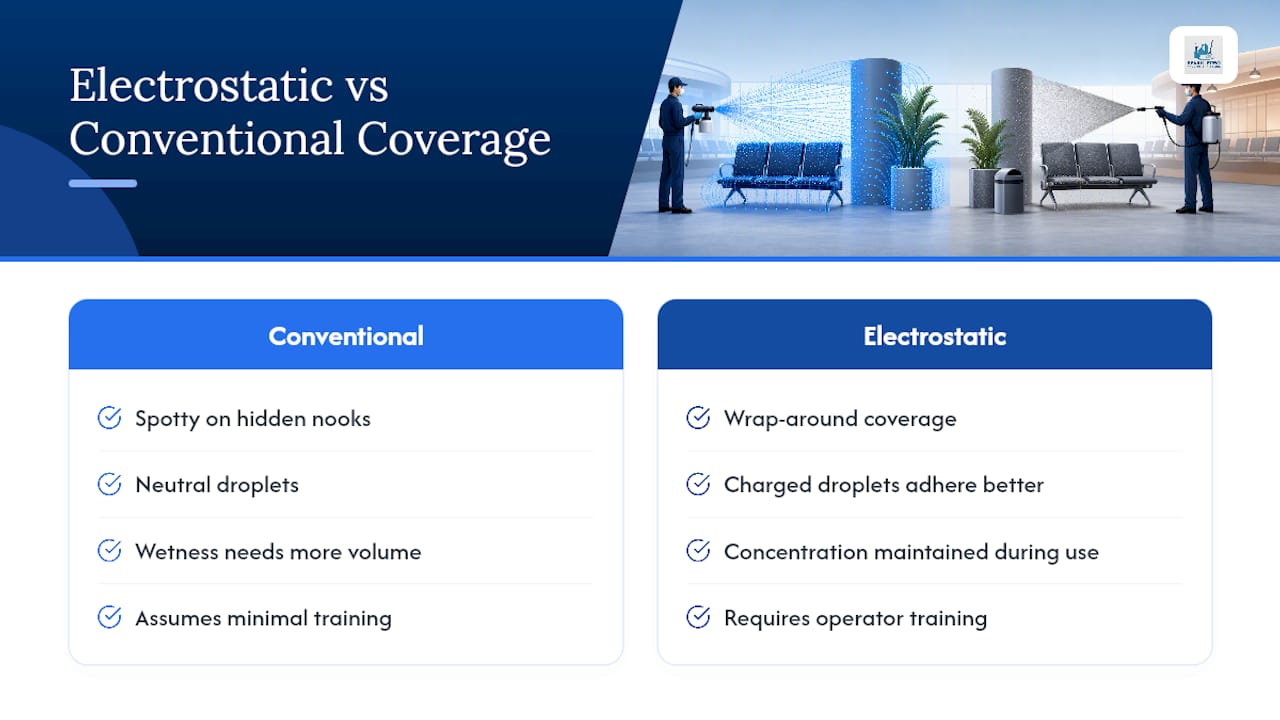
Electrostatic disinfection applies an electrical charge to disinfectant droplets as they leave the sprayer nozzle. Charged droplets repel each other in flight and get pulled toward grounded surfaces, including the sides and undersides of objects a standard spray would miss. That's the theory behind the technology's appeal for facility managers dealing with irregularly shaped equipment, chair legs, door handles, and other surfaces standard trigger sprayers or wipes handle poorly.
The physics behind this depends on two numbers most facility managers never think to ask about: charge to mass ratio and droplet size.
- Charge to mass ratio: Effective electrostatic spraying generally needs a ratio of roughly 0.8 to 1.0 mC/kg to produce a meaningful wrap-around effect, though suggested thresholds vary by source and device.
- Droplet size (VMD): Droplets need a volume median diameter of at least 40 microns for surface application. Go smaller and you drift into aerosol territory, where droplets hang in the air rather than landing on surfaces.
- Spray distance: Most manufacturers recommend holding the nozzle between 2 and 10 feet from the target surface, close enough for the charge to matter, far enough to avoid pooling.
This is also where electrostatic sprayers and foggers part ways, and it's the distinction that trips up a lot of buyers comparing an electrostatic sprayer vs fogger for the first time. An electrostatic sprayer is a surface-directed tool aimed at specific objects and touchpoints. A fogger or ULV mister is a volumetric tool meant to fill a room with fine aerosol, settling on every exposed surface, including ones you didn't intend to treat. Confusing electrostatic vs fogging use cases leads to two common mistakes: fogging a room when you only needed to hit door handles, or expecting an electrostatic sprayer to blanket an entire warehouse the way a fogger would.
Does Electrostatic Disinfection Actually Kill Germs?
The honest answer is: the sprayer doesn't kill anything. The disinfectant does. The sprayer's job is getting that chemical onto surfaces efficiently, and that's exactly where the research gets interesting.
The evidence gap most vendors won't mention: peer-reviewed testing of six electrostatic sprayers found that only four of six units produced sprays meeting the suggested 0.1 mC/kg charge threshold, and wrap-around deposition onto a test cylinder was minimal, not the dramatic 360-degree coating marketing materials sometimes imply.
That single finding should reset expectations for any facility manager who has heard the wrap-around pitch. The same study confirmed most devices tested did achieve the recommended droplet size, with average VMD readings of 40 microns or higher, which is good news for surface targeting. But the charge performance varied by device, and the wrap-around benefit, while real, is modest rather than magical.
Separate testing looked at whether the electrostatic process itself degrades the disinfectant during application. Researchers measured active ingredient concentration in sprayed liquid collected three feet from the nozzle and found minimal loss to the air for the two disinfectants tested. In practical terms, the charging process isn't burning off your chemical before it lands.
Here's what these studies mean for day-to-day operations:
- Electrostatic application can reduce the volume of chemical needed to cover a surface compared to standard spraying.
- Using less volume does not automatically mean equal or better disinfection. It means less margin for error on contact time.
- Wrap-around coverage on complex objects (chair frames, railings, electronics housings) is a real but limited benefit, not full encapsulation.
- Pre-cleaning is not optional. The EPA is explicit that electrostatic sprayers apply disinfectant, they don't remove dirt, grease, or organic debris, and dirty surfaces block the disinfectant from reaching pathogens.
A common misconception is to treat electrostatic technology as a shortcut for basic cleaning. However, it is solely an application method for disinfectants and does not replace cleaning steps, as supported by research.
What Safety Rules Apply to Electrostatic Sprayers?
CDC guidance is blunt about this: electrostatic technology is not a magic wand. Effectiveness depends entirely on which disinfectant you load into the tank and whether the operator follows the label. Safety depends on a separate set of rules that facility managers need to enforce, not just to recommend.
- Use trained operators only. Anyone running an electrostatic sprayer needs training on the specific device, the disinfectant's hazards, and the SDS for that product.
- Vacate the space. Rooms being treated must be unoccupied during application, no exceptions for "just a quick pass" while staff work nearby.
- Wear the required PPE. This typically means gloves, eye protection, and respiratory protection appropriate to the chemical, per the product label.
- Ventilate after application. Air out the space per label instructions before allowing reentry. Don't guess at timing; check the SDS.
- Treat food-prep and child-occupied areas with extra caution. CDC guidance specifically flags kitchens, cafeterias, and childcare spaces as higher-risk environments where residue and inhalation exposure carry added consequences.
- Wipe residue when the label requires it. Some disinfectants need a rinse or wipe-down after contact time on food-contact surfaces; others don't. The label decides, not habit.
The biggest hazard people underestimate is aerosolization. Even electrostatic sprayers, which are more targeted than foggers, put chemical into the air during application. That's why the vacate-and-ventilate sequence matters more than most janitorial staff assume.
Pro Tip: Keep a laminated copy of the disinfectant's SDS taped inside the storage cabinet where the sprayer lives. When a new hire runs the equipment for the first time, that's the first thing they should read, not the device manual.
When Should You Use Electrostatic Disinfection vs Fogging or Wipes?
Choosing between an electrostatic sprayer or fogger, or skipping both for manual wiping, comes down to the surface, the room's status, and how much time you have.
Electrostatic disinfection earns its keep in specific situations:
- Large open areas with many high-touch points: lobbies, gyms, classrooms, waiting rooms.
- Complex or irregular surfaces where wiping every angle would take hours: chairs, exercise equipment, railings, light switches across a whole floor.
- Facilities that can fully vacate a space for treatment plus reentry time.
It's a poor fit in other situations:
- Active food prep areas during service hours. Wait until the kitchen is closed and cleared.
- Occupied rooms where people can't leave, including many healthcare settings that need continuous coverage.
- Sensitive electronics or equipment without covering or powering down first.
For a room that needs to fill with disinfectant aerosol rather than target specific objects, a fogger or ULV mister is the better tool; that's the core electrostatic sprayer vs mister distinction. And in high-acuity healthcare environments, hydrogen peroxide vapor systems or UV-C disinfection often outperform either electrostatic or fogging methods for terminal cleaning between patients.
How Do You Implement Electrostatic Disinfection the Right Way?
Getting consistent results means treating this as a process with three distinct phases, not a single spray-and-done task.
Before the job:
- Clean and pre-treat all surfaces to remove visible dirt, grease, and debris. Electrostatic sprayers can't compensate for a dirty surface.
- Move or cover food items, sensitive electronics, and anything with a fragile finish.
- Post signage indicating the room is being treated and is off limits.
- Confirm the disinfectant's label and SDS explicitly permit electrostatic or spray application, and that any material compatibility concerns for specific surfaces are addressed.
During the job:
- Hold the sprayer at the manufacturer's recommended distance, typically 2 to 10 feet from the surface.
- Apply at the deposition rate specified for that disinfectant, often expressed in ounces per 1,000 square feet, don't wing it based on how the surface looks.
- Wear the PPE specified on the label the entire time, including any respiratory protection.
- Keep ventilation running per protocol; don't seal the room tighter than the label allows.
After the job:
- Verify surfaces stayed visibly wet for the disinfectant's full contact time. This is the step most crews skip, and it's the difference between disinfecting and just dampening.
- Wipe residue if the label requires it for food-contact or high-touch surfaces.
- Follow the label's reentry timeline before allowing staff or tenants back in.
- Log the date, product used, technician, and any deviations for your records.
Pro Tip: Run a simple wetness check by pressing a clean paper towel against a treated surface partway through the labeled contact time. If it comes away dry, the surface didn't stay wet long enough and the job needs to be redone on that section.
How Do You Choose an Approved Disinfectant for Electrostatic Application?
Not every EPA-registered disinfectant is cleared for electrostatic or fogging application, and using the wrong one voids both the efficacy claim and, potentially, your liability protection.
- Start with EPA's List N to confirm the product is registered against the pathogens you're targeting.
- Read the label section on application methods. Some products explicitly list "electrostatic sprayer" or "fogging" as approved; others restrict use to wiping or standard spray only.
- Check the required contact time. Products vary widely, from under a minute to ten minutes or more, and that number drives your entire wetness-verification step.
- Review material compatibility notes for fabric, electronics, and food-contact surfaces before applying near sensitive kitchen equipment.
If the label doesn't say "electrostatic sprayer" or "fogger" explicitly, don't assume it's fine because the chemical itself is List N approved. Application method matters as much as the active ingredient.
What Should Be on Your Electrostatic Disinfection Checklist?
A tight operational checklist keeps this from becoming a liability gap in your facility's cleaning program.
- Keep operator training certificates on file for anyone running the equipment.
- Store SDS and current product labels where staff and inspectors can find them quickly.
- Maintain a wetness-test log showing contact time was verified, not assumed.
- Track an incident log for any spills, exposures, or complaints tied to disinfection work.
- Build insurance requirements and defined scope into any vendor contract before work begins.
- Spot-check treated areas periodically for residue buildup or missed surfaces.
| Checklist Item | Who's Responsible | Why It Matters |
|---|---|---|
| Operator training certs on file | Facility manager or vendor | Confirms staff know device and chemical hazards |
| Current SDS and label copies accessible | On-site supervisor | Required for compliance and emergency response |
| Wetness/contact-time log | Operator | Proves disinfectant met required dwell time |
| Incident and complaint log | Facility manager | Tracks exposure events and vendor accountability |
| Contract scope and insurance on file | Procurement | Protects the facility if something goes wrong |
How Sparkleprocommercialcleaning Handles Electrostatic Disinfection Projects
Facility managers weighing whether to train an in-house crew or bring in a contractor are really asking one question: can this be done consistently, every time, without babysitting it? Sparkleprocommercialcleaning runs specialized disinfecting services alongside its broader janitorial and environmental service lines, covering office buildings, retail centers, healthcare facilities, and industrial spaces nationwide.
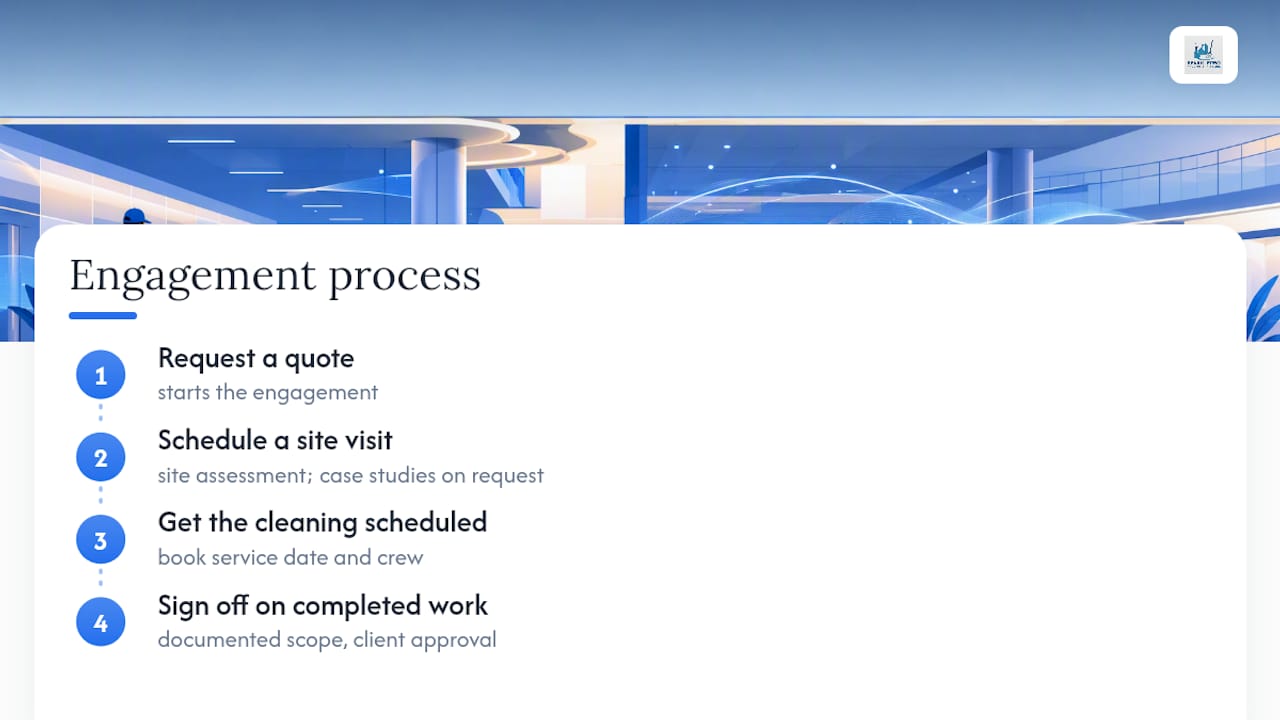
The engagement process follows four steps: request a quote, schedule a site visit, get the cleaning scheduled, and sign off on completed work. That structure exists specifically so facility managers get documented scope, not a verbal promise about coverage and contact time.
Case study details and verified client testimonials specific to electrostatic disinfection projects are available on request during the site visit and quote process.
The Real Question Isn't "Does It Work?" It's "Will Your Crew Do It Right?"
Most of the skepticism around electrostatic disinfection misses the point. The technology isn't overhyped, it's under-explained. Studies confirm the physics works: charged droplets do improve surface coverage on complex objects, and the process doesn't meaningfully degrade disinfectant concentration during application. The failure point almost never sits with the sprayer. It sits with what happens before and after the trigger gets pulled.
Facility managers get sold on the wrap-around effect and skip the pre-cleaning step. Or they buy the fastest disinfectant they can find without checking whether the label even permits electrostatic application. Or worst, they assume less chemical volume means the job takes less time to work, when it usually means the opposite: less margin for the surface to stay wet long enough.
If you keep this in-house, budget real time for operator training and wetness verification, not just equipment cost. If you're deciding whether to hire out, ask any contractor exactly how they document contact time. That one question tells you more about a vendor's competence than any sales pitch about coverage percentages.
— Sales
Get Professional Electrostatic Disinfection Without the Guesswork
Running electrostatic disinfection correctly means managing operator training, disinfectant selection, contact-time verification, and documentation, all while keeping the rest of your facility running. Sparkleprocommercialcleaning handles that entire process as part of its nationwide disinfecting and environmental service line, so property managers and facility directors don't have to build an in-house compliance program from scratch.
Whether you're managing an office tower, a healthcare facility, or a multifamily property, our teams bring trained operators, documented procedures, and the right EPA-registered products for the job. Coverage includes regional service areas such as Delaware, Massachusetts, and Washington, with nationwide reach beyond those markets. If you're comparing in-house training against a contracted service, start by requesting a quote and scheduling a site visit. That visit gives you a documented scope before anyone picks up a sprayer.
Where to Verify Electrostatic Disinfection Claims
- EPA's evaluation of electrostatic sprayers covers device parameters and application guidance.
- CDC's safety precautions page sets the operator and PPE rules.
- OSHA's chemical hazards guidance governs SDS access and worker protection.
- EPA's List N confirms which disinfectants are registered for your target pathogens.
Always confirm the current product label and local regulations before applying any disinfectant electrostatically.
Sources
- Evaluating Electrostatic Sprayers for Disinfectant Application | US EPA
- Safety precautions when using electrostatic sprayers, foggers, misters, or vaporizers for surface disinfection during the COVID-19 pandemic | CDC
- Evaluation of electrostatic sprayers and foggers for the application of disinfectants in the era of SARS-CoV-2 | PMC
- Evaluating electrostatic sprayers and foggers for disinfectant application | PLOS One