
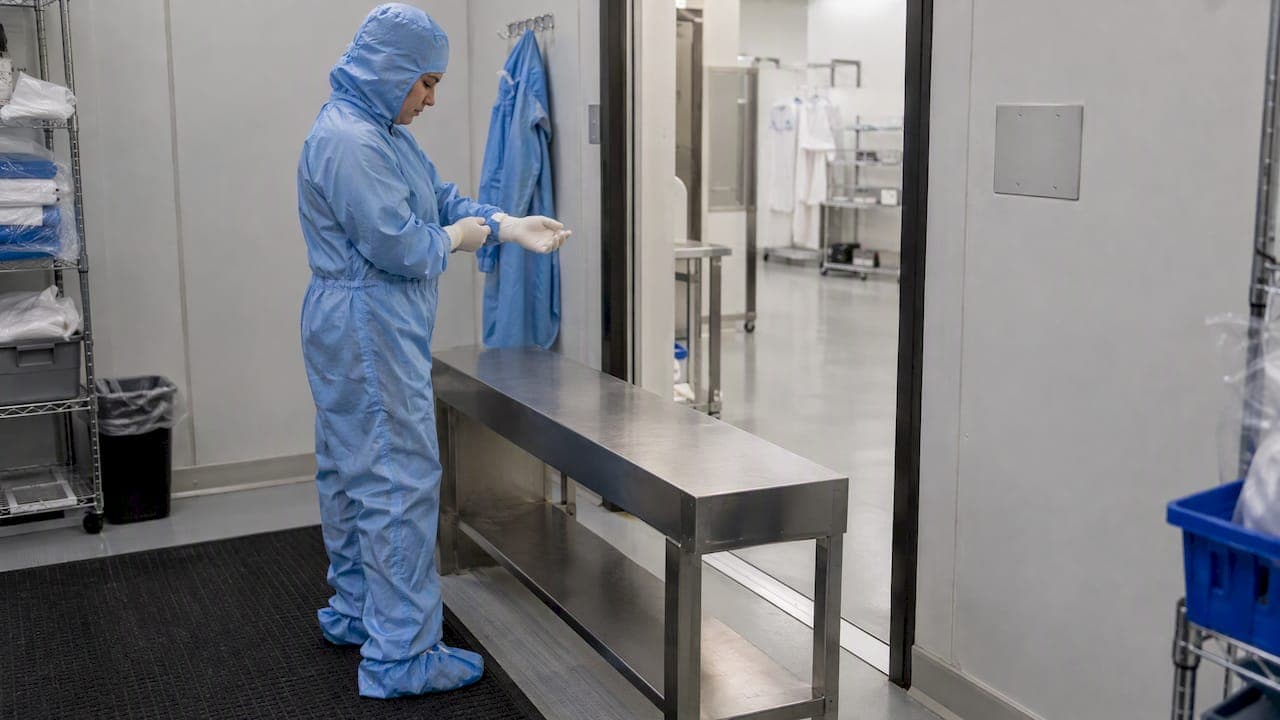
Effective gowning room cleaning is a disciplined program of zoning, a fixed gowning sequence, routine wipedowns on a set cadence, cleanroom-certified supplies, and verified monitoring, all written into one SOP. We reference ISO 14644-5, IEST-RP-CC018, and FDA CGMP guidance throughout. Adopt a documented procedure, start daily wipedowns, and pair them with monitoring so you can prove the room stays under control.
TL;DR:
- Use monitoring results to set the SOP cadence: wipe touchpoints and floors daily, clean anterooms weekly, and intensively clean monthly or after spills.
- Keep gowning order fixed: wash hands, cover hair, don the coverall, cross the bench in booties, then add mask, goggles, and gloves last.
- Use HEPA vacuums reserved for cleanroom use, lint free wipes, and nonfiber mops; standard paper towels are unsuitable, and 70% isopropyl alcohol requires SOP approval.
- FDA CGMP guidance calls for monitoring all production shifts and daily monitoring of ISO 5 zones during operations; record pressure excursions and corrective actions.
- Schedule scrubbing and floor stripping at the end of a shift or week, because particle release requires recovery time before production resumes.
Table of Contents
- How gowning room design and zoning make cleaning easier
- Gowning sequence and personnel hygiene: exact steps and behavior rules
- Cleaning schedule: daily, weekly, monthly, and as-required tasks
- Approved supplies and cleanroom-certified equipment
- Verification: environmental and personnel monitoring that proves cleaning works
- Common pitfalls and practical fixes in gowning room cleaning
- Why specialist crews matter for gowning rooms
- How we can help with your gowning room SOP
- FAQ
- Sources
How gowning room design and zoning make cleaning easier
Layout decides how hard cleaning will be. Gowning room design should be risk-based, weighing cleanroom classification, aseptic needs, and operator volume, and furniture and zoning matter as much as the cleaning procedure itself.
Gowning rooms may be zoned into a "dirty" street side and a cleanroom side. A crossover bench or floor demarcation line can separate the areas. Plan movement and cleaning routes to reduce the risk of transferring contaminants into protected areas.
Recommended layouts typically include these fixtures:
- Lockers and shoe cleaners: keep street items on the dirty side and remove the worst soil before anyone reaches the bench.
- Tacky mats: can be included in the room design. Follow your facility's procedure for maintaining them.
- Enclosed garment cabinets with HEPA blowers: store clean garments off open shelves, so there is less to wipe.
- Ergonomic benches, rails, and a mirror: support donning without leaning on walls and allow self-inspection.
- Air showers and no-touch handwashing: may be included in the room design.
Smooth, non-shedding surfaces can make cleaning easier. High-traffic rooms need more frequent wipedowns, so size your cadence to your volume.
Gowning sequence and personnel hygiene: exact steps and behavior rules
People are the dominant particle source in a cleanroom, so gowning discipline protects your cleaning results. Follow the same order every time:
- Wash hands and remove jewelry, cosmetics, and perfume before entering.
- Put on the hairnet and beard cover, tucking in all hair.
- Step into the coverall without letting it touch the floor.
- Put on booties while seated on the dirty side of the bench, then swing across the line.
- Put on the mask and goggles.
- Put on gloves last and pull the cuffs over the coverall sleeves.
De-gown in reverse: gloves first, then goggles and mask, booties at the bench, coverall, and hair cover. Touch only the inside of each garment, and discard single-use items at the exit.
Replace gloves after any contact with walls, floors, or unclean surfaces. Aseptic SOP guidance says gowns must act as a barrier, be inspected for integrity, and stay clear of surfaces that could compromise them.
Pro Tip: Limit how many people gown at once to what the bench can hold, and use the mirror for a final self-check before every entry.

Follow your facility's procedures for movement between the street-side and clean-side areas.
Cleaning schedule: daily, weekly, monthly, and as-required tasks
IEST-RP-CC018 covers housekeeping frequency, residue coverage, and bucket change rates, and it recommends test procedures to set frequency instead of guessing. Use the cadence below as a starting point, then adjust it with your monitoring data.
Daily
- Wipe benches, lockers, and touchpoints with lint-free wipes.
- HEPA vacuum floors and dispose of waste.
- Change tacky mat sheets.
- Damp-mop with the approved solution, working clean side to dirty side.
Weekly
- Wipe down the full anteroom, including walls, doors, and ceilings within reach.
- Remove and dispose of worn or expired garments.
- Take inventory and replace shedding wipes and tired mop heads.
Monthly and as required
- Perform an intensive wipedown of all surfaces and fixtures.
- Inspect air handling and review pressure differentials with your facilities team.
- Schedule floor scrubbing or stripping and notify operations beforehand.
- Clean immediately after spills, breaches, or excursions.
Heavy particulate work, such as scrubbing or stripping floors, belongs at the end of the shift or week. These tasks release a temporary burst of particles, and finishing last gives the room time to recover before production resumes. For scheduling larger jobs, see our final clean checklist.
Approved supplies and cleanroom-certified equipment
Cleaning tools can add contamination as easily as remove it. Cleanroom janitorial procedures call for cleanroom-certified equipment such as HEPA-filtered vacuums and stainless or foam mops, plus lint-free wipes. Standard paper towels are unsuitable, and cleaning staff must follow the same gowning rules as operators.
- Wipes and mops: lint-free wipes, PVA foam or other nonfiber mop heads.
- Vacuums: HEPA-filtered units kept for cleanroom use only.
- Storage: closed, cleanroom-grade cabinets for garments and tools.
- Agents: 70% isopropyl alcohol where your SOP permits it, and DI water mixes for floors per procedure. Use IPA only as permitted by your SOP and follow the applicable product and facility safety instructions.
- Buckets: change solution on the schedule your SOP sets, and retire any mop or wipe that sheds fibers or particles.
Cleaning agents need proof, too. FDA observations show deficiencies arise when agents lack sporicidal activity or when firms fail to evaluate effectiveness, so validate what you use in prep rooms and anterooms.
Verification: environmental and personnel monitoring that proves cleaning works
Cleaning only counts when you can show it worked. FDA CGMP guidance describes monitoring programs that cover all production shifts, with daily monitoring of ISO 5 zones during operations.
- Routine sampling: viable and nonviable sampling at justified locations, with documented rationale for sites and limits.
- Personnel monitoring: glove and critical gown sites checked before disinfection. Under the aseptic SOP guidance, gowns are monitored at the end of processing before tear-down, and gloves are wiped with sterile 70% IPA afterward.
- Pressure differentials: FDA guidance stresses monitoring them and keeping records and corrective actions for excursions.
- Operations control: ISO 14644-5:2025 requires an operations control programme covering personnel management, entry and exit, cleaning, maintenance, monitoring, and gowning training.
Treat the data as feedback. If monitoring results change, review the cleaning procedure and gowning practices, then assess the effect of any SOP changes through monitoring. Records are what turn a clean room into an auditable one, which is why documentation matters. For deeper steps, see our ISO 14644 cleaning guide.
Common pitfalls and practical fixes in gowning room cleaning
Common issues to review include:
- Cleaning from dirty to clean, which drags soil back to protected surfaces.
- Using non-certified tools such as paper towels or household mops.
- Cleaning while people are gowning or production is running.
- Letting waste pile up or sit in open containers; secure handling steps like this facility checklist help.
- Skipping documentation, so nobody can show what was done or when.
The fixes are practical. Clean in one direction, use certified tools only, and push disruptive tasks to the end of operations. Formalize the SOP, train every cleaner on gowning, and run white-glove checks on benches and rails to catch missed spots.
Pro Tip: Clean from the clean side toward the dirty side. Unidirectional cleaning keeps you from recontaminating critical surfaces you already finished.
For broader facility routines, this best practices guide is a useful companion.
Why specialist crews matter for gowning rooms
Our view: an in-house team can run daily wipedowns well, but validation-grade work is different. Specialist crews bring trained staff, validated procedures, cleanroom-certified equipment, and records that stand up in an audit. That gap matters most in complex aseptic operations, during validation projects, and for annual deep cleans, when a missed step can cost a batch or a requalification.
We offer commercial cleaning services. Contact us to discuss your site and scope. A cleaning provider may be one option for supporting your facility's SOP.
— Sales
How we can help with your gowning room SOP
We provide nationwide commercial cleaning, including environmental and disinfecting services, post-construction cleaning, and specialized facility work for healthcare and cleanroom settings. Our process has four steps:
- A quote based on your space and scope.
- A site visit to review zoning, traffic, and surfaces.
- Scheduled cleaning on the cadence your SOP sets.
- Your approval of the finished work.
Ask for a quote at Sparkle Pro Commercial Cleaning and we will discuss your gowning room cleaning needs.
FAQ
What is a clean room in a pharmacy?
A pharmacy clean room is a controlled space where air quality, surfaces, and personnel behavior are managed to keep sterile preparations free of contamination. Entry runs through a gowning area, and cleaning and monitoring are documented. See our USP cleaning guide for details.
How do you gown for a clean room?
Wash your hands and remove jewelry and cosmetics, then don hair cover, coverall, booties, mask and goggles, and gloves last. Follow one fixed order and touch garments only on the inside. Reverse the order when leaving.
Why does cleaning direction matter in a gowning room?
Cleaning from the clean side toward the dirty side keeps you from moving contaminants back onto surfaces you have already cleaned. It also matches the one-way flow people use to enter, so the room stays consistent.
How often should a gowning room be cleaned?
Set the cleaning cadence for your gowning room in the facility's SOP. IEST-RP-CC018 recommends test procedures to establish the appropriate frequency.
Sources
- Standard Aseptic Practices for Cleanrooms and Biological Safety Cabinets for Production Operations
- IEST-RP-CC018: Cleanroom Housekeeping: Operating and Monitoring Procedures