
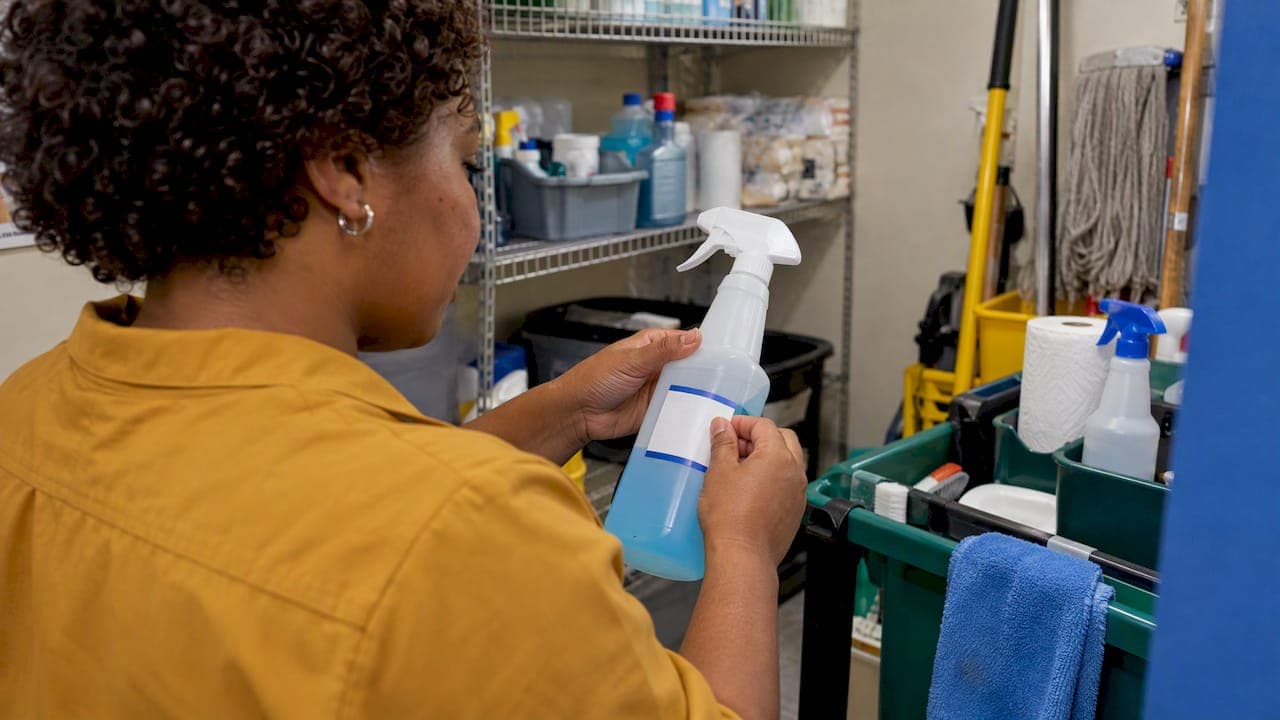
If you employ cleaners, or hire a company that does, OSHA's Hazard Communication Standard (HazCom, 29 CFR 1910.1200) applies to every product on the cart. In practice that means four things: a written program, a chemical inventory, a safety data sheet (SDS) for each product that every crew member can reach during every shift, and training in a language they understand. This guide walks through each requirement, the 2024 update and its extended deadlines, and the mistakes property managers and contractors make most often.
TL;DR
- HazCom requires a written program, a hazardous chemical inventory, current SDSs, proper container labels and worker training. Cleaning products are covered when they meet the hazard criteria.
- SDSs must be accessible during each work shift. A binder in a locked office does not count.
- The 2024 HazCom update has staggered compliance dates, and OSHA pushed the first ones back in January 2026. Check which products and which dates apply to you.
- "Green" is a marketing term, not an OSHA exemption. Eco-friendly products still need an SDS, an inventory entry and training.
- Fewer hazardous products on site means less paperwork, less PPE and less training. Choose the least hazardous product that does the job.
Table of Contents
- Why HazCom matters more for cleaners than for most trades
- Who is responsible: the building owner, the manager or the contractor?
- The five core requirements
- Do you have to train on every product name?
- The 2024 update and the extended deadlines
- Green products are not exempt
- Shrink the paperwork by choosing less hazardous products
- Never mix cleaners
- A practical checklist for the first 30 days
- Our perspective: what we see on the ground
- Working with a cleaning contractor on HazCom
- FAQ
- Sources
Why HazCom matters more for cleaners than for most trades
OSHA describes the standard's purpose as making sure the hazards of chemicals are classified and that this information reaches both employers and employees, as stated in the text of 1910.1200. Cleaners are the end of that chain. They pour concentrates, dilute them, spray them and sometimes combine them, often alone and often after hours.
The health effects are not abstract. OSHA's guidance on protecting workers who use cleaning chemicals notes that some cleaning products irritate the skin, that corrosive ones can cause severe burns if splashed on skin or in eyes, and that mists, vapors and gases can affect the lungs. NIOSH's worker-facing sheet on cleaning chemicals and your health lists coughing, wheezing, headaches, skin rashes, burns and asthma among the possible effects.
OSHA applied the standard to janitorial work specifically. Its interpretation letter on the janitorial service industry explains that the standard extended to all industries where employees are exposed to hazardous chemicals in 1987, giving exposed workers a right to know what they handle.

Who is responsible: the building owner, the manager or the contractor?
The cleaning contractor is the employer of its crew, so the contractor owns the written program, the training and the SDS access for its own people. But the obligations do not stop at the contract line.
There are two practical points for property managers and general contractors:
- Crews move between sites. OSHA's hospital housekeeping guidance stresses that the hazard communication program is a management system, not a folder of papers. For a crew that rotates through several buildings or works overnight, the program has to say how SDSs and the chemical inventory stay reachable at each location.
- Your own chemicals can reach their workers. If your maintenance staff stores products in a janitorial closet that a vendor's crew uses, or a vendor's chemicals sit in your building, both employers should know what is there. Ask for the vendor's inventory and SDSs before the first shift, and share yours.
When you hire a cleaning company, a short vendor review catches most problems. Ask to see the written program, a current inventory, evidence of training and the SDS access plan for your site. A contractor that cannot produce these within a day or two is telling you something.
The five core requirements
1. A written hazard communication program
The program describes how your company handles labels, SDSs and training. OSHA's housekeeping guidance lists the documentation as a written program, a hazardous chemical inventory and up-to-date SDSs for all chemicals in use. It should name who maintains the inventory, how new products get approved, how containers are labeled, and how non-routine tasks are handled.
For a cleaning company, "non-routine" is often the interesting part: a post-construction cleanout using solvent-based adhesive removers, a biohazard or disinfecting job, or a one-off floor strip. The program should say what happens before those products arrive.
2. A chemical inventory
The inventory is a list of the hazardous products your crews use. Build it from the shelf, not from the purchase order. Walk the closets, the vans and the carts, and record the product name and manufacturer for each.
This list drives everything else: the SDS binder, the training content and the PPE choices. It is also where you can shrink your workload, which we come back to below.
3. Safety data sheets that people can reach
OSHA's cleaning chemicals publication is clear that SDSs must be readily accessible to workers during each work shift. Keeping them in a locked office that nobody can enter during an overnight shift is non-compliant.
What works in practice:
- A binder or tablet on each crew vehicle or in each site's janitorial closet, matching the inventory.
- An electronic SDS library that crew leads can open on a phone, with a printed backup for when there is no signal in a basement or mechanical room.
- A habit of checking the SDS list whenever a purchasing change swaps a product.
If you want a closer look at how to audit this, our post on OSHA cleaning compliance and the SDS audit walks through it.
4. Labels on every container
Shipped containers come with manufacturer labels that carry a product identifier, signal word, hazard statements, pictograms and precautionary statements. The trouble starts with secondary containers: the spray bottle filled from a gallon jug.
OSHA's HazCom questions and answers explain the label elements. For workplace labels on secondary containers, an employer may use its own system, but the information has to give employees the same understanding. OSHA's interpretation on labeling secondary containers addresses pre-printed bottles and makes the point that the employer is the one who must show workers understand the hazards. Buying neat-looking bottles does not close that gap, training does.
Two-part products need extra care. In OSHA's letter on dual components, each tube of a Part A and Part B system counts as a separate container and needs its own label, even though the two are meant to be mixed at application. If they are distinct chemicals, each needs its own SDS.
5. Training that people actually understand
Employees must be trained when first assigned to a job and whenever a new chemical hazard is introduced into their work area. Per OSHA's guidance, the training has to be in a language and vocabulary the workers understand, and it has to leave room for questions. Content includes how to detect a release (by odor or appearance, for example), the physical and health hazards, how to protect yourself (PPE and emergency procedures), and how to read labels and SDSs.
Crews in commercial cleaning are often multilingual. A slide deck in English read aloud to a Spanish-speaking or Haitian Creole-speaking crew does not meet the language requirement. Train in the language your people use, and ask them to show you how they would read a label.
Do you have to train on every product name?
No. This is one of the most common misunderstandings. OSHA's janitorial interpretation letter explains that training can be organized around categories of hazards, such as flammability, skin irritation or carcinogenicity. Once a worker has been trained on handling a hazard category, you do not need to retrain them each time a new product with the same kind of hazard arrives.
The chemical-specific information still has to be there: the label and SDS for the new product must be available. So the sequence for a product swap is short:
- Get the SDS and add the product to the inventory.
- Check whether its hazards fall into categories your crew has already been trained on.
- If it introduces a new kind of hazard, train on that before anyone uses it.
- Update labels on any secondary containers.
The 2024 update and the extended deadlines
OSHA finalized an update to HazCom on May 20, 2024, aligning it with Revision 7 of the Globally Harmonized System. OSHA's final rule summary says the rule updates criteria for several health and physical hazard classes and revises provisions for labeling small containers and relabeling chemicals released for shipment. It took effect July 19, 2024, and during the transition employers may follow either the 2012 version or the 2024 version.
The dates have since moved. In a January 2026 Federal Register notice, OSHA extended the compliance dates by four months. The first date, for evaluating substances, moved from January 19, 2026 to May 19, 2026, which has already passed. The later dates for mixtures and for updating workplace labels, hazard programs and training move back by the same four months. Read paragraph (j) of the standard for the current dates before you plan a rollout.
What this means for a cleaning operation:
- Expect new labels and SDSs to arrive in your supply chain first. Manufacturers do the classification. You will see revised SDSs for the products on your inventory, and some will carry changed hazard classifications.
- Reconcile your binder. When a revised SDS arrives, replace the old one and note any new hazard category.
- Plan the training refresh around the final deadline, not around each individual update. A single refresh that covers new label elements and your updated program is more efficient.
- Update the written program so it refers to the labels and SDSs your workers now see.
Green products are not exempt
Many managers assume that a product marketed as green or eco-friendly sits outside HazCom. It does not. The OSHA-NIOSH infosheet on cleaning chemical safety makes the point that such a label is not a regulatory safety designation, and employers still have to assess hazards and manage the product like any other chemical. The same SDS, inventory and training duties apply.
That said, many greener products have lower fumes and a milder hazard profile, which can make the program lighter. If you manage a LEED-targeted property or want to cut volatile organic compounds, our guide on swapping four cleaners to lower VOCs is a good starting point. Just check the SDS rather than the front label.
Shrink the paperwork by choosing less hazardous products
The most effective way to simplify hazard communication is to use fewer hazardous products. The OSHA-NIOSH guidance recommends choosing the least hazardous chemical that does the job and avoiding disinfectants or sanitizers where a simple cleaner is enough. Disinfectants kill or inactivate microorganisms and are important for infection control, as the infosheet text puts it, but they belong where infection control needs them, such as restrooms, food areas and healthcare settings, not on every desk.
Every product you take off the inventory is one less SDS, one less training topic and one less PPE decision. A quarterly review of the shelf usually finds duplicates, near-empty containers from discontinued products and "just in case" items nobody has used.
Never mix cleaners
OSHA's guidance on cleaning chemicals warns against mixing products, bleach and ammonia in particular, because the combination releases dangerous gases that can cause severe lung damage or death. Put it in your program as a rule, post it in the closet, and make sure your training covers it. Do not rely on common sense: crews under time pressure improvise, and a stronger-looking mix feels like a shortcut.
A practical checklist for the first 30 days
| Week | Action | Evidence to keep |
|---|---|---|
| 1 | Walk every closet, cart and vehicle and list every product | Chemical inventory |
| 1 | Remove unlabeled, expired or duplicate products | Disposal record |
| 2 | Match an SDS to every inventory item; set up shift-time access | SDS library and access plan |
| 2 | Check secondary containers for workplace labels | Label standard in program |
| 3 | Train crews by hazard category in their working language | Sign-in sheets, Q&A notes |
| 4 | Review the written program, including site-to-site moves and non-routine tasks | Dated, signed program |
For the property manager, the same table works as a vendor audit. Ask the contractor for the right-hand column.
Our perspective: what we see on the ground
We clean office buildings, retail centers, multifamily properties, industrial spaces and healthcare facilities, and we handle post-construction cleanouts, janitorial work, disinfecting and environmental services. Because those jobs call for different products, we treat chemical selection as a site decision, not a company-wide habit.
Our view is that hazard communication goes wrong in the handoffs: a new product arrives and nobody updates the binder, a crew is reassigned to a different site and the SDS location changes, or a bottle is refilled and the label is not. A program that names who is responsible for each handoff holds up better than a thick binder.
We also think managers should ask vendors for their documentation up front. A cleaning partner that is licensed, insured and open about its quoting and site visit process should be just as open about its chemicals. On healthcare, cleanroom and LEED properties especially, the product list is part of the scope, and it should be agreed in writing.
— Sales
Working with a cleaning contractor on HazCom
If you are sourcing a vendor for an office, retail, industrial or healthcare property, include hazard communication in the request for proposal. Ask for the written program, the inventory for your site, how SDSs are accessible during night shifts, and how often training is refreshed.
Sparkleprocommercialcleaning provides janitorial services, post-construction cleaning, tenant turn and move-out cleans, deep cleans, disinfecting, environmental services, day porter and facility services, and eco-friendly options, with local crews across the United States. Our process starts with a quote and a site visit, so we can agree the scope and the products for your building before work begins. To start, request a quote on our site, or see our New Jersey page if your property is there.
For more safety reading, see our guides to construction cleaning safety requirements and industrial cleaning safety.
FAQ
Are cleaning products hazardous chemicals under HazCom?
They are when they meet the standard's hazard criteria, which many disinfectants, degreasers, strippers and concentrated detergents do. If a product is hazardous, it needs a label, an SDS, an inventory entry and worker training. Read the SDS rather than guessing from the product name.
Where must SDSs be kept for a cleaning crew?
They must be readily accessible to workers during each work shift. A binder in a locked office that crews cannot reach at night does not meet that requirement. Keep a set on the vehicle or in the site closet, or use an electronic library the crew can open on a phone.
Do we have to retrain cleaners every time we switch products?
Not always. OSHA says training can cover categories of hazards, so a product with a hazard type the crew already knows does not require a full retrain. You still need the SDS and label available, and you must train when a new kind of hazard enters the work area.
Are green or eco-friendly cleaners exempt from OSHA rules?
No. A green label is not an OSHA safety designation. These products still need SDSs, inventory listing and training, and the employer must assess their hazards like any other chemical.
Does the 2024 update change what I have to do today?
The updated standard is being phased in, and OSHA extended its compliance dates by four months in January 2026. During the transition you may follow either the 2012 or the 2024 version. Expect updated labels and SDSs from manufacturers, and plan one training refresh around the final dates in paragraph (j).
Sources
- 29 CFR 1910.1200, Hazard Communication (OSHA)
- Protecting Workers Who Use Cleaning Chemicals (OSHA)
- Protect Yourself: Cleaning Chemicals and Your Health (NIOSH)
- HazCom Standard as it applies to the janitorial service industry (OSHA)
- eTool: Hospitals, Housekeeping, Hazardous Chemicals (OSHA)
- Hazard Communication Questions and Answers (OSHA)
- Labeling of Secondary Containers (OSHA)
- Separate SDSs and labels for dual components (OSHA)
- Final Rule Modifying the HCS to Maintain Alignment with the GHS (OSHA)
- Hazard Communication Standard, Federal Register, January 15, 2026
- OSHA-NIOSH Infosheet on cleaning chemicals (NIOSH)
- OSHA-NIOSH Infosheet, full text (CDC Stacks)