
If you've ever signed a janitorial contract expecting spotless carpets and gleaming floors, only to discover those tasks weren't included, you've already experienced the real cost of confusing the difference between janitorial and cleaning services. These two terms get used interchangeably every day, but they describe fundamentally different scopes of work, different schedules, and different levels of expertise. For property managers and facility directors, that confusion translates directly into budget gaps, vendor disputes, and facilities that never quite reach the standard you're paying for.
Table of Contents
- Key takeaways
- The difference between janitorial and cleaning services
- What commercial cleaning services actually involve
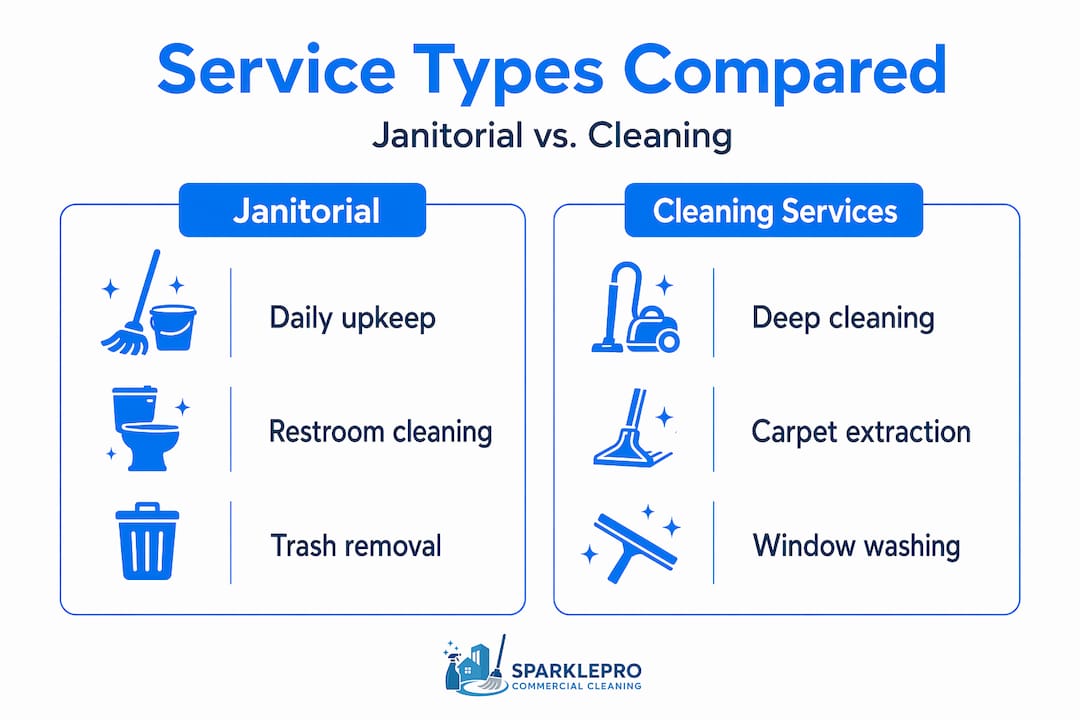
- Janitorial vs. cleaning services: a side-by-side comparison
- How to deploy both services effectively
- My take on what most facility managers get wrong
- How Sparkleprocommercialcleaning can help
- FAQ
Key takeaways
| Point | Details |
|---|---|
| Janitorial is routine upkeep | Janitorial services cover daily or frequent tasks like trash removal, restroom sanitation, and floor sweeping. |
| Cleaning services go deeper | Commercial cleaning handles periodic, specialized work like carpet extraction, floor stripping, and window washing. |
| Contracts must define scope clearly | Misaligned expectations between service types lead to overpayment or gaps in facility cleanliness. |
| Both services work best together | A dual-layer approach pairs daily janitorial maintenance with scheduled deep cleaning for optimal results. |
| Frequency drives the difference | Janitorial runs on daily or weekly cycles; commercial cleaning is scheduled quarterly, seasonally, or after events. |
The difference between janitorial and cleaning services
The simplest way to frame this: janitorial services keep your facility clean on a daily basis. Commercial cleaning services restore it to a higher standard on a periodic basis. Both matter. Neither replaces the other.
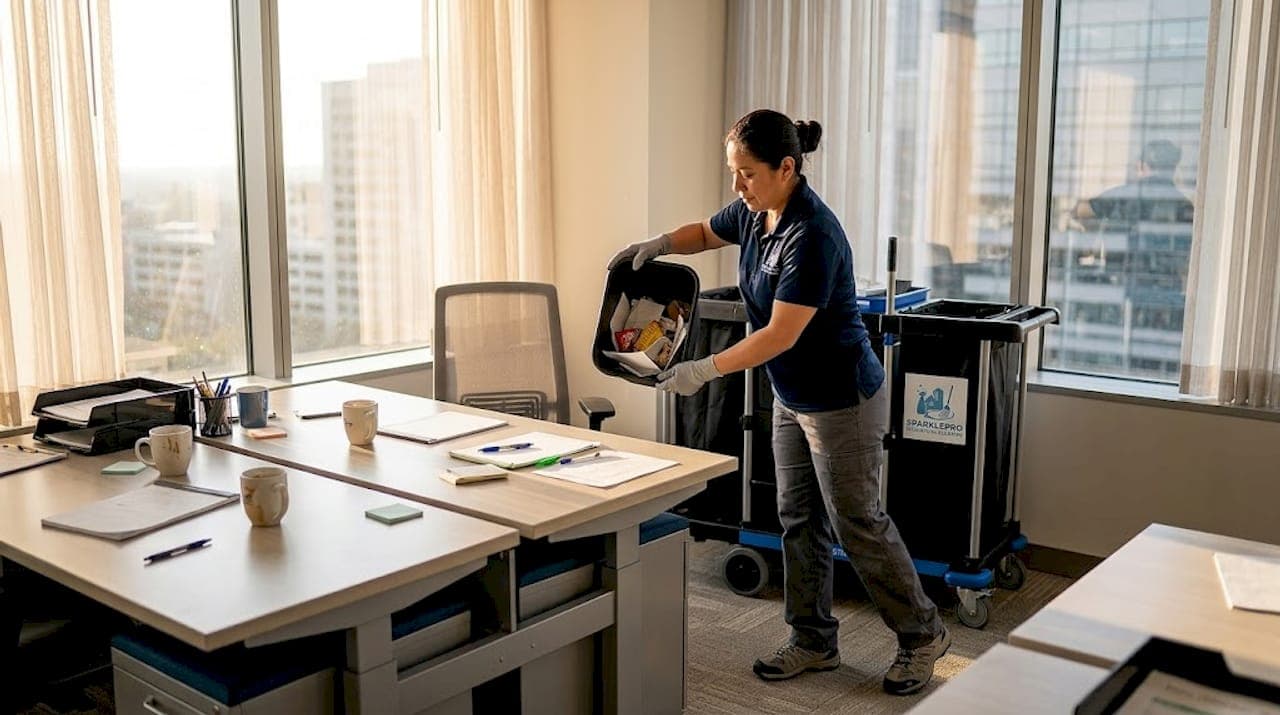
Janitorial services are routine, checklist-driven tasks focused on day-to-day maintenance. Think restroom sanitation, trash disposal, vacuuming, mopping, and wiping down surfaces. These tasks run on a tight schedule because they need to. A restroom that isn't serviced daily in a busy office building becomes a problem fast.
What janitorial services are not is a catch-all for everything cleaning-related. The scope is intentionally limited to repeatable, baseline tasks that keep a facility functional and presentable. When you hire a janitorial company, you're hiring for consistency and frequency, not for deep restoration work.
What janitorial work actually covers
Most commercial janitorial contracts include the following:
- Trash and recycling removal from all areas
- Restroom cleaning, sanitizing, and restocking supplies
- Vacuuming carpeted areas and sweeping hard floors
- Mopping tile, vinyl, or concrete floors
- Wiping down common surfaces like desks, counters, and door handles
- Spot-cleaning glass on interior doors and partitions
- Breakroom and kitchen surface cleaning
These tasks are performed daily or several times per week, and they're typically completed during off-hours to avoid disrupting your tenants or employees. The goal is baseline hygiene, not deep restoration.
Janitorial services are the right fit for office buildings, retail centers, healthcare facilities, schools, and any commercial space that sees regular foot traffic. They're also the backbone of any long-term facility maintenance program.
Pro Tip: When reviewing a janitorial proposal, ask for the actual task checklist and frequency schedule. A reputable provider will have a documented scope of work, not just a verbal description of "daily cleaning."
What commercial cleaning services actually involve
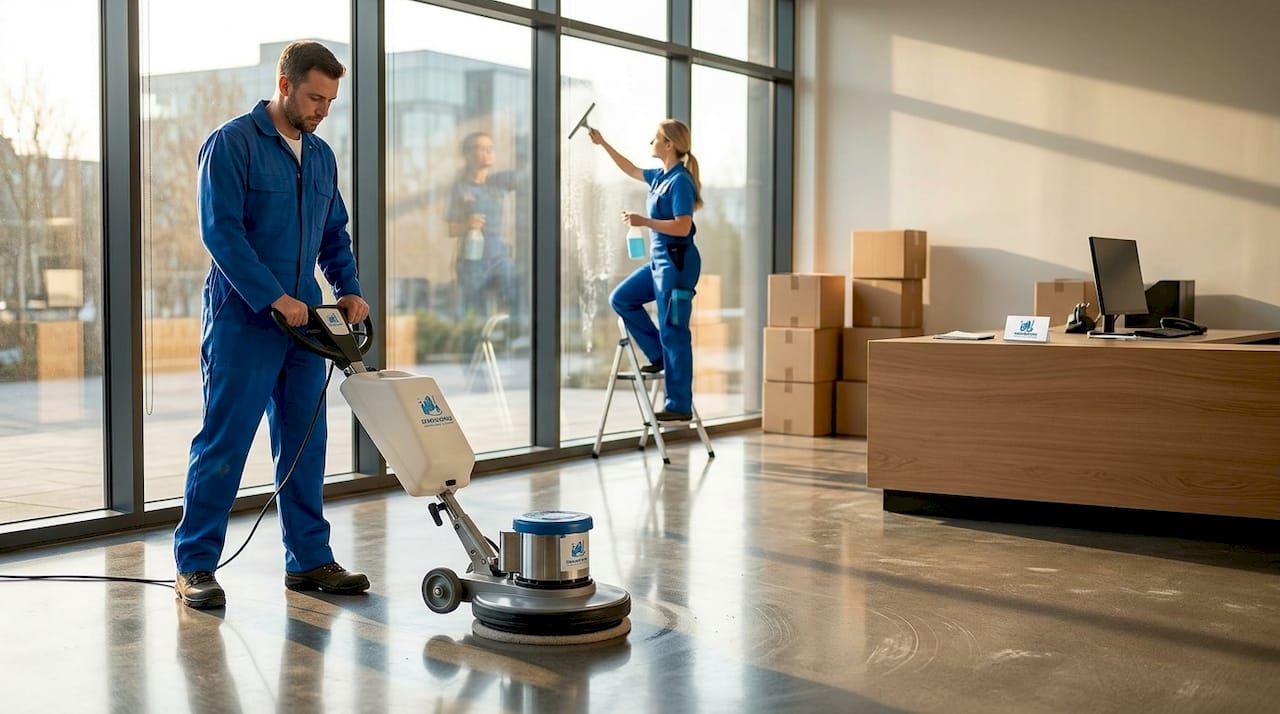
Commercial cleaning services are a different category entirely. These services involve periodic deep cleaning requiring specialty tools and are scheduled seasonally, quarterly, or after specific events like post-construction or tenant move-outs.
The tasks involved go well beyond what a standard janitorial crew handles. They require different equipment, different chemicals, and in many cases, different training and certifications. Here's what typically falls under commercial cleaning:
- Carpet shampooing and hot-water extraction
- Floor stripping, refinishing, and waxing
- High-pressure power washing of exterior surfaces
- Window washing, including exterior glass at height
- HVAC vent and duct cleaning
- Disinfection and sanitization treatments for healthcare or food service environments
- Post-construction debris removal and final cleaning
Floor stripping, carpet extraction, and window cleaning at height require separate scopes, expertise, and safety measures that janitorial staff simply aren't equipped to handle. This is not a criticism of janitorial teams. It's a structural reality of how these services are trained, staffed, and priced.
Pro Tip: Schedule your deep cleaning cycles around your facility's usage patterns. A high-traffic retail space may need quarterly carpet extraction, while a low-traffic office might only require it twice a year. Matching frequency to actual wear is how you control costs without sacrificing standards.
The scheduling model for commercial cleaning also works differently. Rather than a weekly recurring contract, you're typically booking these services on a project basis or as part of a semi-annual maintenance agreement. Effective cleaning programs balance daily maintenance and periodic deep cleans, tailored to facility size and usage patterns. That balance is what separates a well-maintained property from one that looks fine on Monday and deteriorating by Friday.
Pricing reflects this specialization. Specialized tasks like floor refinishing can range from $0.20 to $0.60 per square foot, depending on building type and complexity. Janitorial contracts, by contrast, are typically priced on frequency and fixed scope, making them more predictable on a monthly basis.
Janitorial vs. cleaning services: a side-by-side comparison
Here's where the distinction becomes most useful for your decision-making. The table below breaks down the core differences across the dimensions that matter most when you're evaluating vendors or building a facility maintenance budget.
| Feature | Janitorial services | Commercial cleaning services |
|---|---|---|
| Frequency | Daily or several times per week | Quarterly, seasonal, or event-driven |
| Primary tasks | Trash, restrooms, floors, surfaces | Carpet extraction, floor stripping, window washing |
| Equipment used | Standard mops, vacuums, carts | Industrial extractors, floor machines, pressure washers |
| Staff training | General cleaning procedures | Specialized certifications and safety protocols |
| Scheduling model | Recurring contract | Project-based or periodic agreement |
| Pricing model | Fixed scope, frequency-based | Square footage and complexity-based |
| Goal | Maintain baseline cleanliness | Restore surfaces to higher standard |
The operational distinction matters beyond the task list. Janitorial staff typically work outside business hours to minimize disruption, while custodial or in-house maintenance staff may be present during operating hours for immediate response needs. Commercial cleaning crews, on the other hand, often work on a project timeline that may require temporary access to specific areas.
It's also worth understanding the difference between janitorial and custodial services, since these terms create their own confusion. Custodial services typically refer to in-house staff who handle a broader range of facility oversight, including minor repairs, building security checks, and supply management, in addition to cleaning. Janitorial services are almost always contracted out and focused purely on cleaning tasks.
Facility managers who misunderstand these differences often overpay or experience insufficient cleaning in key areas due to misaligned expectations. The most common version of this: a property manager assumes their janitorial contract includes annual carpet cleaning, then discovers it doesn't when the carpets start looking worn.
How to deploy both services effectively
The most well-maintained commercial properties don't choose between janitorial and cleaning services. They use both in a coordinated strategy. A two-layer cleaning schedule reduces disruption and prevents buildup, with janitorial handling the baseline and commercial cleaning resetting surfaces on a scheduled cycle.
Here's how to structure that approach:
- Define your baseline scope. Start by documenting every space in your facility, its foot traffic level, and the daily tasks required to keep it functional. This becomes your janitorial scope of work.
- Identify restoration needs. Walk your facility quarterly and note surfaces that require more than routine maintenance. Carpets, hard floors, restroom grout, and exterior glass are the usual candidates.
- Build a deep cleaning calendar. Schedule commercial cleaning tasks around low-occupancy periods. Post-holiday weeks, summer slowdowns, or planned tenant transitions are ideal windows.
- Separate the contracts. Don't bundle janitorial and deep cleaning into a single contract unless the vendor explicitly staffs and prices them separately. Bundling often means one service subsidizes the other, and quality drops.
- Review and adjust annually. Facility usage changes. A space that needed quarterly carpet cleaning two years ago may now need it twice a year due to increased traffic.
Service scopes must explicitly define specialty tasks such as floor stripping versus mopping to make sure the right staff and equipment are deployed. Vague contract language is where most facility maintenance problems start.
For budgeting, treat janitorial as a fixed operating expense and commercial cleaning as a capital maintenance cost. This framing makes it easier to plan, approve, and track both line items without one cannibalizing the other. A useful starting point for pricing and scheduling guidance can help you benchmark what's reasonable for your market and facility type.
Pro Tip: Ask any vendor you're evaluating to walk you through how they handle a task that falls outside their standard scope, such as a spill that requires carpet extraction. Their answer tells you everything about how they manage scope creep and whether they'll be a reliable long-term partner.
My take on what most facility managers get wrong
I've worked with property managers across office buildings, retail centers, and healthcare facilities, and the same mistake shows up repeatedly. They treat cleaning as a single category, negotiate one contract, and then spend months frustrated that the facility never looks as clean as it should.
The real issue isn't the vendor. It's the expectation gap created by unclear scope. I've seen a mid-size office building cut its cleaning budget by nearly 20% after separating its janitorial and deep cleaning contracts, because the facility director finally understood what each service was actually delivering. The janitorial vendor got a tighter, more realistic scope. The deep cleaning was scheduled properly twice a year. Total spend went down. Cleanliness went up.
What I find most overlooked is the role of standardized cleaning protocols in maintaining consistency. Vendors who operate with documented SOPs and zone-based or team cleaning methods produce measurably better results than those who rely on individual judgment. When you're evaluating vendors, ask to see their operational methodology, not just their equipment list.
My honest recommendation: before you sign any cleaning contract, write down exactly what "clean" looks like in your facility. Define it by space, by surface, and by frequency. Then match that definition to the right service type. You'll spend less time managing complaints and more time running your property.
— Sales
How Sparkleprocommercialcleaning can help
Sparkleprocommercialcleaning provides both routine janitorial services and specialized commercial cleaning for facilities across the United States. Whether you manage a single office building or a portfolio of commercial properties, the team builds customized cleaning plans that separate daily maintenance from periodic deep cleaning, so you get the right service at the right frequency without overpaying for bundled scopes that don't deliver.
For property managers in the Northeast, the Massachusetts cleaning services page outlines available programs for office, retail, and healthcare environments. If you're managing properties on the West Coast, Washington commercial cleaning covers both recurring janitorial contracts and project-based deep cleaning. Mid-Atlantic clients can explore New Jersey cleaning solutions tailored to high-traffic commercial spaces.
Getting started is straightforward. Sparkleprocommercialcleaning walks every new client through a four-step process: a detailed quote, an on-site assessment, a scheduled cleaning program, and a final approval walkthrough. You define the standard. They deliver it consistently. Reach out today to get a proposal built around your facility's actual needs, not a generic package.
FAQ
What is the main difference between janitorial and cleaning services?
Janitorial services cover routine, daily tasks like trash removal, restroom cleaning, and floor mopping, while commercial cleaning services handle periodic, specialized work such as carpet extraction, floor stripping, and window washing that requires dedicated equipment and training.
Can a janitorial company also provide deep cleaning?
Some janitorial companies offer both services, but they should be scoped and priced separately. Deep cleaning tasks require specialized equipment and trained staff that differ from standard janitorial crews, so confirm the vendor staffs each service type distinctly.
How often should commercial deep cleaning be scheduled?
Most commercial facilities benefit from deep cleaning two to four times per year, though high-traffic spaces like healthcare facilities or retail centers may require more frequent cycles. Match your schedule to actual usage patterns and surface wear.
What is the difference between janitorial and custodial services?
Janitorial services are contracted cleaning focused on routine tasks, while custodial services typically refer to in-house staff who handle a broader facility oversight role, including minor maintenance, supply management, and cleaning during business hours.
How should I budget for both janitorial and cleaning services?
Treat janitorial as a fixed monthly operating expense based on scope and frequency, and budget commercial cleaning as a periodic maintenance cost tied to square footage and task complexity. Keeping them as separate line items prevents one from absorbing the other's budget.