
Key cleaning terminology explained is the foundational knowledge that separates professionals who deliver compliant, effective service from those who cause surface damage or regulatory violations. Terms like "sanitizing," "disinfecting," and "sterilizing" are not interchangeable, yet they are routinely confused in contracts, product selection, and daily operations. Regulatory bodies including the EPA, OSHA, and NSF each define these terms with legal precision. Sparkleprocommercialcleaning applies this vocabulary every day across office buildings, healthcare facilities, and post-construction cleanouts to deliver results that hold up to inspection.
What are the fundamental cleaning terms every professional should know?
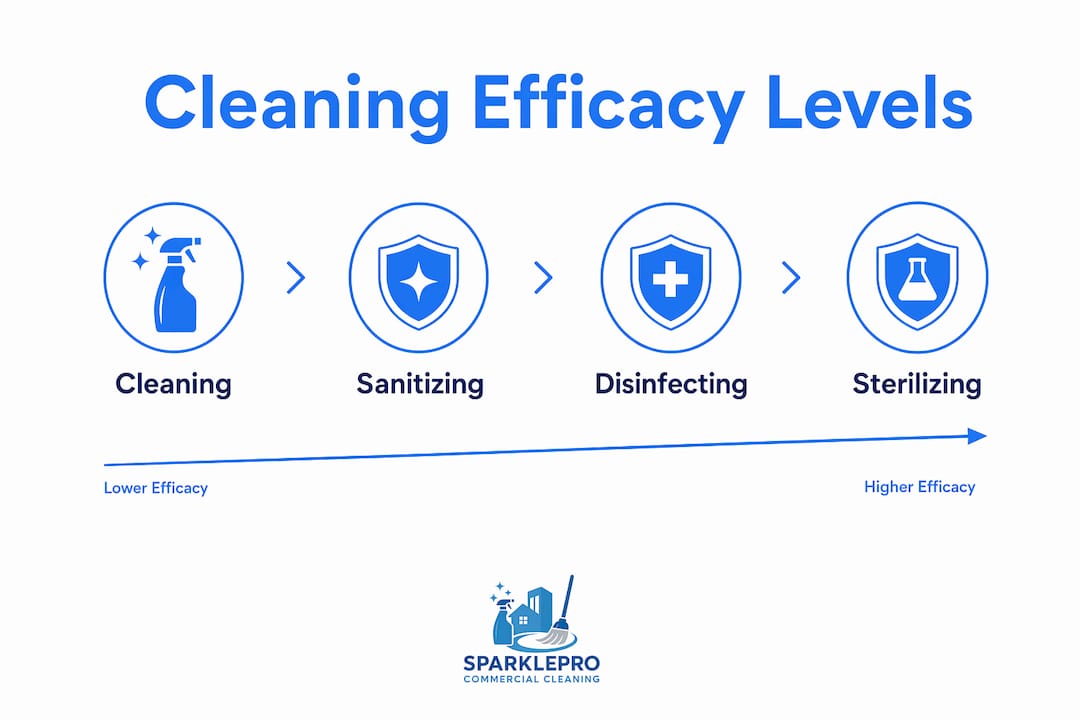
Cleaning, sanitizing, disinfecting, and sterilizing represent four distinct levels of microbial control, each with a specific purpose and application. Treating them as synonyms is one of the most common and costly errors in facilities management.
Cleaning is the physical removal of visible soil, dust, debris, and organic matter from a surface. It does not kill pathogens. It does, however, prepare surfaces so that subsequent chemical treatments can actually work. Cleaning must precede disinfecting for antimicrobial agents to contact microbes directly, because organic soil creates a barrier that blocks chemical action.
Sanitizing reduces bacteria on a surface to levels considered safe by public health standards. Sanitizers reduce bacteria by 99.9% within 30 seconds under standard test conditions. That standard applies to food-contact surfaces in commercial kitchens and cafeterias, where full disinfection is not always required or appropriate.
Disinfecting goes further. EPA-registered disinfectants destroy a broader spectrum of pathogens, including viruses and fungi, not just bacteria. The EPA requires manufacturers to list specific organisms, concentration levels, and contact times on every label. That label is the legal authority on what the product can and cannot do.
Sterilizing is the highest level of antimicrobial action. Sterilants destroy all microbial life, including bacterial endospores, which are the most resistant form of microbial life. Sterilization is reserved for surgical instruments and medical devices, not general facility cleaning.
| Term | Efficacy level | Primary purpose | Typical application |
|---|---|---|---|
| Cleaning | Removes visible soil | Physical soil removal | All surfaces, always first |
| Sanitizing | 99.9% bacterial reduction | Reduce bacteria to safe levels | Food-contact surfaces, restrooms |
| Disinfecting | Destroys pathogens per EPA | Kill viruses, bacteria, fungi | Healthcare, high-touch surfaces |
| Sterilizing | Destroys all microbial life | Eliminate endospores | Medical instruments only |
Pro Tip: Never skip the cleaning step before disinfecting. Organic soil physically blocks disinfectants from reaching the surface. A visibly dirty surface that has been "disinfected" is not actually disinfected.
How do cleaning chemicals and their properties affect terminology?
Chemical knowledge is not optional for facility professionals. The wrong product on the wrong surface causes damage that no amount of re-cleaning will fix.
Surfactants and how they work
Surfactants are the active agents in most cleaning products. They reduce water's surface tension so that water can spread across and penetrate soiled surfaces instead of beading up. The four types of surfactants are anionic, cationic, nonionic, and amphoteric. Each type serves a different role. Anionic surfactants are strong soil removers used in general-purpose cleaners. Cationic surfactants carry a positive charge and are often the active ingredient in disinfectants. Nonionic surfactants are mild and work well on delicate surfaces. Amphoteric surfactants shift behavior based on pH, making them versatile for multi-surface products.
The pH scale and surface compatibility
The pH scale runs from 0 to 14. Acidic cleaners fall below 7, neutral cleaners sit at 7, and alkaline cleaners exceed 7. Acidic cleaners can permanently etch marble and limestone, because carbonate-based stones react chemically with acids. That damage is irreversible. Alkaline cleaners cut through grease and protein-based soils effectively, making them the standard choice for kitchen and industrial environments. Neutral pH cleaners are the safe default for finished floors, painted surfaces, and most general-purpose applications.
| Chemical category | pH range | Best use | Surface risk |
|---|---|---|---|
| Acidic cleaners | Below 7 | Mineral deposits, rust, scale | Damages marble, limestone |
| Neutral cleaners | 6.5–7.5 | General surfaces, floors | Low risk on most materials |
| Alkaline cleaners | Above 7 | Grease, protein soils | Can damage aluminum, some finishes |
| Disinfectants | Varies | Pathogen elimination | Check label for surface compatibility |
Pro Tip: Always check the pH of a cleaner against the surface manufacturer's guidelines before applying. For glass railings and polished stone, surface-specific protection protocols prevent micro-scratching and chemical etching that are invisible until the damage is done.
Surface science knowledge is as critical as chemical knowledge. Professionals who understand both avoid the most expensive mistakes in the field.
What terminology describes cleaning methods, tools, and soil types?
Cleaning methods, equipment terms, and soil classifications form the practical vocabulary of daily operations. Knowing these terms precisely determines whether the right technique gets applied to the right problem.
Common cleaning methods defined
- Wiping is the manual application of a cloth or pad to a surface to remove loose soil or apply a chemical. It is low intensity and appropriate for routine maintenance on finished surfaces.
- Scrubbing applies mechanical force to break down bonded soils. It uses brushes, pads, or machine-driven heads to dislodge material that wiping cannot remove.
- Extraction forces water or cleaning solution into a surface, then vacuums it back out along with dissolved soils. Carpet and upholstery cleaning rely on extraction as the primary method.
- Pressure washing delivers high-velocity water to remove heavy deposits from hard exterior surfaces. It is standard for post-construction cleanouts, parking structures, and loading docks.
Proper terminology helps assign the correct technique for each surface and soil type. Applying scrubbing to a polished stone floor, for example, causes the same irreversible micro-scratching as using an abrasive pad rated too coarsely for the material.
Abrasives and grit ratings
Abrasive tools are rated by grit, a measure of particle coarseness. Lower grit numbers mean coarser abrasion. Higher grit numbers mean finer, gentler abrasion. Using abrasives on delicate surfaces like polished stone or glass causes micro-scratching that dulls finishes permanently. The Mohs hardness scale helps professionals match abrasive intensity to surface hardness. A surface with a Mohs rating of 3, like marble, cannot tolerate abrasives designed for concrete rated at 7.
Soil types every professional must recognize
Understanding soil types determines which chemical and method combination to use.
- Organic soils include food residue, body oils, and biological matter. Alkaline cleaners break them down most effectively.
- Inorganic soils include mineral deposits, rust, and scale. Acidic cleaners dissolve them without mechanical force.
- Biological soils include blood, urine, and other bodily fluids. These require disinfection after cleaning, not just soil removal.
- Hydrophobic soils are oil-based and repel water. Surfactant-rich cleaners are required to emulsify and lift them.
Dwell time and kill claims
Dwell time is the length of time a disinfectant must remain wet on a surface to achieve its stated efficacy. Disinfectants require specific contact time mandated by EPA labels. Wiping a surface dry before dwell time is complete renders the disinfection invalid. A kill claim is the EPA-reviewed statement on a disinfectant label that specifies which organisms the product destroys, at what concentration, and in what contact time. Marketing sheets are not authoritative on kill claims. The label is the only legally binding source.
Pro Tip: Set a timer when applying disinfectants. Most professionals wipe surfaces dry too soon, which voids the kill claim entirely and leaves pathogens alive on the surface.
How does terminology knowledge improve service quality and communication?
Mastering cleaning vocabulary directly improves outcomes at every level of a facility operation. The benefits are concrete and measurable.
Precise terminology prevents product selection errors. A technician who understands the difference between a sanitizer and a disinfectant will not apply a food-service sanitizer to a restroom that requires EPA-registered disinfection. That distinction matters in healthcare settings, where regulatory compliance is audited and failures carry financial penalties.
Clear communication between cleaning teams and facility managers reduces cross-contamination risk. When a supervisor specifies "disinfect all high-touch surfaces using a 30-second dwell time," every technician on the team understands the exact requirement. Vague instructions like "clean the bathrooms" leave room for interpretation that produces inconsistent results.
Terminology knowledge also protects surfaces. Professionals who understand pH compatibility, abrasive grit ratings, and surface hardness avoid the damage that generates costly repair claims. A disinfecting cleaning guide built on accurate terminology gives teams a repeatable framework that protects both the client's property and the service provider's reputation.
Contract evaluation is another area where vocabulary matters. Facility managers who understand cleaning lingo can read service agreements critically and identify whether a vendor is promising sanitization when the space requires disinfection. That distinction can determine whether a building passes a health inspection.
- Terminology fluency reduces product misapplication and surface damage claims.
- Precise language in work orders produces consistent results across large teams.
- Regulatory compliance depends on correctly applying EPA-defined terms in practice.
- Client trust increases when facility managers and service providers speak the same language.
Training programs that include terminology as a core module produce teams that perform better and require less supervision. Continuous education on updated EPA registrations and new chemical formulations keeps professionals current as products evolve.
Key Takeaways
Mastering cleaning terminology is the single most effective way to prevent surface damage, regulatory violations, and miscommunication in any facility operation.
| Point | Details |
|---|---|
| Four distinct levels of control | Cleaning, sanitizing, disinfecting, and sterilizing are not interchangeable; each has a specific purpose and application. |
| Clean before you disinfect | Organic soil blocks antimicrobial agents; skipping the cleaning step makes disinfection ineffective. |
| pH determines surface safety | Acidic cleaners permanently damage carbonate stones; always match pH to surface type before applying. |
| Dwell time is non-negotiable | Wiping a disinfectant dry before its label-mandated contact time voids the kill claim entirely. |
| Terminology protects your operation | Precise vocabulary in work orders, contracts, and training reduces damage claims and compliance failures. |
Why I think most cleaning teams underestimate the cost of getting terminology wrong
Working alongside facility management teams across a range of commercial environments, I have seen the same pattern repeat itself. A technician applies a sanitizer to a restroom that requires a registered disinfectant. A floor gets scrubbed with an abrasive pad that is two grit ratings too coarse for the finish. A disinfectant gets wiped off after 10 seconds instead of the 30 the label requires. None of these errors look dramatic in the moment. The cost shows up later, in failed inspections, damaged surfaces, and client complaints that are hard to trace back to their source.
The most persistent confusion I encounter is the sanitizing versus disinfecting distinction. Facility managers often use the terms interchangeably in contracts, which means vendors can technically fulfill a "disinfecting" requirement with a product that only sanitizes. That gap is where compliance failures hide. Reading the EPA label and understanding the kill claim is not a technical exercise reserved for chemists. It is a basic professional skill that every person in this industry should have.
My advice is direct. Build terminology training into onboarding, not as a one-time orientation item, but as a recurring module that gets updated when EPA registrations change. Pair it with hands-on surface science so technicians understand why pH and abrasive grit matter, not just what the rules are. Teams that understand the "why" behind the vocabulary make better decisions in the field without needing supervision for every edge case. That is the difference between a cleaning operation that runs on compliance and one that runs on competence.
— Sales
Sparkleprocommercialcleaning: where terminology meets execution
Knowing the terms is one thing. Applying them correctly across a healthcare facility, a post-construction cleanout, or a multi-tenant office building is another challenge entirely.
Sparkleprocommercialcleaning trains every technician on the full spectrum of cleaning vocabulary, from EPA kill claims and dwell times to pH compatibility and soil classification. That knowledge base drives every commercial cleaning service in Delaware and across the nationwide portfolio. Facility managers and property owners get a team that speaks the same language they do, applies the right product to the right surface, and delivers results that hold up to regulatory review. Contact Sparkleprocommercialcleaning to schedule a site visit and see the difference that terminology-grounded service delivers.
FAQ
What is the difference between sanitizing and disinfecting?
Sanitizing reduces bacteria by 99.9% to levels considered safe for public health, while disinfecting destroys a broader range of pathogens including viruses and fungi per EPA registration requirements. The two terms are not interchangeable and require different products.
Why does cleaning have to happen before disinfecting?
Organic soil on a surface physically blocks disinfectants from reaching microbes. Cleaning removes that barrier first, which allows the antimicrobial agent to make direct contact and achieve its stated kill claim.
What does dwell time mean on a disinfectant label?
Dwell time is the minimum period a disinfectant must remain wet on a surface to destroy the organisms listed on its EPA-approved label. Wiping the surface dry before that time is up voids the product's efficacy claim.
Can acidic cleaners damage all stone surfaces?
Acidic cleaners permanently etch carbonate-based stones like marble and limestone by reacting chemically with the stone's mineral composition. That damage cannot be reversed, which is why pH compatibility must be checked before any cleaner is applied to natural stone.
Where can I find authoritative information on a disinfectant's kill claims?
The product label is the only legally binding source for kill claims, specifying organisms, concentration, and required contact time. Marketing sheets and product brochures are not authoritative and should not be used to verify efficacy.