
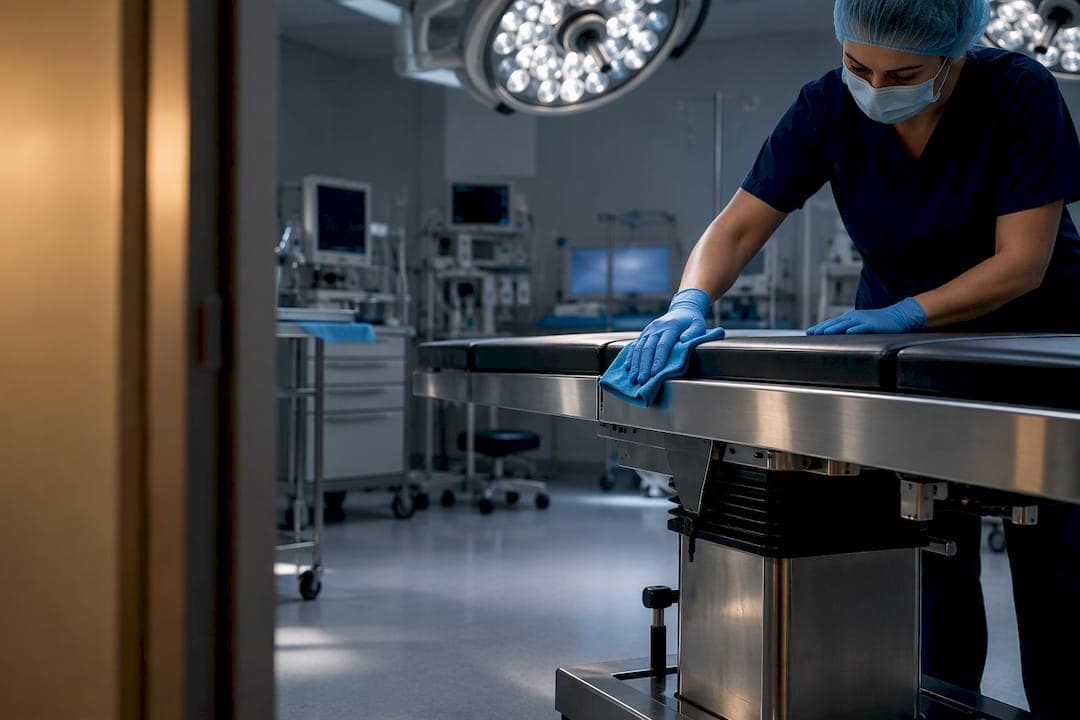
Operating room cleaning follows a staged schedule, before the first case, between cases, and terminal cleaning at the end of the day, and every step relies on the same two-step method: physically remove soil with detergent and friction, then disinfect with an EPA-registered hospital disinfectant held wet for the labeled dwell time. Responsibility is shared between perioperative staff and environmental services, and both groups follow guidance from CDC Appendix B2 and AORN.
TL;DR:
- Proper OR cleaning relies on a two-step process of physically removing soil with detergent and friction, followed by disinfecting with EPA-registered products held at the specified dwell time.
- Cleaning duties are split between perioperative staff handling immediate case cleanup and environmental services performing comprehensive disinfection, with clear handoff points and documented checklists.
- Surface cleaning order should be high-to-low and clean-to-dirty to prevent cross-contamination, with staged stages scheduled before the first case, between cases, and at the end of the day.
- Disinfectants vary in chemistry and contact time, with faster-acting options favored for quick turnovers, but compliance with label dwell times remains mandatory to prevent audit issues.
- Objective monitoring tools like fluorescent markers, ATP testing, and culture sampling, combined with thorough staff training and detailed SOPs, enhance infection control performance and recordkeeping.
Table of Contents
- Cleaning intervals and assigned responsibilities
- Step-by-step cleaning and disinfection SOP for OR turnover
- Disinfectant selection and managing dwell time against turnover pressure
- Equipment, instrument surfaces, and noncritical device handling
- Monitoring, audit, and performance verification methods
- Training, SOPs, documentation, and regulatory recordkeeping
- Waste segregation, sharps, and PPE best practices for OR cleaning
- What the evidence says about closing the gap on infections
- Reconciling dwell time and turnover on the ground
- When outsourcing OR terminal cleaning makes sense
- Sources
- FAQ
Cleaning intervals and assigned responsibilities
Three intervals structure the OR cleaning day, and each carries distinct duties and sign-offs. Before the first case, the room gets a damp-dust check of horizontal surfaces, equipment, and lights even when the space looks clean, since dust settles overnight. Between cases, the focus narrows to visibly soiled areas and high-touch points so the room turns over fast enough to support the surgical schedule. Terminal cleaning happens at the close of the day's schedule and covers the entire room, floor to ceiling vents where applicable, regardless of how many cases used the space.
CDC Appendix B2 lists the specific surfaces and equipment tied to each interval, giving facilities a standardized reference instead of relying on informal habits. Many hospitals run a hybrid model: circulating nurses or surgical techs handle immediate case-related cleanup (removing linens, decontaminating the table), while EVS staff complete the broader surface disinfection and floor work. Clear handoff points prevent gaps, particularly around who confirms the room is ready for the next patient.
- Before first case: verify no dust or debris on horizontal surfaces and equipment.
- Between cases: clean and disinfect the table, mobile equipment, and high-touch surfaces the patient or team contacted.
- Terminal cleaning: complete full-room disinfection including floors, walls as needed, and fixed equipment.
Documentation typically includes a signed or initialed checklist at each interval, timestamped for the case log, which becomes the record reviewed during infection control audits or accreditation surveys.
Step-by-step cleaning and disinfection SOP for OR turnover
A written SOP turns guideline language into something staff can actually follow under time pressure. The sequence below reflects the core method described in CDC's cleaning guidance: clean first, then disinfect, and never skip the dwell time to save minutes.
- Remove gross soil first: bag linens and regulated waste, and clear sharps into designated containers before any surface wiping begins.
- Relocate mobile equipment (anesthesia carts, back tables, monitors) away from walls so surfaces behind and beneath them are reachable.
- Don appropriate PPE, gloves at minimum, plus gown and eye protection when splash risk is present.
- Clean surfaces mechanically using friction, not just a wet cloth passed over the surface, since soil removal depends on physical action as much as chemistry.
- Use single-use wipes or freshly laundered cloths, and change them frequently. Never dip a used cloth back into a clean solution, a practice CDC guidance specifically warns against as a source of cross-contamination.
- Apply the disinfectant to already-cleaned surfaces and keep them visibly wet for the full manufacturer-specified dwell time, no wiping it dry early.
- Work high to low: lights and booms first, then vertical surfaces, then horizontal surfaces, then floors last.
- Work clean to dirty within each zone, starting with the areas least likely to be contaminated and finishing at the floor near the door.
- Confirm all high-touch points, doorknobs, light switches, table controls, were included before signing off the checklist.
- Restock supplies and reposition equipment only after surfaces have fully dried per the disinfectant's dwell requirement.
The order matters because working dirty to clean spreads contamination onto surfaces already treated, undoing the cleaning step. Facilities managing tight turnover windows often stage two-step cleaning to overlap: one team member removes soil and waste while another preps disinfectant solutions, shaving minutes without skipping steps. For a deeper look at prioritizing which surfaces get attention first when time is short, see this guide to high-touch surface cleaning.
Pro Tip: Pre-stage a labeled cart with fresh cloths, disinfectant, and PPE outside each OR suite so turnover teams never lose time hunting for supplies mid-clean.
Disinfectant selection and managing dwell time against turnover pressure
OR disinfectants generally fall into a handful of chemistries: quaternary ammonium compounds, accelerated hydrogen peroxide, sodium hypochlorite (bleach) solutions, and phenolics, each with different contact times and material compatibility. The 2008 CDC Guideline for Disinfection and Sterilization, updated since its original release, discusses these classes along with sterilization methods like steam and ethylene oxide, and it repeatedly stresses that cleaning must precede disinfection or sterilization regardless of which chemistry is chosen.
Every product must be EPA-registered for hospital use, and facilities are expected to follow the manufacturer's instructions for use exactly, correct dilution, correct wet-contact time, no substitutions based on convenience.
- Quaternary ammonium products often carry shorter contact times, making them attractive for fast turnover, though material compatibility varies by manufacturer.
- Accelerated hydrogen peroxide products are common for general surface disinfection and are generally well tolerated by OR equipment finishes.
- Bleach-based solutions offer broad-spectrum activity but can be corrosive to certain metals and electronics over repeated use.
- Phenolics are used in some settings but carry surface and material restrictions that vary by product label.
Some disinfectant processes require exposure times of 10 to 30 minutes, a range noted in CDC's cleaning guidance for higher-level processes, which can collide directly with the pace of a full surgical schedule.
When dwell time genuinely cannot fit the turnover window, facilities have real options short of cutting corners: selecting a shorter-contact-time product validated for the pathogens of concern, tightening the pre-cleaning step so disinfectant works on a truly clean surface, or adjusting case scheduling to allow slightly longer gaps for high-risk cases. Ignoring the conflict is the one option that carries real audit exposure. The Joint Commission frequently cites IFU noncompliance during survey, and unresolved dwell-time shortcuts are an easy finding. For more on reconciling label requirements with daily operations, see this breakdown of dwell time rules for facility managers.
Equipment, instrument surfaces, and noncritical device handling
Environmental services and clinical staff operate in different lanes, and confusing them creates both safety and compliance risk. Environmental surface cleaning covers the room itself: floors, walls, furniture, and equipment housings. Instrument reprocessing is a separate discipline, governed by the Spaulding classification of critical, semi-critical, and noncritical devices, and it belongs to central sterile processing or designated clinical staff, not EVS.
- Noncritical items EVS typically handles: OR tables, light handles, monitor housings, IV poles, and floor and wall surfaces.
- Items requiring central processing or clinical reprocessing: surgical instruments, endoscopic equipment, and anything that contacts sterile tissue or the bloodstream.
- Mechanical cleaning modalities such as ultrasonic cleaners and washer-disinfectors handle instrument soil removal and fall entirely outside EVS scope.
CDC guidance notes that mechanical cleaning methods generally outperform manual wiping for complex instruments with lumens or hinges, which is precisely why that work stays with trained reprocessing staff using validated equipment rather than general cleaning crews. Keeping this boundary explicit in written policy prevents an EVS technician from ever being asked to handle a semi-critical device, a scenario that creates both infection risk and liability exposure.
Monitoring, audit, and performance verification methods
Visual inspection alone catches maybe half of what actually needs attention, since a surface can look spotless and still carry a meaningful bioburden. Objective monitoring tools fill that gap, though none is perfect on its own.
- ATP bioluminescence assays give a fast numeric readout but require local validation since thresholds vary by device and surface type.
- Fluorescent gel markers applied before cleaning and checked under UV light afterward offer immediate, visual feedback that staff can act on in real time.
- Culture-based methods give the most direct evidence of microbial contamination but take days to return results, limiting their use for daily coaching.
AHRQ's research materials recommend randomized surface selection rather than always checking the same predictable spots, paired with defined benchmarks so results mean something consistent over time. The strongest programs mix methods: fluorescent markers for daily spot checks and staff coaching, ATP for periodic verification, and occasional culture sampling when investigating a specific concern. Framing monitoring as a coaching tool rather than a punitive one tends to get better buy-in from EVS teams and produces steadier improvement over time.
Pro Tip: Rotate which surfaces get fluorescent-marker checks each week so staff clean consistently across the whole room, not just the spots they expect to be tested.

Training, SOPs, documentation, and regulatory recordkeeping
A cleaning program is only as defensible as its paperwork. Surveyors and infection preventionists want to see that the protocol exists in writing and that staff actually follow it, not just that cleaning happens.
- SOPs should define scope, assigned roles, approved products with contact times, step-by-step procedure, and the monitoring plan tied to it.
- Competency testing belongs on a set cadence, typically at hire and annually thereafter, with signed records kept on file.
- Checklists and logs at each cleaning interval create the paper trail auditors and accreditation surveyors will request.
AORN's guidance frames environmental cleaning as a shared responsibility requiring local, multidisciplinary policy rather than a single department's checklist, which is exactly the model documentation should reflect.
Waste segregation, sharps, and PPE best practices for OR cleaning
Regulated medical waste rules exist for a reason, but overuse of red-bag waste is a common and costly error. Only items saturated with blood or other potentially infectious material qualify as RMW; ordinary packaging and lightly soiled items belong in general waste.
- Segregate RMW from general trash at the point of generation, not during later sorting.
- Sharps containers should be closed and replaced once they reach the manufacturer's fill line, never packed past capacity.
- Standard PPE for OR cleaning includes gloves and eye protection at minimum, with gowns added for tasks with splash risk.
- Respiratory protection becomes necessary only with certain aerosolizing disinfectants or specific outbreak precautions, per product labeling.
CDC guidance notes that a large share of red-bag waste in many facilities is misclassified, an easy and low-cost fix once staff are retrained on the actual criteria.
What the evidence says about closing the gap on infections
A cluster-randomized trial across multiple U.S. hospitals found that adding UV-C disinfection to standard terminal cleaning reduced acquisition of target organisms, MRSA, VRE, and C. difficile, with a relative risk of approximately 0.70 compared to standard cleaning alone, according to a cluster-randomized terminal disinfection trial. That is a meaningful reduction, though UV-C functions as an adjunct to, never a replacement for, manual cleaning and disinfection.
There is no single agreed-upon monitoring method proven to reduce healthcare-associated infections on its own, which is why a mixed approach, visual audits, ATP, fluorescent markers, used together tends to outperform reliance on any one tool. The priority sequence stays constant regardless of which adjuncts a facility adds: clean first, disinfect second, and follow manufacturer instructions for use without exception.

Reconciling dwell time and turnover on the ground
Getting this right day to day means giving staff a fast way to flag conflicts, not just a policy binder. Rapid huddles when a case runs behind schedule, with a documented escalation path, keep decisions consistent instead of improvised. When time is genuinely short, prioritize the predefined high-touch surfaces first and use monitoring data to show leadership what got covered. Any accepted shortcut on contact time should be written down and approved, not quietly absorbed into habit.
— Sales
When outsourcing OR terminal cleaning makes sense
Surge volume, overnight construction turnover, or a short-staffed EVS shift can all strain an in-house cleaning schedule fast. A nationwide commercial cleaning company provides commercial cleaning support, including disinfecting services and environmental services for healthcare facilities, that can supplement your team for late-night terminal cleans or post-construction turnover without disrupting your daily schedule.
Request a quote and site visit through Sparkleprocommercialcleaning to see how outsourced support fits around your existing OR cleaning protocols.
Sources
Build your written policy directly from CDC Appendix B2 for interval-based procedures and the Guideline for Disinfection and Sterilization for chemistry and sterilization detail. Round out your reference library with AHRQ's monitoring resources and AORN's environmental cleaning guidance for practice-level detail those two primary documents do not cover in depth.
This article is general information, not a substitute for advice from a qualified doctor. Consult a qualified healthcare professional about your own circumstances before acting on anything here.
FAQ
What are the guidelines for cleaning an operating room?
The accepted approach uses a staged schedule, before the first case, between cases, and terminal cleaning at day's end, paired with a two-step process: remove soil with detergent and friction, then disinfect with an EPA-registered hospital disinfectant for its full dwell time. CDC Appendix B2 lists the specific surfaces and frequencies expected at each interval.
What are the CDC operating room cleaning guidelines?
CDC's guidance centers on cleaning before disinfecting, using EPA-registered products at labeled concentration and contact time, and following the interval-based surface lists in Appendix B2. The broader Guideline for Disinfection and Sterilization covers disinfectant chemistry and sterilization methods in more depth.
What are the AORN cleaning guidelines?
AORN frames environmental cleaning in the OR as a shared responsibility between perioperative nursing and environmental services, calling for locally developed, multidisciplinary policies rather than a single department owning the task. Its guidance recommends adapting checklists to actual case mix and turnover patterns rather than using a generic template.
Who cleans the operating room after surgery?
Responsibility typically splits between the perioperative team, who handle immediate case-related cleanup like removing linens and decontaminating the table, and environmental services staff, who complete broader surface disinfection and floor work. The exact split varies by facility policy, but both groups follow the same two-step clean-then-disinfect method.
How often should terminal cleaning happen in an OR?
Terminal cleaning happens once per operating room at the end of each day's surgical schedule, covering the full room regardless of how many cases used it that day. Between-case cleaning handles the room's turnover in between, while terminal cleaning is the full reset described in CDC Appendix B2.