
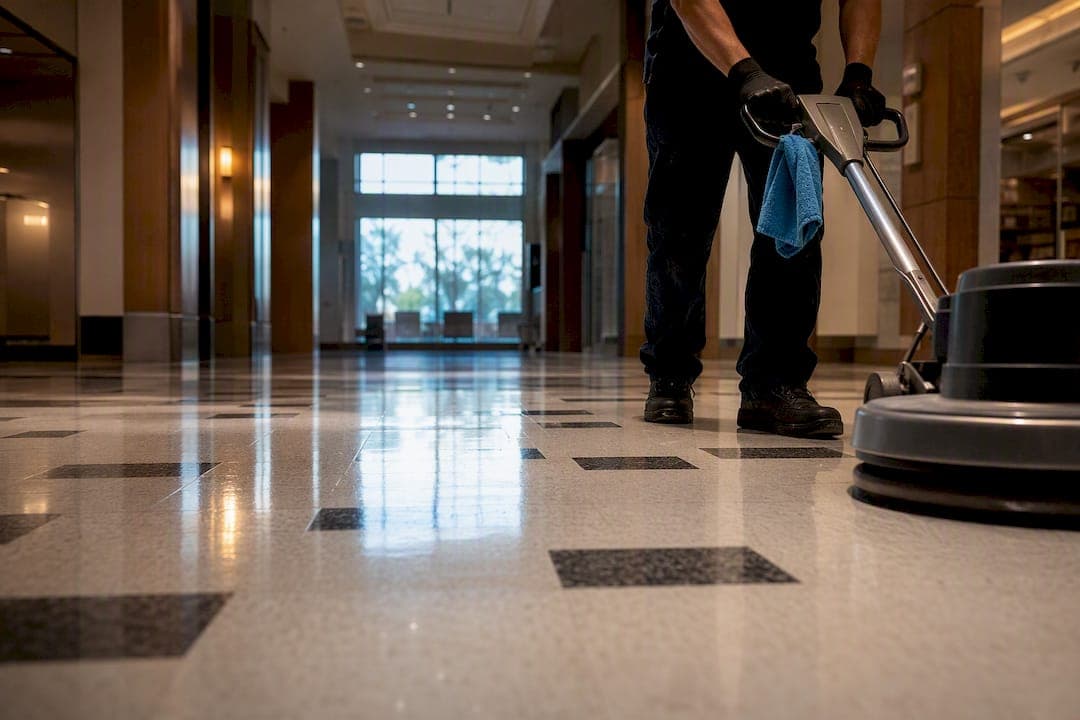
Preserve VCT by protecting the finish, not by stripping your way out of trouble. The proven cadence is daily dust and damp mopping, periodic scrub-and-recoat to renew gloss, and a full strip-and-refinish only when the finish is truly beyond saving. Manufacturer guidance from Armstrong backs this cycle, and a managed program built around it can cut annual strip costs by 15 to 25% in large facilities. Neutral-pH cleaners and correctly matched pads and machine speeds make the whole system work.
TL;DR:
- Proper VCT maintenance relies on daily dust and damp mopping with neutral cleaners, avoiding flooding and using appropriate pads and speeds.
- Entry mats should be large, correctly placed, and cleaned frequently to prevent soil from damaging the finish over time.
- Periodic scrub-and-recoat keeps floors looking new between full strip-and-refinish events, which should be scheduled only when gloss cannot be restored.
- Over-burnishing can thin or remove the finish layer, so it must be limited and replaced with a recoat when gloss diminishes.
- Outsourcing VCT maintenance to professionals can reduce long-term costs by ensuring proper equipment, chemicals, and discipline, especially for large or busy facilities.
Table of Contents
- Entryway Matting and Soil Control
- Daily VCT Floor Maintenance: Dust Mopping, Damp Mopping, and Auto-Scrubbing
- Periodic VCT Maintenance: Scrub-and-Recoat, Burnishing, and Spray Buffing
- How to Strip and Refinish VCT Correctly
- Equipment, Pads, and Chemicals: What to Buy and Why
- Troubleshooting Common VCT Problems
- Safety, Scheduling, and Compliance During Wet Work
- What Belongs in a VCT Maintenance Spec
- Why Most Facilities Get VCT Maintenance Backwards
- Get a VCT Program That Runs Itself
- Sources
- FAQ
Entryway Matting and Soil Control
Grit is the enemy of VCT finish, and most of it walks in through the front door. Studies on soil tracking consistently point to entry mats as the cheapest insurance a facility can buy: they trap the sand, salt, and asphalt particles that act like sandpaper under every rolling cart and shoe.
A few placement rules make the difference between a mat that works and one that is decorative:
- Use a scraper-style mat with a nonabsorbent, textured surface outdoors, and a moisture-absorbing walk-off mat immediately inside.
- Avoid latex or rubber-backed mats on finished VCT; they can trap moisture against the tile and stain or soften the finish over time.
- Size mats for at least 6 to 15 steps of travel (roughly 15 feet) so most soil drops before it reaches the open floor.
- Vacuum mats daily and launder or hose them down weekly; a mat that's saturated with grit stops filtering anything.
A quick test: run a white cloth over the VCT ten feet past your entry mat. If it comes back dirty, your mat setup isn't doing its job.
Daily VCT Floor Maintenance: Dust Mopping, Damp Mopping, and Auto-Scrubbing
Daily care is where most VCT problems get prevented, not fixed. Skipping dry soil removal and going straight to a wet mop just grinds grit into the finish like sandpaper.
- Dust mop or dry vacuum first. Remove loose grit before any liquid touches the floor. This single step does more to prevent premature dulling than any cleaner on the market.
- Damp mop with a neutral cleaner. Dilute a pH 7 to 9 cleaner per the label, following the chemistry guidance most commercial VCT programs follow, and mop in overlapping S-strokes.
- Never flood the floor. Standing water works into seams and can attack the adhesive bond over months of repetition.
- Bring in an auto-scrubber for large open areas like lobbies, corridors, or warehouse floors where mopping alone can't keep pace with foot traffic.
- Recover and rinse properly. Run the scrubber's vacuum recovery on every pass, and rinse the recovery tank between uses so old solution doesn't re-deposit dirt.
Pro Tip: Keep a small logbook at each auto-scrubber station and note the dilution ratio used that day. Crews rotate, memories fade, and dilution drift is the single fastest way to dull a finish nobody meant to damage.
High-dilution neutral cleaners, often in the 1:64 to 1:128 range, clean effectively without leaving the residual film that makes floors look dirty again within hours.
Periodic VCT Maintenance: Scrub-and-Recoat, Burnishing, and Spray Buffing
Full strips are expensive and disruptive, which is exactly why the periodic phase exists. Scrub-and-recoat means lightly abrading the top finish layer, rinsing, and applying one or two fresh coats without removing the whole finish system. It's the workhorse move that keeps floors looking new between restorative strips.
Here's how the three periodic tools stack up:
- Spray buffing restores gloss on lightly soiled floors between deeper services. It's fast but temporary, and it does nothing for embedded soil.
- Burnishing uses a high-speed pad, typically running 1,500 to 2,000 RPM, to melt and re-level the finish surface for a deep shine. High-traffic zones often need this two to three times a week.
- Scrub-and-recoat is the right call once burnishing stops restoring gloss, since that's usually a sign the finish film itself has thinned.
Over-burnishing is a real risk: run a worn pad or too high an RPM too often, and you'll burn straight through a thin finish layer down to bare tile. If a lobby lane looks visibly duller than the surrounding floor from ten feet away, that's your trigger to schedule a recoat rather than reach for the burnisher again.
How to Strip and Refinish VCT Correctly
Restorative strip-and-refinish is the most disruptive, most expensive maintenance event a VCT floor goes through, and it's the one facilities should be actively trying to delay through good daily and periodic care.
- Apply stripper at the correct dilution. Strippers run high-pH, typically 12 to 14, and need real dwell time (usually 10 to 15 minutes) to break down the old finish.
- Machine scrub at low speed, generally at or below 300 RPM, using a black stripping pad to lift the softened finish without gouging tile.
- Wet-vacuum recover the slurry immediately. Letting stripper solution dry on the floor redeposits residue you'll fight later.
- Rinse at least twice with clean water and a neutralizing rinse if your stripper calls for one, then let the floor dry completely before any finish goes down.
- Apply finish in thin coats, roughly 1,000 to 2,000 square feet per gallon per coat, building to 3 to 5 coats for high-traffic areas.
Allow adequate drying time between coats, usually 30 to 45 minutes with good airflow, and don't return furniture or rolling loads until the final coat has fully cured. On brand-new VCT installations, hold off on wet scrubbing or stripping for at least five days to protect the adhesive cure, and keep rolling loads off the floor for the first 72 hours after installation, per Armstrong's installation guidance. Over-coating without ever stripping creates its own problem: layers build up, trap soil, yellow at the edges, and eventually require a much harsher strip to remove than a properly timed one would have.
Equipment, Pads, and Chemicals: What to Buy and Why
Pad color is a starting point, not gospel. White and tan pads suit light daily scrubbing, red pads handle moderate cleaning, blue pads step up to deep scrubbing, and black pads are built for stripping. Always confirm pad specs against the actual manufacturer's rated use rather than color alone, since pad density varies between brands.
Chemistry follows a similarly clear logic:
- Daily and damp-mop cleaners should sit in the pH 7 to 9 neutral range to avoid dulling finish over repeated use.
- Strippers run pH 12 to 14 and should never be used for routine cleaning.
- VCT finishes are acrylic emulsions, and the wrong chemistry, whether too acidic or too caustic, accelerates finish breakdown and shortens the interval between strips.
On equipment, match auto-scrubber deck width to your corridor widths so you're not fighting turns all day, and cap burnisher speed at the manufacturer's recommended RPM ceiling rather than the machine's maximum. A facility running mid-cycle scrub-and-recoat on schedule can trim 15 to 25% off annual strip costs compared to running straight strip cycles alone. Felt glides on furniture legs and non-marking, non-staining casters on carts protect the finish between services at almost no cost.
Troubleshooting Common VCT Problems
Most VCT complaints trace back to one of four predictable patterns, and matching the symptom to the cause keeps you from over-treating a problem that a light fix would solve.
- Yellowing, usually at edges or under mats, typically points to excessive finish build-up or ammonia-based cleaners reacting with the coating; a scrub-and-recoat or strip is often the fix.
- Black heel marks come from rubber sole transfer and usually respond to spot cleaning or a light burnish rather than any restorative step.
- Dull traffic lanes signal worn-through finish in high-use zones; catch this early with a targeted recoat before it spreads.
- Adhesive edge failure, where tile corners lift or curl, often stems from excess moisture or age and may require professional tile replacement rather than a cleaning fix.
These four patterns cover the vast majority of VCT complaints facility teams report, and none of them require guesswork once you know what to look for.
Safety, Scheduling, and Compliance During Wet Work
Any wet maintenance task needs wet-floor signage on both approaches and, ideally, physical cordoning, not just a folding sign near the wall. Stripping and finish application call for real ventilation and, depending on the product, gloves and eye protection during mixing and application. Written cleaning specs should assign signage and rinse-water disposal responsibility explicitly to the contractor. Scheduling strips and recoats during off-hours or in phased sections keeps occupants moving while the work gets done. A closer look at construction-grade safety protocols offers a model worth adapting for routine floor work too.
What Belongs in a VCT Maintenance Spec
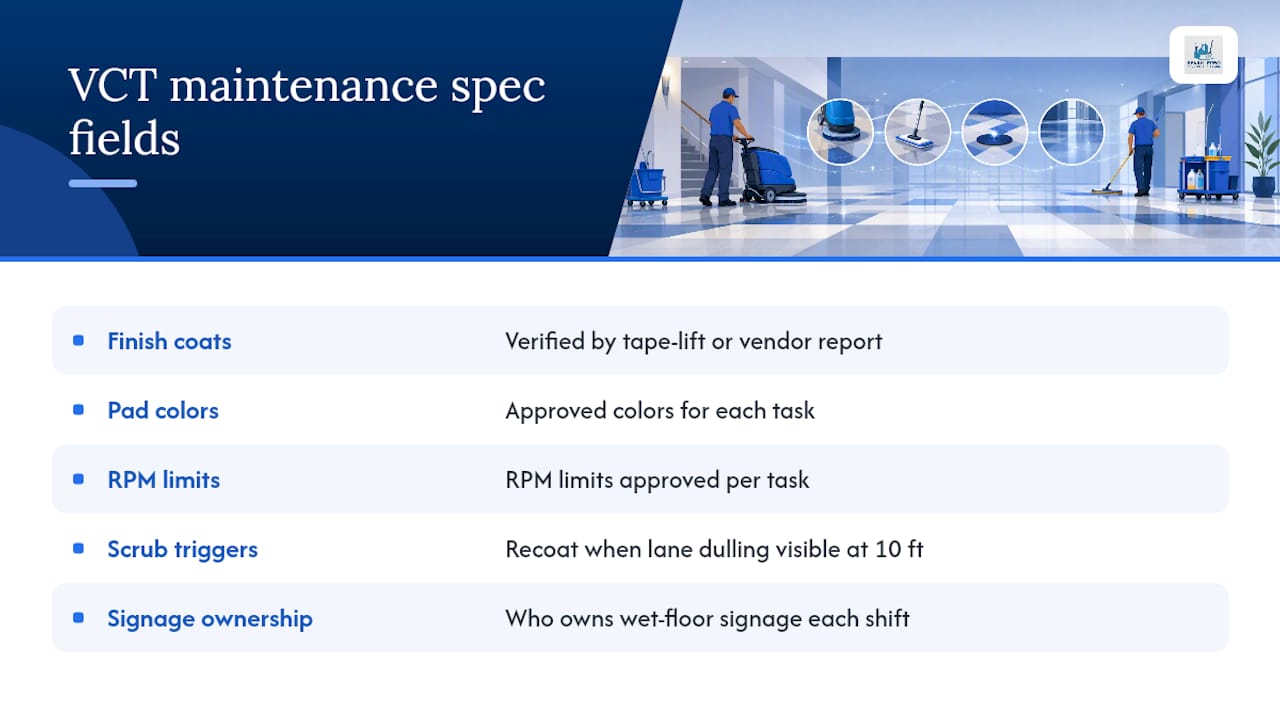
A maintenance addendum worth signing spells out the current finish coat count (verified by a tape-lift test or vendor report), the pad colors and RPM limits approved for each task, and clear scrub-and-recoat triggers such as visible lane dulling at ten feet. It should also name who owns wet-floor signage on any given shift. Programs built around these terms, paired with scrub-and-recoat scheduling, are what drive that 15 to 25% reduction in annual strip costs in larger facilities. SparklePro Commercial Cleaning structures its engagements around a quote, site visit, scheduled cleaning, and customer approval, a sequence that maps directly onto putting these spec items into practice rather than leaving them as good intentions on paper. A structured strip-and-wax program shows what this looks like when it's running well.
Why Most Facilities Get VCT Maintenance Backwards
The conventional advice treats stripping as the main event and daily cleaning as an afterthought. That's backwards. Every dollar spent on dust mopping, correct dilution, and matted entryways is a dollar that doesn't go toward an emergency strip six months early. The facilities that actually keep floors looking good for years aren't the ones with the fanciest burnisher. They're the ones with a supervisor who checks dilution ratios and mat condition weekly, because that's where finish life actually gets won or lost.
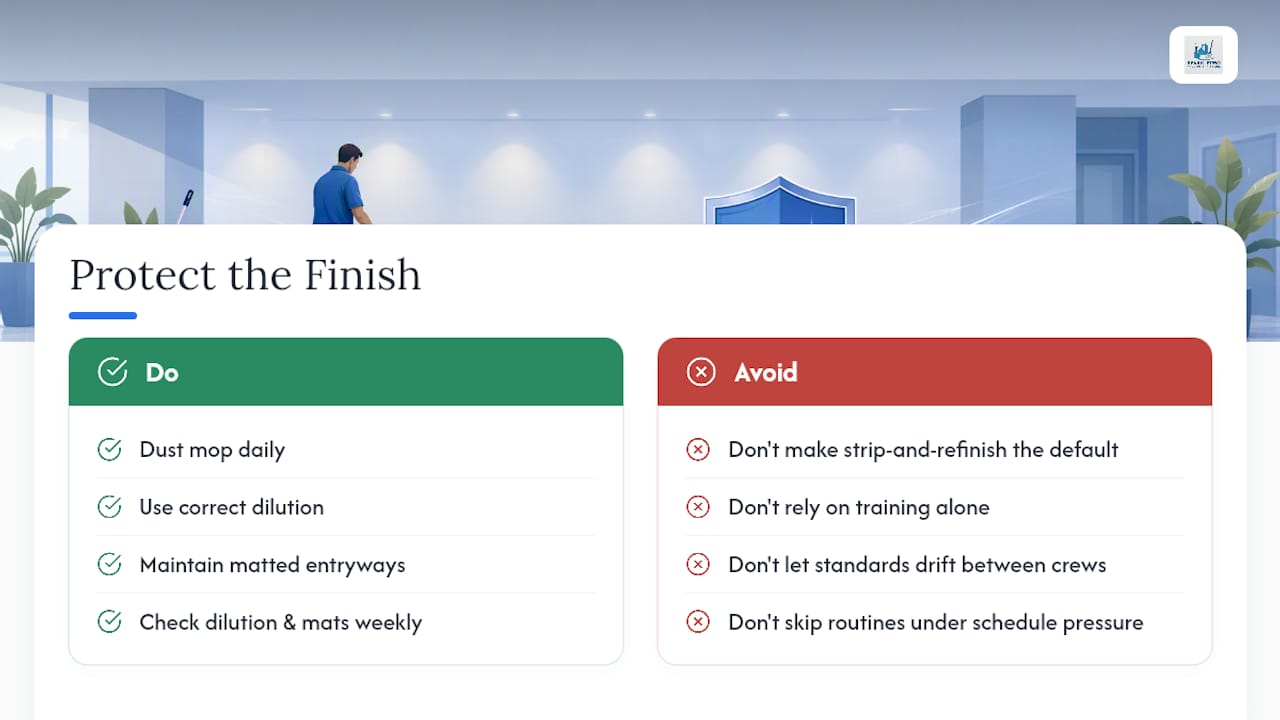
Where most programs fail isn't technique, it's discipline. Crews know how to damp mop correctly; they just don't do it consistently once the schedule gets tight. The fix isn't more training, it's tighter accountability: put coat counts, pad specs, and recoat triggers in writing so the standard doesn't drift when a new crew rotates in.
If you take one thing from this playbook, prioritize protecting the finish over reacting to damage. Strip-and-refinish should be the rare event, not the default plan.
— Sales
Get a VCT Program That Runs Itself
Professional cleaning services can provide the equipment, chemistry, and trained crews to run this entire cadence without buying a burnisher, stocking three pad colors, or training staff on stripper dwell times. That's the real cost most in-house teams underestimate: not the labor hours, but the equipment and chemical handling expertise a proper VCT program demands.

The engagement often works in four steps: request a quote, walk the site with a representative, get on a scheduled cleaning cadence, and sign off once the results meet your standard. It fits best once a facility's square footage or traffic makes in-house scrubber operation and stripping impractical, or when insurance and safety concerns around chemical handling push floor care toward a professional vendor. If your building falls into either camp, a look at the Delaware commercial cleaning page is the fastest way to see what a managed VCT program would cost for your square footage.
Sources
- Armstrong Flooring Vinyl Composition Tile (VCT) Maintenance Instructions
- VCT floor care playbook: strip cycles, finish coats, and burnisher speed
- Complete Commercial VCT Floor Cleaning & Maintenance Guide
FAQ
Do You Need to Seal VCT Flooring?
VCT doesn't require a separate sealer the way natural stone does; the acrylic finish coats applied during refinishing serve that protective role and need periodic renewal instead.
How Often Should You Wax or Recoat VCT Flooring?
There's no fixed calendar interval. Watch for visible dulling in traffic lanes from about ten feet away and schedule a scrub-and-recoat when that appears, which in high-traffic areas often lands every few months.
How Long Does VCT Flooring Last?
VCT tile lifespan depends almost entirely on how well the finish is maintained since a neglected finish leads to premature wear on the tile underneath.
How Do You Maintain VCT Flooring Day to Day?
Daily VCT floor maintenance means dust mopping or vacuuming first to remove abrasive grit, then damp mopping with a neutral pH 7 to 9 cleaner at the correct dilution, and avoiding standing water near seams.
Can I Handle VCT Floor Maintenance In-House, or Should I Hire a Professional?
Small spaces with light traffic can often manage in-house with the right training and equipment, but larger facilities usually save money and reduce risk by working with a managed provider that already owns the equipment and chemical handling expertise.