

A cleaning scope of work is defined as a formal document that specifies every cleaning task, area, frequency, quality standard, and verification method required to maintain a commercial facility. Property managers who skip this document routinely face disputes, unpaid invoices, and service gaps that cost far more to fix than to prevent. The scope of cleaning services functions as the operational blueprint for every janitorial contract, and organizations like ISSA provide objective benchmarks that make these documents enforceable rather than aspirational. A well-constructed cleaning SOW protects your budget, your vendor relationships, and your facility's reputation simultaneously.
What is a cleaning scope of work and why does it matter?
A cleaning scope of work is the critical document that defines what gets cleaned, where, how often, and to what measurable standard. Without it, both the property manager and the cleaning contractor operate on assumptions, and assumptions in facility management always become problems. The industry term used by cleaning professionals and facility directors is "scope of work" or SOW, though you will also hear it called a cleaning specification or service agreement schedule.
The SOW is not a checklist. A cleaning scope is a binding contract element that defines service quality and prevents finger-pointing when standards slip. That distinction matters because a checklist can be ignored without consequence, while a SOW creates legal accountability on both sides of the agreement.

For property managers overseeing office buildings, retail centers, or healthcare facilities, the SOW also determines what is not included. Exterior window washing above the first floor, grounds maintenance, and specialized equipment cleaning are common exclusions that must appear in writing. Leaving these out invites scope creep, which is when a contractor performs extra work and then bills for it, or refuses to perform work both parties assumed was covered.
What are the key components of a cleaning scope of work?
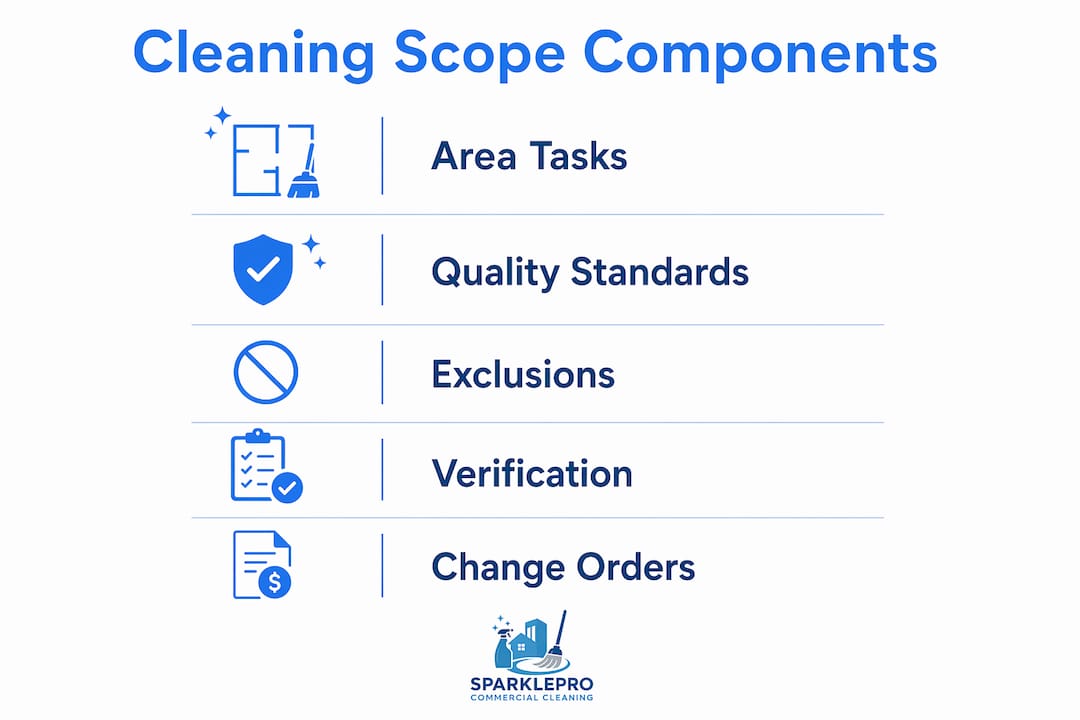
A complete cleaning SOW contains six core elements. Each one closes a specific gap that vague contracts leave open.
1. Area-by-area task listings
Every space in the facility gets its own task list. Detailed space inventories break the building into offices, conference rooms, restrooms, lobbies, break rooms, and storage areas, with explicit tasks assigned to each. A restroom task list reads differently from an office task list. Restrooms require disinfecting fixtures, replenishing supplies, and scrubbing tile grout. Offices require dusting surfaces, emptying trash, and vacuuming carpets. Combining them into a generic "clean the building" instruction is how disputes start.
2. Task frequency schedules
Frequency must use unambiguous language. Scheduling with specific terms like "Monday through Friday" rather than "weekdays" eliminates confusion when holidays or building closures occur. Frequencies typically fall into these categories:
- Daily: trash removal, restroom disinfection, floor mopping in high-traffic areas
- Weekly: vacuuming carpets, wiping down conference room furniture, cleaning glass partitions
- Monthly: deep cleaning of break room appliances, scrubbing tile grout, dusting vents
- Quarterly: carpet extraction, high-dusting above 10 feet, stripping and waxing hard floors
3. Quality and performance standards
ISSA benchmarks give property managers an objective reference point for what "clean" actually means. Measurable standards eliminate subjective disputes by defining exactly what a completed task looks like. A restroom inspection score of 90 or above on a standardized audit form is a measurable KPI. "The restroom should look clean" is not.
4. Explicit exclusions
Stating exclusions clearly prevents scope creep and unexpected service demands. List every task the contractor is not responsible for, even if it seems obvious. What seems obvious to you is not obvious to a new crew member or a contractor reviewing the contract six months after signing.
5. Verification and quality control methods
Specify how performance gets measured. Inspection checklists, digital audit tools, and scheduled walkthroughs with sign-off requirements all qualify. The method matters less than the fact that one exists and both parties agree to it before work begins.
6. Change order procedures
Define how scope adjustments get requested, approved, and priced after the contract is signed. This single element prevents the majority of billing disputes in long-term cleaning contracts.
How does a clear SOW prevent disputes and support contract compliance?
Vague cleaning contracts lead directly to disputes, unpaid invoices, and damaged vendor relationships. The mechanism is straightforward: when the contract does not specify what "done" looks like, both parties fill in the gap with their own expectations, and those expectations rarely match.
Here is how a well-written SOW prevents the four most common compliance failures:
- Disputed invoices. When a contractor bills for a task the property manager believed was included in the base rate, the SOW is the referee. A document that lists every billable task and its frequency makes invoice disputes resolvable in minutes rather than weeks.
- Service gaps. Contractors who are unclear on their responsibilities default to doing less, not more. Explicit task lists remove that ambiguity and give supervisors a concrete standard to enforce.
- Scope creep. Without defined exclusions, a property manager can gradually add tasks to the contractor's workload without adjusting compensation. This erodes the contractor relationship and eventually degrades service quality across the board.
- Costly change orders. Scope gaps surviving into contracts become change orders after work begins, escalating costs and delaying projects. Most of these gaps could be closed during the bid-leveling phase before signing.
Change orders are the formal legal mechanism for adjusting a cleaning contract's scope, cost, or schedule after signing. Effective change order management can save one to two hours per person daily by eliminating manual tracking errors and back-and-forth email chains. The process should follow a documented workflow: written request, cost estimate, written approval, and updated SOW attachment.
Pro Tip: Never allow verbal change orders. Every scope adjustment, no matter how minor, must be submitted in writing, priced, and signed by both parties before work begins. One undocumented change can unravel an otherwise solid contract.
Technology tools like Procore and digital facility management platforms automate change order logs and reduce the administrative burden of tracking scope adjustments. For property managers overseeing multiple buildings, this is not optional. It is the only way to maintain accountability at scale.
Best practices for creating and managing cleaning scopes of work
Writing a cleaning SOW that actually holds up requires more than copying a template. These practices separate documents that prevent disputes from documents that create them.
Start with a physical walkthrough. Walk every space in the facility before writing a single task. Measure square footage, count fixtures, note floor types, and photograph problem areas. A comprehensive facility walkthrough is the only way to build a task list that reflects reality rather than assumption.
Use specific, unambiguous language. "Clean the lobby" fails. "Vacuum lobby carpet, mop tile entry area, wipe fingerprints from glass doors, and empty trash receptacles Monday through Friday before 7:00 a.m." succeeds. Every task should answer who, what, where, when, and to what standard.
Integrate ISSA benchmarks. ISSA publishes cleaning times and quality standards that give both parties an objective reference. Including these in the SOW removes the subjective element from performance reviews and makes audits defensible.
State exclusions explicitly. List every task outside the contract's scope. Common exclusions include exterior window washing above the first floor, biohazard remediation, pest control, and landscaping. For guidance on where biohazard cleaning responsibilities begin and end, treat it as a separate contract entirely.
Schedule regular SOW reviews. A cleaning SOW written for a building at 60% occupancy does not serve a building at 95% occupancy. Build quarterly or semi-annual review meetings into the contract to adjust frequencies and task lists as conditions change.
Pro Tip: Ask your cleaning contractor to co-author the SOW during the bid phase. Contractors who help write the scope are far less likely to dispute it later, and they often identify gaps that property managers miss during walkthroughs.
For a deeper look at evaluating cleaning contracts against quality and cost benchmarks, review the specific criteria that separate a strong agreement from a liability.
How do cleaning scopes differ across property types?
A single SOW template does not work across all facility types. Different property types require tailored cleaning scopes to address specific needs and regulatory requirements. The table below illustrates how scope priorities shift by facility type.
| Property type | Key scope priorities | Special considerations |
|---|---|---|
| Office buildings | Daily trash removal, surface cleaning, restroom disinfection | Adjust frequencies for hybrid work schedules and occupancy fluctuations |
| Retail spaces | Floor care, fitting room turnover, entrance maintenance | High foot traffic requires more frequent hard floor maintenance |
| Healthcare facilities | Disinfection protocols, biohazard handling, regulated waste | Must comply with CDC and OSHA standards; requires certified cleaning staff |
| Post-construction sites | Debris removal, dust control, final polish cleaning | Requires a post-construction cleaning process separate from routine janitorial |
| Residential complexes | Common area cleaning, move-out turnover, seasonal deep cleans | SOW must account for tenant turnover rates and seasonal occupancy changes |
Healthcare facilities represent the most demanding SOW environment. Disinfection protocols must reference specific EPA-registered products, contact times, and surface categories. An office building SOW copied into a healthcare setting creates a compliance liability, not a cleaning program.
Seasonal adjustments apply across all property types. A retail center SOW for November and December needs higher frequencies for entrance cleaning and restroom servicing than the same document covers in February. Building these variations into the original SOW prevents the need for constant change orders during peak periods.
For office cleaning specifics tailored to current building use patterns, the task frequencies and verification methods have shifted considerably as hybrid work schedules change occupancy patterns.
Key takeaways
A cleaning scope of work is the single most important document in any commercial cleaning contract, and its quality directly determines whether your facility is maintained or merely serviced.
| Point | Details |
|---|---|
| Define before you sign | A SOW must specify tasks, areas, frequencies, and standards before any contract is executed. |
| Exclusions prevent scope creep | Listing what is not included protects both parties from billing disputes and service gaps. |
| Change orders require documentation | Every post-contract scope adjustment must be written, priced, and signed to remain enforceable. |
| Tailor SOWs by property type | Healthcare, retail, and office facilities each require distinct task lists and compliance standards. |
| Review SOWs regularly | Occupancy changes and seasonal shifts require scheduled SOW updates to maintain accuracy. |
What I've learned from watching SOWs succeed and fail
After years of working with property managers across dozens of facility types, the pattern is consistent: the managers who treat the SOW as a living document outperform those who treat it as a one-time paperwork requirement. The difference shows up in vendor retention, audit scores, and budget predictability.
The most common mistake I see is not vagueness in the task list. It is the absence of exclusions. Property managers assume contractors understand what falls outside the contract. Contractors assume that if it is not excluded, it is included. That gap is where relationships break down and legal disputes begin.
The second most common mistake is skipping the walkthrough. A SOW written from a floor plan rather than a physical inspection will miss the storage room that doubles as a break room, the restroom with a floor drain that requires special attention, and the lobby with a stone floor that cannot be mopped with standard chemicals. These details are invisible on paper and obvious in person.
The managers who get this right share one habit: they treat the SOW creation meeting with their contractor as a collaboration, not a negotiation. When both parties build the document together, accountability follows naturally. Neither side can claim ignorance of what was agreed.
— Sales
How Sparkleprocommercialcleaning helps you build and execute a cleaning SOW
Sparkleprocommercialcleaning works directly with property managers and building owners to develop cleaning scopes of work that are specific, enforceable, and tailored to each facility's actual conditions. Every engagement starts with a site visit, not a template. The team covers commercial properties across Delaware, Massachusetts, New Jersey, and beyond, bringing local operational knowledge to every SOW they help create. If your current cleaning contract lacks the specificity to protect your budget and your building, Sparkleprocommercialcleaning provides the expertise to fix that before it costs you.
FAQ
What is a cleaning scope of work?
A cleaning scope of work is a formal contract document that specifies every cleaning task, area, frequency, quality standard, and exclusion for a commercial facility. It serves as the legal and operational foundation for any janitorial service agreement.
What should be included in a cleaning scope of work?
A complete cleaning SOW includes area-by-area task lists, task frequency schedules, measurable quality standards, explicit exclusions, verification methods, and a change order procedure. Missing any of these elements creates gaps that lead to disputes.
How do cleaning scopes differ from a simple task checklist?
A cleaning scope of work is a binding contract element that creates legal accountability, while a checklist is an informal reference with no enforcement mechanism. The SOW defines what "done" looks like and what happens when standards are not met.
How should scope changes be handled after a contract is signed?
All scope changes must go through a formal change order process: written request, cost estimate, written approval, and an updated SOW attachment. Verbal agreements for scope changes are unenforceable and routinely cause billing disputes.
How often should a cleaning scope of work be updated?
A cleaning SOW should be reviewed at least quarterly or whenever occupancy, building use, or seasonal conditions change significantly. A document written for one set of conditions becomes a liability when those conditions shift.