

Local cleaning expertise is defined as professional cleaning service delivered by community-rooted companies with direct accountability to the clients and neighborhoods they serve. For commercial property managers and business owners, this distinction is not cosmetic. It determines how fast your calls get answered, how well your building's specific needs are understood, and whether your tenants stay satisfied long enough to renew their leases. The ISSA, the worldwide cleaning industry association, confirms that trained cleaning staff focused on health outcomes drive higher client retention and measurable operational savings. Choosing between local and national providers is one of the most consequential decisions you make for your commercial property.
Why choose local cleaning expertise for commercial properties?
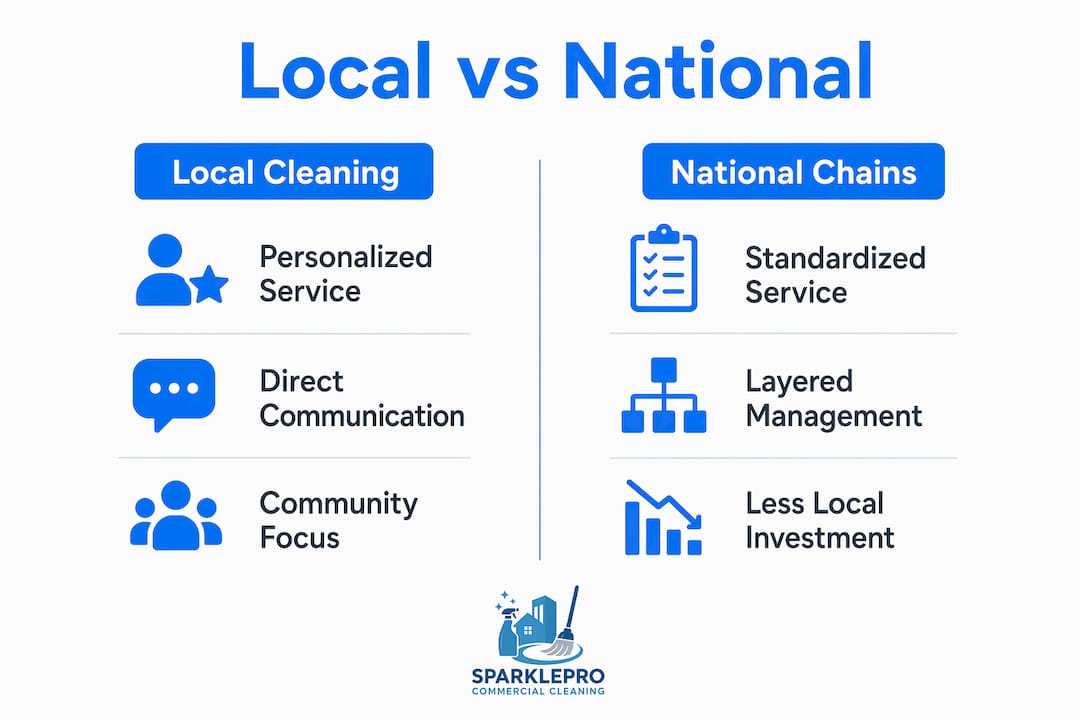
Local cleaning expertise delivers three things national chains structurally cannot: personalized service, direct accountability, and community-level knowledge of your building's environment. These are not soft benefits. They translate directly into cleaner facilities, fewer tenant complaints, and lower turnover costs.
Personalized service that fits your property. No two commercial properties are identical. A medical office building in Delaware has different cleaning requirements than a retail center in New Jersey. Local providers build their service model around your specific property type, tenant mix, and operational schedule. They do not apply a standardized checklist designed for a national average. The result is cleaning that actually matches what your building needs.

Accountability tied to reputation. Local companies rely on word-of-mouth and community reputation in ways national chains never do. When a local provider does poor work, the owner hears about it directly and has a personal stake in fixing it. That incentive structure produces more consistent quality than a corporate service model driven by quarterly profit targets.
Direct communication with decision-makers. No middle management delays means faster problem resolution. When you call a local cleaning company, you reach someone who can authorize a schedule change or dispatch a crew the same day. With national chains, requests often cycle through call centers before reaching anyone with authority to act.
Community investment and economic impact. Locally owned companies pay staff competitive wages and purchase supplies from local vendors, keeping revenue circulating in the community. For property managers who answer to tenants and stakeholders with community ties, this matters beyond the balance sheet.
Eco-friendly practices grounded in local knowledge. Local cleaners frequently adopt non-toxic, biodegradable products because they have a direct environmental stake in the communities where they live and work. This is not a marketing position. It is a practical commitment that reduces chemical exposure for your tenants and building staff.
Pro Tip: When evaluating a local cleaning provider, ask specifically which products they use and whether those products meet Green Seal or EPA Safer Choice standards. A provider that cannot answer this question clearly is not as locally invested as they claim.
How does local cleaning expertise affect tenant satisfaction?
Tenant satisfaction in commercial properties is directly tied to the cleanliness and health of the indoor environment. This connection is more measurable than most property managers realize.
-
Reduced allergens and pathogens. Professional cleaning with commercial-grade HEPA vacuums and non-toxic products improves indoor air quality significantly. Tenants in office buildings and healthcare facilities notice the difference, and fewer health complaints translate directly into fewer lease termination conversations.
-
Perception of management professionalism. A consistently clean property signals to tenants that management is attentive and organized. This perception influences lease renewal decisions more than most property managers account for in their retention strategies. Reviewing cleaning benefits for commercial properties shows how cleanliness correlates with tenant confidence in management.
-
Adaptation to local environmental conditions. Local cleaning providers understand regional factors that national companies overlook. A provider operating in coastal Massachusetts knows how salt air accelerates mold growth on certain surfaces. A provider in the Pacific Northwest understands how persistent moisture affects flooring and grout. Local knowledge allows better care of regionally common flooring types, mold risks, and pollution effects that a standardized national protocol simply does not address.
-
Protection of asset value. Consistent, high-quality cleaning extends the life of flooring, fixtures, and surfaces. A commercial property that is cleaned correctly and regularly requires less frequent capital expenditure on replacements and repairs. This is a direct contribution to asset value that belongs in every property manager's financial model.
The ISSA's research reinforces this: cleaning staff qualification and health-focused operational models reduce turnover and yield strong ROI for commercial property managers. The math is straightforward. Healthier tenants stay longer. Longer tenancies reduce vacancy costs. Reduced vacancy costs improve net operating income.
Local vs. national cleaning companies: what are the real differences?
The choice between local and national providers comes down to incentive structures, communication models, and service flexibility. This table captures the practical differences that matter most to property managers.
| Factor | Local cleaning companies | National cleaning chains |
|---|---|---|
| Communication | Direct access to owner or manager | Call center routing with delayed resolution |
| Service customization | Tailored to property type and tenant needs | Standardized checklists applied uniformly |
| Accountability | Community reputation at stake | Corporate complaint process with slow escalation |
| Economic impact | Revenue stays in local economy | Profits extracted to corporate headquarters |
| Staff consistency | Smaller teams with lower turnover | Frequent staff rotation across accounts |
| Incentive structure | Long-term relationship and repeat business | Quarterly revenue targets |
Local owners care about community reputation and repeat business, not short-term gain. This structural difference in motivation produces measurably different service behavior. A national chain account manager is measured on contract renewals across a portfolio. A local owner is measured on whether you call them back next month.
Staff consistency deserves particular attention. High staff turnover in cleaning services means your building is regularly cleaned by people who do not know your property's specific requirements, your tenant preferences, or your access protocols. Local companies, which typically pay better and operate with stronger team cultures, create loyalty through transparency and personal relationships that national chains fail to replicate at scale.
What to look for when selecting a local cleaning provider
Choosing the right local cleaning service requires evaluation beyond price. These are the factors that separate reliable providers from those who underdeliver.
-
Verified client references from comparable properties. Ask for references from property managers who oversee buildings similar to yours in size and use type. A provider with strong references from office buildings may not have the right protocols for healthcare facilities or post-construction cleanouts.
-
Staff training and certifications. ISSA guidelines set the industry standard for cleaning staff training, particularly for sensitive environments. Ask whether the provider's staff hold any ISSA certifications or follow ISSA-aligned protocols. Providers who invest in staff training and certification deliver fewer errors, better compliance, and higher service consistency.
-
Scheduling flexibility and emergency responsiveness. Your cleaning needs will change. A tenant move-out, a post-construction cleanout, or an unexpected spill requires a provider who can respond quickly. Confirm in advance how the provider handles urgent requests and whether you will reach a decision-maker directly.
-
Transparent pricing and contract terms. Avoid providers who bundle services in ways that obscure what you are actually paying for. Review cleaning contracts for quality and cost before signing anything. Clear line-item pricing protects you from scope creep and billing disputes.
-
Eco-friendly product protocols. Ask for a product list and verify that cleaning agents meet recognized safety standards. This is particularly important for properties with healthcare tenants, food service operations, or LEED certification requirements.
-
Local knowledge of your building type. A provider who has cleaned similar buildings in your market understands the specific challenges your property faces. This is one of the clearest advantages of local expertise in cleaning and one of the easiest to verify during an initial consultation.
Pro Tip: Request a trial cleaning of one floor or one section before committing to a full contract. A confident local provider will agree to this. One who resists should be treated as a red flag.
Key takeaways
Local cleaning expertise outperforms national chains because local providers combine direct accountability, community-specific knowledge, and relationship-driven service models that national companies cannot replicate at scale.
| Point | Details |
|---|---|
| Accountability drives quality | Local providers stake their community reputation on every job, producing more consistent results. |
| Direct communication saves time | Access to decision-makers means faster scheduling changes and problem resolution. |
| Local knowledge improves outcomes | Regional environmental factors like mold, humidity, and flooring types require tailored cleaning approaches. |
| Tenant health affects retention | HEPA vacuuming and non-toxic products reduce allergens and health complaints, supporting lease renewals. |
| Staff consistency matters | Lower turnover in local companies means crews who know your property and your tenants. |
What I've learned from watching local providers outperform national contracts
I have seen property managers sign national cleaning contracts because the brand name felt like a guarantee. It rarely is. The guarantee that actually matters is whether the person responsible for your account has a personal stake in getting it right. Local providers have that stake built into their business model in a way that no corporate service agreement can manufacture.
The most telling moment in any cleaning service relationship is the first time something goes wrong. A spill, a missed area, a scheduling conflict. With a national chain, that moment triggers a complaint ticket and a wait. With a strong local provider, it triggers a phone call to someone who can fix it today. That difference compounds over a 12-month contract into a measurable gap in tenant satisfaction and property condition.
I also think the economic argument for local cleaning is underused by property managers. When you hire locally, you are not just buying a service. You are contributing to the wage base and business ecosystem of the community your tenants live and work in. That is a story worth telling to tenants, stakeholders, and boards who care about community impact.
The practical advice I give to every property manager evaluating providers: weight responsiveness and references more heavily than price. A provider who costs 10% more but answers the phone and knows your building will save you far more than that in avoided problems over a year.
— Sales
How Sparkleprocommercialcleaning delivers local expertise at scale
Sparkleprocommercialcleaning combines the accountability and personalized service of a local provider with coverage across multiple states, including Delaware, Massachusetts, and Washington. Every engagement starts with a site visit and a custom quote, so your property's specific requirements drive the cleaning plan, not a generic checklist. Sparkleprocommercialcleaning's teams are fully licensed and insured, trained on ISSA-aligned protocols, and available for routine janitorial service, post-construction cleanouts, tenant move-out cleaning, and specialized disinfecting. If you manage commercial properties and want a provider who treats your building like a neighbor, not an account number, Sparkleprocommercialcleaning is the call to make.
FAQ
What is local cleaning expertise in commercial properties?
Local cleaning expertise refers to professional cleaning services delivered by community-based companies with direct accountability, regional environmental knowledge, and personalized service tailored to specific property types and tenant needs.
Why hire local cleaning services instead of a national chain?
Local providers offer direct access to decision-makers, faster response times, and service customized to your property. National chains apply standardized protocols and route issues through call centers, which slows resolution and reduces service quality.
How do local cleaners improve tenant satisfaction?
Local cleaning services use commercial-grade HEPA vacuums and non-toxic products that improve indoor air quality, reduce allergens, and lower health complaints. Tenants in cleaner, healthier buildings renew leases at higher rates.
What certifications should I look for in a local cleaning provider?
Look for staff trained under ISSA guidelines or holding ISSA certifications, particularly for sensitive environments like healthcare facilities. Certification signals investment in training, compliance, and consistent service standards.
Does choosing local cleaning services support the local economy?
Local cleaning companies pay staff competitive wages and purchase supplies from local vendors, keeping revenue circulating in the community rather than flowing to corporate headquarters.