
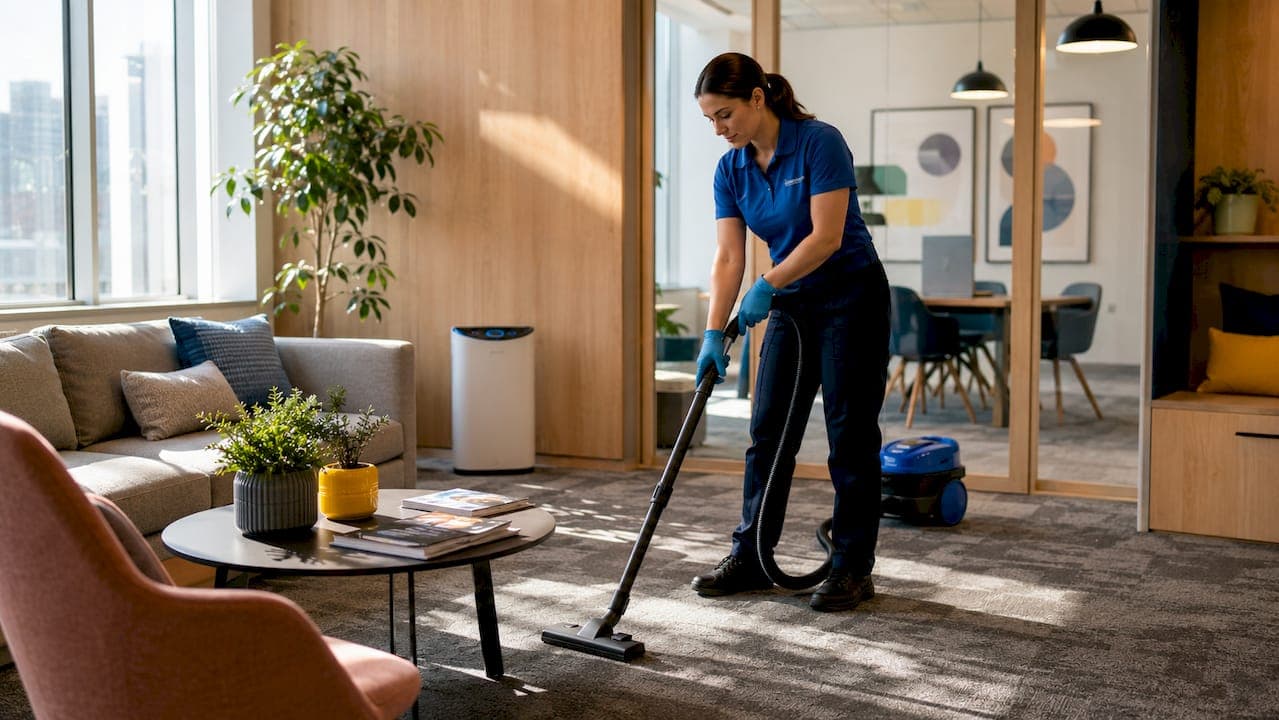
Indoor air quality (IAQ) is defined as the condition of air within a building as it relates to the health and comfort of occupants, and cleaning is its most direct and lasting form of control. Property managers who rely on ventilation alone are missing the core mechanism: physical removal of pollutants from surfaces. A Colorado State University 2026 study confirmed that vacuuming, sweeping, and mopping reduce indoor air toxins in measurable amounts proportional to the surface area cleaned. Understanding the role of cleaning in indoor air quality means recognizing that surface cleaning, HVAC maintenance, and product selection each play a distinct and necessary part in protecting the people inside your building.
How does routine surface cleaning reduce indoor air toxins?
Routine surface cleaning permanently removes pollutants from indoor environments. Ventilation moves air around. Cleaning takes contaminants out of the building entirely. That distinction matters enormously in commercial spaces where foot traffic, equipment, and occupant activity continuously deposit dust, allergens, and chemical residues onto floors, desks, and horizontal surfaces.
Surfaces act as long-term reservoirs. Settled dust re-emits toxins into the air whenever disturbed by movement, HVAC airflow, or cleaning itself. In a busy office building or retail center, this cycle repeats dozens of times per day. The only way to break it is to physically remove the reservoir through consistent cleaning.
The EPA recommends routine vacuuming, damp dusting, and mopping as the primary tools for limiting mold, allergens, and pest-related contaminants that degrade IAQ. These methods work because they capture and contain particles rather than simply redistributing them. For commercial properties, that means scheduling these tasks at a frequency matched to occupancy levels, not just appearance standards.
Best surface cleaning practices for IAQ improvement in commercial spaces:
- Vacuum carpeted areas and fabric surfaces with certified HEPA filtration vacuums at least three times per week in high-traffic zones
- Damp mop hard floors rather than dry sweeping, which launches fine particles back into the air
- Wipe horizontal surfaces including desks, shelving, and windowsills with microfiber cloths that trap rather than scatter dust
- Clean air vents, return grilles, and ceiling fan blades monthly to prevent accumulated dust from re-entering the air stream
- Focus extra attention on entryways, break rooms, and copy rooms where pollutant loads are highest
Pro Tip: Always dust from top to bottom and finish with floor cleaning. Starting at ceiling level and working down prevents allergens from settling on already-cleaned surfaces.
What is the impact of HVAC cleaning on indoor air quality?
Certified HVAC system cleaning significantly reduces occupant exposure to both coarse and fine particulate matter. A pilot study conducted in public schools in june 2026 showed that HVAC cleaning improved real-time air quality by lowering particulate matter concentrations and enhancing ventilation effectiveness. That finding translates directly to commercial buildings: a dirty HVAC system actively undermines every other cleaning effort you make.
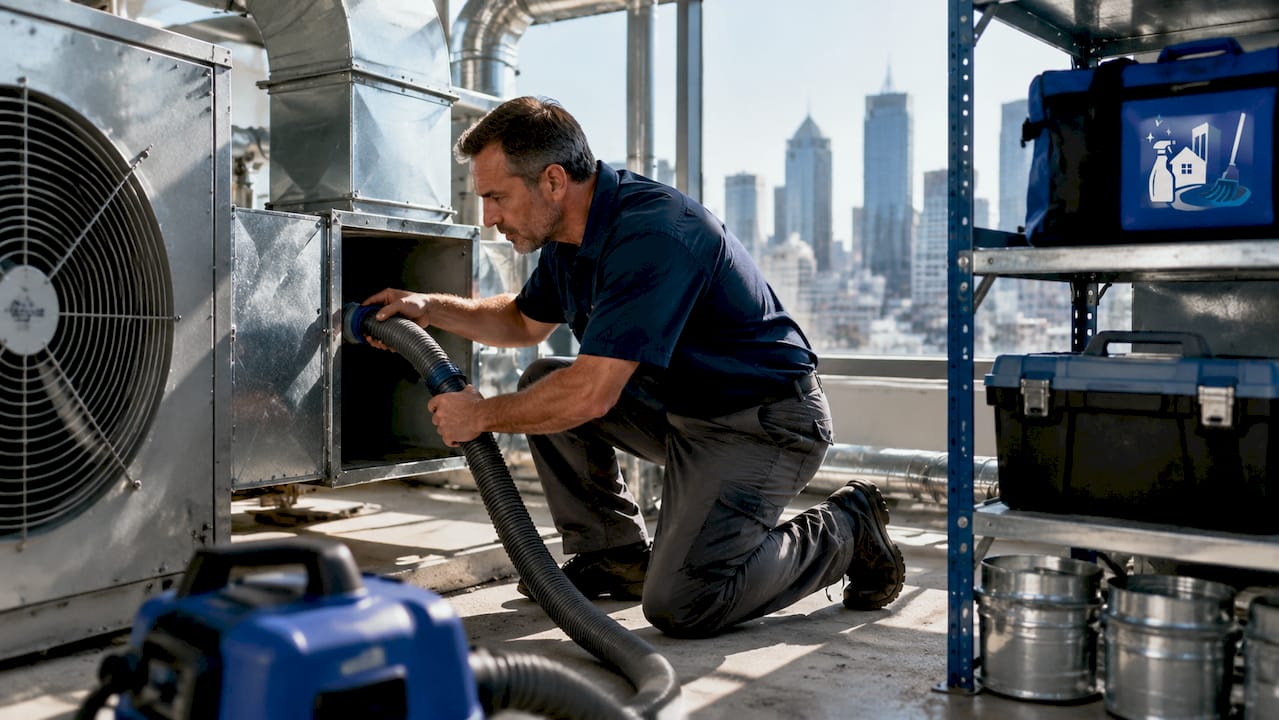
HVAC cleaning protocols for commercial properties typically include coil cleaning, drain pan disinfection, duct vacuuming, and filter replacement. Each step addresses a different contamination pathway. Dirty coils reduce airflow and allow moisture buildup that promotes mold growth. Clogged drain pans breed biological contaminants. Unvacuumed ducts redistribute accumulated dust every time the system cycles on.
HVAC cleaning also improves energy efficiency by restoring ventilation performance to design specifications. A system running at full efficiency delivers cleaner, better-distributed air throughout the building. Portable air cleaners with HEPA filters can supplement HVAC performance in zones with elevated pollutant loads, such as server rooms or areas undergoing renovation.
| Condition | Air quality effect | Occupant health effect |
|---|---|---|
| Uncleaned HVAC system | Elevated particulate matter, reduced airflow | Increased respiratory irritation, fatigue |
| Cleaned HVAC system | Lower particulate concentrations, improved ventilation | Reduced allergen exposure, better comfort |
| Uncleaned filters | Recirculation of captured pollutants | Worsened asthma and allergy symptoms |
| Cleaned filters and coils | Consistent air distribution at design capacity | Stable IAQ across all occupied zones |
Pro Tip: When hiring an HVAC cleaning provider, require proof of certification from the National Air Duct Cleaners Association (NADCA). Certified technicians follow documented protocols that produce verifiable IAQ improvements.
Do cleaning products help or hurt indoor air quality?
Cleaning products play a dual role in IAQ: they remove allergens and biological contaminants, but they also release volatile organic compounds (VOCs) that can harm respiratory health if not managed carefully. The Asthma and Allergy Foundation identifies product selection as equally important as cleaning frequency in achieving better IAQ outcomes. Choosing the wrong product can undo the air quality gains from thorough cleaning.
VOCs are carbon-based chemicals that evaporate at room temperature. Common cleaning products including spray disinfectants, aerosol degreasers, and scented floor cleaners release VOCs during and after application. In a sealed commercial building with limited fresh air exchange, those emissions accumulate quickly. Occupants with asthma, allergies, or chemical sensitivities are most affected, but the impact on all building users is real.
Low-VOC certification for cleaning products involves rigorous emissions testing, giving property managers a reliable way to identify safer options. Certified products carry labels from programs such as Green Seal, EPA Safer Choice, or the Asthma and Allergy Friendly certification mark. Using only the necessary amount of any product further reduces chemical load in the air.
Recommended product certifications and usage practices for commercial IAQ:
- Prioritize products carrying Green Seal GS-37 or EPA Safer Choice certification for general-purpose cleaning
- Use fragrance-free formulations in healthcare facilities, schools, and any space with chemically sensitive occupants
- Disinfect only when clinically indicated, not as a default for every cleaning cycle
- Use certified vacuums carrying the Asthma and Allergy Friendly mark to capture allergens without redistributing fibers
- Store all cleaning chemicals in sealed, ventilated storage areas away from occupied zones
Pro Tip: Request a full ingredient list or Safety Data Sheet (SDS) from your cleaning vendor before approving any new product for use in your building. Transparency on chemical content is the fastest way to screen for high-VOC formulations.
Cleaning vs. ventilation vs. filtration: which one actually works?
The EPA's three-layer approach to IAQ management places source control, which means cleaning, first. Ventilation and filtration supplement cleaning but cannot replace it. Property managers who invest heavily in HVAC upgrades while neglecting surface cleaning schedules are treating symptoms rather than the source.
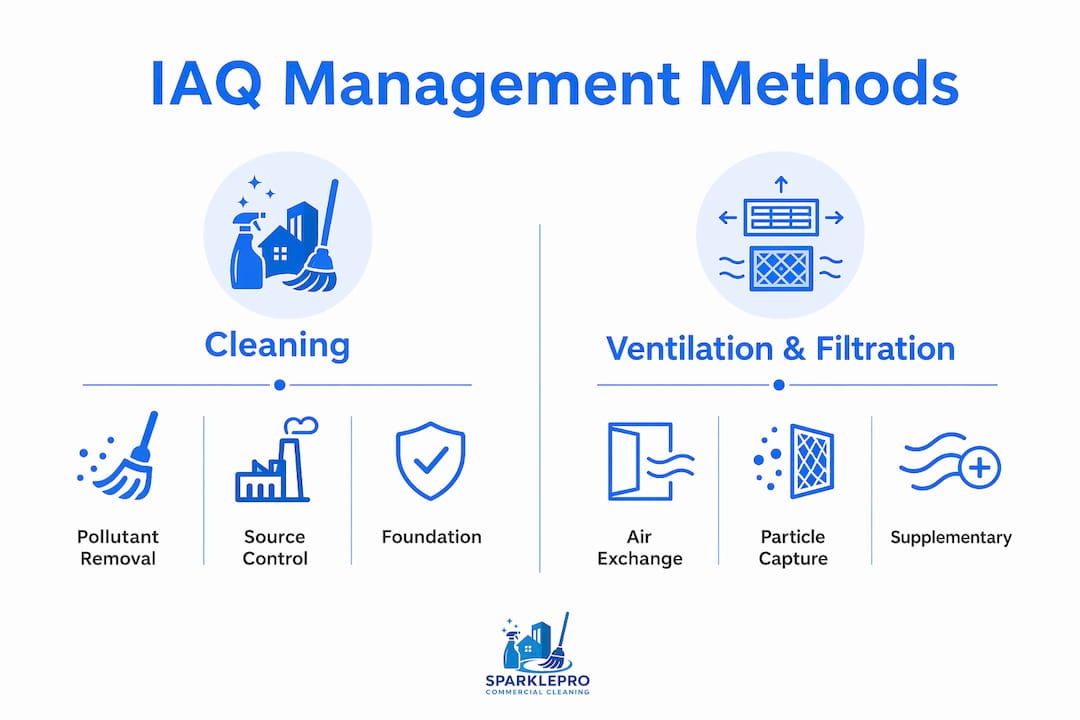
Opening windows flushes acute airborne pollutants temporarily but does nothing to eliminate the surface reservoirs that continuously re-emit those pollutants. Ventilation is valuable for diluting gases and managing humidity. It does not remove the dust, allergens, and biological material sitting on floors, furniture, and duct surfaces. Cleaning does.
Filtration captures airborne particles that cleaning and ventilation leave behind. HEPA filters in HVAC systems and portable air cleaners are most effective when the underlying pollutant load is already reduced through regular cleaning. Running high-grade filtration in a building with infrequent cleaning is like bailing water from a boat with an open drain.
| Method | Primary benefit | Key limitation |
|---|---|---|
| Surface cleaning | Permanently removes pollutant reservoirs | Requires consistent scheduling and trained staff |
| HVAC cleaning | Reduces particulate matter, improves airflow | Needs certified providers and periodic repetition |
| Ventilation | Dilutes and flushes airborne gases | Does not eliminate surface-based contaminants |
| Filtration | Captures fine airborne particles | Only effective when pollutant sources are controlled |
The most effective air quality maintenance strategy combines all three layers, with cleaning as the foundation. Scheduling surface cleaning, HVAC filter changes, and ventilation system checks together as a single maintenance program produces compounding IAQ benefits that no single method achieves alone.
Practical cleaning schedules for commercial property managers
Cleaning frequency must match occupancy patterns and space function. A law office with 20 staff needs a different schedule than a retail center with 500 daily visitors. The impact of cleaning on air quality is directly tied to how often pollutant reservoirs are cleared before they re-emit into the air.
High-touch and high-surface-area zones require the most attention. Lobbies, elevator banks, restrooms, break rooms, and open-plan work areas accumulate contaminants faster than private offices or storage rooms. Targeting these zones with higher-frequency cleaning produces the greatest IAQ return per cleaning hour. For building deep cleaning techniques that address these high-load areas systematically, a documented protocol is more reliable than ad hoc scheduling.
Training cleaning staff on IAQ-sensitive methods is as important as the schedule itself. Staff who understand why damp mopping outperforms dry sweeping, or why top-to-bottom dusting matters, make better decisions in the field. Monitoring tools such as portable IAQ sensors that measure PM2.5, CO2, and VOC levels give property managers objective data to verify that cleaning schedules are producing measurable results.
A practical cleaning checklist for facility managers:
- Conduct a baseline IAQ assessment using a portable sensor before establishing your cleaning schedule
- Map all high-traffic and high-surface-area zones and assign cleaning frequencies based on occupancy data
- Select certified low-VOC products and document approved products in a building-specific cleaning specification
- Train all cleaning staff on HEPA vacuum operation, damp mopping technique, and top-to-bottom surface sequencing
- Schedule HVAC filter inspections monthly and full HVAC cleaning at least annually, or more often in high-occupancy buildings
- Re-measure IAQ metrics quarterly and adjust cleaning frequency or methods based on sensor data
- Document all cleaning activities and IAQ readings to support compliance reporting and lease negotiations
For a broader view of how consistent cleaning frequency connects to measurable health outcomes in commercial buildings, the frequency of service matters as much as the methods used.
What I've learned about cleaning and IAQ after years in commercial facilities
The most common mistake property managers make is treating cleaning as a cosmetic service rather than an environmental health intervention. Buildings look clean long before they are clean from an IAQ standpoint. Dust on a dark surface is visible. The same dust on a light-colored carpet or inside an HVAC duct is invisible, but it is still re-emitting toxins into the air your occupants breathe.
Budget pressure pushes many managers to reduce cleaning frequency before cutting other line items. That trade-off costs more than it saves. Occupant complaints, sick days, and lease renewals are all affected by IAQ, and cleaning is the lowest-cost lever available to improve it. Ventilation upgrades and filtration systems run into tens of thousands of dollars. A well-structured cleaning program costs a fraction of that and delivers measurable results faster.
Emerging technologies like IAQ sensor networks and HEPA-equipped robotic vacuums are making it easier to verify cleaning outcomes in real time. But the fundamentals have not changed: remove the source, maintain the system, choose the right products. Cleaning is not a support function. It is the primary IAQ management tool available to every property manager, regardless of building age or budget.
— Sales
Sparkleprocommercialcleaning: professional cleaning built for better indoor air
Property managers who want measurable IAQ improvements need a cleaning partner with the protocols, products, and trained staff to deliver them consistently. Sparkleprocommercialcleaning provides commercial cleaning services across the United States, covering routine janitorial programs, deep cleaning, HVAC-adjacent surface cleaning, and post-construction cleanouts for office buildings, retail centers, and healthcare facilities.
Sparkleprocommercialcleaning uses low-VOC certified products and HEPA filtration equipment as standard practice, not as an upgrade. Every service engagement includes a site assessment and a documented cleaning specification matched to your building's occupancy and IAQ needs. Property managers in Massachusetts can connect with the Massachusetts cleaning team directly, and those in Washington state can reach the Washington commercial services team for a site-specific quote.
Key takeaways
Cleaning is the primary and most direct method for permanently reducing indoor air pollutants in commercial buildings, and it must be combined with HVAC maintenance and certified product selection to deliver lasting IAQ results.
| Point | Details |
|---|---|
| Cleaning removes pollutants permanently | Surface cleaning eliminates toxin reservoirs that ventilation alone cannot address. |
| HVAC cleaning reduces particulate exposure | Certified HVAC cleaning lowers fine and coarse particulate matter during occupied hours. |
| Product selection affects air quality | Low-VOC, certified cleaning products remove allergens without adding harmful chemical emissions. |
| Ventilation supplements, not replaces, cleaning | Opening windows flushes acute pollutants but leaves surface reservoirs intact. |
| Frequency must match occupancy | High-traffic commercial zones require more frequent cleaning to prevent pollutant buildup. |
FAQ
What is the role of cleaning in indoor air quality?
Cleaning is the primary method for permanently removing pollutants, allergens, and biological contaminants from indoor environments. Surface cleaning eliminates the reservoirs that continuously re-emit toxins into the air, which ventilation and filtration alone cannot accomplish.
How often should commercial buildings be cleaned for good IAQ?
High-traffic zones such as lobbies, restrooms, and open-plan offices require cleaning at least three times per week, with daily attention in healthcare or high-occupancy settings. Cleaning frequency should be set based on occupancy data and verified with IAQ sensor readings.
Does HVAC cleaning actually improve air quality?
A june 2026 pilot study in public schools confirmed that HVAC cleaning lowers particulate matter concentrations and improves ventilation effectiveness during occupied periods. Annual HVAC cleaning is the minimum standard for most commercial buildings.
Are cleaning products a source of indoor air pollution?
Yes. Many standard cleaning products release VOCs that accumulate in sealed commercial buildings and irritate respiratory systems. Choosing Green Seal or EPA Safer Choice certified products and using only necessary amounts reduces this risk significantly.
Can better cleaning reduce occupant health complaints?
Routine cleaning that targets surface reservoirs, uses certified low-VOC products, and follows a schedule matched to occupancy patterns directly reduces allergen and particulate exposure. The EPA links regular vacuuming and mopping to lower biological contaminant levels and fewer IAQ-related health complaints.