
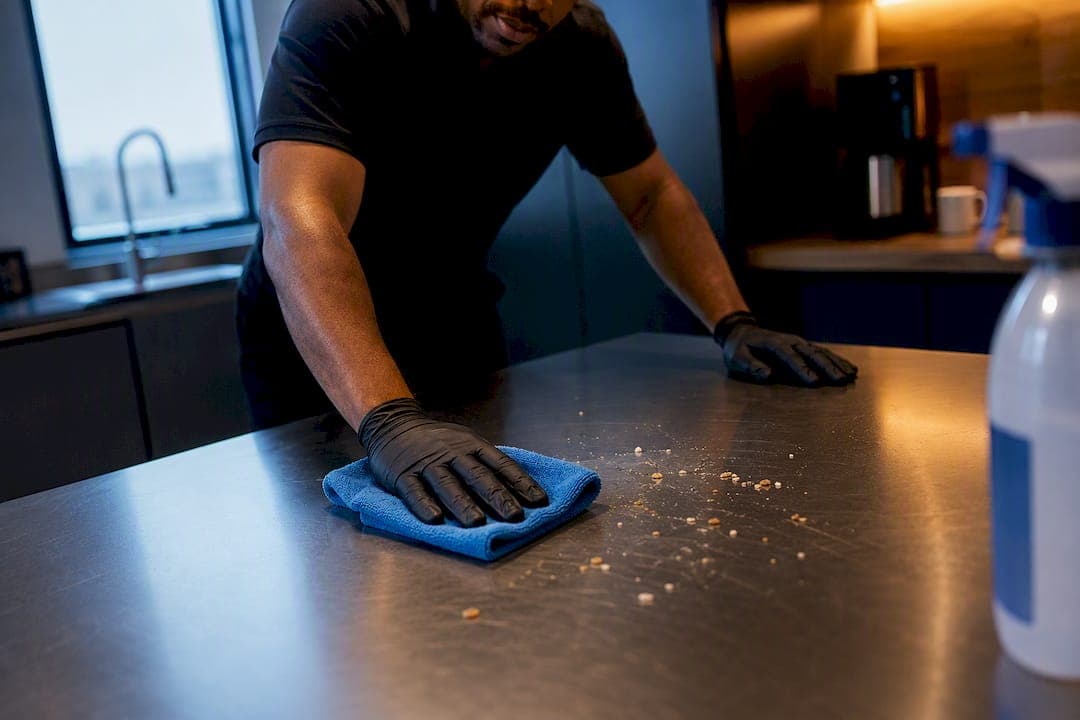
Sanitizing lowers germ counts to a level public health codes consider safe. Disinfecting kills a much wider range of pathogens, including viruses, and requires an EPA-registered product to make that claim legally. Clean the surface first, every time. Then sanitize food-contact and low-risk surfaces on a routine basis, and disinfect high-touch areas or anything touched by someone who's sick.
TL;DR:
- Proper disinfecting requires using EPA-registered products and allowing full contact time to inactivate various pathogens effectively.
- Disinfectants are designed to kill a broad spectrum of viruses and bacteria, but most are not sporicidal or suitable for sterilization.
- Routine cleaning must always precede sanitizing or disinfecting to ensure chemical effectiveness and prevent germs from being shielded by soil or debris.
- For low-risk surfaces like food prep areas, sanitizing is sufficient, while high-touch and illness-prone zones require disinfecting; frequency should match the risk level.
- Professional disinfection services ensure consistent, safe, and compliant coverage for large or high-stakes environments, avoiding common DIY mistakes.
Table of Contents
- Disinfecting vs Sanitizing: What Each Word Actually Means
- Sanitizing vs Disinfecting: How the Results Actually Differ
- When to Sanitize vs When to Disinfect: A Decision Guide
- How to Sanitize or Disinfect a Surface the Right Way
- Choosing the Right Sanitizer or Disinfectant Without Getting Fooled by the Label
- How Professional Crews Handle Disinfecting at Scale
- The Rules Worth Actually Remembering
- Bringing In a Professional Disinfecting Service
- Where to Verify This Yourself
- Sources
- FAQ
Disinfecting vs Sanitizing: What Each Word Actually Means
People use "clean," "sanitize," and "disinfect" like they're interchangeable. They aren't, and the difference matters more than most people realize when it comes to actually stopping the spread of illness.
Cleaning is the physical removal of dirt, grease, food residue, and some germs using soap or detergent and water. It doesn't kill anything on its own. It just clears the debris that would otherwise block a sanitizer or disinfectant from reaching the surface underneath. This is why UNH Extension and nearly every public health agency insist cleaning always comes before the chemical step. Skip it, and you're applying an active ingredient to a layer of grime instead of to the germs you're trying to eliminate.
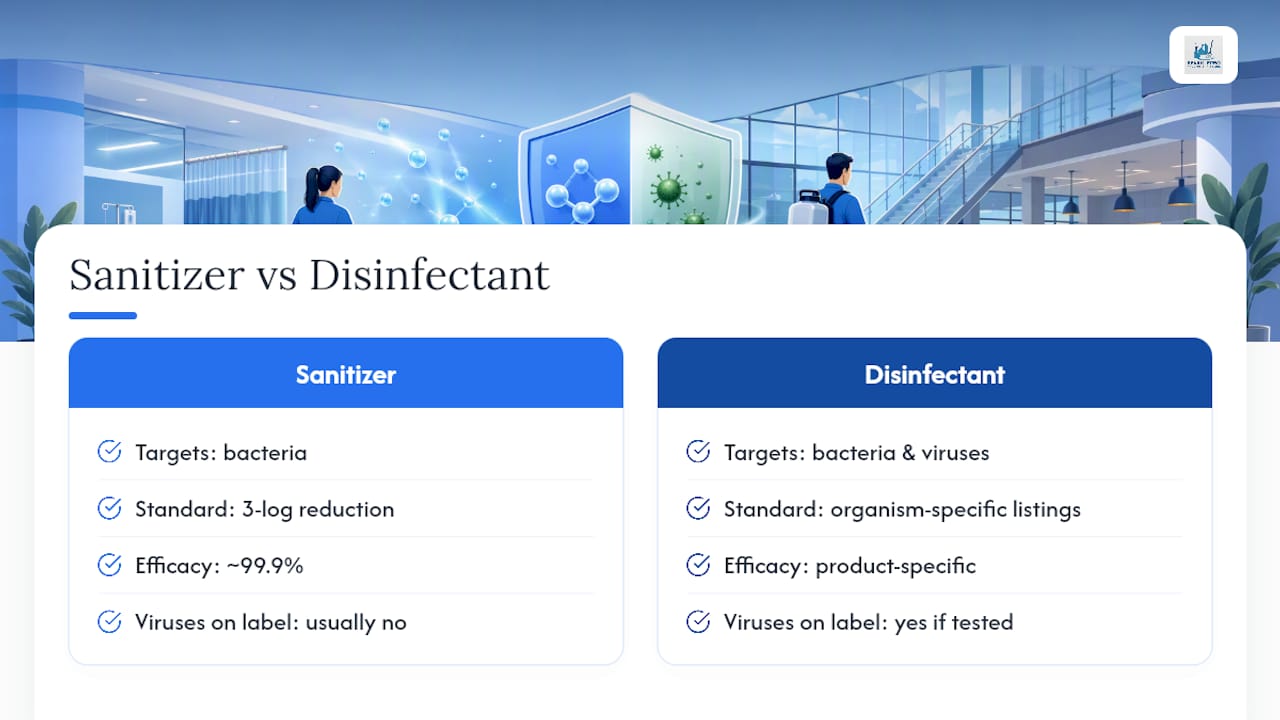
Sanitizing reduces bacteria on a surface to a level considered safe by public health standards, typically a 3 log reduction, or about 99.9 percent, according to the EPA. It's the standard for food-contact surfaces, dishware, and kids' toys, where the risk is generally lower and the exposure is frequent.
Disinfecting goes further. It's designed to inactivate a broader spectrum of pathogens, including viruses, using chemistries the EPA has registered specifically for that claim. Disinfectants are the right call when illness is present or when a surface gets touched by dozens of different hands a day.
Sterilizing sits above both. It destroys all microbial life, including bacterial spores, and it's almost never something you do with a spray bottle. Sterilization relies on specialized methods like autoclaves or chemical sterilants and is reserved for medical instruments and lab equipment, not office desks or kitchen counters, per CDC infection control guidance.
Here's the short version, side by side:
- Cleaning: removes visible soil and some germs; no kill claim.
- Sanitizing: reduces bacteria to a safe public-health level; suited to food contact and everyday low-risk surfaces.
- Disinfecting: inactivates a wider range of pathogens, including viruses; needed for high-touch surfaces and illness response.
- Sterilizing: eliminates all microbial life, including spores; used in medical and lab settings.
Knowing these four terms isn't academic. Buy the wrong product, or use the right one the wrong way, and you get none of the protection the label promises.
Sanitizing vs Disinfecting: How the Results Actually Differ
The gap between "reduce" and "kill" is where most confusion starts. Sanitizers are formulated and tested to bring bacterial counts down to a level regulators consider safe. They're not necessarily designed to address viruses at all. Disinfectants are tested and registered to inactivate a specific list of organisms named right there on the label, viruses included.
By the numbers: A typical sanitizing standard targets a 3 log reduction in bacteria, roughly 99.9 percent, according to the EPA. Disinfectants are evaluated against a broader pathogen list, including specific viruses, and each product's EPA registration number tells you exactly which organisms it's proven against.
That 99.9 percent figure sounds airtight until you consider what it leaves out. A sanitizer knocking down bacteria by that margin can still leave a norovirus or a flu virus fully intact on the same counter, because sanitizers aren't tested or labeled against most viruses. That's not a flaw. It's simply outside what the product claims to do.
Disinfecting has its own limits, too. Most disinfectants are not sporicidal, meaning they won't necessarily kill bacterial spores like Clostridioides difficile. The CDC draws a hard line here: disinfection eliminates many pathogenic organisms, but it is not sterilization, and it shouldn't be sold or treated as one.
Practically, that means a sanitizer is doing its job on a cutting board between meals. A disinfectant is doing its job on a doorknob during flu season. Neither one is "stronger" in some universal sense. They're built for different targets, and picking the wrong one for the situation gets you a false sense of protection.
When to Sanitize vs When to Disinfect: A Decision Guide
Match the product to the risk, not the other way around. Here's how to sort common scenarios:
- Food-prep surfaces, baby bottles, and toys. Clean first, then sanitize. These get touched constantly and the exposure risk is usually low-grade bacteria, which is exactly what sanitizers are built to handle. Restaurant kitchens and childcare centers run on this routine daily.
- Doorknobs, light switches, shared keyboards, and other high-touch points. Clean, then disinfect, especially in offices, gyms, waiting rooms, and any space with regular foot traffic from strangers.
- A household or workplace where someone is sick. Disinfect surfaces the person has touched, particularly in bathrooms and bedrooms, per CDC guidance. This is also the moment to increase frequency, not just switch products.
- Outbreak response in a shared facility, like a school, gym, or multifamily building. This calls for disinfecting on a documented schedule, often with a wider footprint than routine cleaning covers.
- Medical instruments, surgical tools, or lab equipment. This isn't a sanitize-or-disinfect decision at all. It requires sterilization protocols, typically handled by trained staff using validated equipment, not a spray bottle from the supply closet.
Frequency matters as much as product choice. Routine sanitizing on food-contact surfaces can happen after every use. Disinfecting doesn't need to happen everywhere, every day. Reserve it for the higher-risk spots and ramp it up temporarily during illness or outbreak periods rather than running it as a constant baseline.
How to Sanitize or Disinfect a Surface the Right Way
The chemistry only works if the process around it is right. Here's the sequence that actually gets you the result printed on the label.
- Clean first, always. Remove visible soil, grease, or food residue with soap or detergent and water. Organic material physically shields germs from whatever you apply next, which is why UNH Extension treats this as a non-negotiable first step, not an optional one.
- Choose the right product for the job. Sanitizer for food-contact and low-risk surfaces, disinfectant for high-touch or illness situations. For disinfectants, confirm the product is EPA-registered for the specific pathogens you're targeting.
- Mix it per the label. If you're diluting bleach or a concentrate, follow the ratio exactly. Too weak and it doesn't work. Too strong and you're wasting product or risking surface damage, and possibly your own lungs.
- Apply and let it stay wet for the full contact time. This is the step almost everyone gets wrong. A disinfectant might need 1 to 10 minutes of visible wetness to actually inactivate the pathogens on its label, and wiping it dry after 15 seconds means you cleaned the surface, not disinfected it.
- Rinse if the label says to. Food-contact surfaces often require a water rinse after sanitizing or disinfecting to remove chemical residue before the surface touches food again.
- Handle safety basics. Ventilate the room, wear gloves, and never mix chemicals, especially bleach and ammonia-based cleaners, which produces dangerous fumes. The CDC's bleach safety guidance covers safe dilution ratios and ventilation basics if you're working with bleach solutions.
Pro Tip: Set a timer for the contact time listed on the label. Most people eyeball it and wipe too soon, which is the single most common reason a disinfectant fails to perform as advertised.
Wipes and sprays behave differently in practice, too. A wipe that dries out mid-swipe across a large desk probably didn't keep the surface wet long enough. For bigger areas, spray and let it sit, rather than wiping as you go. Cloths should be laundered or replaced regularly, since a dirty cloth just redistributes germs across the next few surfaces you touch.
Choosing the Right Sanitizer or Disinfectant Without Getting Fooled by the Label
Not every bottle that says "kills 99.9% of germs" is telling you the whole story, and label literacy is where a lot of well-intentioned cleaning goes wrong.
- Check for EPA registration. Every legitimate disinfectant carries an EPA registration number. If you're addressing a specific virus concern, cross-reference the product against EPA's List N to confirm it's approved for that use.
- Read the contact time before you buy, not after. A product with a 10-minute dwell time isn't practical for a fast-turnover restroom. Shorter contact times cost more but save real labor hours in high-traffic settings.
- Confirm surface compatibility. Some disinfectants degrade rubber, discolor certain plastics, or corrode metal over repeated use. The label will tell you if a surface needs a rinse afterward or isn't recommended at all.
- Check the expiration date. Active ingredients like bleach degrade over time, sometimes within a year of manufacture, and an expired product may not deliver its labeled kill claim even with a perfect process.
- Match the strength to the actual risk. A weaker sanitizing spray is genuinely fine for a kitchen counter between meals. Save the full-strength disinfectant for the bathroom during a stomach bug, not for everyday use on every surface in the house.
Ignoring EPA registration and contact time is the most common way people undercut their own efforts, according to the American Cleaning Institute. The product isn't the problem. The shortcut is.
How Professional Crews Handle Disinfecting at Scale
Commercial disinfecting looks a lot like the process above, just built for buildings instead of countertops. A typical engagement starts with a quote and a site visit, where a crew assesses square footage, surface types, and risk level, whether that's a healthcare-adjacent facility, a post-construction site, or an office recovering from an outbreak.
From there, the workflow follows the same core sequence homeowners use, just documented and scaled:
- Clean first across the full footprint, removing debris and soil before any chemical is applied.
- Apply EPA-registered disinfectants matched to the facility's actual risk profile and surface materials.
- Track and log dwell times, since enforcing contact time at scale is harder than it sounds across dozens of rooms.
- Use tools like electrostatic sprayers for even coverage on complex surfaces, understanding that faster coverage doesn't shorten the required contact time.
- Maintain safety data sheets and proper waste handling to meet facility compliance standards.
Facilities hire this out for reasons beyond convenience: consistency across large square footage, documentation for compliance audits, and staff trained to avoid the mixing and dwell-time mistakes that undo DIY efforts. For a broader look at how professional disinfecting workflows come together, the operational details scale up but never skip the fundamentals.
The Rules Worth Actually Remembering
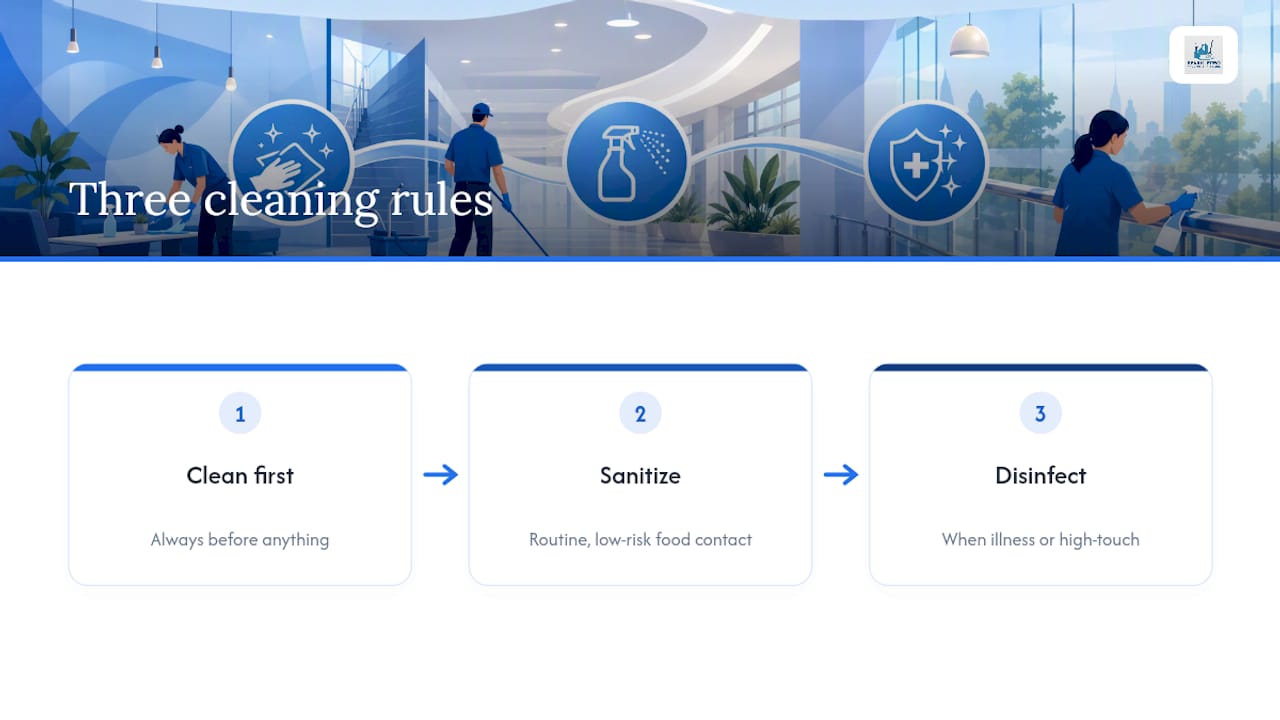
Strip away the chemistry and the label jargon, and disinfecting versus sanitizing comes down to three habits. Clean before you do anything else, no exceptions. Sanitize for routine, low-risk, food-contact situations. Disinfect when illness shows up or when a surface gets touched by more hands than you can count.
The mistake I see most often isn't under-disinfecting. It's over-disinfecting out of anxiety, spraying full-strength disinfectant on a kitchen counter that only ever needed a sanitizing wipe. That's not extra protection. It's unnecessary chemical exposure, wasted product, and sometimes surface damage, with no added safety benefit. The label's contact time and ventilation instructions aren't suggestions. They're the difference between a product that works and one that just smells like it did.
If you're staring down a space bigger than a kitchen, a facility with regulatory exposure, or a situation where getting it wrong has real consequences, that's the point to bring in people who do this for a living.
— Sales
Bringing In a Professional Disinfecting Service
Some jobs are too big, too risky, or too time-sensitive to handle with a spray bottle and a roll of paper towels. Post-construction spaces carry dust and debris that hide germs from surface-level cleaning. Outbreak response in a shared building means dozens of rooms need documented, consistent treatment, fast. Healthcare-adjacent facilities and large commercial properties carry compliance stakes that a weekend cleaning spree just can't meet.
That's the gap Sparkleprocommercialcleaning fills for property managers, facility directors, and building owners who need it done right the first time, not redone next week. A Sparkleprocommercialcleaning engagement starts with a quote and a site visit, moves into scheduled cleaning and documented disinfection with tracked dwell times, and wraps with your approval before the crew leaves. It's licensed and insured coverage with local crews, not a one-size-fits-all franchise script.
Whether you're managing a post-construction cleanout, a tenant turn, or a facility that needs Disinfecting Services built into a recurring schedule, the process starts the same way: request a quote through Sparkleprocommercialcleaning and get a site visit scheduled.
Where to Verify This Yourself
For readers who want to check the primary sources directly, the EPA's guidance on disinfectants covers product registration and List N. The CDC's cleaning and disinfection page breaks down infection-control definitions in plain language, and the CDC's bleach safety guidance walks through safe dilution and ventilation. University extension programs, including UNH Extension, also publish practical technical leaflets worth bookmarking.
This article is general information, not a substitute for advice from a qualified doctor. Consult a qualified healthcare professional about your own circumstances before acting on anything here.
Sources
- Cleaning, sanitizing, disinfecting surfaces (UNH Extension)
- What’s the difference between products that disinfect, sanitize, and clean surfaces? (EPA)
- Introduction, Methods, Definition of Terms (CDC infection control)
- What is the difference between cleaning, disinfecting and sanitizing? (American Cleaning Institute)
FAQ
Does Sanitizing Kill Germs the Same Way Disinfecting Does?
No. Sanitizing reduces bacteria to a level considered safe, typically a 99.9 percent reduction, but it isn't tested or labeled against most viruses. Disinfecting is registered to inactivate a broader range of pathogens, viruses included.
What Is Better, Sanitizing or Disinfecting?
Neither is universally better. Sanitizing fits routine, low-risk, food-contact situations, while disinfecting is the right call for high-touch surfaces or when illness is present, per CDC guidance.
Do I Always Need to Clean Before Disinfecting?
Yes. Cleaning removes soil that shields germs from the disinfectant, and skipping this step reduces the product's effectiveness even if you follow every other instruction correctly, according to UNH Extension.
How Long Should a Disinfectant Stay Wet on a Surface?
Follow the exact contact time on the product label, since it varies by product and pathogen. Wiping a disinfectant dry before that time elapses is one of the most common reasons it fails to work as intended.
Does Sparkleprocommercialcleaning Offer Disinfecting Services for Commercial Properties?
Yes. Sparkleprocommercialcleaning provides Disinfecting Services for office buildings, retail centers, healthcare facilities, and industrial spaces, following a quote and site visit process. Pricing depends on facility size and scope, and current details are available through the company's site.