
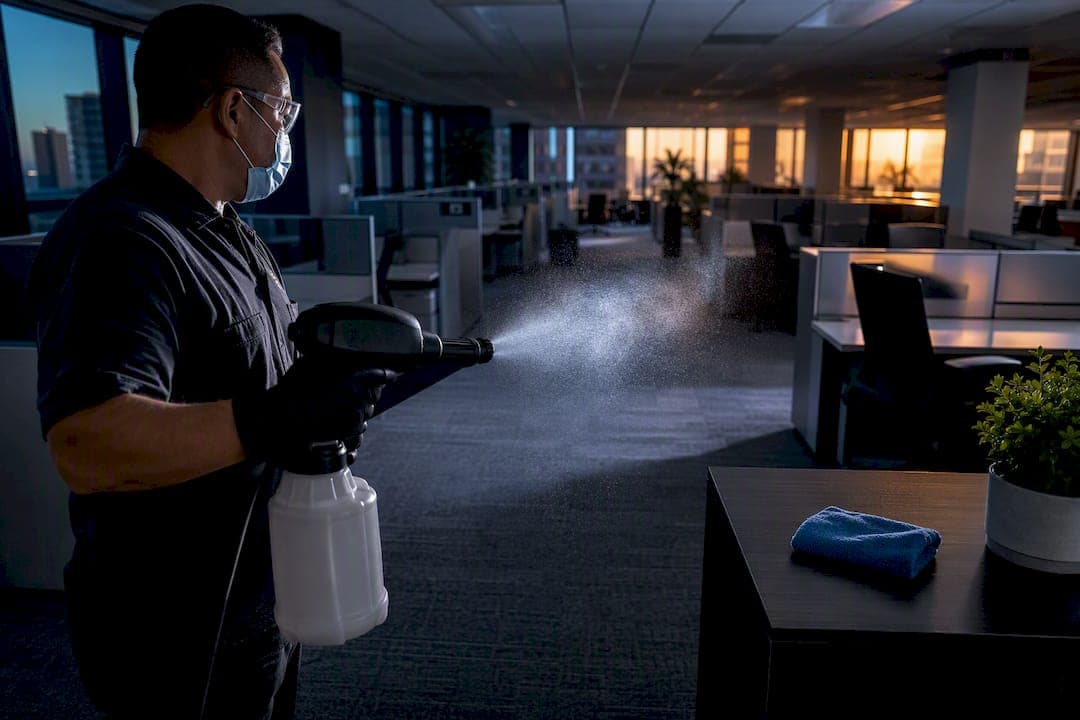
Expect to pay roughly $0.50 to $2.50 per square foot for professional electrostatic disinfection, with most commercial jobs landing near $1.00. A single-room treatment often runs $75 to $350, while a 5,000 square foot office typically costs several thousand dollars depending on factors like pass count and disinfectant type. Your final number depends on facility type, disinfectant, and how many passes the job requires.
TL;DR:
- Costs vary from $0.50 to $2.50 per square foot, depending on the number of passes, disinfectant type, and facility complexity.
- Larger facilities and high-touch environments requiring multiple passes and hospital-grade chemicals typically cost more than open, lightly furnished spaces.
- Labor charges are the main driver of price differences, with regional wages and equipment ownership significantly affecting quotes.
- Fixed-price quotes and detailed itemizations help prevent unexpected costs and enable fair bid comparisons.
- Off-peak scheduling and bundling multiple rooms or buildings into one visit can reduce overall disinfection expenses.
Table of Contents
- What Electrostatic Disinfection Cost Actually Looks Like Per Square Foot
- What Actually Drives Your Quote Up or Down
- Which Pricing Model Fits Your Facility
- Sample Budgets for Three Common Facility Types
- How to Trim the Bill Without Cutting Coverage
- What to Demand Before Signing a Quote
- Electrostatic Disinfection vs. Spray-and-Wipe: The Real Cost Comparison
- Why Licensing and Process Matter as Much as Price
- A Procurement Lead's Take on Buying This Service
- Get an Itemized Quote From Sparkleprocommercialcleaning
- Sources
What Electrostatic Disinfection Cost Actually Looks Like Per Square Foot
The national range breaks down cleanly once you separate the components. On the low end, roughly $0.50 per square foot, you're usually getting a single-pass treatment with a standard EPA-listed disinfectant in an open floor plan with light furniture density. At the high end, $2.50 per square foot, you're paying for multiple passes, hospital-grade chemistry, and a crew working around dense equipment or tight compliance windows.
Per-room pricing for smaller spaces commonly falls between $75 and $350, according to industry cost breakdowns. A typical job quote for a small commercial space often lands between $250 and $1,200 total. Healthcare facilities, labs, and other regulated environments consistently sit at the top of these bands because they require verified dwell times, documented pass counts, and hospital-grade disinfectants that cost more per gallon.
A few things move these numbers regardless of facility type:
- Coastal and major metro markets often run 10% to 25% above the national average because of labor costs and demand.
- Facilities with dense electronics or sensitive equipment require slower, more careful application, which pushes labor time up.
- Multi-pass protocols in high-touch zones add a fixed increment on top of the base per-square-foot rate.
What Actually Drives Your Quote Up or Down
Labor is usually the single biggest line item, varying based on market and crew size. A two-person crew in a rural Midwest facility costs less per hour than the same crew working in Boston or Seattle.
Disinfectant chemistry is the second lever. Standard EPA-registered solutions cost less per gallon than hospital-grade or broad-spectrum formulas required in clinical settings, affecting your per-square-foot materials cost.
Equipment matters more than most facility managers assume. A provider who owns their sprayers absorbs that $1,200 to $4,000 equipment cost over many jobs, while a provider renting equipment for a one-off job passes that cost through to you.
Other variables that shift a quote:
- Furniture density and layout complexity, which slow down coverage speed
- Ceiling height, since electrostatic particles need adequate room to disperse and settle
- After-hours or same-day scheduling, which commonly adds a 10% to 30% premium
- Travel distance for providers dispatching from a regional hub rather than a local branch
Pro Tip: Ask every bidder to separate labor, materials, and equipment into distinct line items before you compare quotes. A vendor unwilling to itemize is usually padding one category to make another look competitive.
Which Pricing Model Fits Your Facility
Providers quote electrostatic disinfection four different ways, and picking the right one changes how easily you can compare bids.
- Per square foot works best for uniform open floor plans, like a single-floor office or warehouse, where coverage is consistent throughout.
- Per room suits facilities with mixed room sizes, such as a medical suite with exam rooms, offices, and a waiting area, where a flat square-footage rate would undercharge small rooms and overcharge large ones.
- Per job gives you a fixed total for a defined scope, useful for one-time post-construction cleanouts or move-out disinfecting where the space and requirements are locked in advance.
- Per pass adds an increment, commonly $0.15 to $0.75 per square foot, for each additional application in high-touch zones like nurse stations or shared equipment areas.
Converting a per-job quote into a per-square-foot figure lets you compare bids fairly:
- A $3,000 quote on a 4,000 square foot suite works out to $0.75 per square foot.
- A $6,500 quote on a 5,500 square foot clinic works out to roughly $1.18 per square foot, which tells you immediately whether that clinic bid is reasonable against the healthcare band above.
Sample Budgets for Three Common Facility Types
Numbers are easier to trust when you can see the math. Here's how the ranges above translate into real budgets for three facility profiles a commercial property manager might actually be quoting this month.
The small office scenario sits near the middle of the national band because open layouts move fast and don't require specialty chemistry. The clinic budget nearly triples on a per-square-foot basis, almost entirely because of the second pass and the higher-grade disinfectant required for compliance documentation.
The large facility looks cheapest per square foot, but the total dollar figure is the highest of the three. That's the scenario where bundling and scheduling efficiency matter most, since even a small per-square-foot swing moves the total by thousands of dollars.
A few levers move any of these numbers in either direction: adding a second pass, switching to a premium disinfectant, requesting weekend service, or consolidating multiple buildings into one visit.
How to Trim the Bill Without Cutting Coverage
The fastest way to lower your rate is bundling. Scheduling multiple rooms, floors, or buildings into a single visit cuts the travel and dispatch charges that get baked into smaller, scattered jobs.
Off-peak scheduling helps too. Avoiding same-day or after-hours requests sidesteps that 10% to 30% rush premium entirely. If your facility can tolerate a standard weekday appointment instead of a weekend rush, say so up front.
A few more procurement moves worth using:
- Clear furniture and obstacles before the crew arrives to cut setup time out of your labor bill.
- Default to standard EPA-listed disinfectants unless your facility type requires hospital-grade chemistry.
- Ask for a fixed-price option with clearly stated exclusions, rather than an open-ended hourly estimate.
- Negotiate a recurring contract if you need disinfection more than once a quarter, since repeat business almost always earns a lower per-treatment rate.
Pro Tip: If your building has a shared HVAC system, ask your provider whether ventilation timing affects dwell-time recommendations. Coordinating with your air quality strategy can shorten the window your space needs to sit empty after treatment.
What to Demand Before Signing a Quote
A vague quote is the single biggest source of budget surprises in this category. Before you approve anything, run the bidder through this checklist.
- Require a full line-item breakdown covering labor, materials, equipment, number of passes, and dwell time.
- Ask for the Safety Data Sheet and EPA registration number for the exact disinfectant they plan to use.
- Confirm current liability insurance and any state-specific licensing for commercial cleaning work.
- Request references from at least two facilities similar to yours in size and use case.
- Get written confirmation of pass count and dwell-time compliance, not a verbal assurance.
Watch for red flags: a scope that says "disinfect the facility" with no square footage or pass count attached, a disinfectant name with no registration number, or a provider who can't produce insurance documentation on request. Requiring an explicit dwell-time compliance statement in writing avoids disputes later about whether the job actually met the standard it was sold on.
Electrostatic Disinfection vs. Spray-and-Wipe: The Real Cost Comparison
Spray-and-wipe has a lower equipment barrier since it needs nothing but bottles and rags, but it's labor-intensive and coverage quality depends heavily on who's holding the cloth that day. Electrostatic application covers irregular surfaces faster and typically uses less chemical volume per square foot, which can offset its higher initial service fee over a full contract.
- Electrostatic wins on speed and consistency across complex surfaces like railings, electronics, and textured furniture.
- Spray-and-wipe still makes sense for small, targeted touch-ups between full disinfection cycles.
- The ROI case for electrostatic often comes from indirect savings: less downtime, fewer missed coverage spots, and potentially fewer sick days in high-traffic facilities.
Full-site disinfection after an outbreak or a compliance audit is where electrostatic earns its premium. Daily touch-point wiping between full treatments is where spray-and-wipe still holds its place.
Why Licensing and Process Matter as Much as Price
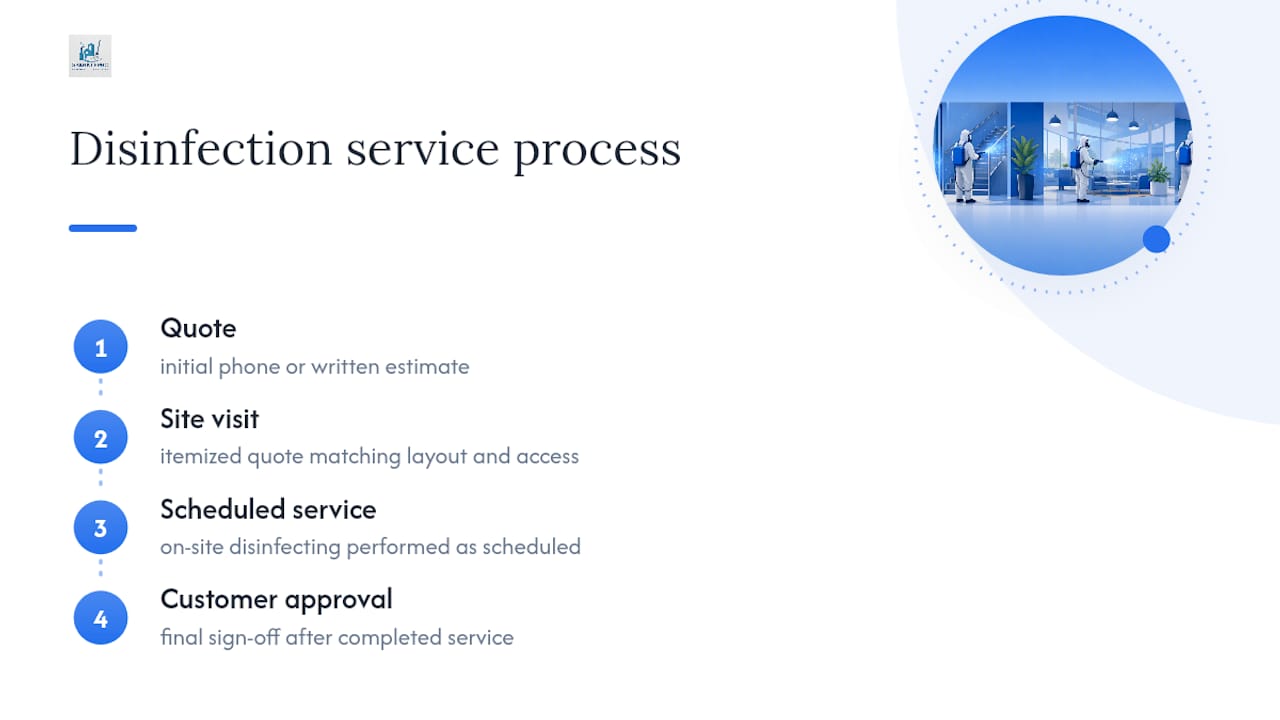
Sparkleprocommercialcleaning works through a four-step process: quote, site visit, scheduled service, and customer approval. That site visit step matters more than it sounds. It's the difference between a phone-quoted number and an itemized quote that actually matches your building's layout, furniture density, and access constraints.
As a nationwide, fully licensed and insured provider, Sparkleprocommercialcleaning brings the same documentation standards to every facility type, from post-construction cleanouts to ongoing disinfecting programs. Facility teams evaluating a disinfecting services guide or reviewing a building sanitation workflow will find the same procurement logic applied consistently across sites.
A Procurement Lead's Take on Buying This Service
Price is the wrong first filter. Scope clarity and verification matter more, because the cheapest bid with a vague pass count almost always costs more once rework enters the picture. Pay the premium for regulated or high-risk sites, healthcare, labs, anywhere dwell time and documentation actually get audited.
For everything else, bundle sites, verify the SDS before you sign, and schedule off-hours only when the premium is worth it.
— Sales
Get an Itemized Quote From Sparkleprocommercialcleaning
Sparkleprocommercialcleaning is the alternative to guessing at a per-square-foot number over the phone. You get a real site visit before pricing, so the itemized quote reflects your actual furniture density, room count, and access constraints instead of a generic national average.
The four-step process—quote, site visit, scheduled service, customer approval—exists specifically to remove pricing surprises from the equation. Because the crews are nationwide, licensed, and insured, the same documentation standard applies whether you're managing an office in Delaware or a clinic in Washington state.
If you're weighing electrostatic disinfection against a construction cleanout or an ongoing janitorial contract, the post-construction cleaning cost guide is a useful companion reference. Ready to see a real number for your building? Request a quote and site visit through the Delaware service page or the Washington service page to get scheduled.
Sources
- Electrostatic Disinfection Cost Per Square Foot: Practical Pricing for U.S. Buyers 2026 – Current Cost
- Electrostatic Disinfection Services Cost: Prices, Factors, and Savings in the U.S. 2026 – LatestCost
- How Much Does Electrostatic Cleaning Cost? - EMist