

Assign four colors to four zones: red for restrooms, yellow for isolation rooms, green for kitchens and food-contact surfaces, blue for general patient areas. This healthcare color coding structure follows CDC environmental cleaning guidance, cuts cross-contamination risk, and turns supervisor walkthroughs into a five-minute visual check instead of a guessing game. Some commercial cleaning providers run this scheme across healthcare accounts because it is fast to train, easy to audit, and nearly impossible to misinterpret on a busy floor.
TL;DR:
- Fading cloths and inconsistent procurement specifications are the main causes of color-coding breakdowns, leading to potential cross-zone contamination.
- Regular training refreshers and detailed documentation are essential to sustain compliance amid high staff turnover and procedural drift.
- Audit protocols combining visual checks with ATP testing using RLU thresholds improve surface cleanliness verification but do not directly measure infection rate impact.
- Proper implementation requires a site survey, fixed procurement specs, staff training, laminated zone maps, and scheduled audits to prevent decay over time.
- A professional cleaning service can streamline setup, ensure consistent supply chain adherence, and maintain ongoing system compliance across healthcare facilities.
Table of Contents
- What Is the Recommended Color Coding System for Hospitals?
- What Tools and Chemicals Should Match Each Zone Color?
- How Do You Roll Out a Color Coding Program Step by Step?
- How Do You Audit and Verify a Color Coding System?
- Why Do Color Coding Systems Break Down, and How Do You Fix Them?
- What Regulations Govern Healthcare Color Coding?
- Who Is Responsible for Maintaining Color Coding Compliance?
- Does Color Coding Actually Reduce Cross-Contamination?
- Why Facility Teams Underestimate the Training Half of This System
- How Sparklepro Handles Color Coding Across Healthcare Accounts
- Get a Color-Coding Program Running This Month
- Sources
What Is the Recommended Color Coding System for Hospitals?
The four-color model is the version most healthcare facilities settle on after trying more complicated systems and abandoning them. More colors sound thorough on paper, but staff turnover and rushed shifts erode a six or seven-color system fast. Four colors survive contact with reality.
Here is the standard mapping and the logic behind each one:
- Red — restrooms and toilet areas. Highest bioburden risk, so tools stay isolated from anywhere food or wounds are present.
- Yellow — isolation rooms and infection-risk zones. Keeps contamination from a C. diff or MRSA room from traveling anywhere else on the unit.
- Green — kitchens, dining areas, and food-contact surfaces. Aligns with food-safety expectations and keeps disinfectant residue away from prep surfaces.
- Blue — general patient rooms, offices, hallways, and low-risk common areas. The default color for everything that is not high-risk.
Standard zones cover most of a hospital floor, but a few areas need customized handling. Operating rooms typically get their own dedicated tool set, often layered on top of the standard four colors rather than replacing them, since surgical suites already follow separate sterile-processing protocols. Isolation rooms should have their yellow tools stored inside or immediately outside the room, never on a shared cart. Sterile processing departments usually run a fifth, restricted color that never leaves that department. Post-construction zones, common when a wing is being renovated, need temporary color assignments documented in writing so contractors and EVS staff are not accidentally sharing tools.
Every zone map should note three things on paper: the physical boundary of the zone, the specific cleaning tasks performed there, and which chemicals are approved for use in that space. A one-page laminated map posted in the EVS closet solves more disputes than any verbal briefing ever will.
What Tools and Chemicals Should Match Each Zone Color?
Color coding only works if the physical tools carry the color, not just the label on the wall. CDC guidance recommends cotton or microfiber cloths matched by color, along with color-matched buckets and caddies so a red cloth never ends up soaking in a blue bucket.
Items that need color-matching, no exceptions:
- Microfiber cloths and cotton rags
- Mop heads and mop handles (color-code the handle too, since heads get swapped)
- Buckets, wringers, and caddies
- Spray bottles for disinfectants and detergents
- Gloves, when your protocol calls for zone-specific PPE
Optional but useful: color-coded trash liners and cart shelving, which speed up visual audits without adding real procurement cost.
Disposable wipes are worth considering for isolation zones and any area with high turnover risk. A prospective intervention using four color-coded disposable wipes in an intensive care unit relied on daily discard for certain colors specifically to prevent any risk of cross-use. Reusable microfiber works fine for lower-risk zones where laundering discipline is reliable.

Set a laundering lifecycle for reusable cloths (most facilities replace at 200 to 300 wash cycles or sooner if fading starts) and keep Safety Data Sheets accessible at every chemical station, matched to the zone's approved product list.
Pro Tip: Buy cloths and mop heads from a single supplier with a fixed color specification sheet. Switching vendors mid-year is the single most common way a "red" cloth quietly turns orange and confuses the entire floor.
How Do You Roll Out a Color Coding Program Step by Step?
A rollout works best as a sequence, not a memo. Skipping steps is why so many programs fail within the first ninety days.
- Walk the site and draft a zone map showing every room, hallway, and shared space.
- Assign colors to each zone and note approved chemicals per zone.
- Order color-matched tools using a fixed procurement spec (fiber type, mop-head model, cloth fold).
- Post laminated zone maps in every EVS closet and supply room.
- Train staff on the map, the colors, and the chemical list before go-live.
- Run a soft-launch week with a supervisor present on every shift.
- Conduct a first formal audit at 30 days, then quarterly.
Training needs two tiers: an initial session before rollout, and an annual refresher. Tie the refresher schedule to your facility's documented exposure control plan under OSHA's bloodborne pathogens standard, since color coding is functionally part of that plan's contamination controls.
Documentation to keep on file:
- Tool inventory by color and zone
- Training attendance records with dates and topics covered
- Inspection and audit logs
- Corrective-action records for any color-zone violation
Facilities managing post-construction cleanouts alongside active patient care should coordinate the construction cleaning safety requirements with the color map before contractors move in.
How Do You Audit and Verify a Color Coding System?
Verification has two layers: what a supervisor sees during a walkthrough, and what a swab test measures at the microbial level.
Walkthrough audits should score specific, visible items:
- Are tools in each closet the correct color for that zone?
- Is any red tool present in a blue or green area?
- Are chemical bottles labeled and matched to the zone's approved list?
- Are laminated zone maps posted and current?
ATP (adenosine triphosphate) testing adds an objective layer on top of visual checks. A swab reads in relative light units, or RLU, and most published protocols treat a reading under 100 RLU as a pass and anything over 250 RLU as a fail. The peer-reviewed intervention study using four color-coded wipes applied exactly this threshold across 15 high-touch surfaces in an ICU setting.
The same color-wipe intervention study found that surfaces passing the ATP cleanliness threshold jumped from 13% before the intervention to 53% after it. The study's short window, however, did not show a measurable drop in healthcare-associated infection rates during that same period.
That gap matters for how you set expectations internally. ATP testing is a reliable feedback tool for retraining staff and catching missed surfaces. It is not, on its own, proof that infection rates will fall immediately. Use it to coach technique, not to promise outcomes you cannot yet measure.
Why Do Color Coding Systems Break Down, and How Do You Fix Them?
Most failures trace back to a handful of predictable causes. Fading cloths lose their color distinction after repeated bleach washes, so a red cloth starts looking pink enough to pass as blue. Staff sometimes grab whatever tool is closest during a rushed shift, ignoring the color entirely. Procurement drift, ordering from a different supplier without checking the color match, is another quiet killer.
Fixes are straightforward once you name the problem:
- Quarantine and replace any tool involved in a cross-zone mix-up rather than returning it to service.
- Standardize procurement specs in writing and require sign-off before switching suppliers.
- Build a color-zone match item directly into your scored inspection checklist.
- Hold a short retraining session the same week a violation is logged, not months later.
Pro Tip: Log every color violation with the date, zone, and staff shift, even minor ones. A pattern of small violations in the same unit usually points to a training gap, not a discipline problem.
What Regulations Govern Healthcare Color Coding?
No single federal law mandates a specific color scheme. Color coding operates as an implementation detail under broader infection-control and worker-safety frameworks that do carry regulatory weight.
The CDC's environmental cleaning guidance provides the most widely referenced framework, recommending specific color assignments and cart setups as best practice rather than binding law. Facilities generally treat CDC guidance as the default standard because state health department surveyors reference it during inspections.
OSHA's bloodborne pathogens standard requires a written exposure control plan, and color coding functions as one of the physical controls supporting that plan. Auditors reviewing a facility's exposure control plan often expect to see color-coding procedures referenced as part of how contamination risk gets managed day to day.
Joint Commission surveyors and state health inspectors do not typically cite a facility for using the "wrong" colors, since no universal standard fixes the palette. They do cite facilities for inconsistent tool use, undocumented procedures, or missing training records, all of which a well-run color-coding program directly prevents. Keeping a documentation package ready, including the items surveyors commonly request, protects the facility regardless of which specific colors are on the wall. Facilities preparing for a compliance review often reference the documents surveyors typically request to make sure the color-coding paperwork lines up with everything else in the file.
Who Is Responsible for Maintaining Color Coding Compliance?
Color coding fails when it is treated as a housekeeping detail nobody owns. It works when specific roles carry specific accountability.
EVS supervisors own the daily walkthrough and the scored inspection. They are the first line of defense against a red cloth showing up in the wrong cart, and they are the ones who log corrective actions when it happens.
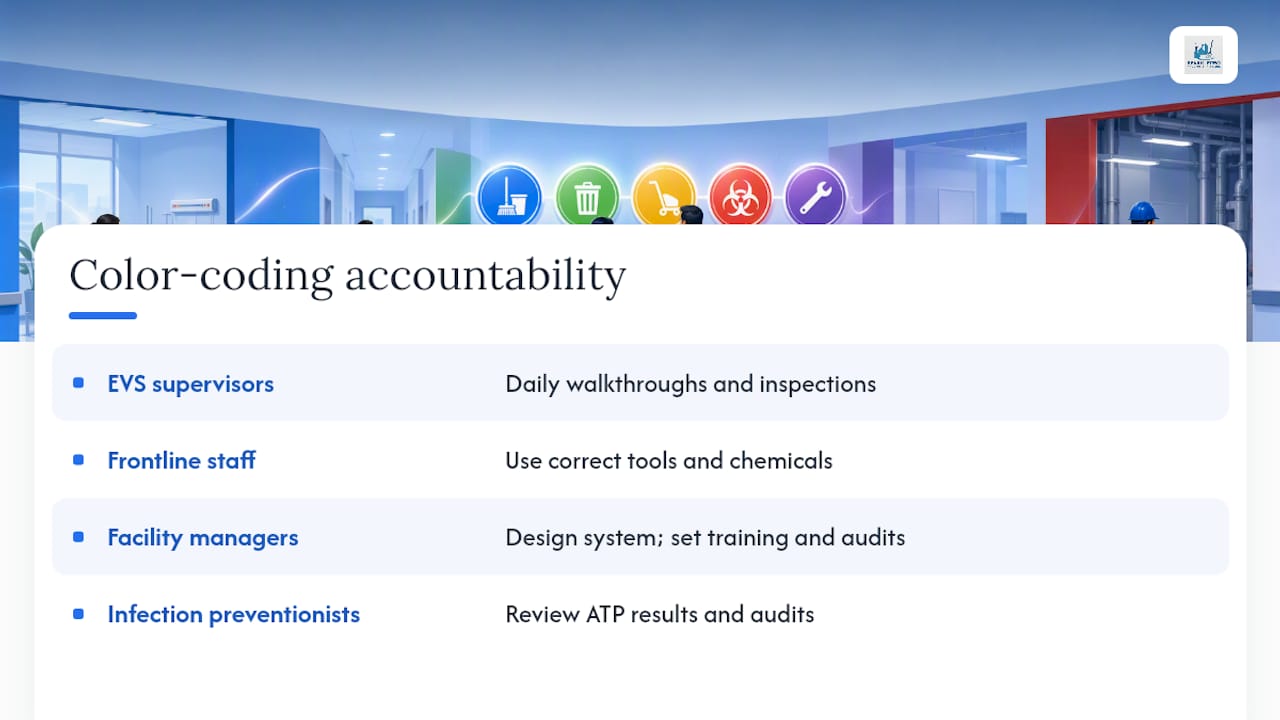
Frontline cleaning staff carry the actual execution: grabbing the right tool, using the right chemical, and flagging a faded or damaged item before it gets misused. Their buy-in depends heavily on how clearly the initial training explained the "why," not just the "what."
Facility managers and environmental-services directors own the system design: the zone map, the procurement spec, the training cadence, and the audit schedule. They are also the ones who decide whether a nationwide vendor or an in-house team runs day-to-day execution.
Infection preventionists, where a facility has one on staff, typically review ATP results and audit data to catch trends a busy supervisor might miss during a single walkthrough. Clear role separation, documented in the same file as your zone map, is what turns color coding from a poster on the wall into an actual operational control. This division of labor mirrors the sterility discipline expected in clinical settings focused on strict contamination control, where role clarity is just as central to preventing cross-contamination.
Does Color Coding Actually Reduce Cross-Contamination?
The strongest evidence available comes from the same four-color disposable wipe intervention referenced throughout this guide, and it is worth looking at from a different angle here: adoption speed. Staff in that MICU setting adapted to the four-color system quickly enough that surface cleanliness pass rates more than tripled within the study period, without requiring additional cleaning time per shift.
That pattern lines up with what facility managers report anecdotally after switching from ad-hoc color use to a documented, trained system: fewer disputes over whose tool caused a problem, fewer wasted minutes hunting for the "right" cloth, and cleaner audit scores within the first quarter. The operational guidance on color-coded implementation echoes this: facilities that pair color coding with consistent procurement and supervisory verification see compliance stick, while facilities that skip either piece see the system quietly decay within a year.
The honest caveat is that no single case demonstrates a direct, isolated drop in infection rates purely from color coding. What the evidence supports is narrower and still valuable: cleaner surfaces, faster audits, and fewer ambiguous cross-contamination incidents. That is a meaningful operational win even without a clean causal line to infection statistics.
Why Facility Teams Underestimate the Training Half of This System
Most facility managers get the color mapping right on the first try. Red, yellow, green, blue: it is not complicated, and CDC guidance makes the assignments obvious. Where programs actually fall apart is training, and specifically, the assumption that a single onboarding session is enough.
Staff turnover in environmental services runs high across the industry, which means your "trained" workforce from January might be 40% different by summer. A color-coding system without a documented refresher cadence quietly reverts to whatever the newest hires assume makes sense, and nobody notices until an audit catches a red cloth in the wrong closet. The annual refresher requirement tied to your exposure control plan is not paperwork theater. It is the mechanism that keeps the system from decaying as your roster turns over.
The other underestimated piece is procurement discipline. A color-coding system is only as reliable as the supply chain behind it, and switching vendors without a fixed color spec is how a "red" cloth becomes pink enough to cause a mix-up six months later. Facilities that treat procurement consistency as seriously as they treat the training schedule tend to keep their systems intact for years, not months.
— Sales
How Sparklepro Handles Color Coding Across Healthcare Accounts
Sparkleprocommercialcleaning builds color coding into its standard onboarding, not as an add-on. A site survey maps zones and chemical assignments before quoting, procurement locks in a fixed color spec, staff train on the map before their first shift, and scheduled audits keep the system honest over time. Facility teams evaluating a rollout on their own can review the sanitation workflow guide or the terminal cleaning protocols for the same operational detail Sparklepro applies on site.
Get a Color-Coding Program Running This Month
You can build this system yourself using the steps above, or hand the setup to a team that already runs it across numerous healthcare accounts nationwide. A professional commercial cleaning service can handle the site survey, set the procurement spec so every cloth and mop head matches on day one, train staff before go-live, and keep audits on a schedule so the system doesn't quietly decay six months in.

That kind of managed rollout matters most for facilities juggling color coding alongside a dozen other compliance priorities, where a fixed vendor relationship removes one more thing to track. If your facility operates in Delaware, Massachusetts, or Washington, request a site visit and get a zone map and quote before your next scheduled audit.
This article is general information, not a substitute for advice from a qualified doctor. Consult a qualified healthcare professional about your own circumstances before acting on anything here.
Sources
- Cleaning supplies and equipment | Healthcare-associated infections | CDC
- Reducing health care-associated infections by implementing separated environmental cleaning management measures by using disposable wipes of four colors (PMC)
- PubMed entry for the 4-color disposable wipes intervention study