
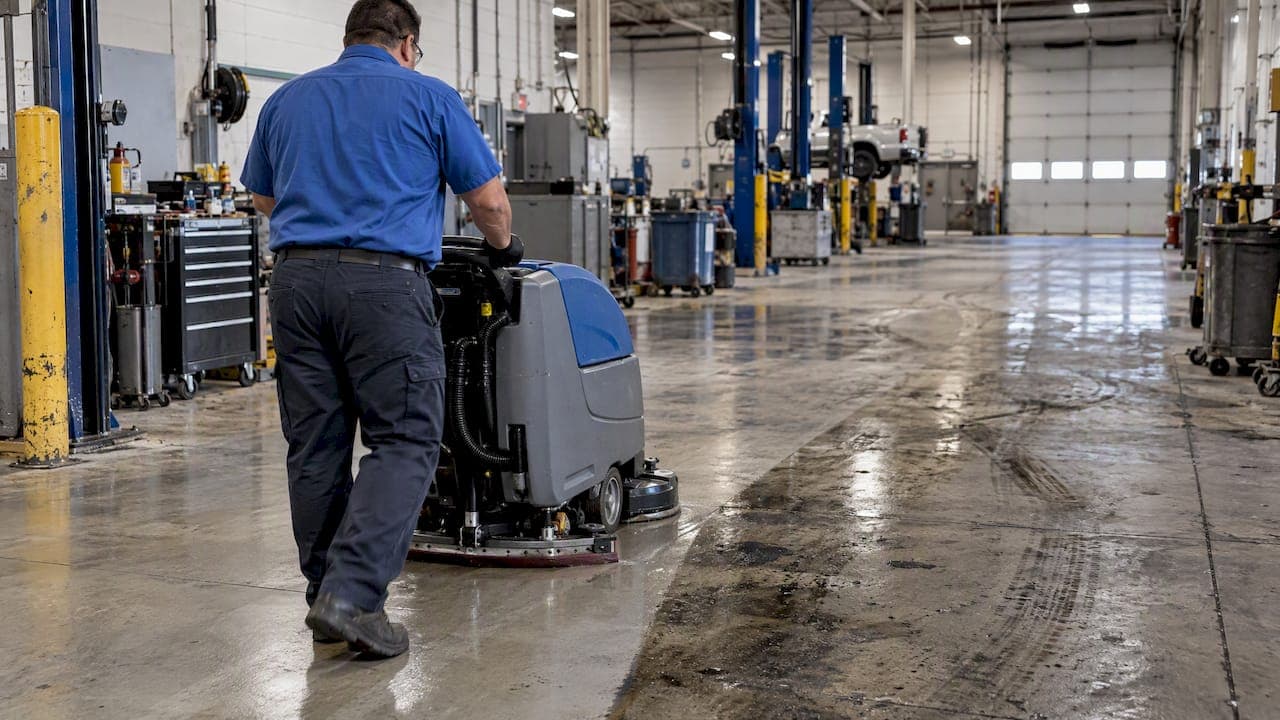
Use a heavy-duty alkaline or enzymatic degreaser at the correct dilution, work it in with an auto-scrubber or pressure-assisted scrubbing, and capture every drop of rinse water. OSHA requires clean, dry floors under 29 CFR 1910.22, and chemical use falls under 29 CFR 1910.1200. For large or complex jobs, we at Sparkleprocommercialcleaning can take it on.
TL;DR:
- Match the degreaser to both soil and flooring: alkaline products lift petroleum oils, enzymes suit food fats, while solvents need ventilation and PPE.
- Follow the product label for dilution and dwell time, then recover rinse water promptly; never let solution dry or assume one ratio fits every cleaner.
- Spot clean high traffic zones every shift, autoscrub production aisles weekly, and deep degrease docks and machinery areas monthly or quarterly based on use.
- Contain wash water and route it to a sanitary sewer or treatment, not storm drains; confirm local requirements before cleaning and evaluate unknown drain destinations.
Table of Contents
- Which degreaser type fits your floor and your soil?
- How do you apply degreasers by hand, by auto-scrubber, and by pressure washer?
- What dilution ratios work for light, medium, and heavy soils?
- What tools make degreasing faster and cleaner?
- What PPE, training, and OSHA rules apply when degreasing?
- Where does the rinse water go?
- How often should each zone be cleaned?
- What do you do when grease keeps coming back?
- How should degreasing chemicals be handled and stored on-site?
- How do you finish a job with proper post-degreasing treatment and drying?
- How much should industrial floor degreasing cost, and how do you budget for it?
- What is the step-by-step procedure for degreasing an industrial floor?
- Which flooring materials are safe for which degreasers?
- How can you degrease floors with less environmental impact?
- A nationwide cleaning provider's view: when should you bring in a pro?
- How can we help with your industrial degreasing project?
- FAQ
- Sources
Which degreaser type fits your floor and your soil?
Chemistry matters more than strength. The wrong product spreads a film of soil instead of lifting it, and that film is what people slip on. Match the formulation to what is actually on the floor.
- Alkaline degreasers break down petroleum oils and many greases by loosening them from the surface so they can be lifted away. They are the workhorse for production aisles, machine surrounds, and loading areas.
- Enzymatic cleaners digest organic oils, fats, and food residues. They suit food handling zones and areas where cooking oils or animal fats are the main soil.
- Solvent-based degreasers dissolve tar, heavy hydrocarbons, and baked-on residue. Use them with strong ventilation and the right PPE, and keep them for spot work rather than whole-floor cleaning.
- Citrus and water-based, low-VOC options handle lighter soils and finish-sensitive floors. They are gentler, which makes them a good fit for sealed or coated concrete.
Whatever you choose, read the label for floor compatibility before it reaches a full aisle. A stronger chemical is not always a better one, and a product that leaves residue will bring the problem back within days.
How do you apply degreasers by hand, by auto-scrubber, and by pressure washer?
The method should match the footprint and the soil load. Auto-scrubbers cover big open areas, pressure washing handles heavy buildup where wash water can be contained, and manual work covers spots and tight corners.
An auto-scrubber workflow runs like this:
- Pre-sweep to remove loose debris and grit that would clog pads.
- Apply the diluted degreaser and let it dwell for the time on the label.
- Fit the right pad or brush for the soil level.
- Scrub in overlapping passes so no strip is skipped.
- Recover the solution immediately so soil does not dry back onto the floor.
For pressure washing, keep pressure and temperature within what the floor surface can take, use a detergent feed for consistent dosing, and hold the wand at an angle that does not etch concrete or lift coatings. For manual work, apply with a mop or deck brush, scrub the soiled area, then squeegee and pick up the liquid promptly.
Pro Tip: Dwell time does the heavy lifting. Giving the product the full time on the label can make scrubbing easier, but never let it dry on the floor.
What dilution ratios work for light, medium, and heavy soils?
Dilution is where most programs either waste money or underperform. Use the dilution specified on your product's label, which overrides any general guidance.
- Ultra-concentrates need precise measuring. Eyeballing a pour wastes product and can leave a sticky residue that attracts new soil.
- Add chemical to water, not water to concentrate, wherever the label calls for it, and use warm water when the manufacturer recommends it.
- Label every mixing container clearly, and wear gloves and eye protection during mixing.
- Use a metered dispenser or a dilution control system to keep every batch the same.
Dilution depends on the product and soil. Follow the product's own instructions rather than relying on a universal standard.
What tools make degreasing faster and cleaner?
The right equipment keeps soil from simply moving from one spot to another.
- Pads and brushes: Soft nylon pads suit light soils and finished floors. Abrasive pads or stiff brushes handle heavy soils on bare or sealed concrete.
- Recovery equipment: Wet vacuums and recovery tanks capture rinse water and dissolved soil so they do not redeposit or head toward a drain.
- Pressure washer accessories: Fan-pattern nozzles and detergent feeders give consistent dosing and even coverage.
- Spill response kit: Absorbent pads or granules, deck brushes, and hand squeegees should sit within reach of every high-risk zone so a spill is dealt with in minutes.
Inspect pads and squeegee blades regularly. A worn blade leaves streaks of grease behind, and a clogged pad polishes soil into the floor instead of lifting it.
What PPE, training, and OSHA rules apply when degreasing?
Two OSHA standards anchor your program. The walking-working surfaces rule, 29 CFR 1910.22, requires clean and dry floors, and failing to deal with spills promptly is a primary cause of workplace injuries. The Hazard Communication Standard, 29 CFR 1910.1200, requires you to tell workers about the hazards of the chemicals they use.
- Chemical-resistant gloves, eye protection, and aprons for all mixing and application.
- Respirators when solvent products are in use, plus ventilation of the work area.
- Slip-resistant footwear for everyone on the floor during and after cleaning.
- Safety Data Sheets that are easy to reach, with workers trained to read them.
- A written spill response procedure that staff have actually practiced.
OSHA's housekeeping guidance lists clean, dry floors and immediate spill cleanup as ways to reduce slips and falls, and it advises cleaning one side of a passageway at a time. Guidance for incidental oil spills notes that hazardous waste response rules may not apply to small releases, but hazard communication still does, so training and PPE remain your responsibility.
Tracking gear matters too. A barcode-based PPE tracking approach helps prevent stockouts so crews are never tempted to work without gloves or eye protection. For a broader walkthrough, see our guide to industrial cleaning safety.
Pro Tip: Train on the actual products on your shelves. A generic safety talk may not stick as well as a walkthrough of your own SDS binder.
Where does the rinse water go?
Rinse water from degreasing is not ordinary mop water. The EPA's Clean Water Act summary frames industrial wash water as an industrial discharge, and EPA guidance points toward a "dry shop" goal: keep wash water volume low and keep it out of storm drains. Water carrying detergents and degreasers should go to a sanitary sewer or proper treatment.
- Seal or cover floor drains where feasible during cleaning.
- Use berms, portable troughs, and recovery pumps to contain and collect spent fluid. EPA's floor cleanup best practices even suggest simple items such as troughs to capture fluid for pumping out or recycling.
- Understand where your drains actually discharge. EPA's archived guidance on industrial floor drains and groundwater explains why drains that empty to soil may need to be evaluated, managed, or closed.
- Learn how your drain system is maintained. This overview of commercial drain maintenance shows what a proper evaluation involves.
When in doubt, call your local sewer authority before the first wash, and use a licensed contractor for treatment or disposal.
How often should each zone be cleaned?
Frequency should follow traffic and spill risk, not the calendar alone.
- Spill-prone and high-traffic zones: spot clean every shift and respond to spills the moment they happen.
- Production aisles: autoscrub weekly, and more often around food handling or vehicle areas.
- Docks, machinery surrounds, and grease-prone areas: deep degrease monthly or quarterly, depending on use.
- All zones: keep a checklist and log so you can show inspectors and auditors that cleaning is controlled and consistent.
Our notes on why clean manufacturing facility floors cover the uptime side of this schedule, and our manufacturing floor cleaning guide shows how to fit it around production.
What do you do when grease keeps coming back?
Most repeat problems come from a handful of causes.
- If grease reappears fast, suspect product residue or an incompatible floor finish. Switch to a residue-free degreaser and rinse thoroughly.
- For embedded oil, increase agitation, raise the dilution strength temporarily, or spot-treat with a compatible solvent, with PPE and ventilation in place.
- Prevent tracking by cleaning in sequence, from the cleanest area to the dirtiest, and by using recovery equipment so wet soil is not walked elsewhere.
- Test any new product or stronger mix on an inconspicuous patch before committing to a whole aisle.
How should degreasing chemicals be handled and stored on-site?
Storage is where good cleaning programs quietly fail. A container left open, unlabeled, or next to the wrong material turns a cleaning product into a hazard.
Start with the container. Keep products in their original labeled packaging, and label any secondary container you fill with the product name and hazard information, as the Hazard Communication Standard expects. Store concentrates on low shelves or in secondary containment trays so a dropped jug does not become a floor spill that needs its own degreasing.
Separate by chemistry. Keep strongly alkaline products away from acids and away from solvents, and keep solvent-based products away from heat, sparks, and open flame. Store them in a cool, ventilated space with doors that close, and keep oxidizers and flammables in different places.
Control access. Only trained staff should draw product, and a short sign-out routine tells you what is used where. Keep SDS binders or digital access near the storage point, not in a manager's office across the plant.
Handle with discipline at the point of use. Pour carefully, use funnels and metered dispensers, wear your PPE every time, and close containers immediately. Put an eyewash station and spill kit near the mixing area, and check them on a schedule.
Last, plan for what is left over. Leftover diluted solution should be used the same shift where possible, and expired or contaminated product should go to proper disposal rather than a floor drain.
How do you finish a job with proper post-degreasing treatment and drying?
A floor is not done when the scrubber stops. What happens afterward helps determine whether it is safe and whether the grease stays gone.
Begin with a clear-water rinse where the product calls for one. Leftover detergent is sticky, and sticky floors collect dust, oil, and tire residue faster than a clean surface does. Recover the rinse water with the scrubber or wet vacuum, working the squeegee toward the recovery path so no puddles remain in low spots or along walls.
Drying is a safety step, not a courtesy. Wet concrete and coated floors can be slick, so run extra recovery passes, use floor fans or air movers in enclosed areas, and keep warning signs up until the surface is fully dry. Close off the area or use partial-lane cleaning, so traffic does not cross wet sections.

Then inspect. Walk the floor and look for dull patches, streaks, or tacky spots, which signal leftover soil or residue. Spot-treat these while the equipment is still out.
Finally, consider protection. On sealed or coated floors, a compatible sealer, slip-resistant coating, or walk-off mat system at doorways reduces how much oil gets tracked in. Apply them only after the floor is fully clean and dry, following the coating manufacturer's cure times. Record the cleaning date, product, dilution, and any issues in your log so the next shift starts with the facts.
How much should industrial floor degreasing cost, and how do you budget for it?
Published prices for industrial degreasing vary too much to quote responsibly; current pricing details are on our website. Cost depends on the factors below, so the useful move is to understand the drivers and build a budget around them.
Square footage and layout. Large open floors are cheaper per square foot than cramped ones full of racking, machinery, and obstacles that slow equipment down.
Soil load. Light film from routine traffic is quick work. Heavy, embedded, or baked-on oil needs stronger chemistry, repeated passes, and more labor.
Floor type and condition. Porous or damaged concrete holds oil deeper and takes longer to treat than sealed surfaces.
Frequency. Regular maintenance cleaning keeps buildup shallow, which usually costs less over a year than occasional emergency deep cleans.
Wastewater needs. Containment, recovery, and proper disposal add labor and equipment, but they cost far less than a discharge violation.
Access and timing. Overnight or weekend work to avoid production downtime can change scheduling costs.
If you run the work in-house, budget for chemicals, pads, recovery equipment, PPE, training time, and the labor hours your team will not spend elsewhere. If you hire out, ask for an itemized quote that spells out scope, frequency, chemicals, and wastewater handling so you can compare bids on equal terms.
A good rule is to budget for prevention first. Daily spill response and a weekly autoscrub schedule are modest line items compared with a slip injury or a production stoppage.
What is the step-by-step procedure for degreasing an industrial floor?
Write this into a standard operating procedure and train every shift on it. Consistency is what makes results repeatable.
- Plan and notify. Pick the area, confirm the product and dilution, and tell nearby staff. Post wet-floor signs and block off the zone.
- Gather PPE and equipment. Gloves, eye protection, apron, slip-resistant footwear, and a respirator if solvents are involved. Stage the scrubber, pads, squeegees, wet vacuum, and spill kit.
- Check hazards. Review the SDS, confirm ventilation, and protect or cover floor drains as your wastewater plan requires.
- Remove obstacles and pre-sweep. Move equipment where possible, then sweep up loose debris and absorb any free-standing oil.
- Mix the solution. Measure to the right dilution for the soil level, adding chemical to water as directed, and label the container.
- Apply and dwell. Apply evenly and let it sit for the labeled dwell time without drying.
- Agitate. Use the auto-scrubber, brush, or pressure-assisted method, with extra attention on heavy spots.
- Recover. Pick up all solution and soil with the scrubber or wet vacuum before it dries.
- Rinse and dry. Rinse if the product requires it, recover the water, and dry the floor fully.
- Inspect, record, and clean up. Check for residue, log the work, rinse and store equipment, and dispose of waste properly.
Our construction cleaning safety guide includes checklist ideas that adapt well to this procedure.
Which flooring materials are safe for which degreasers?
The floor decides the chemistry as much as the soil does. A product that is perfect for bare concrete can dull, soften, or strip something else.
Bare or sealed concrete tolerates most alkaline degreasers and abrasive agitation, though porous bare concrete holds oil deeply and may need poultices or repeated treatment. Highly aggressive chemicals can still etch a sealed surface, so check the sealer.
Epoxy and urethane coatings are chemical-resistant but not immune. Strong solvents and harsh high-alkaline products can dull or soften them, and abrasive pads can scratch the gloss. Use the pad and chemistry the coating manufacturer recommends.
Sealed or finished floors generally call for gentler, residue-free, water-based, or low-VOC products, because aggressive cleaners can strip the finish and invite more soil.
Rubber, vinyl, and tile can swell, discolor, or degrade under strong solvents. Choose neutral or mild products and keep solvent contact brief.
Metal and diamond plate handle degreasers well but need thorough rinsing, since residue makes the surface slick.
Three habits protect any surface. Read the floor manufacturer's cleaning guidance, check the degreaser label for compatible surfaces, and test in a hidden corner before full application. Also match the pad to the surface, because the wrong pad can cause more damage than the chemical.

How can you degrease floors with less environmental impact?
Degreasing leaves a footprint through the chemicals you pick, the water you use, and where that water ends up. You can shrink all three without sacrificing results.
Start with chemistry. EPA's stormwater best practices for vehicle maintenance advise biodegradable, phosphate-free, water-based detergents and using as little detergent as needed. For floors, that points to enzymatic, citrus, and low-VOC water-based products where the soil allows. They will not replace a solvent on tar, but they cover many everyday jobs.
Use less water. Autoscrubbing with recovery uses far less water than flooding a floor with a hose, and a "dry shop" approach keeps wash water out of drains in the first place. Spot-clean spills with absorbents before they spread, so you rarely need a full wash.
Dose correctly. Overuse is the biggest source of waste. Metered dispensing means you apply what the floor needs and no more, which cuts chemical purchases, rinse volume, and residue.
Capture and route water properly. The EPA treats industrial wash water as an industrial discharge, so send it to a sanitary sewer or treatment rather than a storm drain, and confirm requirements with your local authority.
For facilities pursuing green building credentials, we offer eco-friendly cleaning options suited to LEED properties. Whichever route you take, document the products you use and the volumes you apply, because a clear record is the easiest way to show your program is under control.
A nationwide cleaning provider's view: when should you bring in a pro?
We think most facilities can run daily upkeep themselves, but some jobs justify outside help: a very large footprint, heavy and recurring oil loads, or a team without the PPE, training, or wastewater plan the work requires. An engagement may include a quote, a site visit, scheduled cleaning, and your approval of the finished work. The payoff is licensed, insured crews.
— Sales
How can we help with your industrial degreasing project?
If you would rather hand this off, our nationwide team can take it from start to finish.
- Licensed and insured crews, with local teams available.
- A simple process: quote, site visit, scheduled cleaning, and your approval.
- Custom plans and pricing built around your floor, your soil, and your schedule.
Request a quote or schedule a site visit and we will build the plan with you.
FAQ
How do you get rid of a greasy floor?
Apply an alkaline or enzymatic degreaser at the right dilution, let it dwell, agitate with a scrubber or brush, and recover the solution before it dries. Then rinse if the label calls for it and dry the floor fully. Residue left behind attracts new soil, so thorough recovery matters.
What is the best degreaser for a commercial kitchen?
Enzymatic and alkaline degreasers are common choices because kitchen soils are mostly cooking oils and fats. Pick a product rated for food-area use and compatible with your flooring. Follow the label for dilution and rinse, and check the Safety Data Sheet before use.
Which chemical is best for floor cleaning?
No single chemical wins everywhere. Alkaline products suit petroleum oils, enzymatic cleaners suit organic and food soils, and solvents suit tar and heavy hydrocarbons. Match the product to the soil and the floor, and train staff under the Hazard Communication Standard, 29 CFR 1910.1200.
Do warehouse floors get cleaned?
Yes. Warehouse floors need regular sweeping and autoscrubbing, plus immediate cleanup of spills. OSHA's floor rule requires clean, dry walking surfaces, so a documented schedule helps you stay compliant.