
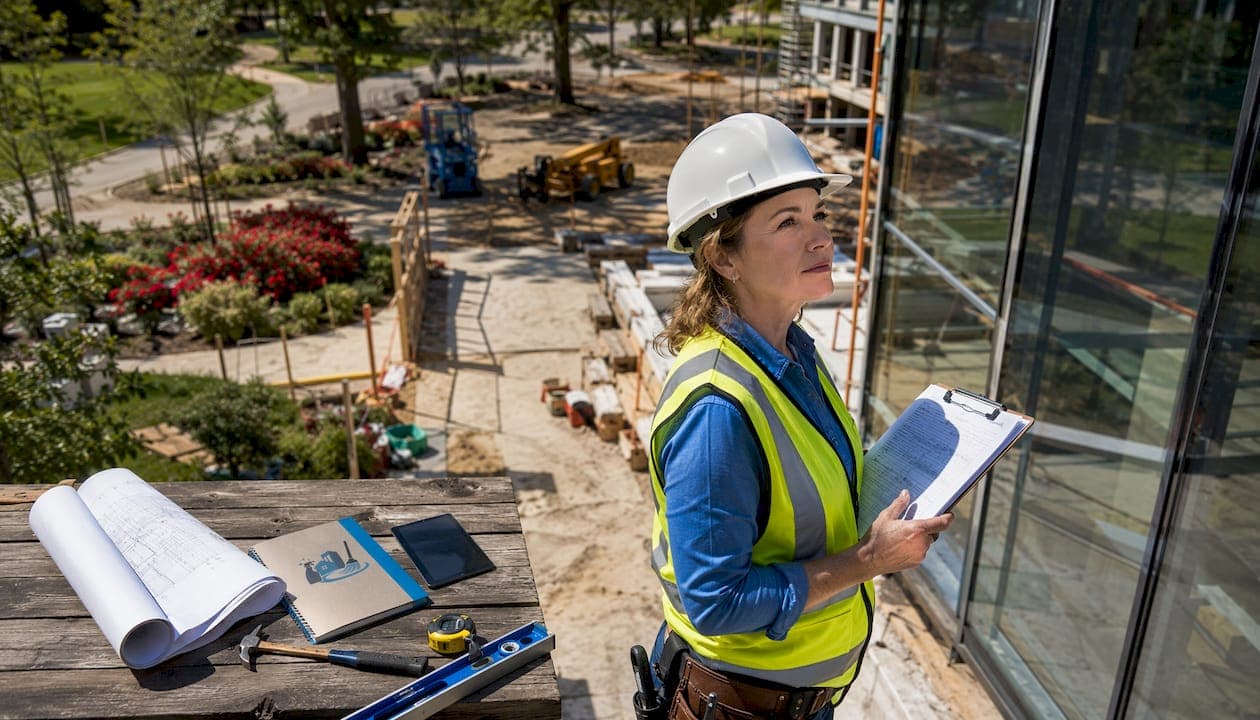
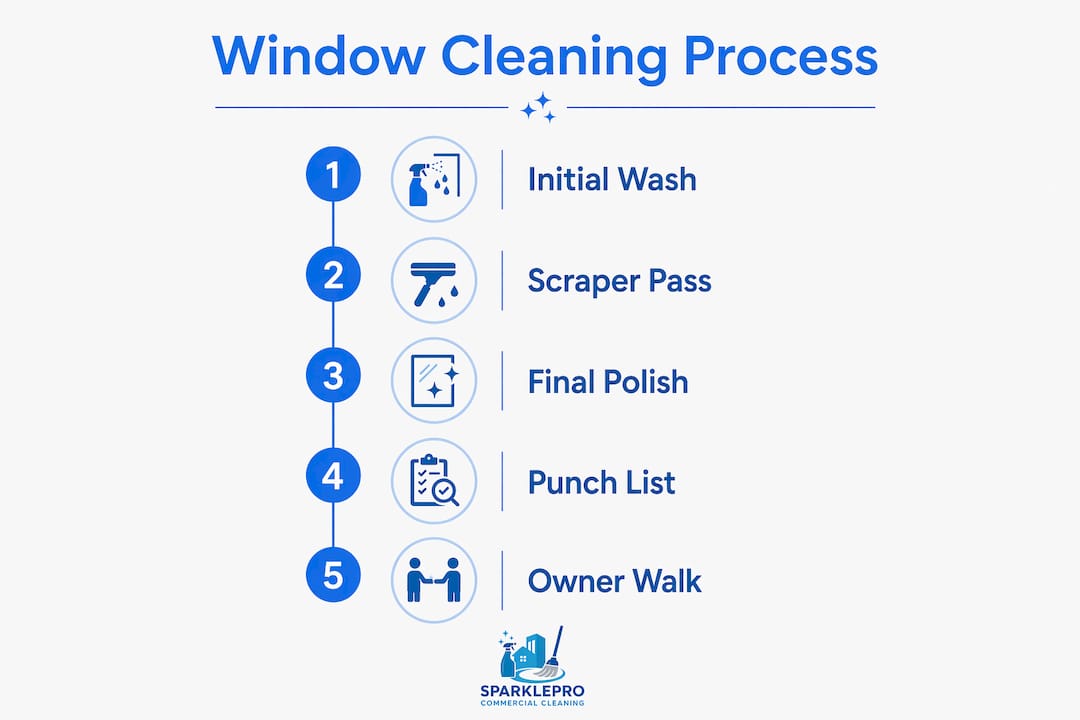
The new construction window cleaning process is a multi-phase restoration sequence covering dry particulate removal, targeted chemical or mechanical treatment, and precision washing with edge detailing. Schedule it a few days before owner walk-throughs or marketing photography, after final HVAC commissioning and interior painting are complete. That timing prevents recontamination from active trades while leaving enough cushion to address surprises before turnover — a key detail in effective contractor off-season marketing strategies for scheduling and project timing. The International Window Cleaning Association (IWCA) and glass manufacturers classify this work as a restoration service, not routine maintenance, which means specialist training, specific chemistry, and the right blade technique are non-negotiable.
Quick phase checklist:
- Dry particulate removal (HEPA vacuum, soft brush, track and sill clearing)
- Label and adhesive removal
- Paint overspray and mortar treatment
- Final wash, squeegee, and edge detailing
- Inspection against punch-list standards
Pro Tip: Book the cleaning crew for two visits: a final pass before the owner walk-through and a punch-list touch-up after. Sparkleprocommercialcleaning structures every commercial new-build engagement this way to catch residue that only appears once the building is lit and occupied.
Table of Contents
- What does the new construction window cleaning process actually involve?
- When should you schedule the final window clean?
- What equipment and chemicals do crews need, and what causes permanent damage?
- What site logistics and safety protocols does a large commercial project require?
- What should a professional post-construction window cleaning contract include?
- How do you vet and hire a qualified post-construction window cleaner?
- Key Takeaways
- What the field actually looks like
- Sparkleprocommercialcleaning handles your commercial new-build window cleaning
- Useful sources and further reading
What does the new construction window cleaning process actually involve?
Professional crews follow a defined sequence on site. Skipping or reordering a phase is where permanent glass damage starts.
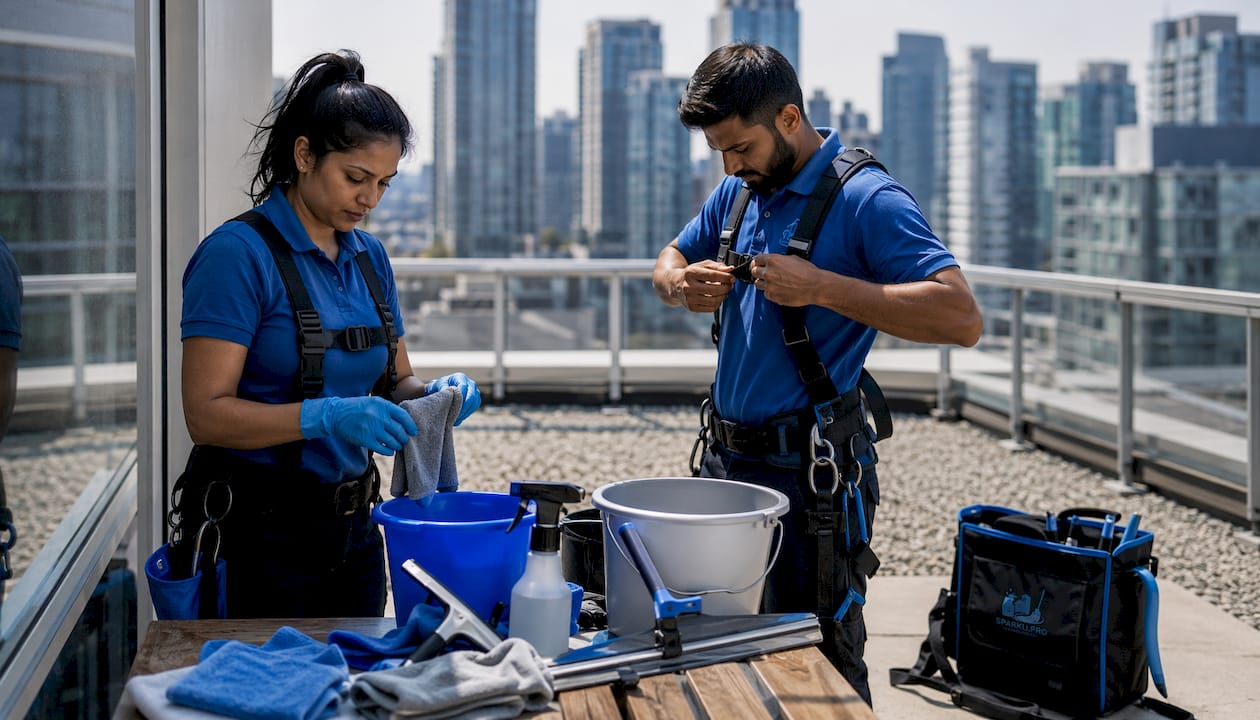
- Initial inspection. Technicians identify glass type (standard, low-E, coated, tempered), frame material, and contamination type before touching anything. Coated and low-E glass requires different blade protocols than standard float glass.
- Dry particulate removal. HEPA vacuums clear drywall dust, metal shavings, and sand from tracks, sills, and frames before any wet process begins. Dragging grit across glass under a wet scrubber is one of the fastest ways to scratch a new pane.
- Label and adhesive removal. Plastic scrapers and approved adhesive removers lift sticker glue and protective film residue. Razor blades are introduced only after the surface is fully wet and lubricated.
- Paint overspray and silicone treatment. pH-appropriate solvents dwell on the contamination, then a razor blade held at a low angle (typically 30 degrees or less) removes softened material. Dry-scraping un-rinsed glass is the single most common cause of permanent post-construction glass damage.
- Mortar and concrete haze treatment. Diluted masonry-specific removers (never full-strength acid on coated glass) dissolve mineral deposits. Crews check Safety Data Sheets and verify frame compatibility before applying any acid-based product.
- Final wash and squeegee. Deionized or distilled water with professional-grade squeegees removes streaks and mineral residue. Multiple wash-and-squeegee passes are standard because contamination hides in gasket edges and top seals, then runs back onto the glass.
- Edge and detail work. Tracks, corners, and frame edges get a final wipe. Construction debris in tracks sheds back onto clean glass after the crew leaves if this step is skipped.
- Punch-list inspection. Technicians check each pane in changing light. Some residue only appears from one angle or when direct sun hits the glass.
A note on blade use: GANA (Glass Association of North America) technical bulletins specify that blades should only contact fully wet, lubricated glass at a low angle, and that liability for scratches shifts to the cleaning contractor when those conditions are not met. Always confirm your vendor knows and follows this guidance.
Recommend including a before/after photo set or a simple process-flow diagram here to illustrate contamination types and phase sequence.
When should you schedule the final window clean?
Timing is the most common project failure point. If painters or HVAC crews work after the final clean, recontamination wipes out the cleaning value entirely and forces a remobilization.
The optimal window is a few days before substantial completion, after final HVAC commissioning and interior painting are done but before owner walk-throughs or marketing photography. For most commercial projects, that means building in a buffer of several days between the final clean and the handover date.
Typical commercial turnover sequence:
- Rough clean during mid-construction (after drywall, before flooring)
- Final clean pre-punch (after painting and HVAC commissioning)
- Punch-list touch-up after the owner walk-through
For exterior services, bundle power washing, parking lot cleaning, and window cleaning so they occur within the same short window. Freshly cleaned glass sitting next to an uncleaned parking structure collects airborne grit within days.
Coordination checklist:
- Confirm site access, power, and water availability
- Verify lift or scaffold availability and clearance from other trades
- Provide crew with trade contact list and dust-control measures
- Lock out painters and caulkers from cleaned zones
For more on aligning window cleaning with HVAC commissioning timing, the sequencing matters more than most PMs realize.
What equipment and chemicals do crews need, and what causes permanent damage?
Post-construction window cleaning requires a different kit than route maintenance work. Using the wrong tool on the wrong glass type causes damage that no amount of re-cleaning fixes.
Specialist equipment inventory:
- HEPA vacuums for dry particulate removal
- Lifts, scaffolding, or rope-access gear for high-rise facades
- Glass-safe razor blades (fresh, never reused) and plastic scrapers
- Deionized water systems for streak-free final rinse
- Low-pH and masonry-specific chemical products
- Microfiber applicators and professional squeegees
Common causes of permanent damage:
- Dry-scraping glass that has not been fully wetted and lubricated
- Using a razor blade at too steep an angle on coated or low-E glass
- Applying acid-based masonry removers to aluminum frames or incompatible coatings
- Reusing dull blades that drag rather than cut
IWCA and manufacturer guidance is clear: post-construction cleaning requires crews trained specifically in blade technique, chemical selection, and coating identification. A general maintenance cleaner without that training is a liability risk on a new-build project.
Manufacturers and industry groups such as GANA publish technical bulletins that specify safe blade techniques and define when liability for scratches shifts to the cleaning contractor. Require your vendor to demonstrate familiarity with those bulletins before signing a contract.
Pre-hire equipment and insurance checklist:
- Current Certificate of Insurance (COI) with adequate limits
- Equipment list including blade type and deionized water system
- SDS sheets for all chemicals used on site
- Proof of IWCA-aligned or equivalent training
What site logistics and safety protocols does a large commercial project require?
Large commercial facades add access complexity and chemical hazard risk that ground-level storefront work does not. A PM who does not confirm these items before mobilization day will lose time.
Access and staging:
- Confirm scaffold or lift clearance and load ratings
- Designate staging areas for deionized water systems and chemical storage
- Establish pathway protection to prevent tracking cleaning chemicals into finished interiors
- Define exclusion zones around active cleaning areas
Utilities and consumables:
- On-site potable water connection for deionized system feed
- Wastewater containment and disposal plan (some municipalities require it)
- Power for equipment charging and lighting in low-light interior zones
Chemical hazard note: Masonry removers and solvent-based adhesive removers require ventilation, PPE, and careful handling near aluminum frames and coated glass. Require the crew to present SDS sheets and confirm that technicians have completed hazardous chemical handling training before they bring product on site.
Required credentials to request:
- COI naming the GC or property owner as additional insured
- OSHA 10 or OSHA 30 card, or site-specific induction documentation
- Fall protection training certification for any work above 6 feet
- Proof of IWCA membership or equivalent specialist training
For a full breakdown of construction cleaning safety requirements that apply to vendor vetting, the OSHA standards for fall protection and hazardous chemical handling are the two most frequently cited gaps in contractor documentation.
What should a professional post-construction window cleaning contract include?
A site visit is required before any accurate quote on post-construction window cleaning. Quotes given without walkthroughs routinely understate passes, access equipment, and labor hours.
Heavy contamination can significantly increase cleaning time per window compared to standard maintenance. That difference drives cost more than any other single variable.
Pricing drivers to evaluate in bids:
- Building height and facade complexity (multiplies access cost)
- Contamination severity and type (mortar and silicone take longer than dust)
- Number of passes required (a multi-pass scope is standard on new builds)
- Access method (rope access costs more than ground-level work)
- Punch-list follow-up visits included or billed separately
| Pricing Factor | Effect on Cost |
|---|---|
| Building height / high-rise access | Significant increase; lift or rope-access adds labor hours |
| Heavy mortar or silicone contamination | Increases time per window; may require additional passes |
| Number of cleaning passes | Each additional pass adds proportional labor cost |
| Deionized water system requirement | Adds equipment mobilization cost |
| Punch-list follow-up visit | Separate mobilization charge if not scoped upfront |
Essential contract items:
- Defined scope by pass (rough, final, punch-list)
- Clear definitions of pre-final vs. final clean deliverables
- Rework and punch-list response time (a couple of days is reasonable)
- Liability clause for glass damage caused by improper technique
- COI and insurance requirements
- Mobilization and demobilization terms
- Wastewater handling responsibility
Document pre-existing glass conditions with photos before work begins. That record protects both the PM and the cleaning contractor if a damage dispute arises. For broader cleaning standards for new commercial builds, the contract language above aligns with current industry expectations.
How do you vet and hire a qualified post-construction window cleaner?
Pre-qualification checklist:
- Current COI with adequate limits and additional insured endorsement
- IWCA membership or documented equivalent specialist training
- References for at least two comparable commercial projects
- Written equipment list (blades, deionized water system, access gear)
- Sample scope of work showing three-pass structure
- Confirmed site visit policy before quoting
Key interview questions:
- How do you identify low-E or coated glass before using blades?
- What blade angle and lubrication protocol do you follow?
- Which acid-based products do you use, and how do you verify frame compatibility?
- What is your access plan for this facade height and configuration?
- Is the punch-list follow-up visit included in your base price?
Red flags:
- Quoting a price without scheduling a site visit
- Reluctance to provide COI or OSHA training documentation
- Promising a one-pass clean for a project with visible mortar or silicone contamination
- No mention of glass type identification before blade use
Sample RFP clause snippets:
- "Vendor shall conduct a site walkthrough prior to submitting a bid. Quotes submitted without a documented site visit will not be considered."
- "Scope shall include a minimum of three passes: rough clean, final clean, and punch-list touch-up. Each pass shall be defined separately in the proposal."
- "Vendor assumes liability for glass damage resulting from improper blade technique, dry scraping, or use of incompatible chemicals."
For additional guidance on crew supervision on construction sites, the sequencing and sign-off protocols matter as much as the cleaning itself.
Key Takeaways
The new construction window cleaning process requires a three-pass scope, specialist equipment, and precise scheduling after HVAC commissioning and painting to protect glass and deliver a punch-list-ready finish.
| Point | Details |
|---|---|
| Schedule after HVAC and painting | Final clean belongs after commissioning and painting are done, with a buffer of several days before handover. |
| Require a three-pass scope | Rough clean, final clean, and punch-list touch-up must each be defined separately in the contract. |
| Dry scraping causes permanent damage | Never allow blades on un-rinsed glass; wrong chemicals on coated glass are equally destructive. |
| Demand COI and IWCA-trained crew | Verify credentials, equipment list, and SDS sheets before mobilization day. |
| Sparkleprocommercialcleaning | Provides nationwide post-construction window cleaning with site visits, written quotes, and punch-list follow-ups built into every commercial engagement. |
What the field actually looks like
The gap between a well-written scope and what happens on site is where most post-construction window cleaning problems live. Painters finish a touch-up the morning after the final clean. An HVAC startup blows dust through an unsealed duct. A subcontractor props a ladder against freshly cleaned glass. These are not edge cases; they happen on most large commercial projects.
What prevents them is contract language with teeth, a PM who enforces trade sequencing, and a cleaning crew that knows how to document conditions before and after each pass. Sparkleprocommercialcleaning operates nationwide with full COI availability, conducts site visits before every quote, and provides written scope documentation that GCs can attach directly to their closeout packages. The punch-list follow-up is not an add-on; it is standard.
Sparkleprocommercialcleaning handles your commercial new-build window cleaning
Post-construction window cleaning on a large commercial project is not a line item to hand to the lowest bidder. The glass is new, the coatings are vulnerable, and one crew with the wrong blade protocol can turn a cleaning invoice into a glass replacement order.

Sparkleprocommercialcleaning delivers post-construction window cleaning for commercial new builds across the United States, with a structured three-pass scope, IWCA-aligned practices, full insurance documentation, and punch-list follow-up visits included. Every engagement starts with a site visit and a written quote so you know exactly what you are getting before a crew mobilizes.
- Site visits and written quotes before every project
- Three-pass scope (rough, final, punch-list) defined in the contract
- COI with additional insured endorsement available
- Nationwide coverage with local operational knowledge
Ready to get a quote for your project? Request a site visit and Sparkleprocommercialcleaning will confirm scope, access requirements, and pricing before your next milestone.
Useful sources and further reading
Industry standards and primary references:
- International Window Cleaning Association (IWCA) — Training standards, blade technique guidance, and contractor certification for post-construction and specialty cleaning.
- GANA (Glass Association of North America) — Technical bulletins on safe blade use, coating compatibility, and contractor liability for glass damage.
- OSHA Fall Protection Standards (29 CFR 1926.502) — Required fall protection training and equipment standards for window cleaning at height on commercial sites.
- Post-construction window cleaning process overview — Covers contaminant types, removal methods, and deionized water use for final cleaning.
- Scheduling and three-pass scope guidance for GCs — Practical timing guidance and contract scope recommendations for commercial new builds.
- Glass damage causes and blade risk — Documents the most common causes of permanent post-construction glass damage and time-per-window estimates.
- Bundling exterior services to prevent recontamination — Sequencing guidance for power washing, parking lot cleaning, and window cleaning on commercial projects.
Sparkleprocommercialcleaning internal resources:
- Post-construction cleaning process breakdown
- HVAC commissioning and window cleaning sequencing
- Commercial cleaning standards for new builds
- Construction site safety and vendor credential requirements