
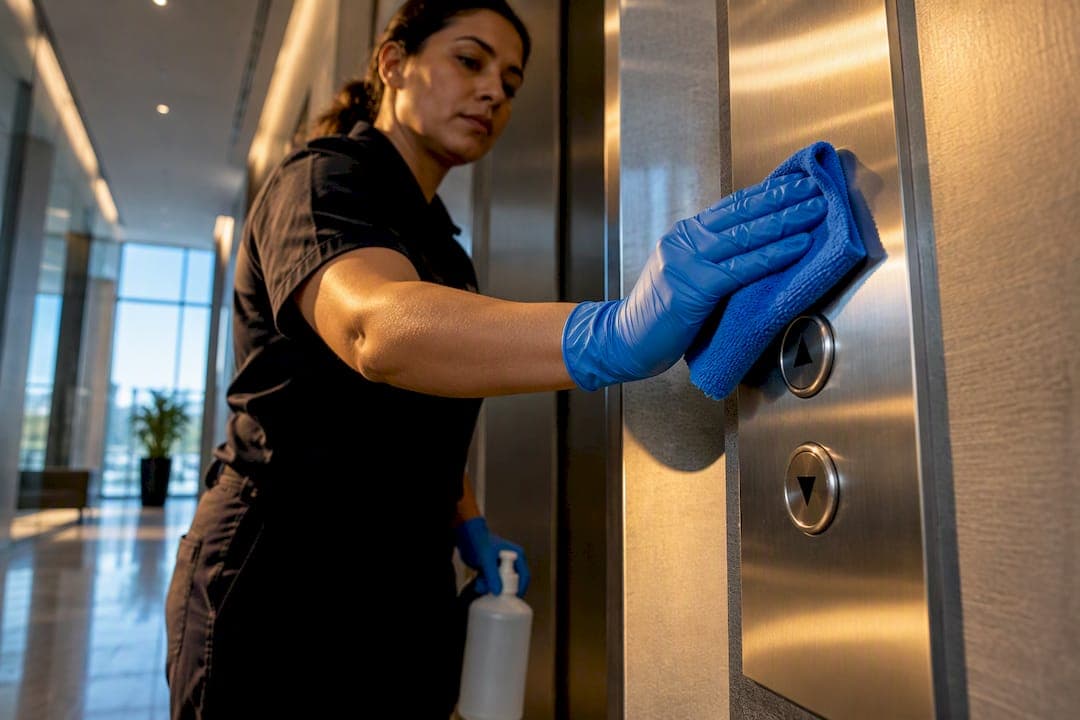
Clean high-touch surfaces once a day at minimum and disinfect shared touchpoints like door handles, light switches, and shared equipment on the same daily cadence. Increase that frequency in high-traffic zones, after a known illness event, or during a local outbreak advisory. Always follow the EPA-registered product's label contact time and your workplace's chemical safety rules before adjusting anything else.
TL;DR:
- Daily cleaning of desks, floors, and shared surfaces is essential to physically remove dirt before disinfecting high-touch points, ensuring disinfectants work effectively.
- Disinfection frequency should match exposure risk, with high-traffic areas like restrooms and lobbies needing multiple daily passes, while private offices usually require only weekly deep cleaning.
- Use EPA-registered disinfectants from List N and follow the label's contact time precisely, avoiding wiping surfaces too early to prevent invalidating the treatment.
- Proper training, safety data sheet access, and documentation are critical to maintaining an effective, compliant disinfection routine.
- Escalate disinfection efforts immediately after visible bodily fluids, confirmed illnesses, or during outbreak advisories, and consider professional services for larger-scale or emergency cleaning needs.
Table of Contents
- A risk-tiered disinfection schedule you can actually run
- Mapping high-touch surfaces across your floorplate
- Choosing and applying an EPA-registered disinfectant correctly
- Building the checklist: training, safety data, and audits
- When to escalate beyond the routine schedule
- What field experience teaches about disinfection routines
- Turning this schedule into a service you don't have to manage
- Sources
- FAQ
A risk-tiered disinfection schedule you can actually run
A single cadence for an entire building rarely makes sense. The CDC frames frequency around exposure opportunity: map your touchpoints and occupancy patterns first, then set a schedule rather than copying a generic interval across every room. That means routine cleaning happens daily throughout the office, but disinfection frequency should track how many hands touch a surface and how often.
Daily cleaning means wiping down desks, floors, and common surfaces with soap and water or a general-purpose cleaner to physically remove dirt and organic material. Disinfecting frequency for high-touch points should be determined based on exposure risk and product label instructions, ensuring proper contact time for efficacy. These are two different jobs, and skipping the first one weakens the second.
Here is how that plays out by space type:
- Private offices and low-occupancy suites: clean daily, disinfect shared touchpoints (door handles, light switches) once a day; a weekly deep clean of desks and surfaces is usually sufficient for single-occupant rooms.
- Open-plan areas, shared workstations, and conference rooms: clean daily, disinfect shared desks, keyboards, phones, and conference tables at least once a day, and add a midday wipe-down for hot-desking setups where multiple people rotate through the same seat.
- Reception areas, break rooms, restrooms, and high-visitor lobbies: clean and disinfect touchpoints multiple times per day, since door handles, faucet handles, microwave buttons, and countertops in these zones see the heaviest and most varied traffic.
Weekly or monthly deep cleans, carpet extraction, upholstery treatment, and behind-furniture cleaning, address buildup that daily routines miss. You can generally scale back disinfection frequency in low-traffic private offices once a stable routine is in place, provided no illness events occur, since the CDC's guidance notes that cleaning once a day is typically enough when no one with a confirmed or suspected illness has been in the space. If more than three days pass since a sick person occupied an area, no additional cleaning is needed for that specific event.
Mapping high-touch surfaces across your floorplate
Not every surface carries the same exposure risk, and treating them equally wastes labor on low-risk items while under-serving the busy ones. The CDC's guidance lists door handles, elevator buttons, touchpads, restroom fixtures, desks, counters, pens, and stair rails as common high-touch points that deserve daily attention at minimum.
A practical mapping approach takes three steps:
- Walk each zone and flag every surface multiple people touch in a normal day.
- Rank zones by foot traffic and shared use, not square footage.
- Assign disinfection frequency by rank, highest traffic gets the most passes.
Typical high-touch items include doorknobs and push plates, light switches, elevator buttons, shared printers and copiers, coffee makers, vending machine buttons, conference room tables, and shared keyboards or phones.
Personal electronics deserve a caveat. Laptops, personal cell phones, and individual keyboards do not need daily disinfecting by cleaning staff, since repeated moisture exposure can damage components, and the device typically has one user rather than many.
Pro Tip: Give each employee a small bottle of alcohol-based wipes for their own keyboard and phone, and reserve staff disinfecting time for genuinely shared surfaces.
Choosing and applying an EPA-registered disinfectant correctly
Frequency only works if the product works. Search EPA List N for disinfectants registered for institutional or office use, since List N entries specify approved use sites and the contact time each product needs to be effective. Contact times vary widely by product and claim, from seconds to many minutes, so the label determines what "disinfected" actually means for that surface.

Clean visible dirt and grime before disinfecting. The EPA's reopening guidance notes that routine cleaning with soap and water reduces contamination on its own and is a necessary first step, since disinfectant applied over visible soil cannot fully do its job.
A few operational rules keep the process safe and effective:
- Never mix cleaning chemicals; combining certain products creates dangerous fumes.
- Follow the safety data sheet and label instructions for gloves, ventilation, and other PPE.
- Keep the surface visibly wet for the full labeled contact time rather than wiping it dry early.
- For electronics and soft surfaces, use products labeled safe for those materials or fall back on 70% alcohol solutions when a commercial disinfectant isn't appropriate.
A frequent operational failure is wiping disinfectant away before the labeled contact time elapses, which invalidates the treatment entirely even though the surface looks clean. Crews need the product label or instructions available at the point of use, and schedules need to build in enough time for proper dwell. For more detail on getting this step right, see our guide to disinfectant dwell time compliance.
Building the checklist: training, safety data, and audits
A schedule on paper means nothing without a system behind it. Written checklists and dated logs turn a disinfecting routine into something you can verify, adjust, and defend if anyone asks what happened and when.
- Write out the daily, weekly, and monthly tasks for each zone, with named products and expected contact times.
- Keep safety data sheets accessible on-site and maintain a written hazard communication program under OSHA 1910.1200, which requires labels, SDS access, and employee training wherever hazardous cleaning chemicals are in use.
- Train every staff member who handles chemicals on dwell time, correct PPE, and safe handling before they start the job.
- Audit adherence on a regular cycle, spot-checking that logs match what actually happened on the floor.
Recordkeeping matters as much as the cleaning itself: shift logs, product lot numbers, and incident reports create a paper trail that protects both the facility and the people working in it. OSHA treats chemical safety as inseparable from the cleaning task itself, not an afterthought layered on top. Our construction cleaning safety guide covers SDS and training requirements in more depth for site managers building this system from scratch.
Pro Tip: A simple daily log with a supervisor's initials catches more missed tasks than any elaborate software system.
When to escalate beyond the routine schedule
Certain events call for immediate action outside your normal cadence, and recognizing them quickly matters more than the schedule itself.
- Visible bodily fluids on any surface require immediate isolation and cleanup, not a wait for the next scheduled pass.
- A confirmed contagious illness in the office means disinfecting the areas that person used, concentrating effort where they spent the most time.
- A public health outbreak advisory for your area is a signal to increase disinfection frequency across shared spaces generally.
- An unusually high foot-traffic day, an all-hands event or a large visitor group, warrants an extra disinfecting pass on lobby and restroom touchpoints.
In each case, isolate the area if needed, remove debris, clean, then disinfect with the appropriate product and full contact time, and notify occupants so they know what happened and what was done. For events beyond routine capacity, a professional deep clean or disinfecting service resets the space faster than stretching an in-house team thin.
What field experience teaches about disinfection routines
The most common failure we see isn't a missed day on the schedule. It's rushing the wet contact time, wiping a surface dry before the labeled minutes pass, or disinfecting without cleaning first, both of which undo the work entirely. Inadequate training on these two points causes more failed disinfection than any gap in frequency.
Cleaning schedules should be staged by client size and use case: a single-tenant office suite gets a leaner routine than a multi-tenant lobby with hundreds of daily visitors. The cadence matters less than whether the crew actually follows it correctly every time.
— Sales
Turning this schedule into a service you don't have to manage
Building and auditing a disinfection schedule takes ongoing attention that most facility teams don't have spare hours for. Disinfecting services can fold into the same visit as routine janitorial work, so high-touch zones get covered without adding a separate vendor to manage.
- Recurring janitorial and scheduled disinfecting for daily and weekly cadences.
- Deep cleans for periodic resets beyond the routine schedule.
- Day porter services for continuous coverage in high-traffic buildings.
Getting started follows four steps: request a quote, schedule a site visit, set up the recurring work, and approve the plan before it begins. Get a quote to see how a scheduled disinfecting routine fits your building.
Sources
- When and How to Clean and Disinfect a Facility | CDC
- CDC’s Cleaning and Disinfecting Guidance (downloaded via OSHA)
- List N advanced search: Disinfectants for coronavirus (COVID-19) | US EPA
FAQ
How often should offices be cleaned?
Routine cleaning should happen at least once daily, with high-touch surfaces like desks, door handles, and shared equipment cleaned and disinfected on that same daily basis according to CDC guidance. High-traffic zones such as restrooms and lobbies often need more frequent passes throughout the day.
What are the CDC guidelines for disinfecting?
The CDC advises cleaning high-touch surfaces regularly and notes that cleaning once a day is usually enough when no one with a known illness has been in the space. Disinfection should target areas where someone has been visibly sick, using an EPA-registered product for the full labeled contact time.
How long does it take to clean a 2,000 square foot office?
The time required depends on the layout, the number of high-touch points, and whether disinfecting is included alongside general cleaning, so there's no single fixed duration that applies universally. A site visit is the most reliable way to get an accurate time estimate for a specific space.
What is the 20/10 rule for cleaning?
Definitions of this rule vary across cleaning industry sources, and it is not a standard defined by the CDC, EPA, or OSHA. Facility teams sometimes use it informally to describe spending short, focused bursts of time on a task, but there's no single authoritative version worth citing as a fixed standard.
How do I choose the right disinfectant for an office?
Search EPA List N for products registered for institutional or office use, then check the label for the specific contact time required. Clean the surface first to remove visible soil, since disinfectant applied over dirt won't work as intended.