
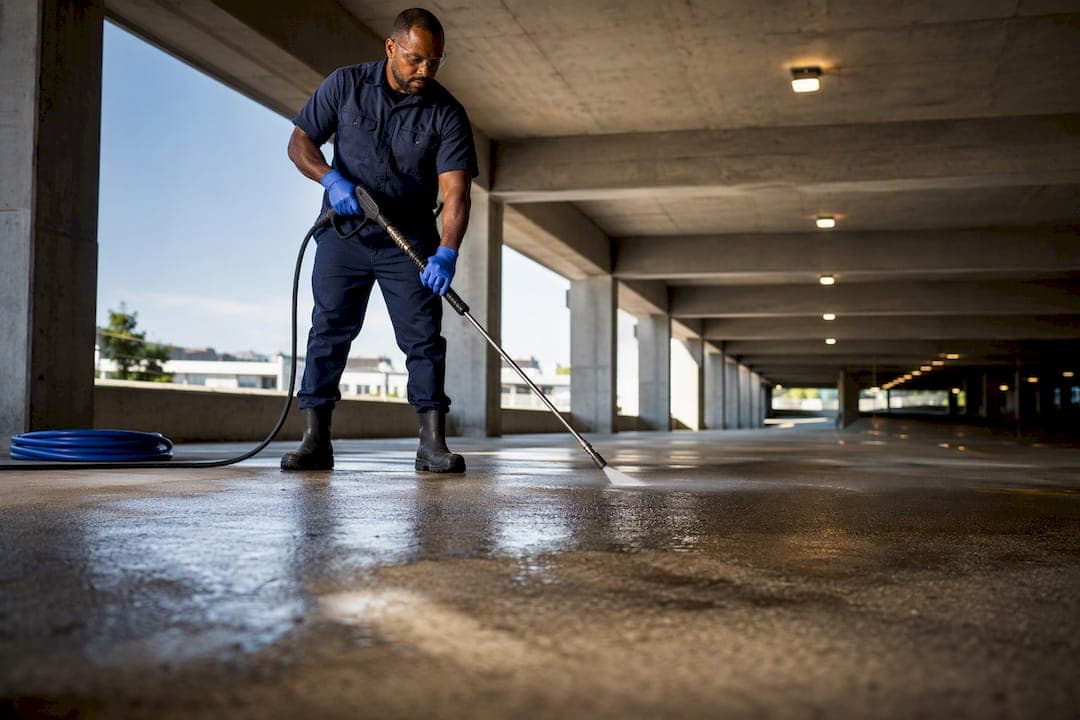
Hire a professional parking garage cleaning service that combines hot-water pressure washing, commercial-grade degreasers, and controlled drain management, rather than a basic cold-water rinse. Most structures need this treatment on a regular schedule, with high-traffic garages cleaned more frequently. The fastest way to see what your building actually needs is to request an on-site estimate and let a crew walk the deck with you.
TL;DR:
- Using hot-water pressure washing with degreasers is essential to fully remove polymerized oil and tire marks, unlike pressure alone which merely spreads dirt.
- Stain-specific treatments, such as poultice for set-in oil or acid for rust, offer better results and cost less than repeated pressure washing.
- Scheduling cleaning deck-by-deck or lane-by-lane preserves parking capacity and minimizes disruptions, especially during off-peak hours.
- Choosing a licensed, insured company that provides clear chemical information, proof of disposal methods, and on-site walkthroughs reduces risks and ensures quality work.
- An on-site estimate is the most effective way to identify actual garage needs and avoid generic square-footage pricing, especially for properties in Delaware, Massachusetts, or Washington.
Table of Contents
- What Does Professional Parking Garage Cleaning Include?
- Why Hot Water and Degreasers Outperform Pressure Alone
- Which Treatment Fits Which Stain?
- How Do Crews Schedule Cleaning Without Shutting Down the Garage?
- What Drives the Cost of a Parking Garage Cleaning Quote?
- How Do You Vet a Parking Garage Cleaning Company?
- Sparklepro's Approach to Parking Garage Cleaning
- Ready for a Cleaner, Safer Parking Structure?
- Where These Recommendations Come From
- Sources
What Does Professional Parking Garage Cleaning Include?
A real parking garage cleaning proposal covers more than a hose and a broom. Vendors typically start with dry sweeping to pull loose debris, sand, and grit off the deck before any water touches the surface, since wet sand turns into an abrasive slurry that just gets pushed around.
From there, the scope usually includes:
- Hot-water pressure washing across drive lanes, ramps, and parking stalls
- Chemical degreasing applied to oil-stained and tire-marked areas before rinsing
- Spot treatment for rust, efflorescence, and stubborn tire marks
- Drain and grate cleaning, with runoff captured or contained rather than sent into storm drains
- Optional water reclamation equipment on sites with tight environmental restrictions
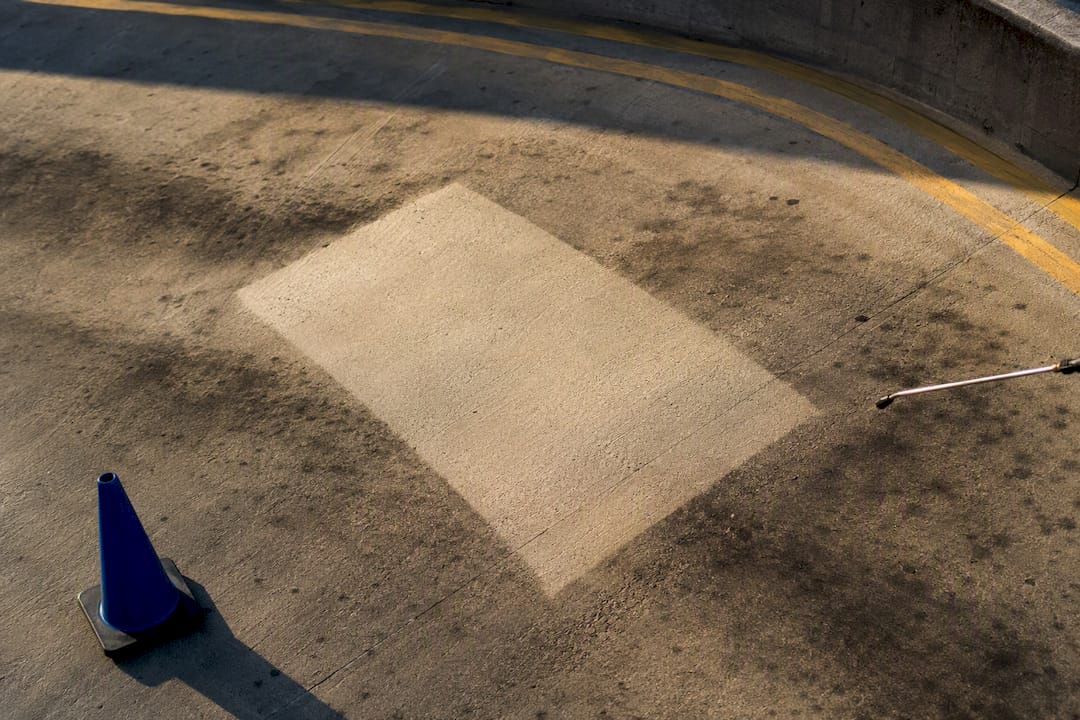
- Before-and-after photos, a written maintenance schedule, and a post-job walkthrough
That walkthrough matters more than it sounds. It's your chance to catch a missed stall or a drain that's still clogged before the crew packs up, not two weeks later when a tenant complains. Garage cleaning also connects directly to broader floor maintenance in commercial buildings, since a clean deck slows the concrete degradation that shortens a structure's useful life.
Why Hot Water and Degreasers Outperform Pressure Alone
Pressure alone moves dirt. It doesn't dissolve it. That distinction explains why so many garages get pressure washed every year and still look stained.
Heat is the working ingredient most property managers underestimate. Crews running hot-water pressure washing at temperatures up to roughly 200°F are relying on that heat to thin out oil, making it far easier for a degreaser to grab onto the hydrocarbons and lift them off the concrete instead of just spreading them into a bigger, fainter stain. Cold water pushes oil around. Hot water breaks it down.
The chemistry side splits by stain type:
- Alkaline degreasers target polymerized motor oil that's bonded to the concrete pores
- Citrus or solvent-based cleaners work better on rubber transfer from tire marks
- Mechanical agitation and large surface-cleaner attachments speed up coverage on big decks
- Enzyme or microbial treatments offer a gentler option for lingering residue where harsher chemicals aren't ideal
Pressure washing without degreasing is a common and expensive mistake, since it commonly fails to fully remove polymerized oil or tire marks no matter how many passes the crew makes. Cleaning a garage floor is chemistry plus agitation, not water pressure by itself.
Pro Tip: Ask any vendor whether their quote includes degreasing chemicals as a separate line item. If it doesn't, you're likely paying for a rinse, not a clean.
Which Treatment Fits Which Stain?
Not every dark patch on a parking deck is the same problem, and treating a fresh oil drip like a decade-old stain wastes time and money. Reading the stain correctly before a crew shows up saves a round of trial and error.
| Stain type | Visual cue | Treatment approach | Realistic outcome |
|---|---|---|---|
| Fresh oil | Dark, still slightly wet or tacky | Absorbent powder, then degreaser rinse | Full removal in one pass |
| Set-in/polymerized oil | Dry, dull, sunk into the concrete pores | Poultice: absorbent paste sealed over the stain for a dwell period | Significant lightening, sometimes near-total removal |
| Tire marks | Black streaks, often curved | Citrus or solvent-based cleaner with agitation | Full removal in most cases |
| Rust | Reddish-orange, often near expansion joints | Acid-based rust remover, applied carefully | Full removal with proper dwell time |
| Efflorescence | White, chalky mineral bloom | Diluted acid wash or specialty efflorescence cleaner | Full removal, may recur if moisture source isn't fixed |
| Old paint/striping residue | Faded painted lines or overspray | Mechanical scraping plus solvent | Full removal, prep for restriping |
For deep-set oil, the poultice method beats repeated pressure washing because it draws the oil out of the concrete pores rather than blasting the surface. After cleaning, sealing the concrete with a penetrating or polymeric coating cuts down on future staining and makes the next cleaning cycle faster. Acid and solvent treatments need proper ventilation and disposal, and a licensed crew should handle both.
How Do Crews Schedule Cleaning Without Shutting Down the Garage?
Nobody wants to close an entire parking structure for two days. Professional crews handle this with staged scheduling rather than an all-at-once shutdown.
- Clean deck-by-deck or lane-by-lane, which commonly preserves roughly half the garage's parking capacity while work is underway.
- Schedule the noisiest, wettest work during off-peak or overnight hours, and notify tenants in advance so parked vehicles get moved.
- Walk the site beforehand to confirm vehicle removal, place signage, and map access points for hoses and equipment.
- Plug or "type" drains before washing begins to contain wastewater on-site rather than letting it run into storm systems.
A written pre-job checklist shared with tenants ahead of time prevents the most common complaint on garage cleaning day: someone's car getting boxed in.
What Drives the Cost of a Parking Garage Cleaning Quote?
Square footage and the number of levels set the baseline price, but they're rarely the only factors that move a number up or down. Stain severity matters just as much. A garage with years of untreated oil and rust needs more chemistry, more dwell time, and more hot water than one that's been cleaned annually.
Access constraints add cost fast. Structures needing lifts, extended hose reach, or complicated mobilization around low ceilings or tight ramps cost more to service than a flat, open deck.
Watch for these line items in a proposal:
- Mobilization and equipment setup fees
- Pre-treatment and degreasing chemicals, priced separately from the wash itself
- Pressure washing labor, typically billed by square footage
- Wastewater collection and disposal, especially where local rules require containment
- Traffic control or signage costs for occupied garages
Recurring contracts usually price lower per visit than a one-time deep clean, since a garage on a maintained schedule never reaches the worst-case staining that drives up labor and chemical costs.
How Do You Vet a Parking Garage Cleaning Company?
Ask direct questions before signing anything. Does the crew use hot water, and at what temperature? What degreaser chemistries do they carry for oil versus tire marks? What's their plan for wastewater, and can they name the disposal method? Do they carry a certificate of insurance, and can they provide references from similar properties?
Red flags show up fast in these conversations:
- Vague or evasive answers about where runoff goes
- No offer of an on-site walk-through before quoting
- No proof of insurance or licensing
- No before-and-after photos from past jobs
Trust signals work the other way: a written safety plan, a documented site-walk report, a service guarantee backed by a follow-up inspection, and client references you can actually call.
Pro Tip: Before committing to a full-building contract, pilot the work on one high-traffic deck or entry ramp first. It gives you a real before-and-after baseline and shows whether the crew's claims match their results.
Sparklepro's Approach to Parking Garage Cleaning
A professional commercial cleaning company typically follows a four-step process: quote, site visit, scheduled cleaning, and customer approval. That site visit isn't a formality. It's where a crew catches the difference between a light annual rinse and a garage that needs poultice work on a decade of oil. Operating across multiple locations means multi-site portfolios can receive consistent quality checks, reducing surprises related to slip-and-fall risk, appearance, and long-term concrete health.
— Sales
Ready for a Cleaner, Safer Parking Structure?
You've seen what separates a real degreasing job from a surface rinse. Licensed and insured crews typically arrive equipped with hot-water equipment, appropriate stain-specific chemistry, and a drain management plan to maintain compliance, helping avoid the confusion of vague quotes. An on-site estimate means a real person walks your deck, flags problem areas like set-in oil or failing drains, and prices the job against what your garage actually needs rather than a generic square-footage number.

Most properties land on an annual or biennial cleaning cadence, with high-traffic garages moving to a tighter schedule after that first visit. If you manage property in Delaware, Massachusetts, or Washington, you can start with a free on-site estimate for Delaware properties, a Massachusetts site visit request, or a Washington garage cleaning quote. Wherever your portfolio sits, requesting that first walkthrough is the fastest way to find out what your garage actually needs.
Where These Recommendations Come From

The cleaning frequency and structural preservation guidance here draws from reporting on how routine cleaning helps concrete reach its full lifespan, which ties buildup of salt and sediment directly to steel corrosion inside the concrete. The hot-water and drain-management details come from operational reporting on parking garage cleaning schedules, and the poultice method for old oil stains is detailed in a technical guide to concrete restoration. For readers managing related building systems, a look at commercial maintenance fundamentals and hydro jetting for commercial plumbing rounds out the picture of how drain and surface systems interact on a maintained property.
Sources
- Parking garage cleaning schedule — Parking Professional
- How to clean a garage floor: The complete guide to oil stains, tire marks & concrete restoration (2026) — Pro Garage Gear