

Cleaning management for commercial portfolios is a consolidated, portfolio-level program that standardizes scope of work, quality assurance, billing, and vendor management across multiple properties under a single operational framework. Instead of each building running its own janitorial contract with its own vendor, invoice cycle, and inspection process, a portfolio program pulls everything into one structure. The core components are standardized SOW templates by building type, a master contract with per-site schedules, centralized billing, digital QA dashboards with defined KPIs, and portfolio-level certification options. Done right, this model reduces administrative overhead, stabilizes labor costs, and measurably improves tenant satisfaction. Industry organizations like ISSA, GBAC STAR, and the Cleaning Accountability Foundation (CAF) provide the certification frameworks that give investors and procurement teams confidence in the program's rigor.
- Standardized SOW templates by building type and service frequency
- Single master contract with site-level schedules and SLAs
- Centralized billing and consolidated invoicing
- Digital QA with scored inspections, photo proof, and KPI dashboards
- Portfolio-level certification options (CIMS, GBAC STAR, CAF Portfolio Certification)
Table of Contents
- What cleaning management for commercial portfolios actually covers
- Why portfolio-level cleaning programs pay off
- What you need to standardize across every site
- Which certifications should you require at the portfolio level?
- How to move from fragmented vendors to a portfolio program
- How portfolio contracts and pricing actually work
- Which KPIs and tools actually reduce your verification burden?
- Common problems and how to fix them before they stall your program
- How Sparkleprocommercialcleaning operationalizes portfolio cleaning
- Key Takeaways
- Why the systems matter more than the people you hire
- Sparkleprocommercialcleaning handles the program so you manage outcomes
- Useful sources for procurement, certification, and operational guidance
What cleaning management for commercial portfolios actually covers
Traditional single-site janitorial is simple: one building, one vendor, one scope. The property manager approves an invoice monthly and calls when something goes wrong. Portfolio cleaning management is a different model entirely. Here, the property owner or manager controls the SOW, owns the QA process, and holds a master agreement that governs every site. The vendor executes; the program governs.
Typical services bundled into a portfolio program include daily janitorial, day porter coverage, floor care (stripping, waxing, and refinishing), window cleaning, specialized disinfection, post-construction cleanouts, and tenant move-out turns. For industrial or healthcare sites, surface compliance and preparation work often sits alongside routine cleaning. Construction cleaning safety requirements add another layer for new builds or renovation projects.
The model applies most clearly at 10 or more sites, but the operational pain shows up earlier. Manual systems tend to collapse somewhere between 5 and 10 sites, when coordination overhead outpaces what a spreadsheet and a group text can handle. Portfolio configurations vary: a geographic cluster of office parks in one metro, a national rollup of retail locations, or a mixed-use portfolio combining multifamily, industrial, and medical office buildings. The program design adapts to the shape of the portfolio, but the underlying structure stays the same.

Why portfolio-level cleaning programs pay off
The financial case is straightforward. A managed, portfolio-level approach consolidates vendor oversight, reduces invoice volume, and creates predictable spending patterns for facility finance teams. Instead of reconciling 20 separate invoices with 20 different line-item structures, accounts payable works from one consolidated monthly statement. That alone reclaims hours of management capacity every week.
Beyond billing, the operational gains compound:
- Single point of contact for escalations, scheduling changes, and service additions across all sites
- Bulk purchasing leverage on supplies, equipment, and consumables that individual sites cannot access
- Stabilized labor rates locked into a master agreement, insulating the portfolio from spot-market volatility
- Consistent standards across buildings, which directly affects tenant renewal decisions and asset preservation
Professional cleaning also protects the physical asset. Consistent cleaning reduces pathogen transmission risk, preserves flooring and carpet life, and supports the workplace reputation that tenants use when deciding whether to renew. For investors, that translates to lower capital expenditure on floor replacement and stronger NOI.
The compliance angle matters too. A portfolio program with documented SOPs, digital inspection records, and third-party certifications gives risk and legal teams auditable proof of service. When a tenant raises a health or safety concern, the response is a dashboard report, not a phone call to a vendor who may or may not have records.
What you need to standardize across every site
Getting a portfolio program to hold together operationally requires standardizing five things. Miss one and the program fragments back into site-by-site chaos within a year.
- SOW templates by building type: Office, retail, healthcare, and industrial each need a baseline scope with defined frequencies. A single generic SOW applied everywhere creates gaps and overspend simultaneously.
- Digital SOPs accessible to field staff: Paper binders do not scale. SOPs need to live in a system field supervisors can access on a phone, with version control so every site runs the current procedure.
- Centralized procurement and inventory visibility: Supplies, equipment, and PPE ordered site-by-site at retail pricing is a hidden cost center. A centralized procurement model with approved vendor lists and par-level tracking cuts that waste.
- Master contract with SLAs, escalation paths, and KPIs: The contract is the program's backbone. It should define response time requirements, performance credit triggers, staffing minimums, and substitution rules for every site.
- Staffing and workforce systems: Onboarding modules, training records, and a standing recruitment pipeline are not HR niceties. They are operational infrastructure. Without them, a single resignation at a critical site becomes a service failure.
Pro Tip: Build your SOW templates before you sign the master contract. Vendors price what they see. A vague scope gets a padded price; a detailed, frequency-specific SOW gets a competitive one. Review commercial cleaning standards as a baseline before drafting.
Which certifications should you require at the portfolio level?
Certifications serve two functions: they verify that a vendor's management systems meet a defined standard, and they give procurement teams and investors a defensible basis for vendor selection. Here is what each major credential covers.
| Certification | Issuing Body | What It Evaluates | Best Used For |
|---|---|---|---|
| CIMS (Cleaning Industry Management Standard) | ISSA | Management systems, quality, service delivery, human resources, and environmental stewardship | Vendor pre-qualification; baseline management standard |
| CMI (Cleaning Management Institute) | ISSA | Training and professional development for cleaning managers and supervisors | Staff competency verification; supervisor credentialing |
| GBAC STAR Facility Accreditation | GBAC / ISSA | Infection prevention protocols, cleaning procedures, and emergency response for facilities | Healthcare, food service, high-traffic facilities; investor reporting |
| CAF Portfolio Certification | Cleaning Accountability Foundation | Procurement, management, and delivery of contract cleaning across multiple properties | Portfolio-level procurement; multi-site investor assurance |
ISSA positions GBAC STAR as the standard for facilities demonstrating commitment to infection prevention and high-performance cleaning. CIMS and CMI sit at the vendor level, verifying that the cleaning company's management systems and staff training meet a defined threshold.
CAF Portfolio Certification operates differently. It assesses the procurement, management, and delivery of cleaning services across a portfolio of properties. To qualify, at least 20% of buildings in the portfolio must be CAF-certified, in process, or have an accepted application, and the portfolio must demonstrate active contractual relationships with cleaning contractors at all buildings.
When to require each:
- Require CIMS at the RFP stage as a baseline management systems check for any vendor bidding on five or more sites.
- Require CMI credentialing for supervisors assigned to healthcare or high-compliance facilities.
- Require GBAC STAR for any facility where infection control is a tenant requirement or investor covenant.
- Pursue CAF Portfolio Certification when the portfolio exceeds 10 buildings and you need a third-party attestation for investor or lender reporting.
Training-based credentials (CMI) are appropriate for individual staff verification. Formal third-party accreditation (CIMS, GBAC STAR, CAF) is what belongs in procurement language and investor reporting. Why certifications matter for vendor selection goes deeper than a checkbox; it signals that the vendor's systems will hold under audit.
How to move from fragmented vendors to a portfolio program
-
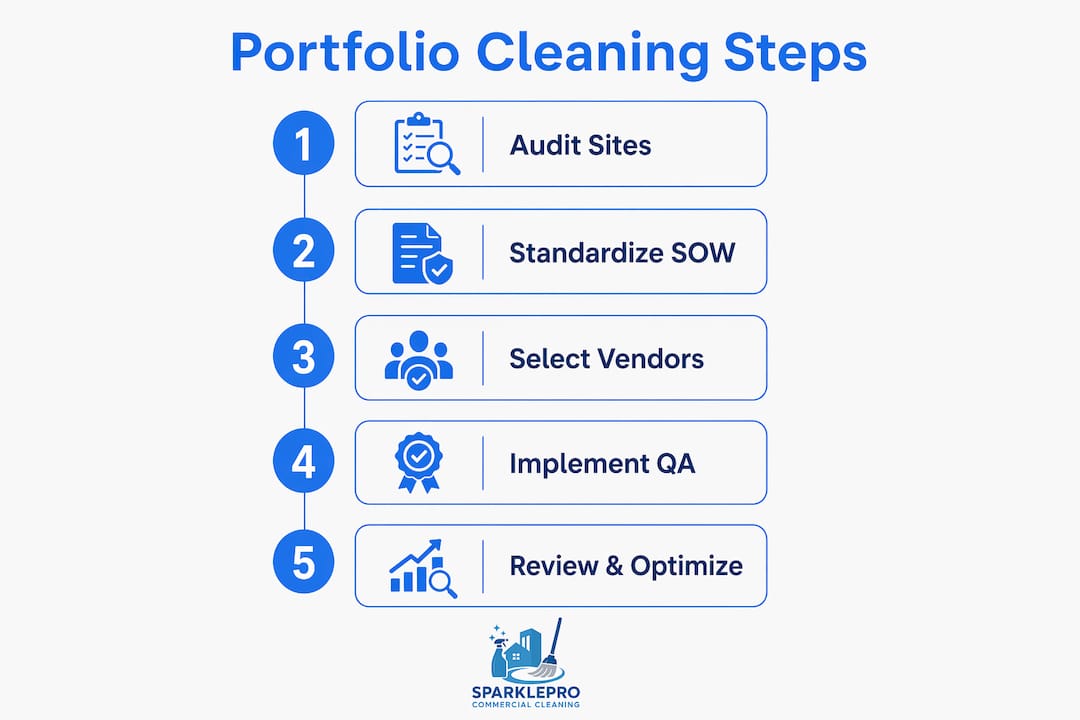
Audit existing contracts and service gaps (weeks 1–3). Pull every active cleaning contract, map service frequencies against actual building needs, and identify SOW variance between sites. Flag sites with no written scope, inconsistent pricing for similar square footage, or vendors without verifiable credentials.
-
Design master SOW templates and procurement rules (weeks 4–6). Build frequency matrices by building type. Draft the master agreement structure with per-site schedules, SLA terms, escalation paths, and performance credit triggers. Establish an approved vendor list with minimum credential requirements.
-
Select a pilot cluster and execute a 60–90 day pilot (weeks 7–18). Choose 3–5 sites that represent the portfolio's range: different building types, different geographies, different service mixes. Activate digital QA, centralized billing, and baseline KPI tracking from day one. Collect inspection scores, response time data, and cost-per-square-foot figures.
-
Analyze pilot results and refine (week 19–20). Review KPIs against the SLA benchmarks. Identify SOW gaps, scheduling failures, and any credential gaps in the vendor's team. Adjust templates before rolling out further.
-
Roll out in waves (months 5–6). Add sites in geographic or asset-type clusters. Integrate subcontractor prequalification for markets where the primary vendor uses local subs. Establish a quarterly performance review cadence with the vendor's account manager.
-
Establish quarterly reviews as standing governance. Review inspection pass rates, response time compliance, cost trends, and open corrective actions. Tie contract renewal decisions to KPI performance, not relationship inertia.
Full rollout typically runs 3–6 months depending on portfolio size and the complexity of existing vendor relationships. The pilot phase is where most programs either prove out or expose fatal SOW gaps. Do not skip it.
How portfolio contracts and pricing actually work
The standard structure is a master agreement with per-site schedules attached as exhibits. The master agreement governs terms, SLAs, insurance requirements, staffing standards, and escalation rules. Each site schedule specifies the SOW, frequency matrix, and unit pricing for that location. This structure lets you add or remove sites without renegotiating the entire contract.
| Pricing Driver | Impact on Cost | Notes |
|---|---|---|
| Square footage | Direct linear driver | Larger sites benefit from lower per-sq-ft rates at volume |
| Service frequency | Major cost lever | Daily vs. 3x/week creates significant unit cost difference |
| Service mix | High variance | Specialty services (floor care, disinfection) priced separately |
| Local labor market | Geographic variable | Wage rates vary significantly by metro area |
| Staffing turnover/coverage | Hidden cost | High-turnover sites require coverage premiums |
| Bundled vs. à la carte | Structural choice | Bundled programs typically yield better overall pricing |
Consolidated billing and centralized oversight reduce AP effort and audit friction, but the pricing model itself needs careful construction. Bulk pricing gives meaningful savings on routine janitorial when the portfolio is geographically concentrated. Dispersed national portfolios often require localized pricing schedules within the master agreement because labor markets differ too much for a single national rate to be accurate. For cost reduction tactics specific to building maintenance, frequency optimization and service bundling are the two levers with the fastest payback.
Which KPIs and tools actually reduce your verification burden?
The KPIs that matter at portfolio scale are the ones you can collect without a site visit:
- Inspection pass rate (scored digital inspections, target above 90%)
- Completion rate (scheduled tasks completed vs. assigned, tracked digitally)
- Response time to corrective requests (measured in hours from report to resolution)
- Recurring issue count (same deficiency flagged at the same site more than once per quarter)
- Client satisfaction score (tenant or building manager survey, quarterly)
- Cost per square foot (normalized across sites for benchmarking)
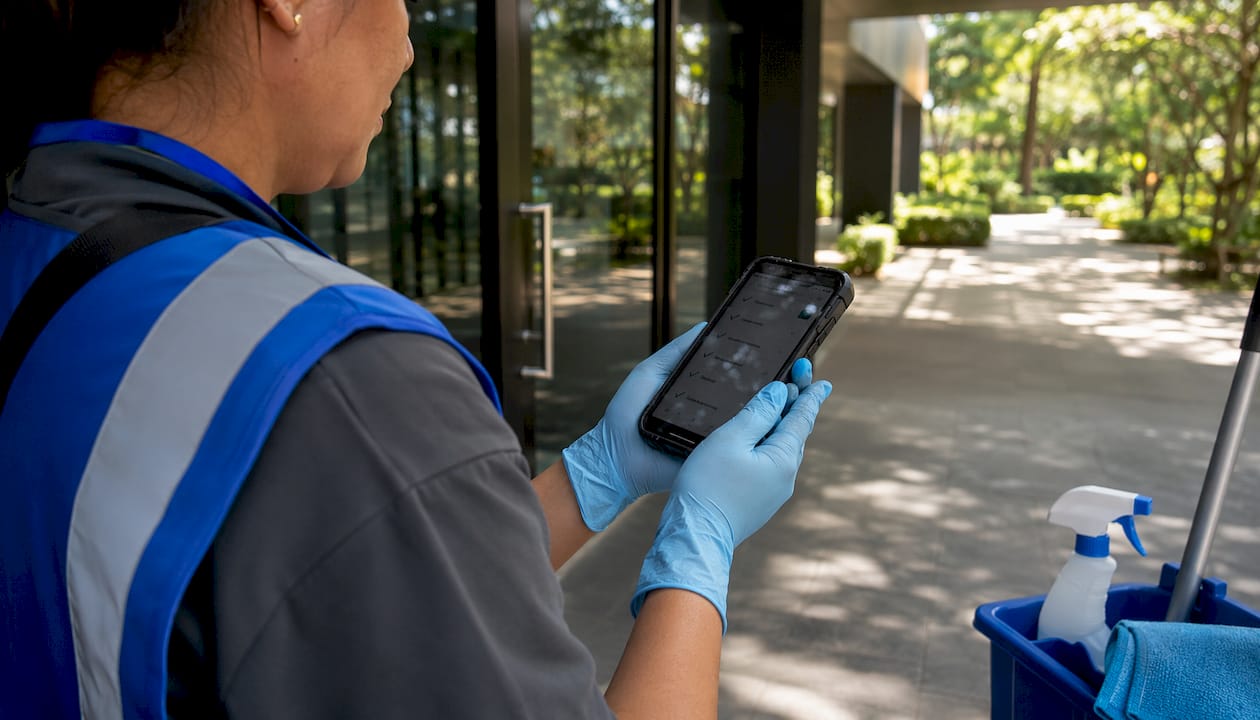
The shift from manual walkthroughs to evidence-based QA is where portfolio programs gain real leverage. Photo verification tied to a scored inspection checklist means a regional supervisor can review 20 sites' QA data in the time it used to take to physically inspect two. Digital sign-offs create a timestamped record that holds up in a dispute.
Digital scheduling with conflict detection becomes necessary as sites and shifts scale. At a handful of sites, a shared calendar works. At 15 or more, you need centralized scheduling with labor-cost visibility and automated conflict detection. Tool categories to evaluate: scheduling and time-and-attendance platforms, digital QA apps with photo capture and scoring, client-facing reporting portals, and ATS or onboarding integration for staffing continuity.
Reporting cadence: a monthly summary dashboard for each property manager, plus on-demand incident reports when a corrective action is triggered. Quarterly portfolio-level rollups for investors or asset managers.
Common problems and how to fix them before they stall your program
Multiple vendors, no coordination. The fix is a master contract and centralized scheduling. When every site has its own vendor relationship, escalations go nowhere and coverage gaps compound. One account manager, one escalation path.
Quality variance between sites. Standardized SOPs with digital QA thresholds tied to payment terms solve this. If a site's inspection pass rate drops below the SLA threshold for two consecutive months, a performance credit triggers automatically. That financial consequence changes vendor behavior faster than any conversation.
Staffing churn and coverage gaps. High turnover in commercial cleaning is structural, not a vendor character flaw. The operational answer is an always-on recruitment pipeline, a float pool for coverage, and local supervisor roles with real authority to solve problems on the day. Reactive hiring after a resignation is too slow.
Pro Tip: Hidden costs live in fragmented invoices. Before you consolidate, run a baseline activity audit: count the number of invoices processed per month, the time spent reconciling discrepancies, and the number of vendor contacts required to resolve a single service issue. That baseline makes the ROI of consolidation concrete and defensible to finance.
How Sparkleprocommercialcleaning operationalizes portfolio cleaning
Sparkleprocommercialcleaning's portfolio process follows a consistent sequence: site audits to establish baseline conditions, standardized SOW templates matched to building type and frequency requirements, a pilot rollout with digital QA activated from the first service date, and then centralized billing and quarterly performance reviews as standing governance.
Operational controls at scale include digital SOPs accessible to field supervisors, regional supervisor oversight across site clusters, photo-based QA tied to scored inspection checklists, and a standing recruitment pipeline that keeps coverage gaps from becoming service failures. For industrial and specialty environments, the team draws on surface preparation workflows as part of the pre-cleaning assessment.
What to ask any nationwide provider during selection: What is your geographic coverage and how do you handle subcontractor prequalification in markets where you use local subs? What is your escalation SLA for a service failure? Can you provide sample QA reports and inspection score histories from comparable portfolios? Do your supervisors hold CMI credentials, and which of your facilities carry GBAC STAR accreditation?
Key Takeaways
Cleaning management for commercial portfolios works when standardized SOWs, a master contract, digital QA, and portfolio-level certifications operate as a single integrated program rather than separate initiatives.
| Point | Details |
|---|---|
| Standardize before you consolidate | Build SOW templates and frequency matrices by building type before signing a master contract. |
| Pilot first, then scale | A 60–90 day pilot on 3–5 sites surfaces SOW gaps and QA failures before they affect the full portfolio. |
| Require credentials in procurement language | CIMS for vendor pre-qualification, GBAC STAR for high-compliance facilities, CAF Portfolio Certification for investor reporting at 10+ buildings. |
| Track evidence-based KPIs | Inspection pass rate, completion rate, and response time are the three metrics that predict program health without requiring site visits. |
| Sparkleprocommercialcleaning | Offers nationwide portfolio programs with master contracts, digital QA, centralized billing, and certification assistance for property managers and investors. |
Why the systems matter more than the people you hire
Most portfolio cleaning programs that fail do not fail because of bad vendors. They fail because the client organization never built the program infrastructure that would make any vendor succeed.
The conventional wisdom is that cleaning quality is a vendor problem. Find a better vendor, get better results. That framing is wrong, and it is expensive. A vendor without a standardized SOW to execute against will drift. A vendor without digital QA requirements will self-report. A vendor without SLA-tied performance credits has no financial reason to prioritize your corrective requests over a client who does have them.
The property managers who get durable results treat their SOPs, QA workflows, and recruiting pipelines as assets, not back-office tasks. That mindset shift is the actual work. Standardization is not bureaucracy; it is the mechanism by which a program replicates quality across 20 buildings without requiring 20 separate management relationships.
Turnover in this industry is structural. Build processes that absorb it rather than people-dependent systems that collapse when a key supervisor leaves. A float pool and a digital onboarding module are not luxuries at portfolio scale. They are the difference between a coverage gap that resolves in four hours and one that becomes a tenant complaint.
The data-driven quarterly review is where programs either improve or stagnate. If the review is a conversation about whether things feel okay, it will not surface the recurring deficiency at Building 7 that has appeared in three consecutive inspection reports. If it is a structured review of KPI trends, corrective action close rates, and cost-per-square-foot movement, it will.
Sparkleprocommercialcleaning handles the program so you manage outcomes
Managing a commercial portfolio means you already have enough to track. Sparkleprocommercialcleaning gives property managers and investors a nationwide cleaning partner that operates on a portfolio model from day one: master contracts with per-site schedules, standardized SOWs matched to your building types, digital QA with photo verification and scored inspections, and centralized billing that replaces a stack of vendor invoices with one consolidated statement.
The starting point is a portfolio audit and pilot assessment. Sparkleprocommercialcleaning's team reviews your existing contracts, maps service gaps, and proposes a pilot scope for a defined cluster of sites. From there, you get a sample QA report, proof of applicable certifications, and a pilot price before committing to a full rollout. For property managers in Massachusetts or Washington, regional teams are ready to start with a site visit and a same-week quote. Request your portfolio audit at sparkleprocommercialcleaning.com and get a pilot scope within days.
Useful sources for procurement, certification, and operational guidance
These are the primary references worth bookmarking for portfolio cleaning procurement and due diligence:
- ISSA — What Is Commercial Cleaning? The industry association's overview of commercial cleaning scope, GBAC STAR accreditation, and the role of infection prevention standards. Start here for certification context and vendor evaluation criteria.
- CAF Portfolio Certification The Cleaning Accountability Foundation's portfolio-level certification program. Download the program requirements to understand the 20% building certification threshold and the procurement tools (model tender questions, contract clauses) available to portfolio owners.
- CleanLog Multi-Site Operations Guide Practical operational guidance on scaling from single-site to multi-site programs, including the scheduling and digital QA systems required at each growth stage.
- NJC Management — Commercial Cleaning Project Management A facility manager's guide to the financial and operational case for managed cleaning programs, including consolidated billing and AP benefits.
- ISSA CIMS and CMI Credentials ISSA administers both the Cleaning Industry Management Standard (CIMS) and the Cleaning Management Institute (CMI) training credential. Use these as the baseline for vendor pre-qualification language in RFPs.
- Sparkleprocommercialcleaning — Commercial Cleaning Standards Guide A property manager's reference for building SOW templates and applying uniform cleaning procedures across a portfolio. Useful for drafting site-level scope documents before issuing an RFP.
- Sparkleprocommercialcleaning — Office Cleaning Guide for Property Managers Operational best practices for office portfolios, including frequency benchmarks and QA setup. Pair with the standards guide when building frequency matrices.