
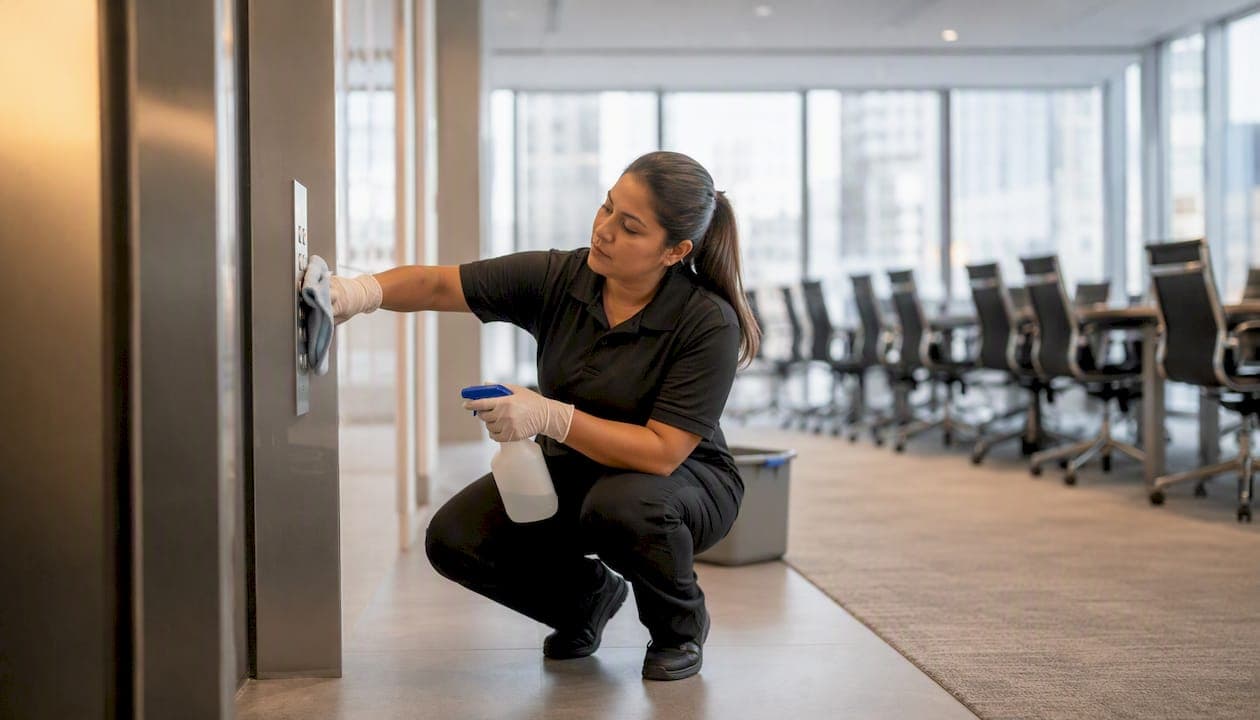
Use a task-level, area-by-area property cleaning checklist tied to measurable standards, not a vague "clean daily" line in your contract. The two standards that matter most in 2026 are the ISSA Clean Standard: Institutional and Commercial and the ANSI/IICRC S400, paired with ATP swab testing to verify the work actually happened. A checklist without a testing method is just a wish list.
Every scope of work (SOW) or field form you build in 2026 needs six elements, at minimum:
- Service areas listed by name and square footage, not lumped into "the building."
- Frequencies tagged as daily, weekly, monthly, or periodic/deep for each task.
- A quality standard referencing ISSA or ANSI/IICRC S400 language, not "clean to a high standard."
- Sampling rules for ATP testing, including which surfaces get swabbed and how often.
- Consumable ownership spelled out (who buys the toilet paper, who buys the floor finish).
- An escalation path for what happens when a zone fails inspection twice in a row.
Your contract and QA program should also name specific tools, because generic language invites generic results. ATP meters like the Hygiena EnSURE Touch and SystemSURE PLUS, the Charm Sciences NOVALUM, the Neogen Clean-Trace LM1, and the Kikkoman Lumitester SMART all measure the same thing, adenosine triphosphate residue, but naming one in the SOW keeps vendor and property manager on the same page about how compliance gets measured. For disinfectant selection, tie approved products to the EPA's List N.
Key Takeaways
A defensible 2026 cleaning program pairs an area-by-area checklist with ISSA and ANSI/IICRC S400 standards and ATP-based testing to make quality measurable and enforceable.
| Point | Details |
|---|---|
| Convert checklist items into SOW lines | Write each task with a frequency and a measurable standard, not a vague instruction. |
| Adopt ATP sampling | Sample at least 10% of high-touch points with ten samples per surface type, per the ISSA guidance. |
| Require mandatory walkthroughs | Have vendors verify cleanable square footage on-site before pricing to prevent scope creep. |
| Document everything | Log photos, timestamps, and audit scores to support SLA enforcement and PIP escalation. |
| Consider a specialized provider | Sparkleprocommercialcleaning builds SOWs and ATP-based QA reporting directly into onboarding for property managers. |
Table of Contents
- What Should a Property Cleaning Checklist Cover Area by Area?
- How Do You Measure Whether the Cleaning Actually Worked?
- What Does a Solid Scope of Work Need to Include?
- What KPIs and SLAs Should You Put in the Contract?
- How Do You Onboard and Manage a Cleaning Vendor Day to Day?
- Should You Go Paper or Digital for Checklist Tracking?
- What Do Vendors Wish Property Managers Understood Before Signing?
- How SparklePro Builds Checklists Into Every Cleaning Contract
- Standards and Tools Worth Citing in Your Contracts
- Frequently Asked Questions
- Sources
What Should a Property Cleaning Checklist Cover Area by Area?
A checklist that actually holds up under a contract dispute breaks work down by room and by frequency. Here's how the core zones typically shake out.
Restrooms need daily full cleaning: fixtures, floors, mirrors, and trash. High-touch points, door handles, faucet handles, stall latches, get wiped multiple times a day in high-traffic buildings. Weekly tasks add grout scrubbing and dispenser refills; monthly work covers drain treatment and deep descaling.
Lobbies and entries get daily touch cleaning of glass doors, floor mats, and trash receptacles, plus weekly dusting of furniture and light fixtures. Quarterly deep cleaning should include light fixture detailing and upholstery treatment.
Offices and conference rooms typically get daily trash pulls and surface wiping, weekly vacuuming and disinfecting of shared touchpoints (light switches, phones, conference tables), and monthly baseboard and vent dusting.
Break rooms and kitchens carry more frequent touchpoint requirements because of food contact: daily counter and sink sanitizing, daily microwave interior wipe, weekly refrigerator exterior cleaning, and monthly interior refrigerator deep clean.
Floors split by material and traffic. Daily sweeping and spot mopping in high-traffic zones, weekly full mopping, and periodic stripping and waxing (or deep extraction for carpet) scheduled quarterly or semiannually depending on foot traffic.
Interior glass usually gets weekly spot cleaning at entry points and monthly full-panel cleaning elsewhere in the building.
Some tasks need proof, not just a checkmark. Restroom disinfecting, food-contact surfaces, and any high-touch point in the ATP sampling plan should require a photo, a timestamp, and either an initial or a digital signature. Supervisor sign-off should apply to anything flagged in a prior audit as a repeat miss.
| Area | Daily task | Periodic/deep task |
|---|---|---|
| Restrooms | Full clean, fixture disinfecting | Grout scrub, drain treatment (monthly) |
| Lobbies/entries | Glass and mat cleaning | Upholstery and light fixture detail (quarterly) |
| Offices | Trash, surface wipe | Baseboard and vent dusting (monthly) |
| Break rooms | Counter/sink sanitizing | Interior refrigerator clean (monthly) |
| Floors | Sweep, spot mop | Strip/wax or deep extraction (quarterly) |
| Interior glass | Spot clean at entry | Full-panel clean (monthly) |
Periodic deep tasks, floor stripping, high dusting above eight feet, interior glass on upper floors, HVAC vent cleaning, belong on a separate schedule from daily janitorial work. Bundling them into the daily line item is how vendors quietly skip them.
To turn any of this into contract language, phrase each line the way you'd want it enforced: "Restroom fixtures disinfected daily; high-touch points sampled weekly via ATP with results logged in the monthly report." That single sentence does the job of a paragraph of vague instructions.
How Do You Measure Whether the Cleaning Actually Worked?
Visual inspection tells you if a surface looks clean. ATP testing tells you if it actually is. The ISSA Clean Standard pairs both methods, combining building audits with ATP swabbing and defined "ranges of clean," requiring corrective action when results fall below target.
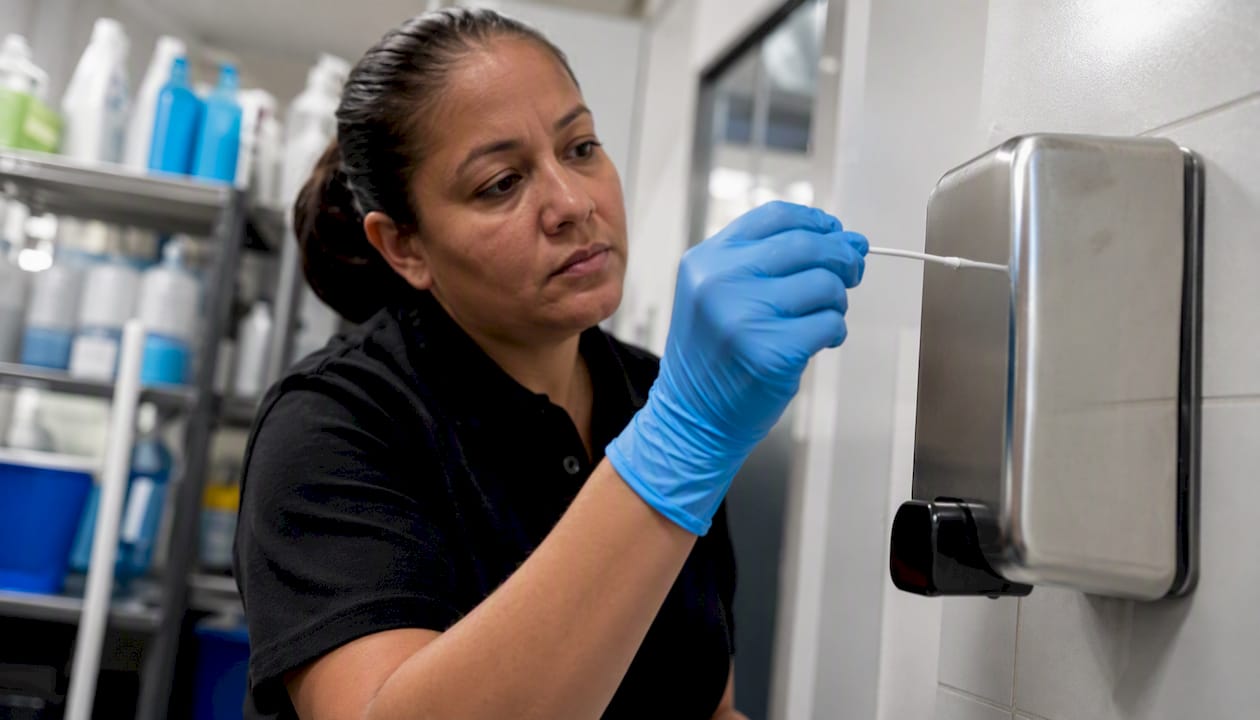
The ANSI/IICRC S400 (2025) standard goes further on process. It defines cleaning principles, frequencies, quality assurance and quality control procedures, and documentation requirements for the commercial built environment. If your SOW references S400, you're committing your vendor to a documented QA/QC process, not a handshake agreement.
Here's the practical protocol to write into your QA plan:
- Identify your high-touch points: door handles, restroom fixtures, break room surfaces, elevator buttons.
- Sample at least 10% of identified high-touch points, with a minimum of ten sample points per surface type.
- Record the RLU (relative light unit) reading for each swab.
- Average the readings per surface category to compare against your benchmark range.
- Trigger a re-clean and re-test for any category averaging above the threshold, rather than reacting to a single high reading.
Any of the major meters, the Hygiena EnSURE Touch or SystemSURE PLUS, the Charm Sciences NOVALUM, the Neogen Clean-Trace LM1, or the Kikkoman Lumitester SMART, will produce comparable RLU data. Naming a specific model in the SOW just removes ambiguity about which device generates the numbers both sides agree to trust.
One outlier reading on a busy Monday morning doesn't mean the program failed. Pairing visual audits with averaged ATP data across a sample set is what separates rigorous QA from panic.
Pro Tip: Set your re-clean trigger at the category average, not the single worst swab. A conference table that tests high because someone just ate lunch there shouldn't trigger the same corrective action as a restroom faucet handle that fails week after week.
What Does a Solid Scope of Work Need to Include?
Scope creep starts with vague square footage. Define cleanable square footage, the areas actually serviced, separately from gross building area, which includes mechanical rooms, elevator shafts, and other spaces nobody cleans. Require vendors to verify this number during a mandatory walkthrough rather than quoting off a floor plan.
Your SOW checklist should include:
- A complete area list with cleanable square footage per zone.
- The task-level checklist from your area breakdown, with frequencies attached.
- Approved products and methods, including EPA List N disinfectants and any green-cleaning requirements for LEED-certified properties.
- Who owns consumables (paper products, liners, floor finish) and who reorders them.
- Excluded zones, stated explicitly, not left to assumption.
- Change-order rules for anything outside the base scope.
Pricing mechanics should match the type of work. Square-foot pricing works well for routine janitorial where the scope is stable. Fixed-fee pricing suits one-time deep cleans or post-construction cleanouts where the job has a clear endpoint. Hourly pricing fits ad hoc or highly variable work, like day-porter coverage during a renovation. Deep-clean and extra services belong on their own line items, not folded into a base rate that obscures true cost.
Before you award a contract, collect the documents that let you compare proposals fairly: draft SOW, service schedule, pricing sheet, insurance certificates, sample contract terms, and a written report from the site visit.
- Draft SOW with task list and frequencies attached.
- Pricing sheet broken out by service type.
- Certificates of insurance and bonding.
- Onsite walkthrough report signed by both parties.
The walkthrough itself isn't a formality. Vendors who skip it or who quietly change their staffing plan after seeing the actual site are a known warning sign of scope creep down the road, since their original bid was based on guesswork rather than real conditions.
Pro Tip: Never accept a proposal from a vendor who declines the walkthrough. If they won't verify the space before pricing it, they're pricing risk into your contract, not into their bid.
What KPIs and SLAs Should You Put in the Contract?
A checklist without enforcement is a suggestion. KPIs give you measurable targets; SLAs give you the teeth to enforce them.
Failure to meet the corrected target within that window authorizes service credits equal to one week's invoice value."
Inspection cadence matters as much as the numbers themselves. Daily supervisor walkthroughs should cover core zones like restrooms and lobbies. Randomized spot checks catch complacency in less-visible areas. Weekly audits and monthly performance reviews roll findings into trend data, and quarterly business reviews are where you decide whether the relationship needs renegotiation.
- Log every issue with a timestamp and photo, not a verbal note.
- Escalate any zone with three or more misses in a rolling 90 days to a formal PIP.
How Do You Onboard and Manage a Cleaning Vendor Day to Day?
Getting a vendor started right prevents most of the disputes that surface six months later.
- Hold a kickoff meeting covering the SOW line by line, access procedures, the escalation path, inspection forms, and who owns which consumables.
- Require documented training on chemical handling and OSHA-relevant safety procedures, equipment operation, and any green-cleaning certification tied to your building's LEED status.
- Document access controls: who holds keys or badges, whether background checks were run, incident-reporting procedures, and PPE requirements for specialized work.
- Run frequent check-ins for the first 30 to 60 days, then shift to the routine audit and quarterly review cycle once performance stabilizes.
- Build a clear PIP process for chronic failures, with defined cure periods before you move to service credits or termination for cause.
- Confirm who has building access and how that access gets revoked when staff turn over.
- Require incident reports within 24 hours for anything involving injury, property damage, or a security breach.
Reviewing your own training and safety expectations before onboarding gives you a benchmark to hold vendors against, rather than accepting whatever their internal training program happens to cover.
Should You Go Paper or Digital for Checklist Tracking?
Paper checklists work for a single small site with one supervisor who sees everything. Once you're managing multiple properties, digital tracking stops being optional.
A field form, digital or paper, needs these fields: task item, frequency, a completion checkbox, staff initials, a timestamp, a photo upload field for sampled items, a supervisor verification checkbox, and an ATP result field where applicable.
- Task item and frequency pulled directly from the SOW checklist.
- Completion checkbox plus staff initials and a timestamp.
- Photo upload for any item in the ATP sampling plan.
- Supervisor verification checkbox for flagged or repeat-issue zones.
Digital systems earn their cost when you're managing multiple sites, need tenant-facing reporting, or want KPI data to roll up automatically instead of getting retyped from a clipboard. They also tie more cleanly into work order and ticketing systems for extra-service requests, which keeps change orders documented instead of verbal.
Pro Tip: Pilot digital checklists at one to three sites before rolling out portfolio-wide. Require photo evidence only on the sampled subset of tasks, not every line item, or your janitorial staff will spend more time photographing than cleaning.
What Do Vendors Wish Property Managers Understood Before Signing?
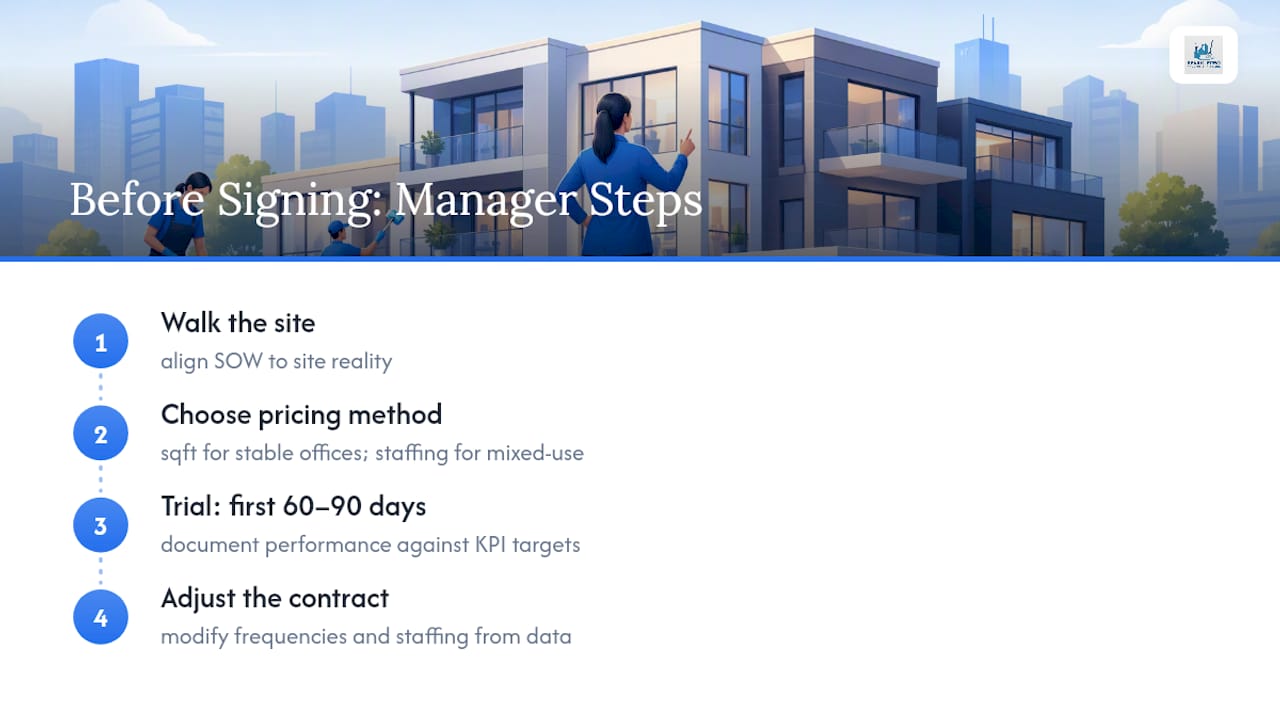
The biggest disconnect isn't in the contract language. It's between what the SOW says and what the site actually requires once cleaning crews show up. A property manager writes "daily restroom service" into a bid package, and three different vendors price that phrase three different ways, because none of them walked the space to see how many stalls, how much traffic, or how far the restrooms sit from the supply closet.
Square-foot pricing works cleanly for stable, routine janitorial work in offices with predictable traffic. It breaks down fast in mixed-use retail, healthcare, or any property with unpredictable foot traffic, where staffing-based pricing reflects real labor hours better than a blanket rate per square foot. A walkthrough resolves this argument before it starts, because it forces both sides to price the same reality instead of two different assumptions about the same floor plan.
The most useful thing a property manager can do in the first 60 to 90 days isn't demanding perfection. It's documenting performance against the KPI targets before locking into long-term pricing or renewal terms. That window is where you learn whether the frequencies in your SOW match the actual traffic pattern of the building, and whether the vendor's staffing plan was realistic or optimistic. Treat that period as a trial, not a formality, and adjust the contract based on what the data shows rather than what the original proposal promised.
How SparklePro Builds Checklists Into Every Cleaning Contract
Sparkleprocommercialcleaning turns the checklist work above into the actual scope of work your contract runs on, so you're not translating a generic template into your own SOW language after the fact. Every engagement starts with a site walkthrough and a SOW draft that maps directly to your building's zones, frequencies, and ATP sampling plan.
What that looks like in practice:
- Onboarding and startup that includes a kickoff walkthrough, access documentation, and a task-level checklist built for your property before the first clean happens.
- ATP-based QA with digital reporting, so restroom and high-touch compliance gets measured with real RLU data and timestamped records, not a supervisor's guess.
- Tailored SOW drafting that separates daily janitorial from periodic deep cleaning, post-construction cleanouts, and tenant turn cleaning, priced against your actual cleanable square footage.
If you manage property in Massachusetts, request a quote and walkthrough for your building and get a SOW draft built around the checklist standards covered here, not a boilerplate proposal.
Standards and Tools Worth Citing in Your Contracts
Copy these references directly into your SOW or QA protocol language rather than paraphrasing them:
- The ISSA Clean Standard: Institutional and Commercial for combined visual-audit and ATP methodology.
- The ANSI/IICRC S400 (2025) standard for cleaning principles, frequencies, and documentation requirements.
- ATP meter models to name explicitly: Hygiena EnSURE Touch, SystemSURE PLUS, Charm Sciences NOVALUM, Neogen Clean-Trace LM1, and Kikkoman Lumitester SMART.
- The EPA List N for approved disinfectant selection.
- Sampling guidance from ISSA's Clean Standard Commercial reference for sample-rate percentages and RLU averaging.
For specialty mechanical cleaning needs, like drain and vacuum services on large campuses, reference providers such as commercial vacuum and jetting services when scoping work beyond standard janitorial tasks.
Frequently Asked Questions
What should a property cleaning checklist for 2026 include at minimum? It needs area-specific tasks, assigned frequencies (daily, weekly, monthly, periodic), a referenced quality standard like the ISSA Clean Standard or ANSI/IICRC S400, an ATP sampling protocol, and clear consumable ownership.
How often should ATP testing happen? Sample at least 10% of identified high-touch points weekly or biweekly, with a minimum of ten samples per surface type, then average results against your RLU benchmark rather than reacting to single readings.
Is a digital checklist necessary for a single small property? Not always. Paper works for one site with a hands-on supervisor. Once you manage multiple properties or need tenant-facing reports, digital tracking with photo evidence and timestamps becomes worth the switch.
What's the difference between a deep cleaning checklist and a routine one? A deep cleaning checklist covers periodic tasks, floor stripping, high dusting, interior glass, HVAC vents, scheduled quarterly or semiannually, while routine checklists cover daily and weekly touchpoint cleaning.
How do I stop scope creep in a cleaning contract? Require a mandatory walkthrough before pricing, define cleanable square footage explicitly, list excluded zones, and build change-order rules into the SOW from day one.
Sources
- Clean Standard: Institutional and Commercial - ISSA | The Association for Cleaning & Facility Solutions
- ISSA Clean Standard Commercial (Kikkoman PDF)
- Secure High-Quality Commercial Cleaning Contracts – Facility Management Insights