
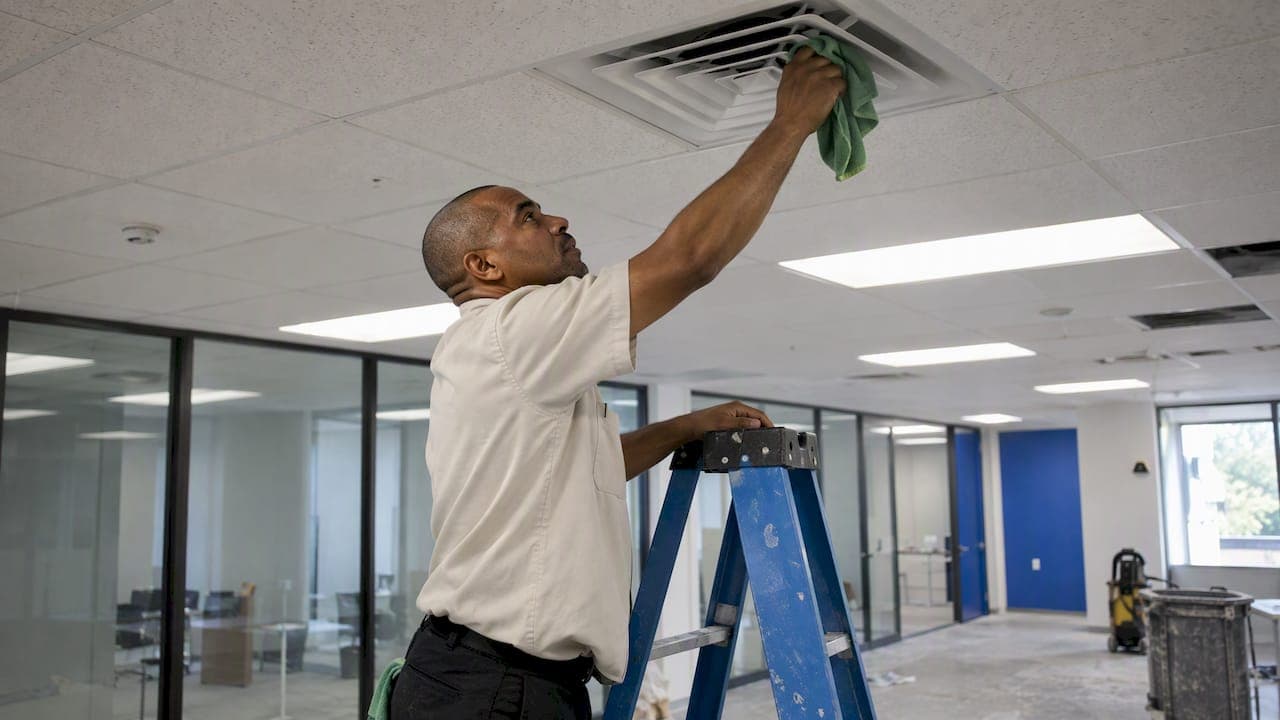
Punch list cleaning is the final cleaning pass that happens after the punch list walkthrough, once the trades have fixed their items and the owner or property manager has flagged what still looks unfinished. It removes the last dust, residue, smudges, labels and debris so the space is ready for occupancy, and it is usually the step that stands between a nearly finished building and a signed handover.
This guide is for property managers, general contractors, building owners and facility managers who have to schedule, specify or approve that work. It covers what belongs on the list, how to build it, how to run the walkthrough, and how to verify and document the result.
TL;DR
- A punch list is the list of incomplete or corrective items that must be finished before substantial completion. Cleaning items belong on it like any other trade's items.
- Punch list cleaning is the touch-up and final-detail pass: residue, fingerprints, labels, glass, fixtures, floors, HVAC components and lighting, done after repairs so it is not undone.
- Build the list by area, from the exterior and lowest floor upward, and record what is incomplete and why.
- Schedule the clean after the last repair trade leaves, then re-inspect and sign off in writing.
- Spell out cleaning methods and products in the scope. Owner specifications routinely require manufacturer-approved agents.
Table of Contents
- What a punch list is, and where cleaning fits
- What punch list cleaning covers
- How to prepare a punch list that includes cleaning
- Running the walkthrough
- Scheduling the clean around the closeout timeline
- Verifying and documenting the work
- Our perspective: treat the last clean as a trade, not a favor
- How Sparklepro handles punch list cleaning
- Common mistakes to avoid
- FAQ
- Sources
What a punch list is, and where cleaning fits
A punch list is the contractor's list of incomplete or corrective items needed before substantial completion. The University of Southern California's closeout specification treats the punch list, substantial completion, final completion, warranties, final cleaning and repair of the work as connected closeout procedures. Cleaning is not an afterthought in that sequence. It is written into the same document that governs when a project counts as finished.
Most teams talk about post-construction cleaning in three passes:
- Rough clean. Bulk debris removal and sweeping while trades are still working, so the site stays safe and the next trade can work.
- Final clean. The detailed clean of every surface once construction work ends, before the building is occupied.
- Punch list touch-up. The return visit that handles whatever the walkthrough found, plus the dust and marks created by the repair work itself.
The University of Colorado Anschutz closeout specification requires final cleaning immediately before occupancy for the whole project or the designated portion. That timing is the key point. A clean done too early gets covered in drywall dust, paint touch-ups and fingerprints from the punch trades. If you want to see how the first two passes are timed, our guide on booking rough and final cleans by trigger walks through the triggers.
What punch list cleaning covers
Owner specifications are the best guide to scope because they are written to be enforced. The USC specification lists the areas and items that final cleaning has to reach, and the list is longer than most people expect:
- Disturbed site areas and paved areas
- Hard finishes and limited-access spaces
- Concrete floors, carpet and other soft surfaces
- Mirrors and glass
- Mechanical and electrical equipment
- Plumbing fixtures
- Filters, diffusers, registers and grilles, plus ducts, blowers and coils when required
- Light fixtures
The same document calls for removing nonpermanent labels and foreign substances, following manufacturers' instructions, and leaving the project ready for occupancy. Where HVAC cleaning is required, it also asks for a written report. If your project includes air handling, our HVAC cleaning after construction guide explains what that work involves.
Floors and specialty equipment
Floors often decide whether an owner accepts the clean. The Colorado specification adds power scrubbing and power buffing for resilient flooring, tile and fluid-applied flooring. It also requires food-service equipment to be cleaned to a sanitary condition acceptable for its intended use and approved by the authority having jurisdiction. For a restaurant tenant space or a healthcare kitchen, that means the cleaning scope and the inspector's expectations have to be read together, not separately.
Products matter as much as effort
Yale's September 2025 closeout standard requires cleaning agents recommended by the surface manufacturer and prohibits agents that could harm health, property or finished surfaces. A crew that reaches for the wrong chemical on a sealed stone floor or a coated glass panel can create a new punch item instead of closing one. Ask any cleaning vendor how they confirm manufacturer guidance before they start.
How to prepare a punch list that includes cleaning
A usable list is organized so that the person doing the work can find each item without asking. The USC specification gives a practical model:
- Identify the affected spaces. List every room, corridor, roof area and exterior zone that will be handed over.
- Order them logically. Arrange items from the exterior and the lowest floor upward, and group them by ceilings, walls, floors, equipment and systems.
- Record the reason. For each item, note what is incomplete or wrong, not just the location. "Level 2 east corridor, adhesive residue on glass film" is actionable. "Clean level 2" is not.
- Label every page. USC requires each page to identify the project, date, architect, contractor and page number, and requires electronic submission in spreadsheet and PDF formats.
You may not be bound by a university's rules, but that format works on any commercial project. A spreadsheet can be filtered by trade, by floor or by status, and the PDF becomes the record you attach to the closeout file.
If you track tasks across several subcontractors, a structured system keeps cleaning items from getting lost between repair trades. This overview of construction task management shows how to coordinate trades so a clean site and resolved issues arrive at handover together.
A short sample of cleaning line items
| Area | Item | Why it is open | Owner |
|---|---|---|---|
| Lobby | Storefront glass | Paint overspray and label residue | Cleaning contractor |
| Level 3 suite | Carpet | Drywall dust after patching | Cleaning contractor |
| Restrooms | Plumbing fixtures | Protective film and fingerprints | Cleaning contractor |
| Mechanical room | Registers and grilles | Dust from ceiling repair | Cleaning contractor after HVAC trade |
| Exterior | Entry paving | Concrete splatter and debris | Site contractor, then cleaner |
Notice the last column. Some items need a repair trade to finish first. Naming the dependency on the list prevents the cleaner from arriving before the work is done.
Running the walkthrough
The walkthrough is where cleaning deficiencies are found and written down. An American Institute of Architects community document describes the process: the design professionals, owner and contractor walk the project together, corrections they identify are added to the contractor's initial list, and a consultant's list is gathered with the architect's.
Some practical habits make the walk more productive:
- Walk in the same order as the list. Exterior and lowest floor first, then upward.
- Bring raking light. Use a flashlight held at a low angle against walls, glass and floors to expose film and residue that overhead lighting hides.
- Photograph each item. Pair the photo with the room name and the line number.
- Separate cleaning from defects. A scratched window is a glazing repair, not a cleaning item. A smeared window is a cleaning item. Mixing them sends the wrong crew back.
- Invite the cleaner when scope is disputed. A short site visit settles arguments about what "clean" means before they turn into change orders.
Because of the order, the cleaning contractor is typically the last trade on site. That makes their work the final impression the owner gets, and it is why the punch list clean deserves its own line in the schedule.
Scheduling the clean around the closeout timeline
Closeout checklists give a sense of how much lead time owners expect. The University of Tennessee project closeout checklist schedules closeout preparation at 75 percent complete or 30 days before substantial completion. It then calls for a notification and an incomplete-items list at 95 percent or 5 days before substantial completion, with final-completion actions following review of the punch list and documentation.
The NID Water contract closeout section adds specific notice periods. It requires at least seven days' notice for both the preliminary and final inspections, project record documents 15 days before the final inspection, and a contractor punch list before the owner's inspection. It also requires complete cleaning before final inspection and removal of temporary facilities.
Translate that into a cleaning schedule:
- Book the cleaning contractor when the 95 percent list is issued, not when the inspection date is already close.
- Hold the punch list clean until the last repair trade confirms completion.
- Leave a buffer day between the clean and the inspection so one missed spot does not push the inspection back.
- Keep the space locked or controlled after cleaning so foot traffic does not undo it.
Your own contract and owner's specification control the real dates, so check them before you commit to a plan.
Verifying and documenting the work
Cleaning sign-off should be as formal as any other trade's. Wisconsin's construction closeout checklist requires all field issues resolved, the site and building clean per specifications, and all building systems tested, certified complete and operational. That last point matters for cleaning: filters, coils and diffusers should be cleaned and the systems running before the building is called ready.
Yale's standard says final cleaning must be done before the substantial-completion inspection and must achieve the condition expected in an average commercial building cleaning and maintenance program. That gives you a measurable standard: the space should look like a building that is already being maintained, not like a site.
For the paper trail, the AIA-MBA Joint Committee contracts page states that the architect confirms the required corrections and attaches the punch list to the Certificate of Substantial Completion. So the cleaning items you recorded become part of the formal completion record.
A sign-off package for cleaning should include:
- The final punch list with every cleaning item marked closed, with date and initials
- Before and after photos for contested areas
- The HVAC cleaning report, if the specification required one
- The product list or data sheets, where the owner asked for manufacturer-approved agents
- A signed acceptance from the owner's representative
Our perspective: treat the last clean as a trade, not a favor
We see the same pattern on projects across the country. The punch list is long, the schedule is tight, and cleaning is the last line item anyone assigns. Then the walkthrough turns up film on glass, dust in diffusers and scuffed floors, and the handover slips by days for work that could have been planned.
Our approach is built around that reality. We work nationwide with local crews, we are licensed and insured, and we respond within 24 hours, which matters when a punch list clean is the only thing holding up occupancy. Our process is four steps: a quote, a site visit, scheduled cleaning, and customer approval. The site visit is the step we would not skip, because it lets us read the punch list against the actual conditions, flag dependencies on other trades, and agree on what "done" looks like before a crew shows up.

We also push owners and contractors to write the product and method requirements into the scope. If a manufacturer specifies how a surface is cleaned, that belongs in the work order. It protects the finish, protects the warranty position, and avoids a second punch item created by the first.
Finally, plan for specialized environments early. Healthcare, cleanrooms and food-service spaces carry sanitary requirements that a general clean does not meet, and the sooner that is in the scope, the fewer surprises appear at inspection.
— Sales
How Sparklepro handles punch list cleaning
If you are closing out a building and need the last clean done on a schedule that matches your inspection, our post-construction cleaning and related commercial services cover final cleans, deep cleans, disinfecting, environmental services for healthcare and cleanrooms, eco-friendly options for LEED properties, and tenant turn cleans. Pricing depends on property size, scope and timing, so we start with a quote and a site visit rather than a flat number.
For projects in New Jersey, you can reach our local team through our New Jersey cleaning page. If you want to prepare before you call, these guides help: the construction final clean checklist, the step-by-step post construction cleaning process and the contractor cleaning compliance checklist.
Common mistakes to avoid
- Cleaning before repairs finish. The most common and most expensive mistake. Every repair trade generates new dust.
- Vague scope. "Clean the suite" invites disagreement. List surfaces, finishes and standards.
- Ignoring hidden surfaces. Limited-access spaces, grilles, light fixtures and equipment interiors are named in owner specifications for a reason.
- Skipping product approval. The wrong agent on a finished surface causes damage that no amount of extra labor repairs.
- No re-inspection. Without a second look, closed items are just claimed items.
- Forgetting the tenant side. In tenant improvement work, access rules and safety requirements affect how the crew operates. Our tenant improvement cleaning guide covers what property managers should expect.
FAQ
What is punch list cleaning?
It is the final cleaning pass that handles the cleaning items found during the punch list walkthrough, plus the dust and marks left by the repair work. It removes residue, labels, fingerprints and debris so the building is ready for occupancy. It follows the main final clean rather than replacing it.
Who is responsible for paying for punch list cleaning?
That depends on your contract. Many owner specifications put final cleaning on the general contractor, so the cost sits in the construction contract. In tenant turn and move-out work, the lease or the property manager's agreement may assign it differently, so read those documents first.
How long before handover should I book it?
Book it when the near-complete incomplete-items list is issued, not after the walkthrough. Closeout checklists such as the University of Tennessee's put that notification about five days before substantial completion, and inspection notice periods can run seven days. Your own contract sets the real timing.
What is the difference between a final clean and a punch list clean?
The final clean is the complete, detailed cleaning of the building after construction work ends. The punch list clean is the targeted follow-up that addresses items the walkthrough flagged and the mess from the last repairs. On smaller projects the two are sometimes combined into one visit.
Sources
- USC closeout procedures specification, 2015
- University of Colorado Anschutz closeout procedures
- Yale closeout procedures, September 2025
- AIA community hub document on punch list walkthroughs
- University of Tennessee project closeout checklist
- NID Water contract closeout section
- Wisconsin construction closeout checklist
- AIA-MBA Joint Committee contracts
- Construction task management guide