
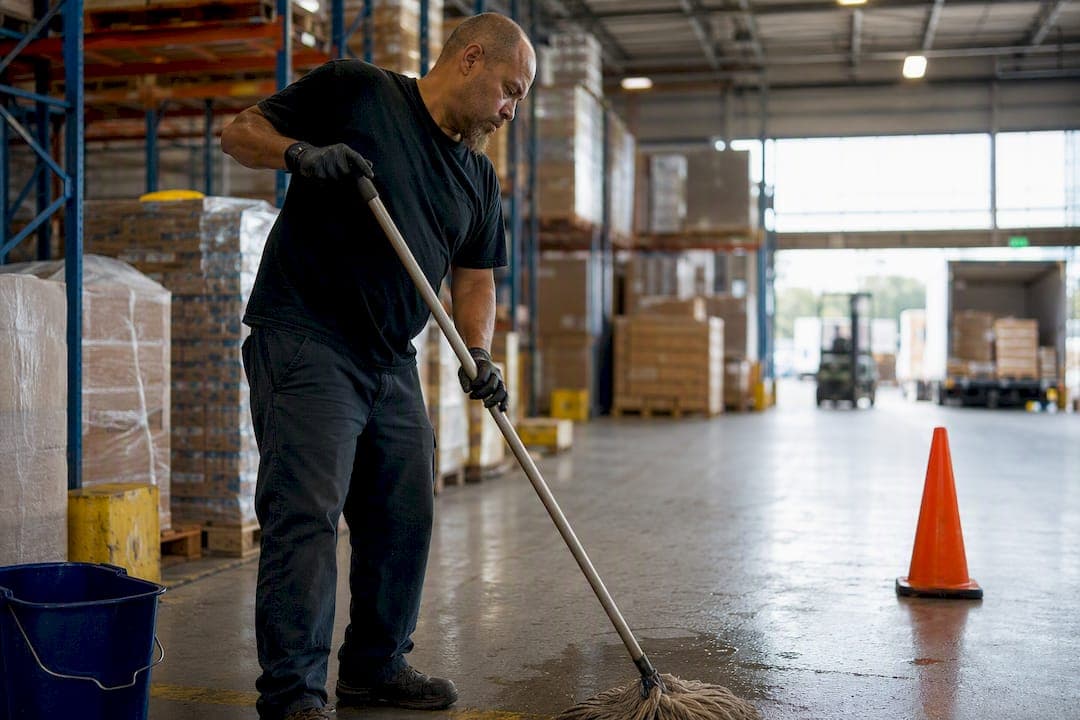
Expect recurring warehouse cleaning in the U.S. to run roughly $0.10 to $0.20 per square foot per month for a standard program. A 100,000 sq ft facility at $0.15 per square foot lands around $15,000 a month. Lighter programs, like periodic sweeping with minimal wet mopping, can drop to $0.03 to $0.08 per square foot. Complex sites with heavy soil load, food-grade sanitation, or specialty flooring push past $0.20.
Three quick facility examples at a common midpoint of $0.15/sq ft:
- Smaller warehouses cost in the low thousands per month
- Medium-sized warehouses cost several thousand dollars per month
- 100,000 sq ft warehouse: about $15,000/month
If your quote lands well outside that range, check three things first: cleaning frequency, soil load or process cleaning needs, and whether special equipment like autoscrubbers or pressure washers is required.
Key Takeaways
Warehouse cleaning cost depends less on square footage alone than on frequency, soil load, and scope, and a proper site walk is the only reliable way to compare vendor bids.
| Point | Details |
|---|---|
| Know the benchmark range | Standard recurring programs run $0.10–$0.20 per sq ft/month, with light programs as low as $0.03–$0.08. |
| Use cleanable square footage | Base every $/sq ft comparison on cleanable area, not gross footprint, to avoid inflated vendor quotes. |
| Check the big three cost drivers | Labor (via loaded wage), equipment type, and shift schedule move the price more than any other factor. |
| Insist on an itemized scope | Frequency, exact tasks, and explicit exclusions must appear in writing before you sign. |
| Request a Sparkle Pro site visit | Sparkle Pro Commercial Cleaning builds quotes from an on-site walkthrough covering racking, dock count, and shift needs. |
Table of Contents
- How Vendors Price Warehouse Cleaning Services
- What Actually Drives Warehouse Cleaning Costs?
- Sample Monthly Bids: Small, Medium, and Large Warehouses
- How to Evaluate a Warehouse Cleaning Quote
- How Sparkle Pro Structures a Fair, Verifiable Quote
- Why the Site Visit Matters More Than the Rate Sheet
- Get a Site-Specific Warehouse Cleaning Quote
- Sources
How Vendors Price Warehouse Cleaning Services
Most vendors quote one of three ways: per square foot for recurring work, hourly for smaller or irregular jobs, and per-visit or per-project for one-time work. Knowing which model you're looking at matters more than the number itself, because a $0.12/sq ft recurring quote and a $45/hour deep clean aren't comparable without doing the math both ways.
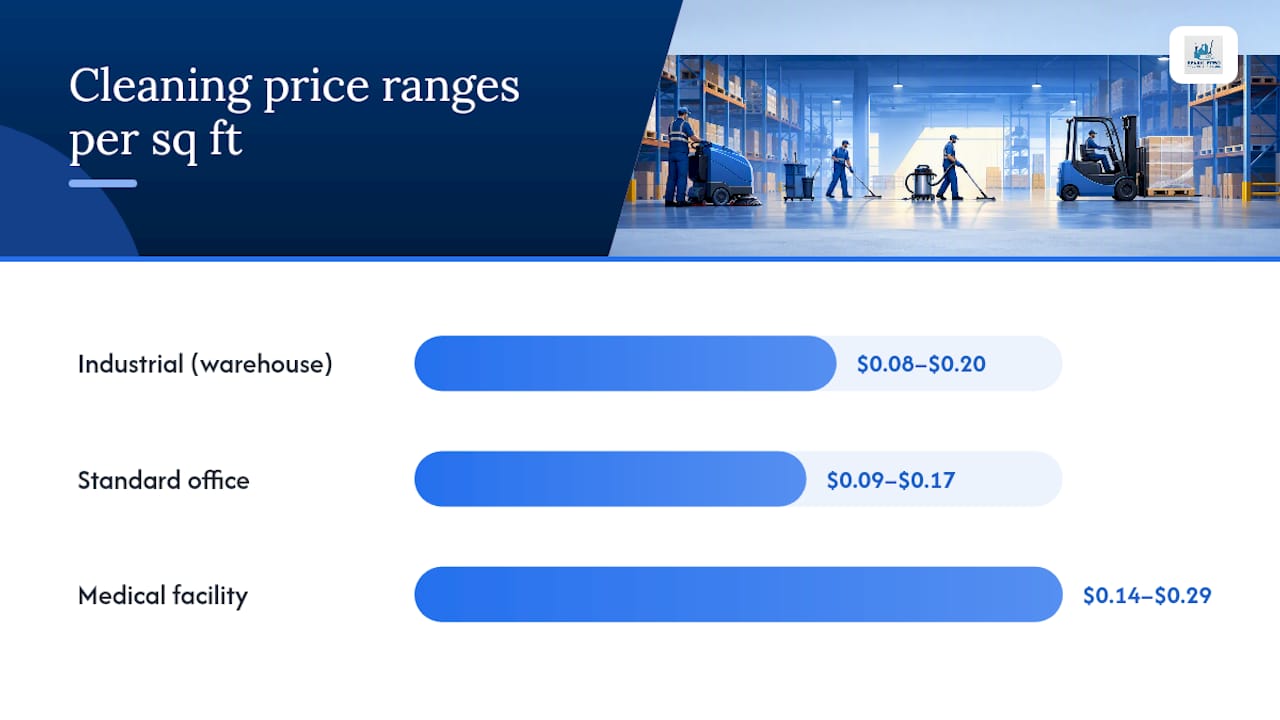
Square-foot pricing is the industry default for recurring janitorial contracts. ISSA's benchmark data puts industrial and manufacturing cleaning at $0.08 to $0.20 per square foot, compared to $0.09 to $0.17 for standard office space and $0.14 to $0.29 for medical facilities. Warehouses tend to sit in the middle of that band unless they involve food-grade sanitation or heavy machinery.
Hourly and per-visit pricing shows up for one-time deep cleans, post-construction cleanouts, or jobs where production rates are hard to predict, like cleaning around active machinery or navigating irregular racking layouts. CleanQuote notes that warehouse programs generally fall in a $0.03 to $0.20 per square foot band overall, with the low end covering light-frequency sweeping and the high end covering daily service with heavier scope.
Certain tasks almost always get quoted separately rather than folded into the base rate:
- Strip and refinish (concrete sealing or epoxy touch-up): often priced per square foot as a standalone project, separate from monthly service
- Electrostatic disinfection: typically billed per visit, based on square footage and the number of touchpoints treated
- Dock degreasing and high-pressure exterior washing: usually quoted as an add-on line item
| Cleaning type | Typical pricing model | Rough range |
|---|---|---|
| Recurring warehouse janitorial | Per sq ft, monthly | $0.10–$0.20/sq ft/month |
| Light-frequency recurring | Per sq ft, monthly | $0.03–$0.08/sq ft/month |
| One-time deep clean | Per visit or hourly | Varies by scope and soil load |
| Specialty add-ons (strip & refinish, electrostatic) | Per project or per visit | Quoted separately |
Millennium Facility Services and other industry sources point out that recurring contracts commonly exclude these specialty tasks by design, which is why a "cheap" monthly rate sometimes hides a much larger annual bill once add-ons get factored in.
What Actually Drives Warehouse Cleaning Costs?
Labor is the single biggest line item in any warehouse cleaning bid, usually 50 to 65 percent of the total. Vendors calculate a loaded wage, meaning hourly pay plus payroll taxes, workers' comp, and insurance, and BLS occupational wage data is the standard reference point for that baseline. A crew working in a high-cost metro like Seattle or Boston will run noticeably higher than the same job in a lower-cost market, even with identical scope.
Equipment is the second variable. A walk-behind autoscrubber costs far less to deploy than a ride-on unit, but ride-on machines cover ground faster on large open floors, which lowers labor hours per visit. Vendors either own this equipment or rent it, and rental costs get passed through on jobs that don't recur often enough to justify a purchase.
Layout and shift schedule matter more than most managers expect:
- Racking density slows crews down because aisles narrow and machines can't run at full speed
- Ceiling height affects high-dusting and lighting cleaning, often requiring lifts
- Dock count adds exterior touchpoints like degreasing and door tracks
- Multi-shift operations shrink the access window, sometimes forcing overnight or weekend crews at a premium
Compliance adds cost too. OSHA's 29 CFR 1910 standards govern PPE, hazard communication, and in some warehouses confined-space or lockout-tagout procedures, all of which require documented training that shows up in the vendor's overhead. Our construction cleaning safety guide covers how these requirements translate into staffing decisions on job sites with similar hazard profiles.
Pro Tip: Ask every bidder to itemize labor, equipment, and compliance costs separately. A vendor who can't break down their number usually hasn't calculated it carefully.
Sample Monthly Bids: Small, Medium, and Large Warehouses
Here's how a vendor typically builds a bid, working from labor up to a final $/sq ft rate:
- Estimate labor hours per visit based on cleanable square footage and production rate (roughly 3,000 to 5,000 sq ft per hour per technician for standard sweeping and mopping)
- Multiply hours by the loaded hourly wage for that market
- Add equipment costs (owned equipment amortized, or rental fees for specialty jobs)
- Add supplies (chemicals, liners, consumables)
- Add overhead and margin, typically 15 to 30 percent of direct costs
- Divide the monthly total by square footage to get the $/sq ft rate quoted back to you
Larger facilities benefit from economies of scale in $/sq ft terms, since fixed costs like a supervisor visit spread across more square footage, even though the total monthly spend climbs. Add a one-time strip and refinish on a 60,000 sq ft warehouse floor, and that single project can run several thousand dollars on top of the recurring contract, separate from the monthly number above.
How to Evaluate a Warehouse Cleaning Quote
A flat $/sq ft number tells you almost nothing without the scope behind it. ISSA's own pricing guidance makes the point directly: a proper site walk and itemized scope are the only reliable way to compare bids, since two vendors quoting the "same" rate can mean very different service levels.
Every itemized scope should define:
- Cleanable square footage (not gross footprint, since racked storage volume shouldn't count)
- Exact frequency (3x/week vs 5x/week changes the number substantially)
- Task list by area (floors, docks, restrooms, breakrooms, high-dusting)
- Explicit exclusions (what's NOT included, like window washing or exterior pressure washing)
On the walkthrough, ask about crew size per visit, what equipment they'll actually bring, current insurance and bonding, and whether they can provide references or a sample service log from a similar facility. Watch for red flags: auto-renewing contracts with no performance metrics, vague scope language like "general cleaning," or a vendor willing to quote sight unseen without visiting the site. Our guide on decoding cleaning service quotes walks through this in more detail. Choose a recurring contract for ongoing janitorial needs and project-based pricing for one-time deep cleans or post-construction work.
How Sparkle Pro Structures a Fair, Verifiable Quote
Sparkle Pro Commercial Cleaning quotes warehouse work through a four-step process: an initial quote, an on-site walkthrough, scheduled cleaning, and customer approval before the contract locks in. That site visit is where the real scope gets defined, not guessed at over the phone.
Before any walkthrough, it helps to have your own numbers ready:
- Measure your actual cleanable square footage, not gross footprint
- Note racking density as a rough percentage of floor coverage
- Record ceiling height, dock count, and current shift schedule
- Photograph floor condition, especially any areas with existing coating damage
Pro Tip: Bring these numbers to every vendor walkthrough. It cuts negotiation time in half and exposes any vendor who's guessing instead of measuring.
Why the Site Visit Matters More Than the Rate Sheet
A rate sheet without a site visit is a guess with a decimal point. Sparkle Pro insists on walking every facility before quoting because racking, dock count, and shift schedule change the real number more than any published benchmark ever will. Readers who want an itemized, site-specific quote rather than a phone estimate are exactly who this process serves.
Get a Site-Specific Warehouse Cleaning Quote
Sparkle Pro Commercial Cleaning prices warehouse work off an actual walkthrough, not a generic rate card, so the number you get reflects your racking layout, dock count, and shift schedule rather than a industry average that may not apply to your building.
Whether you need a recurring janitorial contract, a one-time post-construction cleanout, or specialized industrial and environmental services, Sparkle Pro's four-step process starts with a quote and a site visit before anything gets scheduled, integrating Commercial HVAC, Plumbing & Electrical San Antonio to coordinate facility maintenance efficiently. Property managers in Delaware can request a site visit in Delaware, and teams managing multi-building portfolios can also start with a general request for a quote to get an itemized proposal built around your facility's actual scope, not a rounded estimate.
Sources
- Commercial Cleaning Rates per Square Foot: Full Pricing Guide
- Warehouse Cleaning | Commercial Cleaning Quotes | CleanQuote
- Warehouse Cleaning Cost Guide 2026 | Janitorial Appointment
- OSHA regulations, standard number 1910
- Usa