
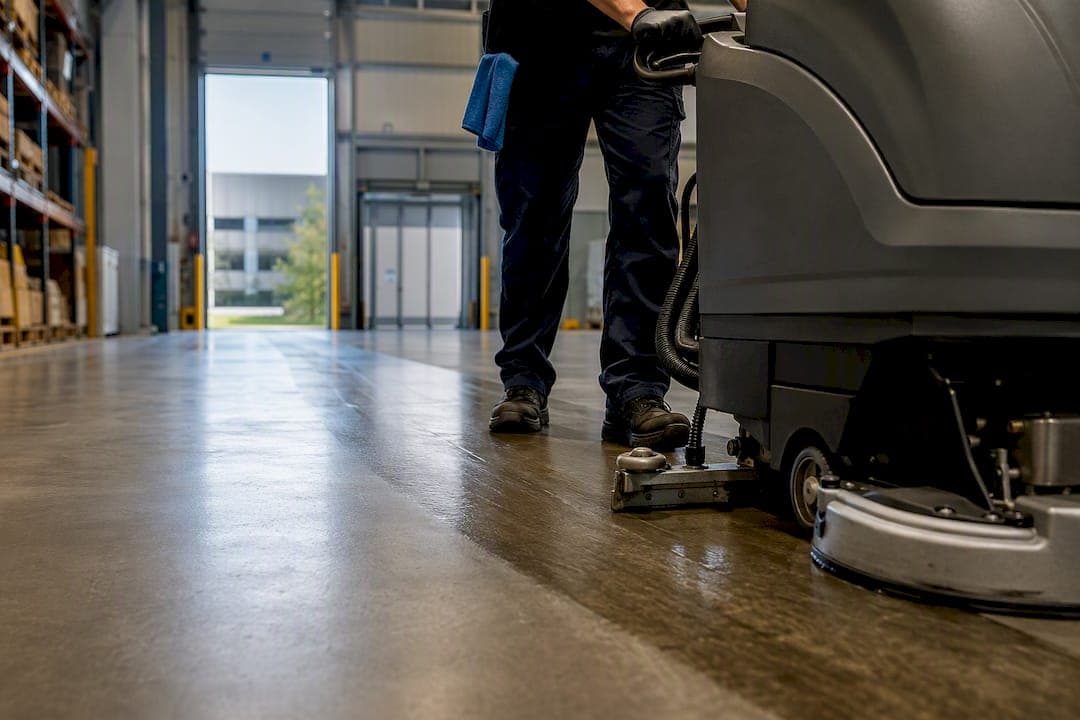
For reliable, safe warehouse floors, remove dry soils daily, then scrub targeted lanes with the right class of mechanical scrubber: walk-behind, ride-on, sweeper-scrubber, or robotic. Skipping the sweep step grinds grit into your finish and wears out pads fast. Matching the machine to the zone, rather than buying one unit for the whole building, is what actually keeps floors safe and labor costs down.
TL;DR:
- Dry soil makes up the majority of warehouse soil load and acts abrasively under scrubber pads if not removed by sweeping beforehand.
- Using a combination machine or sweeping first significantly reduces equipment wear, improves cleaning effectiveness, and lowers long-term costs.
- Matching machine type and size to specific warehouse zones ensures higher productivity and prevents inefficient operations caused by mismatched equipment.
- A proper scrubbing sequence involves walking the floor first, removing dry soil, pre-treating stains, and overlapping machine passes for thorough cleaning.
- Most warehouses benefit from a mixed fleet of walk-behind, ride-on, and sweepers for different zones, rather than relying on a single machine class.
Table of Contents
- Why sweeping before warehouse floor scrubbing matters
- Which floor scrubber is right for each warehouse zone?
- How do you run an effective warehouse floor scrubbing pass?
- How do you size equipment to your warehouse's square footage?
- How often should you scrub, and what does it actually cost?
- How does a professional crew approach warehouse scrubbing at scale?
- Does floor type change how you scrub it?
- What most warehouse floor guides get wrong
- Ready to get a warehouse floor scrubbing quote?
- Sources
Why sweeping before warehouse floor scrubbing matters
Dry soil isn't just dirt sitting on the surface. It's the majority of what actually accumulates on a warehouse floor, and under the weight of a scrubber pad, it behaves like sandpaper. That's the finding at the center of Kaivac's clean academy guidance: grit, dust, and packaging debris grind into concrete and coatings the moment you introduce water and pressure.
Statistic Callout: Dry particulates make up the large majority of the soil load in a typical warehouse, and left in place, they act abrasively under scrubber pads, according to Kaivac.
That abrasion has downstream costs beyond scratched concrete. Wet grit clogs recovery tanks, shortens squeegee life, and turns a clean pass into a muddy smear that has to be redone. A two-step approach, sweeping first and scrubbing second, or using a combination machine that does both in one pass, consistently outperforms scrubbing straight over unswept floors.
So which approach fits your operation?
- Dedicated sweeper first, scrubber second: best when dry soil is heavy and unpredictable, like near dock doors or forklift lanes.
- Sweeper-scrubber combo: best when floor space is tight, staffing is thin, or downtime for two separate passes isn't realistic.
Either way, dry removal isn't optional prep work. It's the step that determines whether your wet scrubbing actually cleans or just relocates the problem.
Which floor scrubber is right for each warehouse zone?
There's no single best machine for an entire warehouse. Kärcher's commercial guidance recommends matching machine class to area size and aisle width, not buying one unit and hoping it fits everywhere.
Walk-behind scrubbers fit narrow racking aisles and tight mezzanine areas where a rider unit simply won't turn. They cost less upfront, but productivity per labor hour is lower, since an operator walks the entire route.
Ride-on scrubbers make sense in open receiving areas, cross-dock zones, and long, unobstructed runs. Bigger tanks mean fewer refill stops, and an operator seated for a two-hour shift covers dramatically more square footage than someone walking it.
Sweeper-scrubbers combine dry pickup and wet scrubbing in one machine. They're the right call in heavy-dust environments, like near loading docks or areas with constant pallet traffic, where running two separate machines eats into limited overnight cleaning windows.
Robotic scrubbers (often called autonomous mobile robots or AMRs) can run repetitive routes with minimal operator time, but Tennant's own product guidance is candid about the tradeoff: they need predictable, unobstructed layouts and someone monitoring for obstacles, spills, or route errors. Drop a robot into a warehouse with shifting pallet placement and constant forklift cross-traffic, and you'll spend more time supervising it than you'd spend running a ride-on yourself.
- Walk-behind: tight aisles, lower cost, lower output per hour.
- Ride-on: open floors, higher output, and better operator comfort on long shifts.
- Sweeper-scrubber: heavy dry soil, constrained cleaning windows.
- Robotic: repetitive open routes, requires supervision and stable layouts.
Pro Tip: Don't standardize on one machine class for the whole facility. Most mid-size and large warehouses run a mixed fleet, a ride-on for the main floor and a compact walk-behind for racking aisles, because no single unit handles both well.
How do you run an effective warehouse floor scrubbing pass?
Running a scrub pass without a sequence wastes water, chemical, and labor. Here's the order that actually works.
- Walk the floor first. Identify problem zones, oil spots, tire marks, standing residue, and flag anything that might be a hazardous spill requiring special handling before machines roll.
- Remove dry soil. Sweep or vacuum the entire route before introducing any water. This single step prevents the sanding effect covered above.
- Pre-treat stubborn stains. For oil and tire marks, apply a low-foam alkaline degreaser and let it dwell for the time the product label specifies before scrubbing. LVTONG's guidance warns against high-foam cleaners, which reduce suction at the squeegee and leave streaky residue behind.
- Set up the machine correctly. Choose the least aggressive pad or brush that removes the soil, moderate down pressure, and dilute solution to the manufacturer's ratio. Overly aggressive pads strip coatings faster than they clean.
- Run overlapping passes. Slow, steady travel speed with a few inches of overlap between passes prevents streaking and missed strips, especially near walls and equipment bases.
- Recover and inspect. Empty recovery tanks, check squeegee blades for nicks or wear, and rinse the machine before storage.
Pro Tip: Always run a short test pass in a representative problem area first. It tells you fast whether dust is turning into slurry, whether the degreaser is actually lifting tire marks, or whether you're leaving wet edges that create a slip hazard before you commit to the full floor.
How do you size equipment to your warehouse's square footage?
Manufacturer spec sheets list rated productivity in square feet per hour, and that number is almost always optimistic. Kärcher's own productivity guidance recommends calculating route-based output instead, factoring in refill stops, recovery tank dumps, and turning time at aisle ends, rather than taking the rated number at face value.
A few rules of thumb help translate spec sheets into a realistic fleet plan:
- Subtract 20 to 30 percent from rated sqft/hr to account for refills, turns, and recovery dumps on a real route.
- If your narrowest aisle is under 6 feet, you need a compact or walk-behind unit; most ride-on scrubbers won't fit.
- Larger solution and recovery tanks mean fewer stops, which matters more as square footage climbs.
- Match tank size to distance from the nearest drain or fill station. A big tank is wasted if the water closet is two aisles away.
For fleet mix, Aokelang's warehouse cleaning guidance suggests a workable pattern: facilities under roughly 20,000 square feet with narrow aisles often do fine with one or two walk-behind units. Mid-size operations typically pair a sweeper with a ride-on scrubber for main aisles. Larger distribution centers usually run a full fleet, ride-on units for open floor, walk-behinds for racking, and a dedicated sweeper for dock aprons. A guide to broader industrial cleaning strategies covers similar fleet-planning logic for facility managers juggling multiple building types.
How often should you scrub, and what does it actually cost?
Frequency depends on traffic, not a fixed calendar. Aokelang's guidance suggests daily sweeping across the whole facility, with main aisles scrubbed two to three times a week, and lower-traffic racking aisles on a lighter schedule. Docks and charging stations, where forklift traffic and battery residue concentrate, often need daily attention.
Cost breaks into a few predictable buckets: labor, machine purchase or rental, consumables (pads, chemical, filters), routine maintenance, and wastewater disposal where local rules require it. Of these, labor is usually the largest line item.
Statistic Callout: Labor typically represents the biggest share of ongoing floor-care cost, and Shoppa's Material Handling notes that mechanized cleaning often pays back its equipment cost within months by cutting labor hours, depending on facility size and schedule.
There's a compliance angle too. OSHA's general housekeeping standards treat clean, dry walking surfaces as a baseline safety requirement, not a cosmetic nicety, which gives facility managers a risk-reduction argument to pair with the cost case when requesting budget.
A simple ROI check for leadership:
- Current labor hours per week on manual mopping or spot cleaning, times hourly rate.
- Equipment cost (purchase or rental) divided by expected monthly labor hours saved.
- Reduced slip-and-fall incident risk, tied to your facility's own claims history if available.
How does a professional crew approach warehouse scrubbing at scale?
A vendor handling multiple warehouse accounts follows a process, not guesswork. A professional commercial cleaning model runs four steps: quote, site visit, scheduled cleaning, and customer sign-off, so the equipment plan and pricing are set before a machine ever touches your floor. Typical projects range from post-construction cleanouts full of concrete dust to routine janitorial scrubbing and deep-degreasing of dock aprons where tire marks and hydraulic fluid build up.
Before hiring any vendor, ask for three things: a written equipment list matched to your aisle widths, proof of insurance, and a site-specific method statement covering chemical use and wastewater handling. A vendor who can't produce these on request usually can't back up the quote either.
Does floor type change how you scrub it?
Sealed concrete, epoxy coatings, and bare polished concrete each respond differently to the same scrub pass, and using the wrong pad or chemical shortens the life of the finish faster than normal wear would.
Epoxy-coated floors are the most sensitive to aggressive pads. LVTONG's guidance on pad selection is direct: choose the least aggressive pad that still removes the soil, since a too-aggressive pad dulls the coating and shortens its service life well before the concrete underneath needs attention. Stick to soft or medium pads and a neutral pH cleaner unless a stain genuinely requires more.
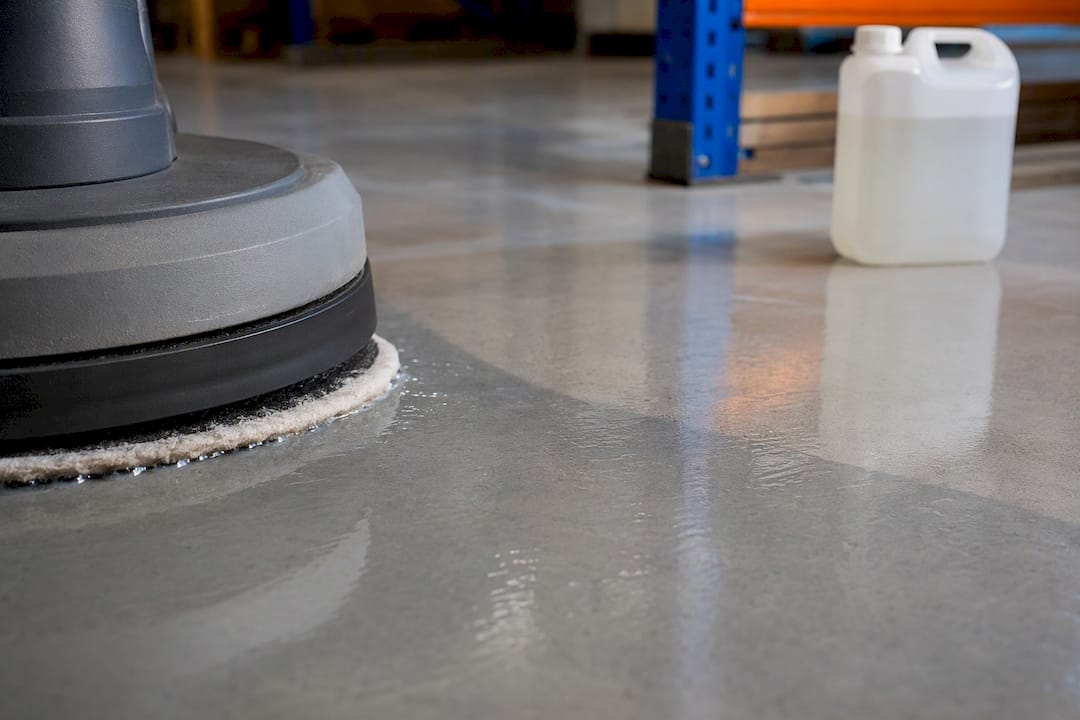
Sealed concrete without a topcoat tolerates slightly more aggressive scrubbing but still needs the sweep-first sequence, since unsealed grit can wear through a sealer faster than traffic alone.
Bare or polished concrete in older warehouses is the most forgiving surface, but it's also the most porous, meaning oil and chemical spills soak in fast. Pre-treatment dwell time matters more here than pad aggressiveness. Concrete dust from nearby construction or renovation work compounds the problem, and a dedicated cleanup approach for post-construction dust is worth reviewing before a first scrub on a newly poured or newly renovated floor. The same abrasive-soil logic applies to outdoor surfaces adjacent to loading areas; even artificial turf around a facility's perimeter needs debris cleared before it grinds into the material underneath.
What most warehouse floor guides get wrong
Most equipment guides sell you on rated productivity numbers and stop there. That's backwards. The real constraint on warehouse floor scrubbing isn't how fast a machine can theoretically move, it's how your aisles, dock schedule, and staffing actually let it move. A ride-on scrubber rated for 40,000 square feet an hour is nearly useless if your racking aisles are six feet wide.
The conventional advice also treats machine selection as a one-time purchase decision. In practice, the warehouses that keep floors consistently clean run mixed fleets and adjust frequency by zone, not a single machine on a fixed schedule. Docks and charging stations need more attention than back-corner storage, and treating them identically wastes labor on low-traffic areas while under-cleaning high-risk ones.
If there's one place to start, it's the sweep-first discipline. It's the cheapest fix on this list and the one most facilities skip under time pressure, which is exactly why it shows up so often in the guidance from equipment manufacturers themselves.
— Sales
Ready to get a warehouse floor scrubbing quote?
If running your own fleet isn't the right fit, hiring it out skips the equipment purchase, the training curve, and the maintenance headaches entirely. A vendor can handle warehouse floor scrubbing as part of routine janitorial and post-construction cleaning contracts, with crews experienced in sequencing a sweep-then-scrub pass on epoxy, sealed, or bare concrete without guessing.
To get a quote, send square footage, a few photos of your problem zones (docks, charging stations, heavy-traffic aisles), and your preferred cleaning frequency. The vendor responds with a site visit, an equipment plan matched to your aisle widths, and a written quote before anything is scheduled. Facilities in the Northeast can start by checking the Delaware service page or the Massachusetts landing page for regional availability and next steps.
Sources
- How to Clean a Warehouse Floor — Kaivac clean academy
- Warehouse cleaning — Kärcher US
- How to clean industrial concrete floors in warehouses — LVTONG