
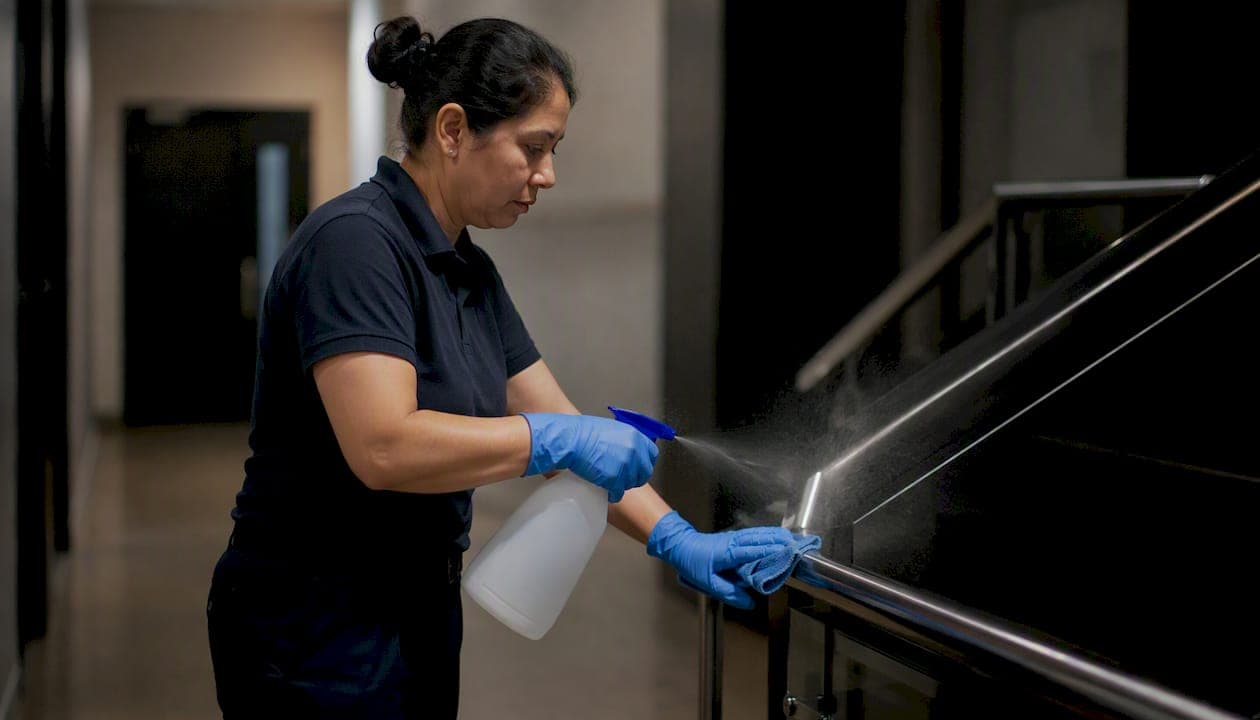
The most damaging commercial cleaning mistakes aren't the dramatic ones. They're the quiet, recurring errors: a disinfectant wiped off before it's had time to work, a vacuum filter that hasn't been changed in months, a damaged countertop that nobody reported. Left unchecked, these mistakes drive up labor costs, shorten asset life, and put you in front of a client asking why the same problem keeps coming back.
Here are the top mistakes to watch for, and what to do about them today:
- Wrong chemical or dilution — Pull your SDS sheets and verify every product matches the surface it's being used on.
- Ignoring dwell/contact time — Check product labels; most disinfectants need a sufficient wet contact time to work, as specified on their labels.
- Skipping high-touch surfaces — Add door handles, elevator buttons, and light switches to your daily checklist explicitly.
- Dirty or poorly maintained tools — Inspect mop heads, microfiber cloths, and vacuum filters before every shift.
- No documented SOPs or training — If it isn't written down, it isn't being done consistently.
- No formal cleaning schedule — Reactive cleaning costs more than scheduled cleaning, every time.
- Carpet and stain-care errors — Over-wetting and delayed spot treatment are the two fastest ways to ruin carpet.
- Deferred equipment maintenance — Clogged extractors and worn vacuum motors don't clean; they redistribute dirt.
- Improper chemical storage or mixing — Unlabeled containers and mixed chemicals are both a safety violation and a liability.
- Poor ventilation and waste handling — Fumes from cleaning chemicals in enclosed spaces are an OSHA concern, not just a comfort issue.
Quick triage: fix these two first. Safety issues (chemical mixing, ventilation, missing PPE) carry the highest liability and must be corrected before the next shift. Revenue-impact issues (damaged surfaces, missed high-touch areas, no audit trail) are second priority because they're what clients notice and what drives contract loss.
Pro Tip: Before your next walk-through, use the building preparation checklist to confirm your team is set up to clean correctly, not just quickly.
Key Takeaways
Fixing the most damaging commercial cleaning mistakes requires enforcing dwell time, maintaining equipment on a documented schedule, training staff to written SOPs, and running formal audits that trigger root-cause analysis, not just re-cleans.
| Point | Details |
|---|---|
| Enforce contact time | Disinfectants must stay wet for the full label-stated period; wiping early leaves pathogens behind. |
| Clean before you disinfect | Soil on a surface blocks disinfectant chemistry; the CDC-recommended sequence is clean first, then disinfect. |
| Maintain equipment on a schedule | Daily, weekly, monthly, and quarterly maintenance tasks prevent equipment from redistributing dirt instead of removing it. |
| Run formal audits with RCA | Recurring failures need root-cause analysis, not repeated re-cleans; audit scores and corrective action logs are the KPIs to track. |
| Sparkleprocommercialcleaning | Provides site-visit-based SOPs, documented audits, and a defined damage-reporting process for facilities nationwide. |
Table of Contents
- The 10 most common commercial cleaning mistakes and how to fix each
- Cleaning vs. sanitizing vs. disinfecting: what the label is actually telling you
- Training, SOPs, and a damage-reporting flow that stops recurring errors
- Tools, machines, and inventory: keeping your equipment effective
- A one-page facility cleaning audit you can use on your next walk-through
- What the recurring failures are really telling you
- A professional cleaning partner eliminates these mistakes at the source
- Sources
The 10 most common commercial cleaning mistakes and how to fix each
1. Using the wrong chemical or the wrong dilution
Applying a product that isn't rated for the surface it's touching is one of the most expensive mistakes in janitorial services. Vinegar on natural stone etches the finish. Bleach on stainless steel causes pitting. A disinfectant diluted too heavily won't kill pathogens; diluted too lightly, it damages surfaces and wastes product. Practitioners consistently flag overuse of cleaners and ignoring label directions as leading causes of surface damage and ineffective disinfecting.
Immediate fixes:
- Pull the Safety Data Sheet (SDS/MSDS) for every chemical in use and confirm surface compatibility.
- Post dilution ratios at every dispensing station.
- Remove any product that doesn't have a current, legible label.
Audit checklist: Are SDS sheets accessible at the point of use? Are dilution ratios posted? Is every container labeled?
Do: Match the product to the surface and the task. Don't: Assume a stronger concentration cleans better.
2. Ignoring dwell time and contact time
This is the single most common technical failure in commercial disinfection. A cleaner sprays a surface, wipes it immediately, and moves on. The product never had time to work. Research on surface cleaning and disinfection confirms that improper technique and insufficient contact time leave viable pathogens on surfaces even after a product is applied. Most EPA-registered disinfectants require a specific wet contact time detailed on their labels, and that window is stated on the label.
Immediate fixes:
- Read the contact time on every disinfectant label and add it to your SOP.
- Train staff to apply product and move to the next surface, returning to wipe after the stated time.
- Use a timer or a zone-rotation system to build dwell time into the workflow naturally.
Audit checklist: Can your staff state the contact time for the disinfectant they're currently using? Is the surface still wet when they wipe?
Do: Let the product do the work. Don't: Spray and immediately wipe.
Pro Tip: Zone rotation is the practical fix here. Staff apply product in Zone A, move to Zone B, then return to wipe Zone A. No extra time, no extra labor.
3. Missing high-touch surfaces
Door handles, elevator buttons, light switches, shared keyboards, faucet handles, and copier touchscreens are touched dozens of times per hour. They're also the surfaces most likely to be skipped because they're small, scattered, and easy to overlook on a generic checklist. For open-plan offices and healthcare-adjacent facilities, this gap is a direct hygiene failure.
Immediate fixes:
- Build a dedicated high-touch surface list into your daily checklist, zone by zone.
- Assign a specific staff member to high-touch coverage each shift so accountability is clear.
Audit checklist: Is there a written high-touch surface list for each zone? Is it checked off daily?
Do: Name every high-touch surface explicitly in the SOP. Don't: Assume staff will identify them on their own.
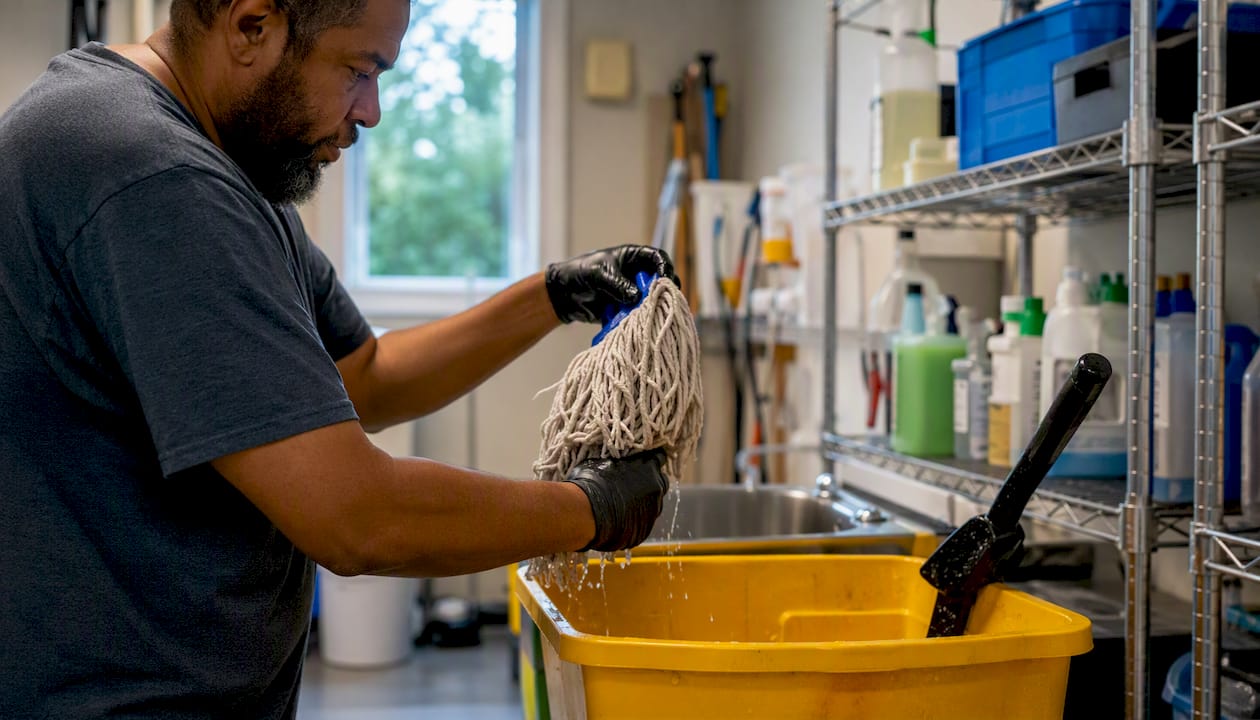
4. Cleaning with dirty or poorly maintained tools
A mop bucket changed once a week is spreading bacteria, not removing it. A vacuum with a clogged filter recirculates fine particulate into the air. Microfiber cloths that haven't been laundered properly lose their electrostatic charge and stop picking up pathogens. The tool is the delivery mechanism for every cleaning technique you've trained your staff on, and a compromised tool undermines all of it.
Immediate fixes:
- Change mop water between zones, not between shifts.
- Inspect vacuum filters before every shift and replace on a documented schedule.
- Launder microfiber cloths separately from cotton and without fabric softener, which destroys the fiber structure.
Audit checklist: Is mop water visibly clean at the start of each zone? Are vacuum filters dated? Are microfiber cloths stored dry and separated by zone?
Do: Treat tool maintenance as part of the cleaning process. Don't: Reuse a dirty cloth across multiple zones.
5. Inadequate staff training and no documented SOPs
If the process lives only in someone's head, it leaves when they do. Undocumented procedures are the root cause of inconsistency across shifts, sites, and staff turnover. A lack of documented cleaning schedules and checklists drives missed areas and inconsistent results. Without written SOPs, you can't audit, you can't train to a standard, and you can't hold anyone accountable.
Immediate fixes:
- Document every task: product name, dilution, contact time, PPE required, surface type, and sequence.
- Run a 30-minute onboarding session for every new hire before they touch a surface.
- Schedule quarterly competency rechecks, not just annual reviews.
Audit checklist: Does every staff member have a copy of the SOP for their zone? Can they demonstrate correct dilution and contact time without prompting?
Do: Write it down, test it, and update it when products change. Don't: Rely on verbal handoffs between shifts.
6. No formal cleaning schedule or inconsistent frequency
Reactive cleaning, responding to visible dirt rather than following a schedule, costs more in labor and materials than a structured program. It also means high-risk areas get cleaned when they look dirty, not when they need it. A restroom cleaned twice a day during peak hours costs less in the long run than one deep-cleaned weekly after complaints.
Immediate fixes:
- Build a frequency matrix: daily, weekly, monthly, and quarterly tasks by zone.
- Assign ownership for each frequency tier so nothing defaults to "someone else's job."
Audit checklist: Is there a written schedule for every zone? Is it being followed and signed off?
Do: Schedule by risk and traffic, not by appearance. Don't: Let occupant complaints drive your cleaning calendar.
7. Carpet and stain-care errors
Over-wetting is the fastest way to ruin commercial carpet. Excess moisture wicks soil back to the surface as it dries, leaving a ring that looks worse than the original stain. Delayed spot treatment lets stains set into fibers, often permanently. Both mistakes are avoidable with a clear protocol and the right equipment.
Immediate fixes:
- Treat spills within 15 minutes using a blotting technique, never scrubbing.
- Use a low-moisture extraction method for spot cleaning rather than saturating the area.
- Add carpet inspection to the daily walk-through checklist.
Audit checklist: Is there a spot-treatment kit accessible on every floor? Are staff trained to blot, not scrub?
Do: Act fast and use minimal moisture. Don't: Scrub a fresh stain or leave wet carpet unventilated.
8. Deferred equipment maintenance
A wet/dry extractor with a partially blocked hose doesn't extract; it redistributes moisture and leaves carpet wetter than before. A floor scrubber with worn pads scratches rather than cleans. Equipment failure is rarely sudden. It's the result of skipped maintenance intervals compounding over weeks. Construction site debris removal and post-construction environments are especially hard on equipment, making maintenance schedules non-negotiable in those settings.
Immediate fixes:
- Log every piece of equipment with its last service date.
- Run a quick pre-shift check: hoses clear, filters clean, pads intact, solution tanks clean.
Audit checklist: Is there a maintenance log for each machine? When was the last filter change? Are pads and brushes within spec?
Do: Treat equipment maintenance as a scheduled task, not a response to failure. Don't: Run a machine that's underperforming and assume it's still cleaning.
9. Improper chemical storage, mixing, or overuse of fragranced products
Storing bleach next to ammonia-based cleaners is a chemical hazard. Mixing them, even accidentally, produces chloramine gas. Beyond the safety risk, overuse of fragranced products masks odors without addressing their source, and introduces volatile organic compounds (VOCs) that irritate occupants and degrade indoor air quality. Neither outcome is acceptable in a commercial facility.
Immediate fixes:
- Segregate incompatible chemicals in labeled, locked storage with secondary containment.
- Remove any unlabeled container immediately.
- Replace fragrance-heavy products with odor-neutralizing formulations where possible.
Audit checklist: Are chemicals stored by compatibility? Are all containers labeled? Is there a spill kit accessible in the storage area?
Do: Store, label, and segregate. Don't: Use fragrance as a substitute for source-odor elimination.
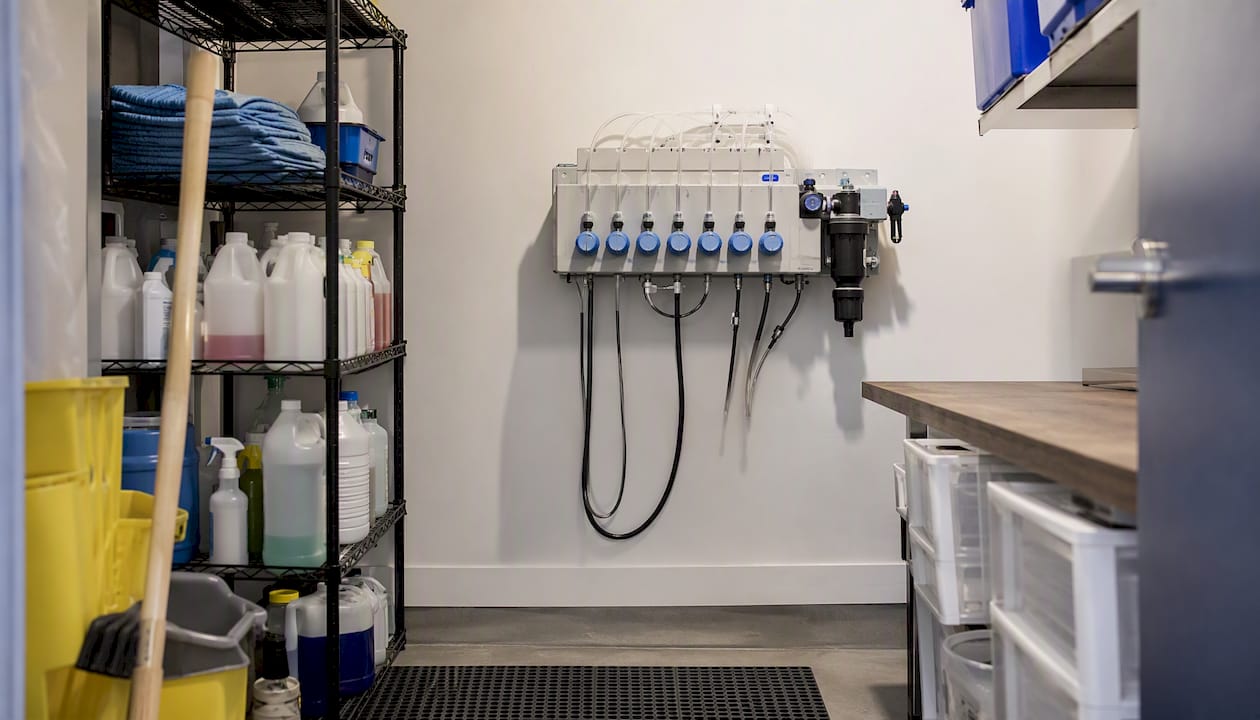
Pro Tip: Dispenser-controlled dilution systems eliminate the guesswork and reduce both overuse and accidental mixing. They also make SDS compliance easier to document.
10. Poor ventilation, waste handling, and failure to audit
Cleaning chemicals in enclosed spaces without adequate airflow create exposure risks for staff and occupants. OSHA's Hazard Communication Standard requires that workers know what they're handling and that ventilation is adequate for the products in use. Separately, skipping formal audits means problems compound invisibly until a client notices, or worse, until there's a health incident.
Immediate fixes:
- Open windows or activate HVAC before applying any chemical with a ventilation requirement on the label.
- Establish a waste disposal protocol that matches your local regulations and post it in the storage area.
- Schedule a monthly audit walk-through with a written report, not just a verbal debrief.
Audit checklist: Is ventilation confirmed before chemical application? Is waste disposal documented? Is there a written audit report from the last 30 days?
Do: Treat ventilation as a pre-task step, not an afterthought. Don't: Skip audits because nothing looks wrong.
Cleaning vs. sanitizing vs. disinfecting: what the label is actually telling you
These three terms are not interchangeable, and using them as if they are is one of the most persistent office cleaning pitfalls in facility management.
Cleaning removes visible dirt, dust, and debris through physical action. It reduces the number of germs on a surface but doesn't kill them. Sanitizing reduces bacteria to a safe level as defined by public health standards. Disinfecting kills a broader spectrum of pathogens, including viruses and fungi, using EPA-registered chemical agents. The CDC's guidance on cleaning and disinfection is clear: clean the surface first, then sanitize or disinfect where needed. Applying a disinfectant to a visibly dirty surface reduces its effectiveness because organic matter interferes with the active ingredient.
The sequence matters operationally:
- Clean the surface to remove soil and debris.
- Sanitize or disinfect based on the risk level of the area (restrooms and healthcare spaces require disinfection; break rooms may need only sanitizing).
- Follow the label for dilution, contact time, PPE, and ventilation requirements.
Label-reading quick guide:
- Dilution: Use the ratio stated on the label. More concentrated is not more effective and often causes surface damage.
- Contact time: The surface must remain wet for the full stated period. This is the most commonly skipped step.
- PPE: Gloves, eye protection, and respiratory protection requirements are listed per product. They aren't optional.
- Ventilation: If the label says "use in a well-ventilated area," that's a regulatory requirement, not a suggestion.
- Storage: Incompatible chemicals are listed on the SDS. Follow them.
For disinfecting cleaning guidance specific to commercial environments, including healthcare and cleanrooms, the distinction between sanitizing and disinfecting carries real compliance weight. The EPA maintains a list of registered disinfectants effective against specific pathogens. Verify that every disinfectant your team uses appears on the relevant EPA list for your facility type.
Research confirms that proper technique and contact time are what reduce microbial load. A product applied correctly but wiped too soon can leave a surface with nearly the same pathogen count as an uncleaned one.
Training, SOPs, and a damage-reporting flow that stops recurring errors
The American Cleaning Institute's guidance on systematic cleaning sequences, working top-down and preparing supplies in advance, applies directly to commercial operations. Reversing the sequence (cleaning floors before dusting overhead fixtures, for example) adds rework and wastes labor. A documented SOP locks in the correct sequence so it doesn't depend on who's working that day.
Core training checklist for every staff member:
- Product identification and surface compatibility
- Correct dilution procedure and dispenser use
- Contact time for each disinfectant in use
- PPE requirements per product
- Safe mixing rules and incompatible chemical pairs
- Surface-specific techniques (microfiber vs. mop, blot vs. wipe)
- Color-coding system for cloths and tools by zone
Color-coding is an inexpensive, high-impact control. Red cloths for restrooms, blue for common areas, green for kitchens. It eliminates cross-contamination risk without requiring staff to memorize zone rules, and it's immediately auditable during a walk-through.
Accountability tools that work in practice:
- Digital check-ins: Mobile apps that require staff to log in at the job site before starting. This eliminates missed appointments and provides a timestamp record.
- Daily logs: A signed checklist per zone, per shift. Not a general "building cleaned" sign-off.
- Supervisory spot audits: Unannounced, documented, and tied to a corrective action process.
- Competency rechecks: Quarterly for new staff, semi-annually for experienced staff, and immediately after any product or procedure change.
Incident and damage reporting flow:
When damage occurs, silence is the worst response. Transparent damage reporting is what preserves client relationships when something goes wrong. A cleaning service that stays silent after damaging a counter loses the contract. One that reports immediately, documents the damage, and proposes a remedy usually keeps it.
The flow should be:
- Staff identifies damage during or after cleaning.
- Staff photographs and logs the damage immediately.
- Supervisor is notified within the same shift.
- Client is notified in writing within 24 hours with photo documentation.
- Remediation plan is proposed within 48 hours.
This process protects both the vendor and the client, and it's the difference between a recoverable incident and a contract termination.
Tools, machines, and inventory: keeping your equipment effective
Equipment that isn't maintained doesn't clean. It redistributes soil, damages surfaces, and generates callbacks that cost more than the original service.
Common equipment-failure mistakes and their consequences:
- Clogged extractor hoses: Leave carpet wetter than before extraction, promoting mold growth.
- Worn vacuum filters: Recirculate fine dust and allergens, degrading indoor air quality.
- Dirty mop buckets: Spread bacteria across floors rather than removing it.
- Expired or improperly stored chemicals: Lose efficacy and may become hazardous.
- Uncalibrated dispensers: Deliver incorrect dilutions, either wasting product or under-dosing.
Maintenance schedule (adapt for your CMMS or facility log):
| Frequency | Task |
|---|---|
| Daily | Inspect mop heads and replace if soiled; empty and rinse mop buckets; check vacuum suction and filter condition; wipe down equipment exteriors |
| Weekly | Launder all microfiber cloths; clean extractor tanks and hoses; inspect spray bottles for residue and label accuracy; verify dispenser output against target dilution |
| Monthly | Replace vacuum filters per manufacturer spec; deep-clean extractor heads and brushes; audit chemical inventory for expiry dates; test dispenser calibration |
| Quarterly | Full equipment inspection and service log review; replace worn pads, brushes, and squeegees; review SDS file for accuracy; restock PPE supplies |
Inventory rotation and dispenser controls:
Rotate chemical stock on a first-in, first-out basis. Expired product is a liability, not a cost saving. Lockable dispensers with preset dilution ratios prevent both overuse and accidental mixing, and they make it easier to document compliance with your SDS requirements. Store chemicals in a dedicated, ventilated area with secondary containment, and never store incompatible products on the same shelf.
Pro Tip: *Calibrate dispensers quarterly using a simple titration test.
A one-page facility cleaning audit you can use on your next walk-through
The fastest way to convert this list of cleaning service errors into operational improvement is a structured audit. Root Cause Analysis applied to recurring cleaning failures reveals systemic causes, equipment gaps, frequency mismatches, and training deficits, rather than just identifying the same dirty spot week after week.
Audit structure (copy into your CMMS or a shared document):
- Zone: Name the specific area (restroom 2F, lobby, server room corridor).
- Mistake observed: Use the numbered list above as your reference.
- Severity score: 1 (cosmetic) to 3 (safety/compliance risk).
- Immediate corrective action: What gets fixed before the next shift.
- Owner: Named individual, not a role.
- Follow-up date: Specific date, not "next week."
Prioritization matrix:
| Severity | Frequency | Action |
|---|---|---|
| High (3) | Recurring | Immediate corrective action + RCA within 48 hours |
| High (3) | Isolated | Immediate corrective action + monitor for recurrence |
| Medium (2) | Recurring | Scheduled fix within 7 days + RCA |
| Medium (2) | Isolated | Scheduled fix within days |
| Low (1) | Any | Log and address in next scheduled maintenance cycle |
Converting audit results into lasting fixes:
Short-term fixes address the symptom: the dirty surface, the missing label, the skipped zone. Root Cause Analysis addresses why it happened. A restroom that fails every audit isn't a training problem; it may be a frequency problem, an equipment problem, or a staffing problem. Ask "why" three times before assigning a corrective action, and you'll stop re-cleaning the same spot.
For facilities with multiple zones and different surface types, adapt the checklist by zone. A healthcare corridor has different severity thresholds than a retail stockroom. High-rise and exterior cleaning programs require their own audit criteria, particularly around access equipment and chemical runoff.
What the recurring failures are really telling you
The pattern shows up the same way in facility after facility. Audits get skipped because nothing looks obviously wrong. Then a client notices a persistent odor, a stained grout line that's been there for months, or a scuffed floor finish that nobody reported. By that point, the damage is done, and so is the trust.
The mistake most managers make isn't ignoring cleaning. It's treating it as a background function that runs itself. A cleaning program without documented SOPs, scheduled audits, and a clear damage-reporting process isn't a program. It's a hope.
Client engagement steps that protect the relationship:
- Site visit before contract start: Walk the facility with the cleaning team. Document surface types, high-risk zones, and any pre-existing damage.
- Documented SOPs delivered to the client: The client should know what's being cleaned, how often, and with what products.
- Trial period with weekly reporting: The first 30 days should include a written report after each service.
- Defined reporting cadence: Monthly summary reports with audit scores and any corrective actions taken.
- Damage-claims policy in writing: Agreed before the first service, not after the first incident.
Sparkleprocommercialcleaning's four-step engagement process, quote, site visit, scheduled cleaning, and client approval, is built around exactly this structure. The site visit isn't a formality; it's where the SOP gets written.
A professional cleaning partner eliminates these mistakes at the source
Fixing these mistakes in-house takes time, documentation, and consistent follow-through across every shift and every site. For many facility managers, the more direct path is a partner who arrives with verified SOPs, calibrated equipment, and a documented audit process already in place.
Sparkleprocommercialcleaning operates nationwide, fully licensed and insured, across office buildings, retail centers, healthcare facilities, and industrial spaces. Every engagement starts with a site visit to document surface types, zone-specific protocols, and any pre-existing conditions, so the first clean is done right, not redone. Routine janitorial contracts include scheduled audits and written reports, and the damage-reporting process is defined before the first service, not after the first incident.
If you're managing a facility in Delaware, Massachusetts, or Washington, request a site visit and quote to get a cleaning program built around your facility's specific zones and risk profile.
Sources
These are the primary references behind the guidance in this article. Consult them when writing or updating your own SOPs, evaluating products, or responding to a compliance question.
- CDC: When and How to Clean and Disinfect Your Home
- American Cleaning Institute: Fast and efficient home cleaning guide
- Cleaning Masterclass: Root cause analysis in cleaning service failures
- Syracuse
- Real Simple: Cleaning editor—most life-changing tips
- NCBI PMC: Research on surface cleaning and disinfection effectiveness