
Corporate office cleaning security protocols are the set of strict practices and guidelines designed to secure facilities while maintaining high sanitation standards. Every time a cleaning crew enters your building after hours, they interact with your alarm systems, access cards, sensitive areas, and chemical supplies. Without a defined framework covering vendor compliance, access control, and standardized cleaning procedures, that interaction becomes a liability. This guide gives corporate executives and office managers a clear, actionable structure for managing cleaning service security guidelines from vendor vetting through ongoing audit and documentation.
1. What are the essential credential and compliance requirements for cleaning vendors?
Vendor compliance is the first line of defense in any cleaning security program. Before a single cleaner sets foot in your building, your vendor must provide a complete documentation package covering criminal background checks, insurance certificates, and safety data sheets.
Corporate executives should require national criminal background checks covering each cleaner's full residential history before vendor engagement. Top vendors deliver compliance packages including insurance and police checks within 48 hours of inquiry. If a vendor cannot meet that timeline, treat it as a disqualifying signal.
Key credential requirements to enforce before contract signing:
- National criminal background checks for every individual assigned to your facility
- Employment verification confirming direct hire status, not subcontractor placement
- General liability and bonding certificates with your company listed as an additional insured
- Safety data sheets for all cleaning chemicals used on site
- Annual renewal of all compliance documentation, not just at onboarding
The distinction between direct employees and subcontractors matters significantly. Subcontractors fall outside the vendor's direct supervision and training chain. A vendor using direct employees gives you a single accountable party for behavior, training, and security compliance.
Pro Tip: Request that your vendor's compliance package include a named account manager responsible for your facility. Dedicated account managers handle building access, key security, and alarm codes, which reduces your facility team's daily involvement.
2. How should building access and alarm system protocols be managed?
Access control is where cleaning security most often fails in corporate environments. Vague verbal instructions and shared master codes create exposure that is difficult to audit or reverse.
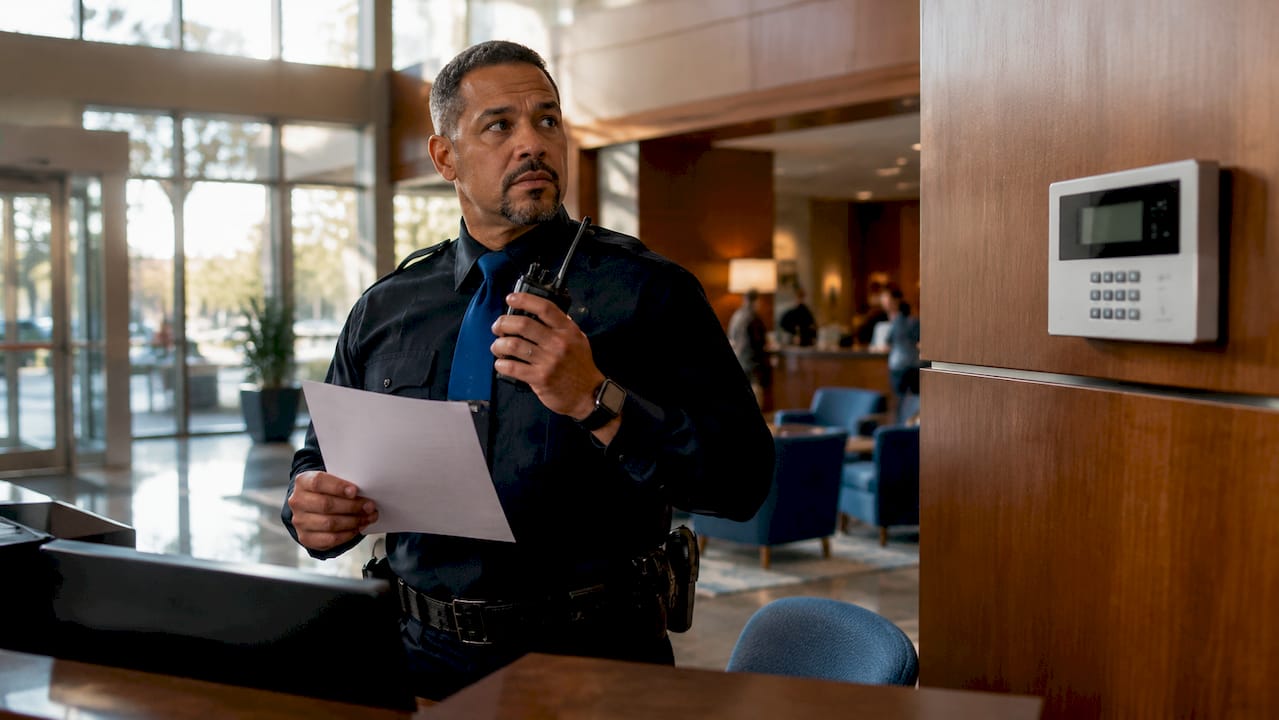
A secure setup requires written entry instructions, defined access windows, and individual vendor codes. Cleaner-specific alarm codes that can be revoked immediately are the standard. Master codes shared with cleaning crews are a known security risk and should never be used.
Follow this sequence for managing access and alarm systems:
- Issue vendor-specific alarm codes that activate only during scheduled cleaning windows.
- Provide written, one-page access instructions covering entry sequence, alarm disarm steps, and lock-up procedures.
- Log every entry and exit using a digital access system or a physical sign-in sheet kept at the security desk.
- Restrict access to sensitive areas such as server rooms, executive suites, and HR offices by default.
- Conduct supervised entries for new cleaning staff during the first two weeks of service.
- Require a lock-up checklist that the cleaning supervisor signs and submits after each visit.
- Revoke and reissue codes immediately when a cleaning staff member leaves the vendor's employment.
Using one-page cleaning access checklists reduces errors and no-access callouts significantly. That single document eliminates the most common cause of after-hours security incidents: a cleaner who was never given clear instructions.
Pro Tip: Schedule cleaning access windows to end at least 30 minutes before your building's next scheduled occupancy. That buffer gives your security team time to verify the space before employees arrive.
3. What SOPs maximize cleaning security and hygiene?
Standard operating procedures, or SOPs, are the backbone of any facility cleaning best practices program. Cleaning programs fail most often when the scope of work is vague and lacks defined products, task sequences, and finish standards. A well-written SOP eliminates that ambiguity.
SOPs must be written as step-by-step instructions from the cleaning crew's perspective. They specify which product to use on which surface, in what order, and to what measurable standard. A defined cleaning scope of work protects both parties: the vendor knows exactly what is expected, and you have a document to audit against.
Disinfection and chemical handling
Industry-standard disinfection requires observing manufacturer-stated dwell times of up to 10 minutes to effectively eliminate pathogens. Ignoring dwell times results in complete disinfection failure. Your SOP must state dwell times explicitly for each product used, not leave them to the cleaner's judgment.
Proper PPE including gloves, masks, eye protection, and non-slip footwear is required during all cleaning tasks. Training on chemical handling and replacing PPE as needed reduces workplace injuries and limits your liability as the facility owner.
Zoning and cross-contamination prevention
| Protocol | Standard approach | Recommended corporate approach |
|---|---|---|
| Cloth color coding | Single cloth for all surfaces | Separate colors per zone (restroom, kitchen, desk areas) |
| Mop heads | Shared across floors | Dedicated mop heads per floor or zone |
| Chemical dilution | Mixed on site by cleaner | Pre-measured dispensing systems |
| Vacuum filtration | Standard bag vacuum | HEPA-filter vacuum trapping 99.97% of particles |
| Cleaning sequence | Variable | Top-to-bottom, clean before disinfect |
Written cleaning checklists aligned with OSHA and CDC guidance improve accountability and safety. The sequence rule is non-negotiable: clean surfaces before disinfecting, and always work top-to-bottom to prevent recontamination of already-cleaned areas.
4. How to monitor, audit, and document ongoing compliance
Monitoring transforms a cleaning contract from a promise into a verified record. Without regular audits, even the best SOP degrades over time as staff turns over and shortcuts accumulate.
The most reliable verification tools are UV fluorescent marker audits and ATP surface testing. UV markers and ATP testing verify cleaning thoroughness and confirm infection control standards are being met. ATP testing measures biological residue on surfaces and produces a numeric score, giving you objective data rather than a supervisor's opinion.
Core documentation your vendor must maintain and share with you:
- Digital task checklists completed after each cleaning visit, with timestamps
- Staff training and induction records updated when new cleaners are assigned to your facility
- Incident and security breach reports filed within 24 hours of any access or safety issue
- Chemical inventory logs tracking what products are brought into and removed from the building
- Audit reports from quarterly performance reviews with corrective action notes
A named account manager is the single point of contact for all documentation requests. That structure prevents information from getting lost across multiple contacts and gives you a clear escalation path when issues arise. For a structured approach to routine facility cleaning documentation, a defined process template saves significant setup time.
5. Comparison of common security models used in corporate office cleaning
Not every corporate environment requires the same level of access control. The right model depends on your building's occupancy pattern, the sensitivity of your data, and the size of your cleaning vendor's team.
| Security model | Access method | Best suited for | Key risk |
|---|---|---|---|
| Lockbox key system | Physical key in secure lockbox | Low-traffic single-floor offices | Key duplication risk if not audited |
| Shared alarm code | One code for all cleaners | Small offices with low turnover | Cannot be revoked per individual |
| Individual electronic codes | Unique code per cleaner | Multi-floor corporate buildings | Requires access control software |
| Supervised entry | Security staff escorts cleaners | High-security or government facilities | High operational cost |
| Keycard access | Vendor-issued temporary cards | Large campuses with multiple zones | Card loss or sharing risk |
Routine janitorial work and project-based deep cleaning require separate access models. Deep cleaning is a disruptive project distinct from daily janitorial work and should be scheduled, supervised, and documented separately to protect floor finishings and avoid operational disruption. Treating them as the same service is a common mistake that leads to both security gaps and facility damage. For a practical breakdown of open office cleaning strategies, the distinction between routine and project-based work is covered in detail.
Key takeaways
Effective corporate office cleaning security protocols require vendor compliance verification, individual access controls, written SOPs, and regular ATP-based audits working together as a single system.
| Point | Details |
|---|---|
| Vendor compliance comes first | Require background checks, insurance, and compliance documents within 48 hours before service starts. |
| Use individual alarm codes | Assign vendor-specific codes that activate only during scheduled windows and can be revoked instantly. |
| SOPs must specify products and sequences | Vague scopes of work are the leading cause of cleaning program failure in corporate environments. |
| Dwell times are non-negotiable | Disinfectants must remain on surfaces for up to 10 minutes; skipping this step means zero pathogen elimination. |
| Audit with objective tools | ATP surface testing and UV marker audits produce measurable data that replaces subjective supervisor reports. |
What I've learned from watching cleaning contracts go wrong
Most cleaning security failures I see are not caused by bad vendors. They are caused by facility managers who hand over a key and assume the rest will sort itself out. The vendor gets blamed when the real problem is that no one defined what "secure" meant in writing.
The most common mistake is treating the SOP as a formality. Executives sign off on a cleaning contract, the vendor provides a generic checklist, and six months later no one can explain why the server room door was left unlocked on a Tuesday night. A vague scope of work is not a minor administrative gap. It is the direct cause of most security incidents involving cleaning staff.
The second mistake is conflating routine cleaning with deep cleaning. These are fundamentally different operations with different access requirements, chemical exposures, and supervision needs. Running a deep clean under a routine janitorial contract creates gaps in both security and quality. Treat them as separate projects with separate documentation.
The vendors worth keeping are the ones who push back on vague instructions and ask for specifics. That behavior signals a team that actually follows SOPs rather than improvising. If a vendor accepts any scope of work without questions, that is a warning sign, not a convenience.
— Sales
How Sparkleprocommercialcleaning handles corporate cleaning security
Corporate clients need more than a cleaning crew. They need a vendor who arrives with documentation, follows a defined protocol, and reports back in writing.
Sparkleprocommercialcleaning delivers fully vetted cleaning teams with background-checked staff, liability insurance, and compliance documentation ready before the first visit. Every corporate engagement includes written SOPs, defined access procedures, and a named account manager who handles alarm coordination and key security directly. Audit reports and digital checklists are standard, not optional add-ons. If your facility is in the Northeast, corporate cleaning in Massachusetts is available with full compliance documentation and security protocol adherence built into every contract. Contact Sparkleprocommercialcleaning to get a quote tailored to your facility's security and hygiene requirements.
FAQ
What are corporate office cleaning security protocols?
Corporate office cleaning security protocols are the documented rules governing how cleaning vendors access, operate within, and exit a corporate facility. They cover vendor credentialing, alarm code management, SOP compliance, and audit procedures.
How should alarm codes be managed for cleaning crews?
Cleaning crews should never use master alarm codes. Assign vendor-specific restricted codes that activate only during scheduled cleaning hours and can be revoked immediately when staff changes.
What compliance documents should a cleaning vendor provide?
A compliant vendor provides national criminal background checks, general liability and bonding certificates, safety data sheets, and staff training records. Top vendors deliver this package within 48 hours of inquiry.
How do you verify that cleaning was completed correctly?
ATP surface testing and UV fluorescent marker audits are the two most reliable verification methods. ATP testing produces a numeric score measuring biological residue, giving facility managers objective data on cleaning thoroughness.
What is the difference between routine cleaning and deep cleaning in a corporate office?
Routine janitorial work covers daily or weekly maintenance tasks. Deep cleaning is a separate, scheduled project involving intensive treatments that can disrupt operations and require distinct access controls and supervision.