
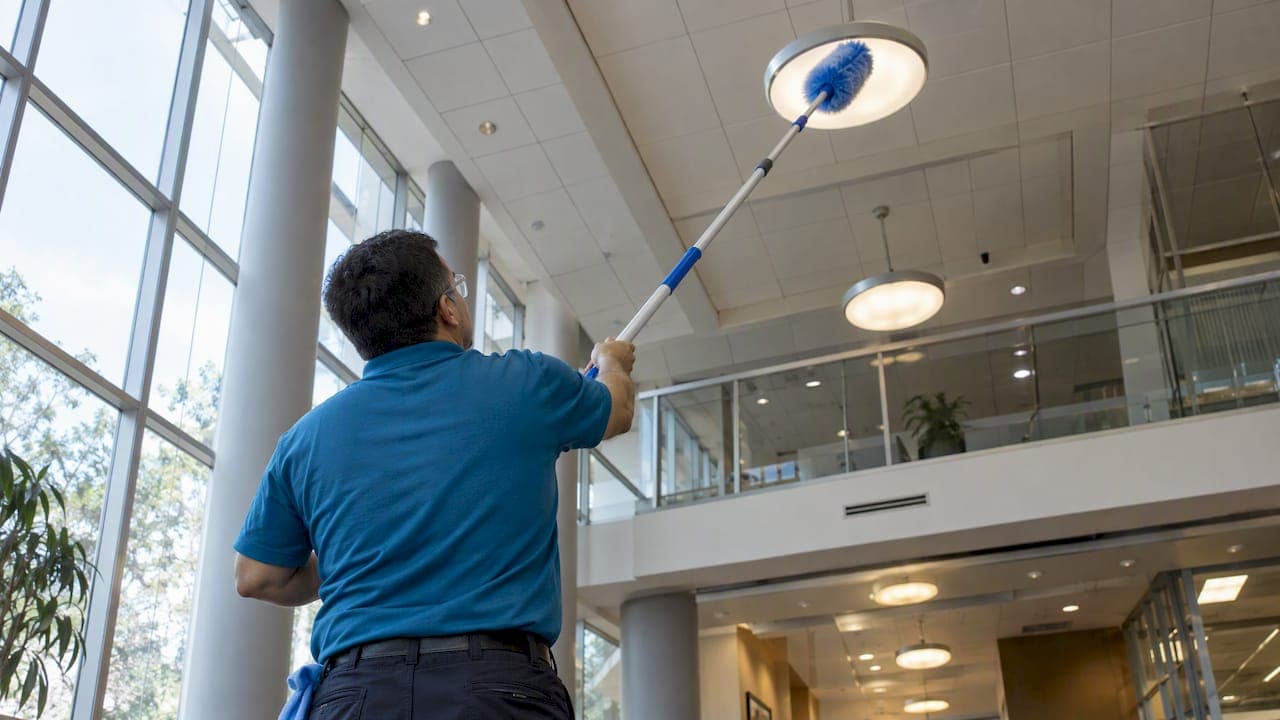
The safest high dusting approach combines vacuum-first extraction with HEPA equipment, extension poles or telescopic wands for reach, and OSHA-compliant aerial access with proper fall protection when ladders will not do the job. Get those three elements right, a HEPA vacuum, the right access equipment, and a trained crew working under a fall-protection plan, and most of the fall, dust-exposure, and equipment risks tied to overhead cleaning drop sharply. The details of how to execute each piece follow below.
TL;DR:
- A HEPA vacuum must capture at least 99.97% of particles down to 0.3 microns; inspect its filter, gasket, and housing seals before each job.
- Offices and retail spaces typically need quarterly cleaning; dusty warehouses may need monthly or weekly service, while duct cleaning should follow filter changes.
- For combustible dust, avoid compressed air and trigger an engineering review when deposits reach roughly paperclip thickness across a significant area.
- Before lift work, verify operator training, inspect the equipment daily, and review a written fall protection and suspended worker rescue plan.
- Rotate workers between overhead tasks and ground support every 20 to 30 minutes to limit sustained overhead posture and reduce cumulative strain.
Table of Contents
- What High Dusting Covers and Why It Matters
- Equipment and PPE: What to Use and Why
- Fall Protection and Regulatory Requirements to Plan For
- Combustible-Dust Recognition and Controls During High Dusting
- Safe Step-by-Step High-Dusting Workflow and Ergonomic Tips
- Scheduling, Frequency, and Contract Language to Get Right
- How We Deliver Safe High Dusting Across Every Site
- A Field Perspective on What Actually Reduces Risk
- Hire Us for Compliant High Dusting
- FAQ
What High Dusting Covers and Why It Matters
High dusting refers to cleaning surfaces above standard reach, typically anything from eight feet up to the ceiling line. That includes light fixtures, HVAC vents and ductwork, pipes, ceiling grids, high shelving, exposed beams, sprinkler heads, and the tops of cabinets or partitions. If a surface collects airborne particulate and sits beyond a worker's extended arm without a ladder, it belongs in a high dusting program.
Overhead particulate is not a cosmetic issue. Dust that settles on high surfaces eventually falls back into the breathing zone, degrades indoor air quality, and accelerates wear on HVAC coils and electrical components. In facilities that generate combustible dusts, accumulation on elevated surfaces creates fuel for flash fires if it becomes airborne near an ignition source. That is why high dusting functions as a source-control task, not routine janitorial polish.
Common surfaces and situations that call for a structured high dusting plan:
- Overhead HVAC diffusers, return grilles, and exposed ductwork that recirculate settled dust
- Warehouse racking, exposed steel, and pipe runs above eight feet
- Light fixtures and ceiling grids in offices, retail spaces, and healthcare corridors
- Production-area beams and ledges in manufacturing or woodworking facilities
- Post-construction ceilings and high walls where concrete and drywall dust has settled
Facilities with heavy particulate loads, active combustible-dust processes, or ducting that has not been serviced in years should treat high dusting as a specialist job rather than a line item folded into general janitorial work. A dedicated dust remediation assessment, not a quick wipe-down, is the right first step in those cases.
Equipment and PPE: What to Use and Why
HEPA filtration is the baseline requirement for any vacuum used in high dusting. A HEPA filter captures at least 99.97 percent of particles down to 0.3 microns, which keeps fine dust out of the air instead of redistributing it through an exhaust port. Before any job, crews should inspect the filter for tears, confirm the gasket seal is intact, and check that the housing latches fully. A vacuum with a compromised seal performs worse than no HEPA filter at all, because it gives a false sense of containment while leaking dust around the edges.
Extension poles and telescopic wands extend a worker's reach without requiring a ladder for short jobs. Fiberglass and aluminum poles are common, with fiberglass preferred near electrical fixtures because it does not conduct current. Bendable-neck wands let a worker angle the head toward a surface instead of craning the neck or shoulder upward, which matters on jobs that run for hours. OSHA guidance on ergonomics points to sustained overhead postures as a driver of musculoskeletal strain, and tool selection is one of the simplest ways to reduce that exposure.
For anything beyond the reach of an extension pole, the choice is between aerial lifts and ladders, and in most industrial or extended-duration settings, ladders are the wrong tool. A scissor lift works well for open floor areas with a flat surface and vertical-only access needs. An articulating or boom lift handles obstructions, uneven terrain, or situations where the worker needs to reach up and over equipment. Ladders remain appropriate only for brief, low-height tasks; extended overhead work from a ladder increases fall risk and rarely satisfies fall-protection expectations under OSHA's aerial-lift standard.
PPE requirements scale with dust risk:
- N95 or higher respirators for routine high dusting with moderate particulate loads
- Half-face or full-face respirators with appropriate cartridges in combustible-dust or chemical-residue environments
- Safety glasses or goggles any time dust is being dislodged overhead
- Hard hats when working beneath structural elements or near overhead equipment
Pro Tip: Run a 30-second vacuum suction test and a visual filter check before every shift. It catches a failing seal before it becomes an exposure incident.
Fall Protection and Regulatory Requirements to Plan For
Aerial lift use for high dusting falls under OSHA 1910.67, which governs vehicle-mounted elevating and rotating work platforms and references ANSI A92.2 design and use standards. These rules set expectations for inspection intervals, load ratings, and operator conduct, and OSHA interpretations built on 1910.67 clarify how those expectations apply in day-to-day use.
Fall arrest or restraint requirements depend on the lift type and the work being performed. OSHA's fall protection interpretations for aerial lifts note that workers in boom-type lifts typically need a personal fall arrest system tied to the manufacturer-designated anchor point, while some scissor lift configurations call for restraint rather than arrest. The practical rigging rule is simple: use the shortest lanyard practicable so a fall, if it happens, is arrested before the worker contacts the platform floor or guardrail.
A compliance-ready high dusting program should include:
- Daily pre-use inspection of the lift: outriggers, brakes, controls, and anchorage points
- Verification that the operator holds current aerial-lift training and authorization
- A written fall-protection plan specifying restraint versus arrest for each lift type in use
- A rescue plan for a suspended worker, reviewed before the job starts, not after an incident
- Logged inspection and training records kept on file for audit or insurance review
Operator training is not optional paperwork. An untrained operator is far more likely to misjudge outrigger placement or overload a platform, and OSHA inspectors treat missing training records as a standalone citation risk separate from the fall-protection violation itself. For broader OSHA-aligned site practices beyond aerial work, our construction cleaning safety guide covers the adjacent checklist items that often surface in the same audits.
Combustible-Dust Recognition and Controls During High Dusting
Combustible dust risk shows up most often in woodworking, grain handling, metal fabrication, pharmaceutical manufacturing, and plastics processing, anywhere fine organic or metal particulate accumulates on elevated surfaces, beams, and equipment housings. OSHA's Revised Combustible Dust National Emphasis Program, effective January 30, 2023, directs inspectors toward these industry groups specifically because accumulated dust on overhead surfaces is a recognized fuel source for flash fires and secondary explosions.

Practitioners commonly use a thin layer of dust accumulation, roughly the thickness of a paperclip, as a trigger point for industrial controls rather than routine cleaning alone. When accumulation reaches that depth across a significant area, the response shifts from scheduled high dusting to an engineering and process-safety review, often guided by NFPA 654 alongside the OSHA NEP.
Controls that reduce fire and explosion risk during high dusting in these environments:
- Vacuum-first extraction using HEPA-filtered equipment instead of brushing or sweeping, which only redistributes particulate into the air
- No compressed-air cleaning of overhead surfaces, since blowing dust airborne near an ignition source is one of the most direct ways to trigger a flash fire
- Grounding and bonding of vacuum equipment in areas with static-sensitive dust types
- Elimination or control of ignition sources, including hot work and non-rated electrical equipment, during cleaning
- Coordination with the facility's process-safety or environmental health team before cleaning areas flagged under the combustible-dust program
A dust remediation specialist should be brought in whenever accumulation, dust type, or process conditions suggest the job has moved beyond routine janitorial scope.
Safe Step-by-Step High-Dusting Workflow and Ergonomic Tips
A repeatable workflow keeps fall, inhalation, and strain risks consistent across crews and sites, instead of depending on individual judgment calls each time.
- Pre-job: Conduct a hazard walk-through, isolate the work area with signage or barriers, inspect the vacuum, poles, and lift, and have the crew don respirators and eye protection before starting.
- Execution: Work top-down and vacuum-first, starting at the highest point in a zone and clearing dust before it has a chance to fall onto surfaces already cleaned below.
- Pattern: Move through the space in defined grids or zones so no surface gets skipped and no area gets double-handled, which also makes supervision and sign-off easier.
- Rotation: Swap crew members between overhead tool work and ground-support tasks (such as managing the vacuum hose or staging equipment) every 20 to 30 minutes to limit sustained overhead strain.
- Post-job: Do a visual walk-through to confirm surfaces are clear, swap or clean filters per the equipment schedule, and log the work along with any inspection notes.
Ergonomics deserves the same weight as fall protection in a high dusting program, since musculoskeletal injuries from overhead work are common and largely preventable. Bendable-neck wands let workers keep their elbows close to the body instead of reaching at full extension. Limiting continuous overhead posture to short intervals, paired with the rotation step above, cuts cumulative strain over a full shift. Crew supervisors who actively manage rotation schedules see fewer repetitive-strain complaints than crews left to self-pace, a pattern we cover in more detail in our crew supervision guide.
Pro Tip: Stage the vacuum and extra filters at the base of the work zone before starting. Walking back and forth for supplies is a common source of distraction-related slips near lift bases.
Scheduling, Frequency, and Contract Language to Get Right
Frequency depends heavily on environment. A standard office or retail space typically needs high dusting on a quarterly basis, since particulate accumulates slowly and foot traffic is the main dust generator. Manufacturing floors, warehouses, and any facility with combustible-dust exposure need monthly or even weekly attention on critical surfaces, since accumulation that would be a minor issue in an office becomes a fire-code concern on a production floor.
HVAC ducting and overhead vents deserve their own cadence tied to filter-change schedules rather than general cleaning calendars, since dirty ducts recontaminate a freshly dusted ceiling grid within weeks. Our HVAC cleaning guide covers how that timing interacts with post-construction turnover specifically.
When writing or reviewing a cleaning contract, facility managers should confirm it specifies:
- HEPA-filtered equipment as a requirement, not an option left to the vendor's discretion
- Aerial-lift operator certification documentation available on request
- A written fall-protection plan referenced in the scope of work
- Proof of insurance and indemnification covering elevated work
- Defined frequency and surface list, so scope creep does not turn a quarterly quote into a monthly bill
The biggest cost driver is access difficulty, not square footage. A warehouse with open floor space and a scissor lift costs far less per square foot to high dust than a retail space with obstructed ceilings requiring a boom lift and tighter maneuvering. Negotiating a clear surface list up front, rather than a vague "high dusting included" line, is the single best way to avoid scope disputes later. For broader program-level planning, our industrial cleaning safety guide walks through how high dusting fits into a facility's larger compliance calendar.
How We Deliver Safe High Dusting Across Every Site
Every high dusting engagement follows a four-step process: a quote based on your surfaces and access conditions, a site visit to confirm equipment needs, scheduled cleaning on the agreed cadence, and a final walk-through for customer approval before sign-off.
Crews work HEPA-first on every job, use aerial-lift operators trained on the equipment assigned to that site, and complete daily equipment inspections before work begins. Records of inspection and training documentation are kept available for review.
What that looks like on site:
- A documented pre-job hazard check at every property, every visit
- HEPA vacuum verification and filter checks logged before cleaning starts
- Aerial-lift operators matched to the specific lift type required by the job
- Post-job documentation you can file for your own compliance records
A Field Perspective on What Actually Reduces Risk
In the field, the sites with the fewest incidents are the ones where crews follow a fixed vacuum-first routine instead of improvising. Clear fall-protection records and HEPA logs also cut down on callback disputes, since there is no ambiguity about what was done and how.
— Sales
Hire Us for Compliant High Dusting
If your facility needs high dusting handled without managing equipment certifications, operator training, or fall-protection paperwork yourself, that is exactly the gap our commercial cleaning services are built to close. HEPA-filtered vacuums, aerial-lift certified operators, and written fall-protection plans are provided at every job, so clients receive cleaned surfaces and compliance documentation in the same visit.
A quote may include a site visit to assess access conditions and recommend appropriate equipment, a written scope covering surface list, frequency, and HEPA requirements, proof of licensing, insurance, and operator certification documentation, and a scheduled start date with customer sign-off built into the process.
Request a quote through our primary services page to get a site visit scheduled, or reach out through our New Jersey regional page if you need a local point of contact for that market.
FAQ
What Are the Health Risks of Inhaling Dust?
Inhaled dust can irritate the respiratory tract and, with repeated exposure, contribute to longer-term lung and airway issues depending on the dust type and concentration. Combustible or chemically contaminated dusts add fire and toxicity concerns on top of the respiratory risk, which is why source-extraction methods are preferred over methods that stir dust into the air.
What Type of Vacuum Is Best for High Dusting?
A HEPA-filtered vacuum is the standard choice because it captures fine particulate instead of exhausting it back into the air. Before each job, check that the filter is intact and the housing seals fully, since a damaged seal undermines the filtration even with a HEPA cartridge installed.
What Is Grandma's Simple Trick to Eliminate Dust?
Household tricks like a barely damp microfiber cloth or a dryer sheet rubbed on blinds work fine for light, low-reach dusting at home. They are not a substitute for HEPA extraction on elevated commercial surfaces, where particulate volume, reach, and fall risk require proper equipment rather than a household shortcut.
What Does "High Dusting" Mean?
High dusting refers to cleaning surfaces above normal reach, typically starting around eight feet, such as light fixtures, ductwork, high shelving, and ceiling grids. It is treated as a source-control task rather than routine tidying because settled particulate on these surfaces affects air quality and, in some industries, fire risk.
How Often Should High Dusting Be Scheduled?
Standard offices and retail spaces typically need high dusting quarterly, while manufacturing and warehouse environments with heavier dust loads often require monthly or weekly attention. Facilities with combustible-dust exposure should set frequency based on accumulation findings rather than a fixed calendar alone.