

Getting a cleaning quote for your commercial property sounds simple until you're staring at two proposals with wildly different numbers and no clear way to compare them. Many property managers treat the quote process like ordering a product off a shelf, expecting a quick price, when it's actually a structured evaluation that touches on facility complexity, regional labor costs, scope definition, and contract terms. The cleaning quote process for commercial properties follows a standardized sequence starting with a client request, then moving through a site assessment that evaluates square footage, facility type, specific needs, and challenges you've had with prior services. Understanding each step puts you in control before you sign anything.
Table of Contents
- Understanding the cleaning quote process: Step by step
- How cleaning quotes are calculated: Methods and benchmarks
- Inside the proposal: What a transparent cleaning quote should include
- Nuances that impact your quote: Scope, property type, and special cases
- Why transparency at every step matters more than a low number
- Take the next step with a dependable cleaning quote
- Frequently asked questions
Key Takeaways
| Point | Details |
|---|---|
| Quote process steps | A standard cleaning quote includes request, walkthrough, assessment, detailed proposal, and follow-up. |
| Multiple pricing models | Quotes are calculated using per square foot, hourly, or flat monthly rates, depending on property and service. |
| Itemized proposals matter | Transparent, detailed proposals let you compare scope and avoid unexpected charges. |
| Scope drives costs | Facility type, size, and special needs have the biggest impact on your cleaning quote price. |
| Transparency beats low price | Clear terms and itemization offer better long-term value than just choosing the lowest number. |
Understanding the cleaning quote process: Step by step
Now that we've set the stage, let's walk through what actually happens during a commercial cleaning quote process. There's more preparation involved on your end than most managers expect, and the companies that shortcut this process are typically the ones that show up with surprises on your first invoice.
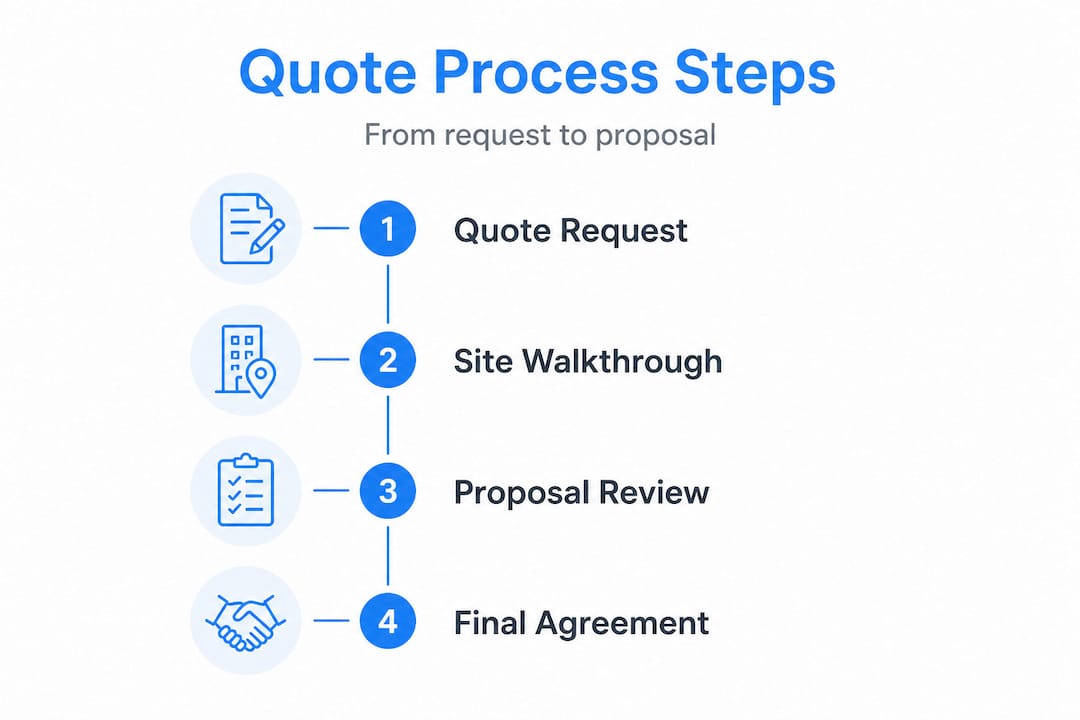
Here's the typical sequence you should expect from any reputable commercial cleaning provider:
- Client request. You reach out with basic details about your property. The more you share upfront, the more accurate the initial estimate will be. Square footage, building type, number of restrooms, and current cleaning frequency are the bare minimum to communicate.
- Site walkthrough. A qualified estimator or account manager visits your property. This is not optional if you want a reliable quote. They're evaluating traffic patterns, floor types, restroom counts, breakrooms, loading docks, and any areas with specific sanitation requirements.
- Needs assessment. During or immediately after the walkthrough, the provider maps your cleaning challenges. Did your last vendor skip high-touch surfaces? Are there compliance requirements for your industry? This is the moment to disclose everything. A thorough cleaning scope assessment at this stage prevents misaligned expectations later.
- Scope definition. The provider translates your needs into a written scope of work. This document lists which areas are cleaned, at what frequency, and with which methods. If a task isn't in the scope, it won't get done unless it's added later, usually at extra cost.
- Quote delivery. A formal proposal lands in your inbox, ideally within a few business days of the walkthrough. It should include pricing, service frequency, staffing notes, and contract terms.
Pro Tip: Always ask for an itemized quote rather than a single lump sum. Itemization lets you see exactly what you're paying for, makes it easy to remove or add services, and gives you a fair basis to compare bids from multiple vendors.
Full disclosure on your end matters at every stage. If you have a server room that needs weekly attention, a lobby that floods with foot traffic during business hours, or a history with a prior vendor who consistently missed restroom restocking, say so during the walkthrough. Providers who understand your specific challenges build more accurate proposals and are less likely to use vague language that creates disputes later.
How cleaning quotes are calculated: Methods and benchmarks
With an understanding of the sequence, let's look at how cleaning companies actually put together the numbers in your quote. Pricing isn't arbitrary. It follows recognized formulas, and knowing the basics makes you a more informed buyer.
The three main pricing models in commercial cleaning are:
- Per square foot: The most common model for recurring services. Pricing typically runs from $0.07 to $0.25 per square foot per visit or monthly, with the formula built around labor, overhead, supplies, and a profit margin of 10 to 30 percent.
- Hourly rate: Used for irregular or one-time jobs. Rates generally range from $30 to $75 per hour depending on region and service type.
- Flat monthly rate: Often applied to straightforward properties with predictable cleaning needs. Easier to budget but harder to audit if service quality slips.
Here's a quick look at 2026 U.S. rate benchmarks by property type:
| Property type | Monthly rate per sq ft (nightly service) | Notes |
|---|---|---|
| Office | $0.08 to $0.18 | Standard services, moderate traffic |
| Medical | $0.18 to $0.28 | Enhanced sanitation required |
| Retail | $0.10 to $0.20 | Variable based on customer traffic |
| Warehouse | $0.04 to $0.12 | Typically lower frequency |
These 2026 benchmarks per square foot are solid starting points, but your actual cost depends heavily on location, frequency, and the complexity of your scope.
As a property manager, you have real leverage over several cost drivers. Here are the factors within your control:
- Cleaning frequency: Reducing from 5 nights per week to 3 can significantly lower monthly costs.
- Access scheduling: Giving cleaners a consistent, uninterrupted access window reduces wasted time and labor costs.
- Consolidating scopes: Bundling services under one vendor rather than splitting janitorial and specialty cleaning often earns volume discounts.
- Reducing square footage complexity: Clearly defining which areas require cleaning versus which are storage or mechanical rooms cuts unnecessary scope.
When evaluating cleaning contract costs, look at the total monthly investment in context with what's included, not just the per-square-foot number. A lower rate with vague scope often ends up costing more in dispute management and rebidding.
Inside the proposal: What a transparent cleaning quote should include

After receiving a quote, here's how to verify that it gives you the clarity and control you need, from the cover page down to the fine print.
A professional proposal isn't a one-page price sheet. According to industry standards for proposal structure, a well-built quote contains a cover page, an executive summary, a statement of understanding that reflects what was discussed in the walkthrough, a detailed scope of work organized by area and frequency, staffing notes, pricing tiers, and full contract terms including payment schedule, cancellation policy, and how out-of-scope work is handled.
The scope of work section deserves the most scrutiny. It should list every area to be cleaned, every task, and at what frequency. Floors, surfaces, restrooms, breakrooms, entrance glass, and common areas all belong here. If you're using quote transparency insights to evaluate bids, the scope section is your primary comparison tool.
A practical way to evaluate competing proposals is to look for tiered pricing options. Here's what a well-structured Good/Better/Best quote looks like for a 20,000-square-foot office building:
| Tier | Services included | Monthly estimate |
|---|---|---|
| Good | Nightly vacuuming, trash removal, restroom cleaning | $1,800 |
| Better | All of the above plus breakroom deep clean, weekly floor scrub | $2,400 |
| Best | All of the above plus window cleaning, monthly carpet extraction | $3,100 |
This format lets you control your budget while understanding exactly what you're trading off. Flat proposals with a single price give you no flexibility and no benchmark to evaluate scope.
Itemized proposals empower you to compare on scope rather than just price. A proposal missing a restroom restocking line item or a high-touch surface protocol isn't cheaper, it's incomplete. Always check what's excluded, not just what's promised.
According to cleaning proposal standards used by top-tier providers, exclusions should be explicitly listed in the contract, not buried in vague language. If floor stripping and waxing, carpet extraction, or exterior window cleaning are not mentioned, ask directly.
Pro Tip: Before accepting any bid, ask the provider to walk you through the exclusions section verbally. Any hesitation or vagueness is a red flag. Reputable companies list exclusions clearly because they want defined scope as much as you do.
Nuances that impact your quote: Scope, property type, and special cases
However, several nuances, often overlooked, can fundamentally reshape your cleaning quote. Knowing them before the walkthrough gives you a major advantage.
The most significant variables include:
- Facility type: Medical offices and healthcare environments require different products and protocols. Retail centers with high foot traffic need more frequent restroom checks and floor maintenance.
- High-touch surface density: Properties with lots of shared equipment, elevator buttons, door handles, and lobby kiosks require more time per square foot than open office floor plans.
- Special sanitation requirements: Some facilities require documented sanitation logs or specific EPA-registered disinfectants. This adds both labor and material costs.
- Region and local labor market: Cleaning rates in major metros like New York, Los Angeles, and Chicago run significantly higher than rates in mid-sized markets. Regional variation is a real factor when comparing national provider bids against local ones.
Add-on services are another major source of confusion. Deep carpet cleaning, exterior window washing, floor stripping and waxing, pressure washing, and post-event cleanup are typically billed separately. Edge case pricing follows clear patterns: medical facilities typically see a 25 to 35 percent premium over standard office rates, high-traffic properties add 15 to 25 percent, and small spaces under a certain threshold often trigger minimum charge policies.
"When calculating bids, experienced cleaning contractors use production rate benchmarks of 2,500 to 4,000 square feet per labor hour for standard office environments and target a profit margin of 10 to 20 percent. Deviations from these benchmarks, whether from unusually complex layouts or specialty surface requirements, should always be reflected transparently in the pricing." (How to calculate a janitorial bid)
One area that consistently surprises property managers is the commercial vs. residential cleaning comparison in scope and complexity. Commercial properties have compliance expectations, higher liability, and often require certified products. That's why the quote process is more detailed, and why shortcuts in that process cost you downstream.
The takeaway: define your scope in writing before any quote is finalized. Verbal agreements don't hold up when a service provider says window cleaning was never included and you were certain it was.
Why transparency at every step matters more than a low number
With all these details in mind, here's our take on what truly separates a valuable cleaning quote from a costly mistake.
We've seen it happen consistently across thousands of commercial accounts. A property manager selects the lowest bid, service quality erodes within 60 days, disputes over scope become a monthly headache, and the rebidding process costs more in management time than the original price difference ever saved. The lowest number on a proposal is usually the starting point for problems, not the solution to them.
The reality is that benchmarks are guides, not fixed prices. Local labor costs, supply chain conditions, and the actual complexity of your facility determine what a fair price looks like. When a provider quotes significantly below market benchmarks, something has to give. Either the staffing hours are inadequate, the scope is narrower than you realize, or there are upcharges built into the contract waiting to surface.
Transparency is quantifiable. A proposal that lists every task, every frequency, every exclusion, and every add-on rate creates a performance baseline. When service quality slips, you have documentation to hold the provider accountable. When it's time to renew, you can evaluate changes against a clear record. Vague proposals offer no such protection.
The most experienced facility directors treat the site walkthrough as an interview, not just a formality. They ask hard questions: How do you handle a missed cleaning night? What's your staffing backup plan? How are complaints escalated? A provider who gives confident, specific answers to those questions is far more valuable than one who wins on price alone.
We also know that transparent quote breakdowns build better long-term vendor relationships. When both sides agree on scope from day one, there are fewer disputes, smoother renewals, and a genuine partnership rather than a transactional grudge match. That's the outcome every smart property manager should be optimizing for.
Take the next step with a dependable cleaning quote
Armed with knowledge, it's easier to choose a cleaning partner that delivers both clarity and quality.
At Sparkle Pro Commercial Cleaning, we follow a straightforward four-step process: quote, site visit, scheduled cleaning, and customer approval. Every proposal we deliver is itemized, regionally calibrated, and built around your specific facility type, whether that's a medical office, retail center, multi-tenant building, or industrial space. We cover the full United States with local operational knowledge that generic national chains simply can't match. If you're ready to compare your current contract against a transparent, fully scoped alternative, request a quote today and see what a professional proposal actually looks like.
Frequently asked questions
How long does the cleaning quote process typically take?
Most commercial cleaning quotes can be completed within 2 to 5 business days after the site walkthrough, depending on the size and complexity of the facility.
What details should I provide to get the most accurate quote?
Share your property's square footage, facility type, cleaning frequency, and any special requirements such as high-touch areas or restroom count. Providing this information upfront allows the provider to build a precise scope rather than a generic estimate.
What's the most common pricing model for commercial cleaning?
Most cleaning companies use per square foot pricing for recurring services, ranging from $0.07 to $0.25 per square foot, though models vary by property type and region.
Why do medical and high-traffic buildings cost more to clean?
Medical and high-traffic properties require enhanced sanitation protocols and more frequent service intervals, leading to rate premiums of 15 to 35 percent above standard office rates.
How can I compare cleaning quotes from different companies effectively?
Ask for itemized proposals from each vendor, compare on scope and listed exclusions, and resist focusing on the bottom-line price alone, since scope differences make direct number comparisons meaningless.