
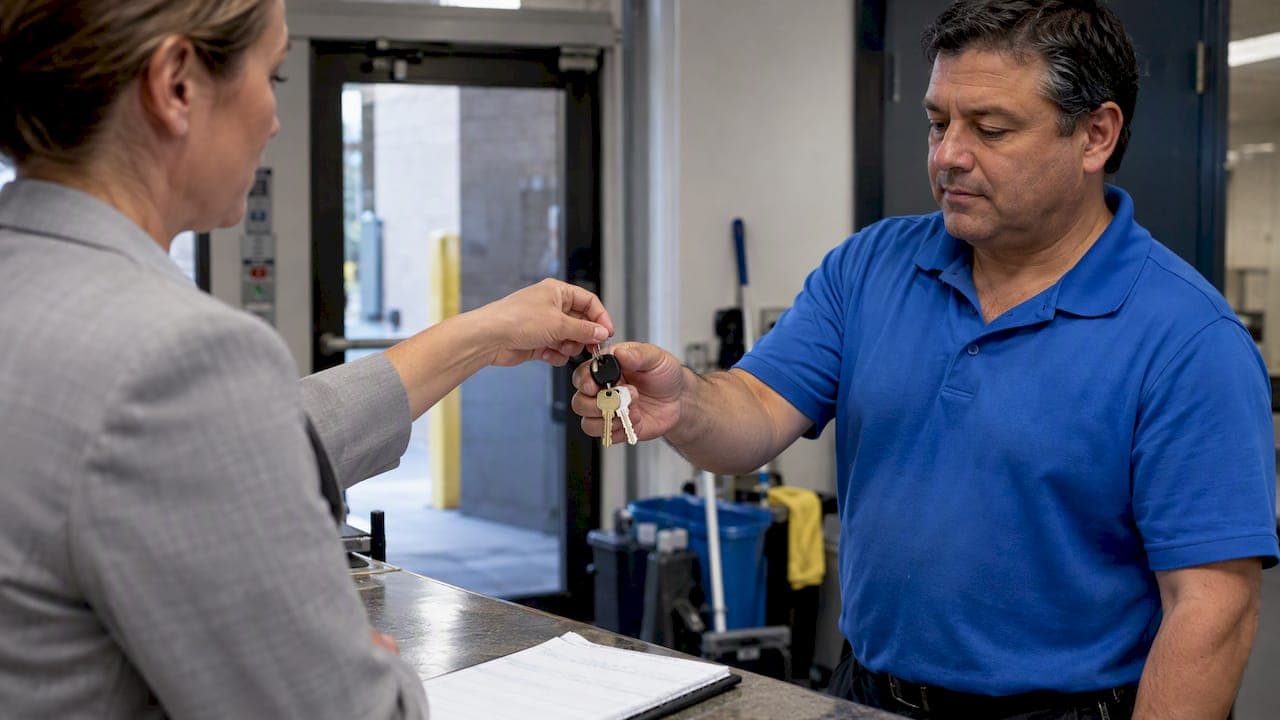
Janitorial key control is the set of rules that decides who holds keys to your building, when they get them, how every handoff is recorded, and what happens when a key goes missing. Cleaning crews usually work after hours, alone, and in every room, so they hold some of the most sensitive access in a building. A good policy gives them exactly the access the job needs and gives you a record of it. This guide covers the policy, the hardware choices, the audit routine and what to ask of your cleaning contractor.
TL;DR
- Issue the least access that gets the job done: one key or credential per person, tied to named zones and scheduled hours, never a grand master for a cleaning crew.
- Keep a written log of every key: what it opens, how many copies exist, who holds it, and when it was issued and returned.
- Audit in person. A periodic muster, where every holder shows the key they were issued, catches copies and stale access that paper logs miss.
- A lock is only as strong as the door around it, so pair keys with alarms, cameras and daily review of after-hours activity.
- Put key rules in the cleaning contract, including lost-key reporting, no duplication, and who pays for re-keying.
Table of Contents
- Why janitorial access deserves its own key policy
- Start with a key audit
- Match the key system to the risk
- Write the policy: seven rules that cover most buildings
- The key log: what to record
- Audit in person, not just on paper
- Watch the after-hours record
- Construction sites and turnovers need a different routine
- What to put in your cleaning contract
- Our perspective: access is part of the service
- Let us handle the cleaning, with your key rules
- Frequently asked questions
- Sources
Why janitorial access deserves its own key policy
Most key control advice is written for hotels, apartment communities or police departments. Cleaning is different in three ways.
Timing. Crews typically arrive when tenants have left. Nobody is watching the door, so the key log and the alarm record are the supervision.
Breadth. To clean an office floor, a crew needs the suite door, restrooms, break rooms, supply closets and often the loading dock. That is a lot of doors for one person to open, and it is why a master key is so tempting to hand over.
Turnover. Janitorial staffing shifts more than most roles in a building. Each change is a chance for a key to walk out the door, so the system must work when people come and go.
The cost of getting it wrong is concrete. A lost master key can force a re-key of an entire floor or building, and the invoice lands on someone. A written policy decides in advance whether that someone is you, the tenant or the vendor.
Start with a key audit
You cannot control what you have not counted. ComtyLink's building key management guide begins with the same step we recommend: list every key in the building, identify what each one opens, document how many copies exist, and note who holds each one. Mark any key you cannot account for.
For a cleaning program, build the inventory around these questions:
- Which doors does the crew need, and in which hours?
- Which keys currently open those doors, and at what level of the hierarchy (single door, sub-master, grand master)?
- Who holds copies today, including prior cleaning vendors, contractors and former staff?
- Are any keys stamped with the building name or address? If so, a lost key tells a finder exactly where to go.
The third question is the one that surprises people. Keys issued to a previous janitorial vendor often never came back. If you cannot prove they did, treat those doors as exposed.
Match the key system to the risk
There are three broad families of key control, and many buildings use a mix.
| System | How it works | Strength | Weakness |
|---|---|---|---|
| Standard mechanical keys | Keys cut on common blanks, often in a master key hierarchy | Cheap, familiar | Copies are easy to make at a kiosk, and re-keying costs money |
| Restricted keyway | Patented blanks that standard commercial kiosks cannot duplicate | Hardest to copy without authorization | Higher hardware cost, and replacements go through an authorized source |
| Electronic or digital access | Cards, codes, mobile credentials or smart key cabinets | Instant changes, audit trails, lockout | Needs power, software and someone to administer it |
The hierarchy and category descriptions above follow a commercial locksmith's overview of master key and access control systems, which describes restricted keyways as the most effective hardware upgrade for long-term security and electronic systems as the way to change access without re-keying hardware.
Be careful with master keys
In a master key system, one key opens a series of locks, and each lock also has its own key. The catch is stated plainly in ASIS-based physical security guidelines: because a compromised master key can compromise an entire facility, it needs special protection. For cleaning, that means a crew member should rarely, if ever, carry a grand master. A sub-master limited to the floor or zone being cleaned is the more defensible choice.

Do not let the lock outrun the door
The same guidance makes a point worth repeating: a strong lock on a weak door protects nothing. A sound policy combines mechanical hardware with intrusion detection and surveillance as layers. If your cleaning crew enters through a side door with a hollow frame or a glass panel beside the handle, fix that before you spend money on a restricted keyway.
Write the policy: seven rules that cover most buildings
A key control policy does not need to be long. It needs to be specific enough that a new supervisor can follow it on day one.
1. Least access, by name
Each person gets access to the zones they clean, for the shifts they work. Low Rate Locksmith's office key control guide describes key control as the structured process of issuing, tracking and recovering physical keys. Notice the three verbs. Your policy should say who issues, who tracks and who recovers, with names or job titles, not "management."
2. One person, one key, one signature
No sharing between crew members and no "borrowing" a key from the lead. If the lead hands out keys at the start of a shift, the log records the handoff in and out.
3. No duplication, ever
State it in writing: keys marked "do not duplicate" are not copied by anyone, for any reason. Pair the rule with hardware that backs it up, such as restricted blanks on sensitive doors.
4. Keep keys off-site when possible
In larger buildings, many managers keep keys in a lockable cabinet or lock box on the property and do not let them go home with staff. Crew members check keys out at the start of a shift and return them at the end. Smaller sites with a single cleaner often require the key to travel, and then the rule is that it never leaves the person's control and never carries an address tag.
5. Report losses immediately
Set a time limit, such as before the end of the shift, and a single phone number. Make the first response calm and procedural: log it, assess which doors are affected, decide whether to re-key. If people fear blame, they will hide the loss.
6. Recover keys at every change
When a crew member leaves a contract or a vendor is replaced, the keys come back the same day, and the log is closed. Our 30 to 60 day janitorial transition plan treats key return and re-issue as a first-week task for exactly this reason.
7. Define who pays
Put the cost of re-keying after a lost key in the contract. Ambiguity here produces the arguments nobody wants.
The key log: what to record
A simple spreadsheet works if someone keeps it current. Each row should capture:
- Key ID (a code, never the building name)
- Door or zone it opens and its place in the hierarchy
- Holder's full name and employer
- Date and time issued, and the signature
- Expected return date or "permanent while assigned"
- Date and time returned, and who received it
- Notes on loss, damage or replacement
Electronic key cabinets and access control software build this log automatically and add timestamps. They also let you cancel a credential in seconds, with no re-keying, when someone leaves. If you run janitorial operations across many sites and want an idea of what a purpose-built key database looks like, this overview of key management software for cleaning companies shows how one platform ties key records to scheduling and reporting. It is written in Danish, but the screenshots and feature list make the concept easy to follow.
Audit in person, not just on paper
A log tells you what should be true. An audit tells you what is true. The most effective programs, according to Low Rate Locksmith, run a periodic in-person muster where every key holder physically presents the keys issued to them. Discrepancies tend to expose undocumented copies or keys still held by people who no longer need them, and neither shows up in a database.
A workable audit rhythm for a building with a cleaning contract:
- Monthly: the property manager or security lead reconciles the log against the cabinet and spot-checks two or three keys with the crew lead.
- Quarterly: a full muster of every janitorial key holder.
- At any vendor change or incident: an immediate full count, with the affected doors flagged for re-keying if any key is unaccounted for.
Write down the result each time, even when it is clean. A record of clean audits is also evidence of due diligence if something goes wrong later.
Watch the after-hours record
Key control does not end at issue. Physical access programs rely on monitoring. The Department of Education's physical and environmental protection standard, which follows NIST-based controls, calls for maintaining a list of individuals with authorized facility access, reviewing it, and monitoring for anomalous activity. That applies to a federal data environment, but the logic scales to any office tower.
In practice, ask these questions of your alarm and access logs each week:
- Did anyone enter outside the scheduled cleaning window?
- Were there repeated failed attempts at a door or code?
- Did a door stay open or unlocked after the crew's scheduled departure?
- Does the number of arming and disarming events match the crew roster?
The underlying model is the one security teams call AAA, which TechTarget explains as identification, authentication, authorization and accounting. For keys, translate it: each key holder is identified, proves who they are when they take a key, is authorized only for certain doors, and leaves a record behind.
Construction sites and turnovers need a different routine
Key control is hardest where many hands touch a space: new construction, tenant move-outs and unit turns. Locks may be temporary, construction cores may be in place, and several trades may share a code. Three habits help:
- Issue a dedicated key or code to the cleaning crew for the clean-out, and cancel it the day the final clean is approved.
- Do not leave keys in the unit, on a door or in a lockbox with a code everyone knows.
- Re-key or swap the core once the space is handed to the tenant, so no construction-era key still works.
Our guides on construction cleaning crew supervision and the contractor cleaning compliance checklist show where access control fits in a project closeout.
What to put in your cleaning contract
Whether you hire a national provider or a local one, the key terms should be in the agreement, not in a handshake. Ask for:
- A named account manager who is responsible for keys on your site.
- A written statement of how the vendor stores, issues and tracks keys, and whether keys leave the property.
- A no-duplication clause and a lost-key notification window.
- A cost allocation for re-keying after a loss.
- Proof of licensing and insurance, which tells you who pays if something is stolen or damaged.
- Return of all keys and credentials within a set time after termination.
Our corporate office cleaning security protocols guide goes deeper on the security side of the vendor relationship, and how to approve cleaning services gives you a manager's checklist for the sign-off stage.
Our perspective: access is part of the service
We clean office buildings, retail centers, multifamily properties, industrial sites and healthcare facilities across the United States, and in nearly every one the first question that matters is not about equipment or schedules. It is: how will our crew get in, and who answers for that access?

That is why our process begins with a quote and a site visit rather than a price over the phone. At the walkthrough we look at the doors, the zones, the existing key or card system and the tenant sensitivities, so the access plan matches the building. We use local crews in each state, which keeps accountability close to your property, and we are licensed and insured.
Our view is simple. Property managers should not have to choose between a clean building and a secure one. The right arrangement gives the crew the narrowest access that lets them do the work well, records every handoff, and makes the vendor answerable when something goes missing. If a cleaning provider is vague about how it handles your keys, treat that as information about how it will handle everything else.
— Sales
Let us handle the cleaning, with your key rules
If you are writing or tightening a key policy, bring your cleaning contractor into the conversation early. We provide janitorial services, day porter and facility services, post-construction cleaning, tenant turn and move-out cleans, and specialized environmental work for commercial properties nationwide. Request a quote and we will schedule a site visit to review your access points and agree how keys and credentials will be handled before the first shift.
Frequently asked questions
What are the different types of key control systems?
The main types are standard mechanical keys (often arranged in a master key hierarchy), restricted keyway systems that resist unauthorized duplication, and electronic systems such as cards, codes and smart key cabinets. Many buildings combine them: restricted keys on sensitive doors, electronic credentials for general access.
What are the best practices for key management?
Inventory every key, issue the minimum access per person, log every handoff, prohibit duplication, and recover keys whenever someone leaves. Then verify by auditing in person on a schedule. The policy matters less than whether someone actually checks it.
Should a janitorial crew ever carry a master key?
Avoid it where you can. A compromised master key can expose an entire facility, so zone-limited keys or time-limited electronic credentials are safer. If a master is unavoidable, keep it in a locked cabinet on site, check it out per shift and log it.
What should we do if a cleaner loses a key?
Require an immediate report, log the loss, and identify every door the key opened. Then decide whether to re-key or change the credential. A contract clause on who bears the re-keying cost makes this decision faster and less contentious.
How often should we audit janitorial keys?
Reconcile the log monthly, run a full in-person check of all holders at least quarterly, and count everything whenever a vendor or crew changes. Increase the frequency for high-risk areas such as healthcare, data rooms or tenant spaces with confidential records.
Sources
- Office Key Control: A Practical Guide for Workplaces, Low Rate Locksmith
- Building Key Management: How to Track Every Key and Who Has It, ComtyLink
- Commercial Locksmith: Master Key, Access Control, Lockout, 4 Keys Locksmith
- Security architecture and engineering, ASIS facilities physical security guidelines
- Information Technology Physical and Environmental Protection Standard, U.S. Department of Education
- What is Authentication, Authorization and Accounting?, TechTarget