
Luxury vinyl tile (LVT) is easier to maintain than many hard surfaces, but it is not maintenance-free. The routine that works is simple: remove grit before anything wet touches the floor, clean with a neutral pH product and a soft pad, rinse with clean water, and stay on a written schedule. Most LVT problems we see in commercial buildings come from skipping one of those steps, or from using the wrong chemical, pad or finish.
This guide is for property managers, facility directors and building owners who need to set or audit an LVT program across offices, retail, multifamily common areas, healthcare and industrial space.
TL;DR
- Dust mop or vacuum first, every time. Grit is what scratches the wear layer, and wet cleaning over it grinds it in.
- Use a neutral pH cleaner (pH 6.0 to 9.0), a microfiber mop or an auto-scrubber with a red or white pad, and finish with a clean-water rinse.
- Never use black or brown pads, string mops, or aggressive no-rinse strippers, especially on floors under two years old.
- Too much finish or the wrong polish is the most common cause of a slippery LVT floor. Follow the manufacturer's dilution rates and approved products only.
- Put a schedule in writing: daily dust mopping, weekly wet cleaning, quarterly deep scrubbing, adjusted for traffic.
Table of Contents
- Why LVT still needs a program
- Start with the first clean after construction
- The routine: daily, weekly, quarterly
- Pads, tools and chemicals: what is safe
- Slip resistance and finish
- Where LVT meets other floors
- Building a maintenance plan that holds
- Our perspective
- Let us handle the floors
- FAQ
- Sources
Why LVT still needs a program
The wear layer is what makes LVT durable, but it is not invincible. Interface's maintenance guidance describes LVT as a product that needs a proactive, scheduled plan, and warns that too much finish or the wrong chemical can turn a high-performance floor into a slip-and-fall liability.
The misunderstanding is common. Because LVT does not need the stripping and waxing cycle of older vinyl composition tile, it gets treated as zero-maintenance. Then dirt builds up in the texture, a well-meaning crew applies the wrong product, and the floor looks worn at year three instead of year ten. If you manage VCT elsewhere in your portfolio, our guide to VCT floor maintenance shows how different the two programs are.
Start with the first clean after construction
LVT maintenance begins before the first tenant walks in. Research on vinyl floors in health facilities found that a significant share of early failures trace back to execution errors during installation and the post-construction phase, such as adhesive residue that was not fully removed before the floor went into service.

For glue-down installations, one commercial LVT maintenance guide says to keep all traffic off the floor for 24 hours after installation. Check the manufacturer's document for your specific product before you schedule the final clean, because waiting periods before the first wet cleaning vary.
Practical steps for the handover:
- Walk the floor with the flooring contractor and note adhesive haze, drywall dust and scuffs before cleaning starts.
- Remove debris with dust mopping or a vacuum without a beater bar.
- Clean with a neutral product that the LVT manufacturer approves, not a general construction-cleanup stripper.
- Rinse, dry and inspect under raking light, which shows residue that overhead light hides.
Our post-build janitorial guide covers how this fits into the full closeout sequence.
The routine: daily, weekly, quarterly
Traffic sets the real frequency, but a baseline gives you something to audit against. The schedule below follows the structure of the manufacturer guidance above and the Altro cleaning guide, which says to build a program suited to the use and traffic of each area.
| Frequency | Task | Notes |
|---|---|---|
| Daily | Dust mop with microfiber, or vacuum without a beater bar | Add a second pass at entrances in wet weather |
| Daily, as needed | Spot clean spills | Wipe up liquids promptly and place wet floor signs |
| Weekly | Damp or wet clean with neutral cleaner | Auto-scrubber for open areas, two-bucket method for small ones |
| Quarterly | Deep scrub | Red or white pad, followed by a clean-water rinse |
| Per manufacturer | Maintainer or finish, if the warranty calls for it | Only products approved for your LVT |
High-traffic zones such as lobbies, food areas, healthcare corridors and retail entrances usually need the weekly and quarterly steps moved up. For help setting frequencies by building type, see our cleaning frequency guide for large commercial buildings and the deep cleaning frequency guide.
Dry cleaning comes first
Always pre-vacuum or dust mop before any wet process. Interface's guide is explicit that removing abrasive grit first prevents scratching. Entrance matting does half the work for you: the more soil stopped at the door, the less your crew has to remove from the floor.
Wet cleaning that does not leave a film
Use a neutral pH cleaner in the 6.0 to 9.0 range, applied with a microfiber wet mop or an auto-scrubber. Interface recommends auto-scrubbers for large, open commercial spaces and a two-bucket system as the manual alternative, to limit cross-contamination.
Then rinse. This is the step crews skip most often. Without a final pass of clean water, the cleaner dries into a sticky surfactant haze that Altro's guide addresses, and that haze attracts new soil. The floor then looks dirty again within a day, and someone concludes that it needs a stronger chemical. The fix is the opposite: less chemical and a proper rinse.

Pads, tools and chemicals: what is safe
Pads
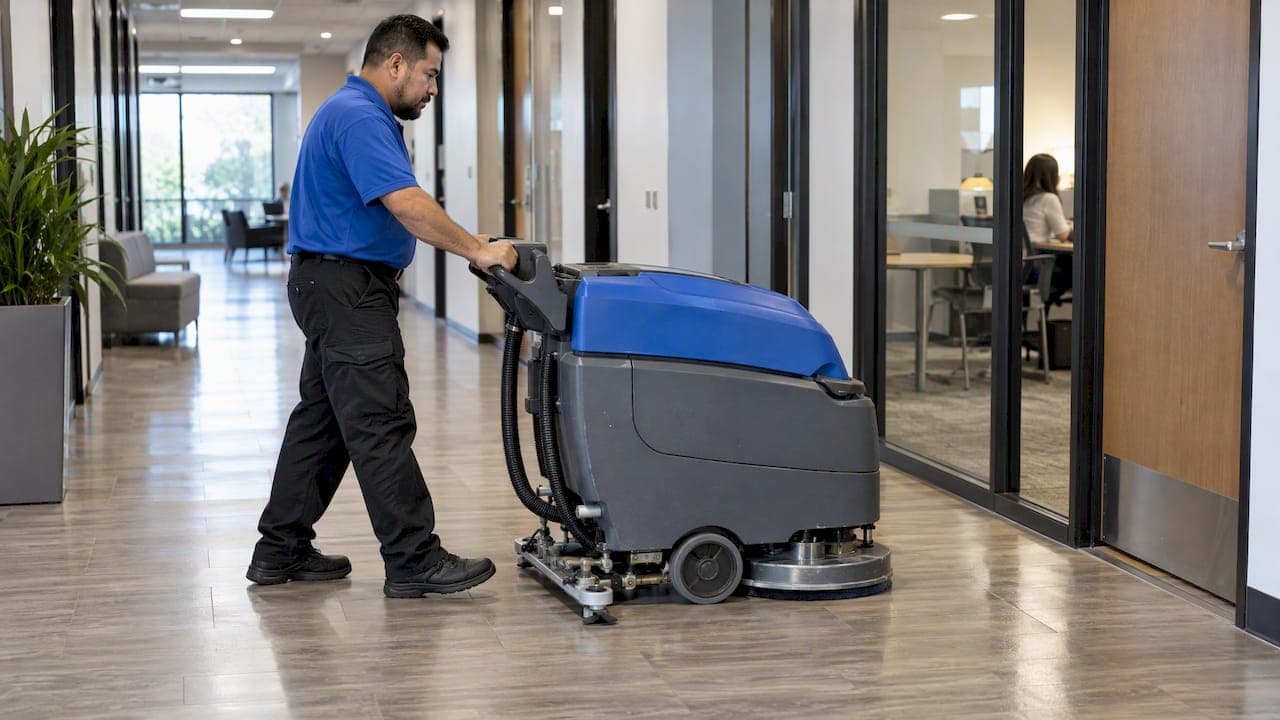
For auto-scrubbers and rotary machines, use a red (light scrub) or white (polishing) pad. Black and brown pads are aggressive enough to permanently abrade the wear layer. Interface also advises against string mops, which can leave excess moisture or lint that traps dirt in textured surfaces and dulls the look over time.
Cleaners
Safe LVT cleaners are pH neutral and free of abrasive additives. Several manufacturers make products for exactly this purpose, for example Bona's Professional Series luxury vinyl cleaner, which is listed as pH neutral, fast drying and safe for LVT, LVP and WPC flooring. Whatever you choose, match it against the flooring manufacturer's technical document, since that document governs your warranty.
If you are building an eco-friendly program, for instance for a LEED property, look for products that meet the EPA Safer Choice standard, which the agency lists in a searchable product directory. Compatibility with LVT is a separate check from the green label.
Disinfectants
Disinfecting is routine in healthcare, schools and shared workspaces, and it is where surface damage happens. Use EPA-registered disinfectants, and confirm each one against the LVT maker's manual first, because some disinfectants can spot or damage vinyl. Shaw's healthcare resilient floor checklist is a useful model of how a manufacturer lays out preventative, routine and wet cleaning steps for a clinical setting.
What not to use
- Dish soap. It can leave a residue that attracts dust and makes the floor slippery, so it does not belong in a commercial program.
- Aggressive strippers. Avoid mop-on/mop-off, no-scrub and no-rinse strippers on LVT under two years old. They can weaken the wear layer and the adhesive bond beneath it.
- Steam mops. One flooring retailer's guide warns that excess heat may loosen the adhesive. Check your manufacturer's position before using any heat.
- Carpet equipment. Extractors with metal brushes are a known cause of permanent scratching on LVT.
Slip resistance and finish
A common worry among facility owners is that LVT becomes slippery, particularly in busy corridors and healthcare areas. Manufacturer guidance points to improper polish application as the most common cause of reduced slip resistance. The remedy is plain: follow dilution rates exactly, and use only non-slip polishes designed for LVT.
A few habits that protect you:
- Measure concentrate. Auto-dosing systems beat eyeballing, and a crew that over-doses "to be safe" creates residue.
- Do not add finish by default. Many modern LVT floors do not need it, and some warranties restrict it.
- Log cleaning and incidents together, so a pattern of slips on one corridor leads you to the cleaning method before it leads you to a claim.
- For ceramic and stone areas next to LVT, see our tile and grout cleaning guide, since those need different chemistry and tools.
If you have a real slip-resistance concern, such as a recurring incident, ask your flooring manufacturer's technical service team and your risk manager to review the floor. Do not try to fix it with more product.
Where LVT meets other floors
Treat each surface by its own rules, even where they touch. Carpet tile beside LVT needs different equipment, and moisture from LVT cleaning can reach adjacent carpet or subfloor if it is not contained. Assign separate tools and pads per surface, color-code them, and train crews to dry the transition strips. Mixed-flooring sites are where one generic procedure causes the most damage.
Building a maintenance plan that holds
A plan works when anyone can read it and verify it. Include:
- A floor inventory. Product, install date, manufacturer, adhesive type and which areas are LVT.
- Approved products. A short list of cleaners, pads and disinfectants checked against the manufacturer's document.
- Frequencies by zone. Entrances, corridors, restrooms, break rooms and clinical areas rarely share a schedule.
- Rinse and dry steps written into the checklist, not left to habit.
- Inspection points. Look for haze, dull traffic lanes and edge buildup monthly.
- Records. Dates, products, dilution and who did the work.
Preventive planning is the same discipline for any building asset. This facility manager's guide to preventive maintenance shows how a scheduled, documented routine protects equipment, and the logic carries over to protecting a wear layer. For the broader case, read our piece on the role of floor maintenance in commercial buildings and our commercial floor cleaning process.
Our perspective
We clean LVT in offices, retail centers, multifamily properties, industrial spaces and healthcare facilities, and the pattern repeats. The floor rarely fails because of traffic. It fails because of the cleaning method: a pad that was too aggressive, a cleaner mixed too strong, a missing rinse, or a post-construction clean that left adhesive behind.
So we start with the floor's manufacturer document, not with our own habits. During the site visit we identify which areas are LVT, what is next to them, and how much traffic they carry. Then we write the scope around that: dry cleaning first, neutral chemistry, the right pad, a clean-water rinse, and a frequency that matches the zone. Our crews are local, our service is not franchised, and we put the process in writing so you can check it.
One thing we tell every property manager: do not buy a stronger chemical to fix a dull floor until someone has checked for residue. Nine times out of ten, the answer is to use less product and rinse better.
— Sales
Let us handle the floors
If you manage multiple properties or a large facility, a scheduled program is easier to hold when one team owns it. We provide janitorial services, post-construction cleaning, tenant turn cleans, deep cleans, disinfecting and day porter services across the United States, fully licensed and insured. Our process has four steps: a quote, a site visit, scheduled cleaning and your approval. Request a quote and we will walk your LVT areas with you.
FAQ
How often should commercial LVT be deep cleaned?
Quarterly is a common baseline in manufacturer-style programs, with daily dust mopping and weekly wet cleaning in between. Busy entrances, healthcare corridors and food areas often need it more often. Inspect the floor for haze and dull lanes, and adjust to what you find.
Can I use dish soap on LVT?
We do not recommend it for commercial floors. It can leave a residue that attracts dust and makes the surface slippery. Use a pH-neutral cleaner made for LVT and rinse with clean water.
What is the safest way to disinfect LVT?
Use an EPA-registered disinfectant, and check that it is compatible with your specific LVT in the manufacturer's technical manual. Some disinfectants can spot or damage vinyl. Follow the label's dwell time and rinse where the label or the flooring manufacturer calls for it.
Does LVT need to be stripped and waxed like VCT?
Generally not, and aggressive strippers can harm LVT, especially floors under two years old. Follow your manufacturer's guidance for any finish. If you also have VCT, our VCT stripping and waxing guide covers that separate program.
How do I protect LVT from scratches?
Stop grit at the door with matting, dust mop daily and use soft microfiber and light pads. Avoid string mops, carpet extractors with metal brushes and black or brown pads. Felt guards on furniture help in offices and break rooms.
Sources
- Interface LVT maintenance guidelines
- Vinyl and Linoleum Floorings in Health Infrastructures: Maintenance Recommendations Based on Fieldwork Data
- Maintenance recommendations for commercial LVT, AHF
- Altro cleaning guide for LVT floors
- Bona Professional Series Luxury Vinyl Floor Cleaner
- US EPA Safer Choice product search
- Shaw resilient maintenance checklist, healthcare
- How to Clean and Maintain LVT, Parterre
- How to clean luxury vinyl flooring, Harvey Maria