
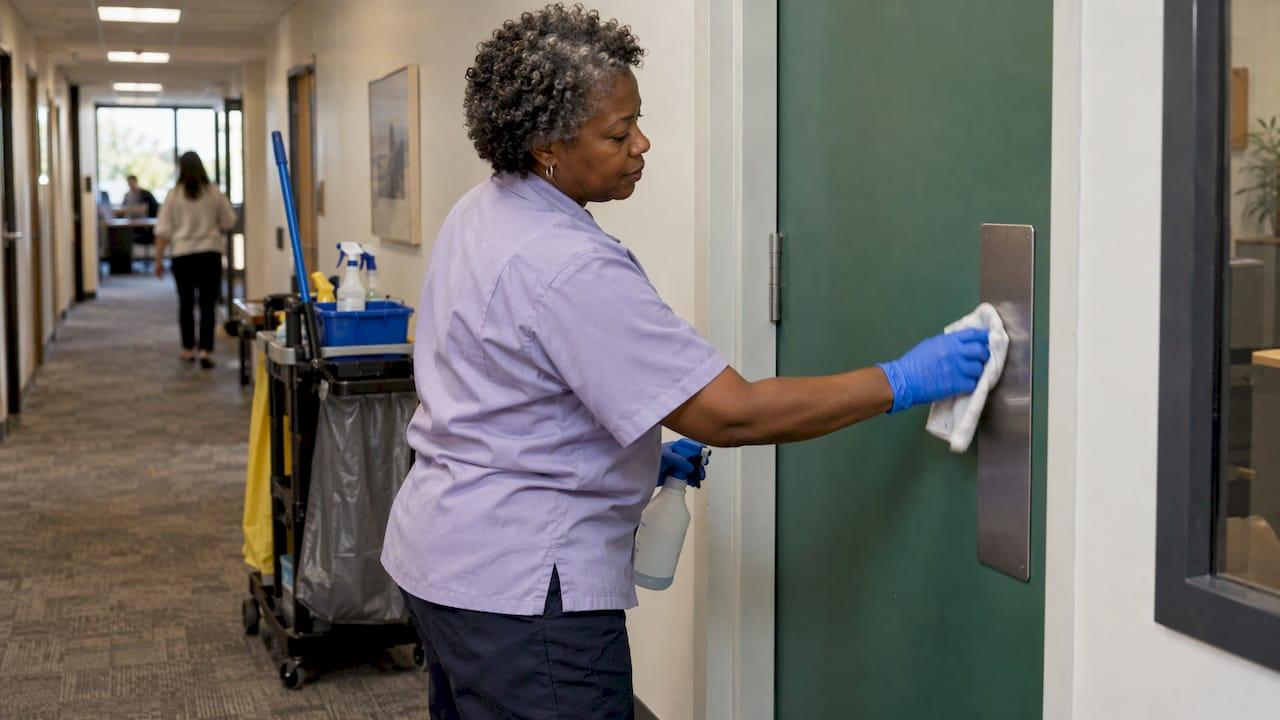
A workable pandemic cleaning plan is a written document that says who cleans what, how often, with which products, what changes when an outbreak reaches your building, and how you prove it was done. Building owners and facility managers who put those pieces on paper before an outbreak get faster, calmer responses than those who improvise. A national commercial cleaning contractor with local crews in every state can carry out the plan, which is why we built this guide around the tasks a contractor and a facility team share.
TL;DR
- A plan needs seven parts: roles, schedules, an outbreak protocol, approved products, PPE and hand hygiene, training, and auditing.
- Clean high-touch surfaces regularly, and disinfect where someone has obviously been ill or where local health authorities call for it.
- Always clean before you disinfect, and follow the product label on every chemical.
- If someone with COVID-19 was in the space, close it off, ventilate, and wait 24 hours when you can before cleaning.
- Keep logs, checklists and audits, because a plan nobody can verify is a plan nobody can defend.
Table of Contents
- What a pandemic cleaning plan has to include
- Set cleaning frequency by risk, not by habit
- Clean first, disinfect when it counts
- How to clean different surface types
- Choosing and using disinfectants safely
- What to do when someone with COVID-19 was in the space
- Training, PPE and records
- Our perspective
- Putting the plan to work with a commercial cleaning partner
- Frequently asked questions
- Sources
What a pandemic cleaning plan has to include
Start with structure, not products. Cleveland Clinic's Six Building Blocks of a Robust Cleaning and Disinfection Program (June 2020) describes policies in seven areas. They translate directly to a commercial building:
- Roles and responsibilities. A clear organizational structure and reporting lines. In a managed property, name who at the owner, the property manager and the cleaning contractor decides what.
- A cleaning and disinfection schedule for every area. Where, what, when, how and by whom. A schedule that says only "restrooms: daily" fails this test.
- An emergency plan. The required cleaning and the protocols to follow when an outbreak is reported.
- Approved products, supplies and equipment. Manufacturer, item number, where to buy, acceptable substitutes, and safety, storage and disposal details.
- PPE and hand hygiene expectations. Specific to products, tasks and situations.
- Education and training. How often, by what method, and to what performance standard.
- Monitoring and auditing. The methods, the frequency, and the staff responsible.
The same guide draws a useful line between policy and procedure. Policies explain what should be done; procedures explain how. Keep them in separate documents or separate sections so a policy does not need rewriting every time a product changes.
The Pennsylvania Department of Health's COVID-19 Infection Control and Outbreak Response Toolkit (July 2023) was written for long-term care, but its list is a good check for any building. It calls for education on cleaning responsibilities and procedures, named individuals responsible for each task with a contingency staffing plan, documentation such as logs and checklists, a process for auditing and giving feedback to cleaning staff, and an environmental risk assessment based on the risk of pathogen transmission and how vulnerable the occupants are.
That last item is where plans differ most. A medical office, a daycare tenant and a warehouse mezzanine do not carry the same risk, so they should not share one schedule.
Set cleaning frequency by risk, not by habit
Cleveland Clinic's guide recommends setting frequency from three factors: the probability of contamination with pathogens, the susceptibility of the people in the building, and the potential exposure from frequently touched surfaces. Apply that to each zone and write the answer down.
The CDC's guidance on cleaning and disinfecting a facility (April 2024) says high-touch surfaces should be cleaned regularly and other surfaces cleaned when visibly dirty. Its examples of high-touch surfaces include pens, counters, shopping carts, door handles, stair rails, elevator buttons, touchpads, restroom fixtures and desks.
Other official sources give firmer numbers for a pandemic setting:
| Zone | Suggested frequency | Source |
|---|---|---|
| High-touch surfaces (door handles, shared equipment, light switches) | At least daily | NIH cleaning and disinfection guidance |
| Public-facing areas (reception, kiosks, customer service) | Regularly, for example twice daily | NIH guidance |
| Point-of-sale keypads and shared carts | Before each use | CDC, April 2020 |
| Common and public areas | At least once per day | Cleveland Clinic guide |
| Public restrooms | At least once per shift | Cleveland Clinic guide |
| Elevator buttons, push bars, automatic door buttons | At least daily | Washington State Department of Health (August 2024) |
Two more details belong in your plan. First, the CDC's 2020 guidance notes that more frequent cleaning may be needed based on level of use, so build a trigger for busy periods. Second, Cleveland Clinic advises adjusting frequency for external factors such as local outbreaks or spills of blood or body fluids. Write those triggers into the plan so a supervisor does not need to ask permission to step up the schedule.
The NIH also notes that breakrooms and meeting rooms should have enough cleaning supplies for staff to clean or disinfect their space before and after use. That shifts part of the load to occupants and keeps the contractor's crew focused on the building as a whole.
For a deeper look at which surfaces belong on the list, see our guide to high-touch surface cleaning for facility managers. To turn the frequencies above into a calendar, use the maintenance cleaning schedule process.
Clean first, disinfect when it counts
Most buildings over-disinfect and under-clean. The CDC states that in most situations, regular cleaning is enough to prevent the spread of germs. Disinfect areas where people have obviously been ill, and during certain disease outbreaks local health authorities may recommend specific disinfection procedures.
The order matters too. The CDC advises cleaning a surface before sanitizing or disinfecting it, because dirt can make it harder for the chemicals to kill germs. The CDC's business FAQ gives the same instruction: wash dirty surfaces with soap and water first, then disinfect.
Your plan should therefore have two tiers:
- Routine tier: detergent and water on all surfaces, with a documented cadence for high-touch points.
- Outbreak tier: disinfection of named zones, using named products, triggered by a defined event such as a reported case or a health authority recommendation.
Writing the outbreak tier in advance is what saves time later. The product list, the PPE, the zones and the person who authorizes the switch are already decided.
How to clean different surface types
Hard, high-touch surfaces. Clean with detergent, rinse if the label requires it, then disinfect where your plan calls for it. Use dedicated cloths per zone, and never carry a cloth from a restroom to a reception desk.
Soft and porous surfaces. For carpeted floors, rugs and drapes, the CDC's 2020 facility guidance recommends cleaning with soap and water or a cleaner suited to the surface, laundering items where possible on the warmest appropriate water setting and drying them completely, or disinfecting with an EPA-registered product that meets EPA's criteria for use against COVID-19.
Vacuuming. The same CDC document recommends a vacuum with a HEPA filter if available, no vacuuming in a room with people in it, and considering temporarily turning off room fans and the central HVAC system serving the room so escaped particles do not circulate through the facility. Schedule vacuuming for vacant hours and write that into the shift plan.
Equipment that cannot be cleaned. The CDC's General Business FAQ (May 2020) says machinery or equipment thought to be contaminated that cannot be cleaned can be isolated: at least 24 hours for papers and soft porous surfaces, and at least 7 days for hard non-porous surfaces, before handling.
For the day-to-day rhythm that surrounds these tasks, our daily commercial cleaning routines and commercial building sanitation workflow guides show how the routine tier fits together.

Choosing and using disinfectants safely
The approved-products list is one of the seven plan elements, so choose carefully and record the choice.
- Use products that meet EPA criteria. The CDC business FAQ tells cleaning staff to use products meeting EPA criteria for use against SARS-CoV-2. OSHA's guidance on preparing workplaces for COVID-19 likewise points employers to EPA-approved disinfectant labels with claims against emerging viral pathogens. The NIH points to EPA's List N.
- Follow the label. Contact time, dilution and surface compatibility all sit on the label, and your procedures should repeat them.
- Never mix chemicals. The EPA, CDC and White House joint guidance states plainly that bleach and other cleaning and disinfection products should not be mixed together. That guidance also gives a fallback if no EPA-approved product is available: 1/3 cup of bleach per gallon of water, or 70% alcohol solutions.
- Consider safer active ingredients. Green Seal's COVID-19 guidelines (November 2021) recommend List N products with active ingredients such as hydrogen peroxide, citric acid, lactic acid, ethyl alcohol, isopropyl alcohol, peroxyacetic acid or hypochlorous acid. They also note that the combination of hydrogen peroxide and peroxyacetic acid is a designated asthmagen, so products containing both should be avoided. This matters for occupants and for crews.
- Choose the application method with care. Green Seal states that wiping a surface with a cloth, mop or sponge soaked in disinfectant leads to the lowest inhalation exposure. Only a small subset of List N products is approved for electrostatic sprayers. Both CDC and WHO discourage fogging a room with disinfectant because it has not been shown to work better and can raise exposure to dangerous chemical concentrations.
If your property has green-building goals, the product list is where they meet the pandemic plan. Eco-friendly options and disinfecting services can sit in the same scope of work, as long as every product on the list is also on the EPA's list for the pathogen you are targeting.
What to do when someone with COVID-19 was in the space
This is the section the emergency plan exists for. Official guidance from the early pandemic is consistent and still a sound template. The CDC's Cleaning and Disinfecting Your Facility (April 2020) lays out the sequence:
- Close off the areas the sick person used.
- Open outside doors and windows to increase air circulation.
- Wait 24 hours before cleaning and disinfecting. If that is not feasible, wait as long as possible.
- Clean and disinfect all areas the person used: offices, bathrooms, common areas and shared electronics such as tablets, touch screens, keyboards, remote controls and ATM machines.
- Reopen once the area has been appropriately disinfected. Workers without close contact with the sick person can return to work immediately after disinfection.
If more than 7 days have passed since the person visited the facility, the CDC says additional cleaning and disinfection is not necessary.
Two refinements are worth including. The CDC's business FAQ says that when an employee comes to work with symptoms, in most cases you do not need to shut down the whole facility, only close off areas used for prolonged periods. The NIH guidance adds that disinfection is required if the space had a positive case within the past 24 hours, while in most scenarios where the symptomatic staff member is already quarantined, routine cleaning is enough.
OSHA's guidance for environmental services workers asks employers to make sure areas being cleaned are properly ventilated, including more air changes per hour and more air circulation before and during cleaning, especially if workers must enter contaminated areas during the 24-hour waiting window.
Because this guidance dates from specific periods, your plan should state which public health source it follows and name the person who checks current CDC and local health department recommendations before each activation. Local authorities may call for different procedures during an outbreak.
Our pandemic cleaning protocols template turns this sequence into a fill-in document for facility managers.
Training, PPE and records
A plan lives or dies on whether the crew follows it, and whether you can show they did.
PPE. OSHA's environmental services guidance says that for routine cleaning, workers should use gloves and gowns along with any PPE normally used for the job. For environments contaminated with blood, body fluids or other potentially infectious material, or suspected or known sources of SARS-CoV-2, workers may also need masks and eye and face protection. The CDC business FAQ adds that staff should always wear gloves and gowns appropriate for the chemicals used, and may need more PPE depending on the setting and product.
Training. Cleveland Clinic asks for defined frequency, method and performance standards. In practice, record who was trained on which procedure, on what date, and how competence was checked.
Records. The Pennsylvania toolkit calls for logs and checklists to track the work, plus a process for auditing and giving feedback to cleaning staff. A simple structure works:
- A zone-by-zone checklist initialed at each visit.
- A product log showing what was used where.
- A monthly audit by someone who does not do the cleaning.
- A corrective action note whenever an audit finds a miss.
These records matter for tenants, insurers and your own managers. They also make contractor reviews factual rather than anecdotal.
Our perspective
Most pandemic plans we see in commercial buildings fail in one place: the document is thorough, but the scope of work given to the cleaning vendor never mentions it. The building has a plan, the crew has a generic checklist, and nobody has connected them.
We think the plan and the contract should be one thing. Every zone, frequency, product and escalation trigger in your plan should appear in the scope, with a named person on each side. That is why our process starts with a quote and a site visit: a crew that has walked your building can tell you which restrooms, lobbies and shared equipment need which tier of service.
Being licensed and insured, with local crews in every state and a 24-hour response time, means an outbreak tier can be activated without a procurement scramble. Our services cover routine janitorial work, disinfecting, environmental services for healthcare settings, day porter coverage and eco-friendly options, so the routine tier and the outbreak tier can live under one agreement instead of several.
We are non-franchised, so the people who scope your building are the people accountable for the result. Put the plan in writing, put it in the contract, and audit it.
Sales
Putting the plan to work with a commercial cleaning partner
Once the plan is written, the remaining question is who carries it out across your properties. We offer janitorial services, disinfecting services, day porter services, environmental services, facility services and eco-friendly options for offices, retail, multifamily, industrial and healthcare facilities. Engagement follows four steps: a quote, a site visit, scheduled cleaning, and your approval of the work. Pricing is based on property size, frequency and service scope, so the quote reflects the tiers you wrote into your plan.
If you manage one building or a portfolio, you can request a quote through our commercial cleaning services page and bring your draft plan to the site visit. For mixed-use properties, our cleaning scope of work guide for property managers shows how to divide responsibilities between tenants and vendors.
Frequently asked questions
How often should a pandemic cleaning plan be reviewed?
Review it at least once a year and whenever public health guidance, your building's use or your products change. Also revisit it after any activation of the outbreak tier. The CDC guidance cited here carries specific dates, so the plan should name who checks for updates from the CDC and your local health department.
Do we need to disinfect every day?
Not usually. The CDC says that in most situations regular cleaning is enough, and disinfection is for areas where people have obviously been ill or where local health authorities recommend it during an outbreak. High-touch surfaces are the ones to keep on a regular schedule.
How long should we wait before cleaning after a sick person was in the building?
The CDC advises waiting 24 hours before cleaning and disinfecting the areas the person used, or as long as practical if 24 hours is not feasible. Keep those areas closed and open outside doors and windows to increase air circulation during the wait. After more than 7 days, additional cleaning and disinfection is not necessary.
Which disinfectants should we put on the approved list?
Choose products that meet EPA criteria for use against SARS-CoV-2, as listed on EPA's List N, and follow every label for contact time and dilution. Never mix bleach with other products. Green Seal also lists safer active ingredients such as hydrogen peroxide, citric acid and ethyl alcohol for buildings that want lower-exposure options.
Who should be named in the plan?
Name one accountable person at the owner or property manager, one supervisor at the cleaning vendor, and a backup for each. Cleveland Clinic's guide and the Pennsylvania toolkit both call for clearly defined responsibilities and a contingency staffing plan, so cleaning does not stop when someone is out.
Sources
- Six Building Blocks of a Robust Cleaning and Disinfection Program, Cleveland Clinic
- COVID-19 Infection Control and Outbreak Response Toolkit, Pennsylvania Department of Health
- When and How to Clean and Disinfect a Facility, CDC
- Cleaning and Disinfection, NIH
- Cleaning and Disinfecting Your Facility, CDC
- Public Spaces: Safe Cleaning and Disinfecting, Washington State Department of Health
- General Business Frequently Asked Questions, CDC
- Guidance on Preparing Workplaces for COVID-19, OSHA
- Guidance for Cleaning and Disinfecting Public Spaces, EPA, CDC and White House
- COVID-19 Cleaning and Disinfection, Green Seal
- Environmental Services Workers and Employers, OSHA