
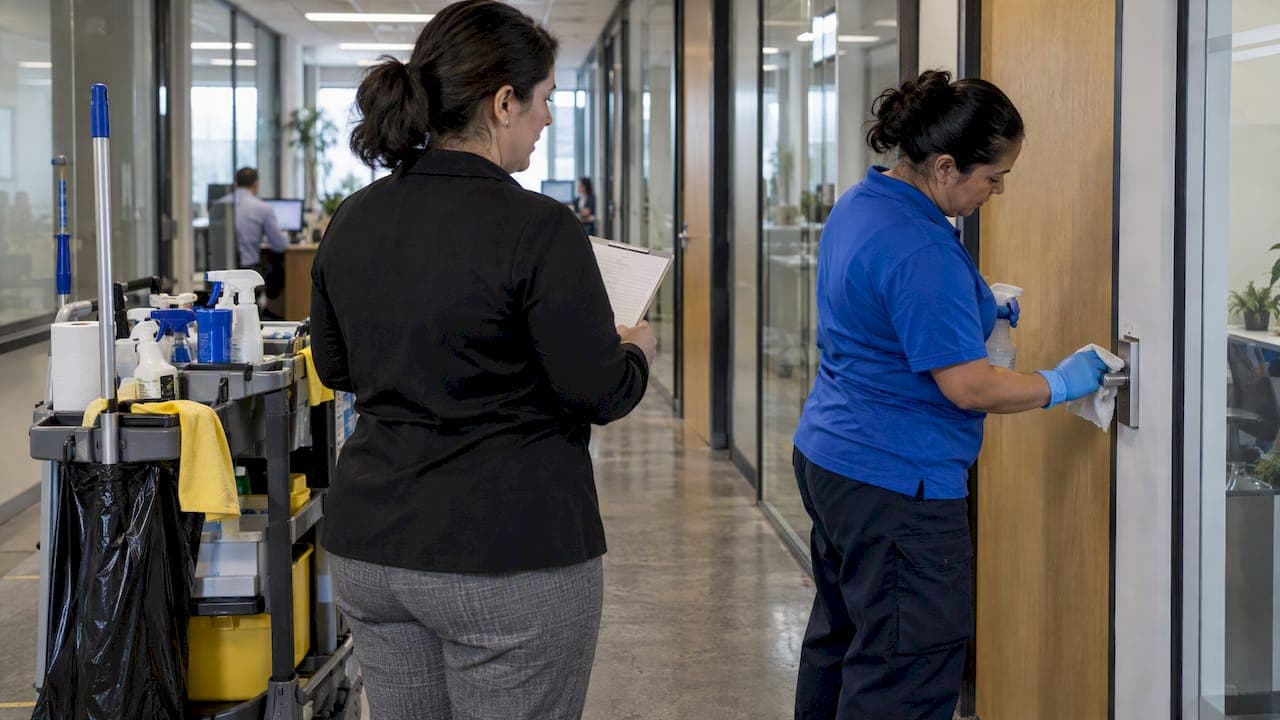
For most non-healthcare facilities, clean daily and disinfect only when there's a reason to: a sick person occupied the space within the last 24 hours, or you're dealing with a known exposure. Follow EPA List N products and their label contact times, prioritize high-touch surfaces, and pair every cleaning routine with better ventilation. Protect your staff with the right PPE and chemical training along the way.
TL;DR:
- Regular cleaning with soap or detergent once daily is sufficient in most cases, with disinfection needed only after a suspected or confirmed recent occupant.
- Prioritize high-touch surfaces identified through direct observation, scaling cleaning frequency according to traffic volume and contact rate.
- Use EPA List N registered disinfectants and strictly follow their contact times to ensure effective pathogen inactivation.
- Improving ventilation by upgrading filters to MERV-13 and increasing outdoor air intake significantly reduces airborne transmission risk.
- Staff safety depends on proper PPE, chemical handling training, and avoiding unnecessary or outdated disinfection practices like fogging or spraying entire rooms.
Table of Contents
- Cleaning vs. disinfecting: the science and the 24-hour rule
- Identifying and prioritizing high-touch surfaces and setting frequency
- Selecting disinfectants and enforcing contact time
- Ventilation and air cleaning: achieving meaningful air changes
- Staff safety: PPE, chemical handling, and training essentials
- A ready-to-use protocol template and sample schedule
- Pitfalls and myths: what to stop doing
- How Sparkleprocommercialcleaning applies these protocols
- Adopt a risk-based, sustainable approach
- Get these protocols implemented without managing it yourself
- FAQ
- Sources
Cleaning vs. disinfecting: the science and the 24-hour rule
Cleaning removes dirt, grease, and germs from a surface using soap or detergent and physical friction. Disinfecting uses chemicals to kill or inactivate pathogens that remain after cleaning. The two are not interchangeable, and skipping the first step undermines the second: CDC guidance on environmental services notes that physical removal of soil and organic matter often matters more than the antimicrobial action of any product applied afterward. A disinfectant sprayed onto a dirty surface has less to work with and performs worse than its label promises.
This is where the 24-hour rule comes in. According to CDC guidance on cleaning and disinfecting facilities, cleaning with soap or detergent at least once a day is usually enough for non-healthcare spaces. Disinfection becomes necessary only when a sick person has occupied the area within the past 24 hours, or when other high-risk conditions apply, such as a confirmed outbreak cluster or a facility serving vulnerable populations.

A widely cited peer-reviewed study found that 92% of surveyed cleaning personnel reported increased cleaning frequency during COVID-19, often alongside new or additional disinfection tasks, according to research on cleaning protocol changes among service personnel. That surge in activity came with a cost: the same research linked expanded disinfection routines to higher rates of reported respiratory symptoms among workers, a reminder that more chemical exposure is not automatically safer for anyone.
Before defaulting to disinfection, ask three questions:
- Has anyone with a suspected or confirmed infection used this space in the last 24 hours?
- Is this a high-touch surface in a high-traffic area, or a low-contact spot that cleaning alone handles fine?
- Does the benefit of disinfecting outweigh the added chemical exposure to staff and occupants?
Treating every surface as if it needs daily disinfectant is not caution. It's waste, and it carries its own occupational hazard.
Identifying and prioritizing high-touch surfaces and setting frequency
Generic checklists miss the surfaces that matter most in your specific building. A short walkthrough beats a template every time: spend 20 minutes watching how people actually move through a space, and note what hands touch repeatedly. A facility manager's guide to high-touch surface cleaning walks through this observation method in more detail, but the core steps are simple.
- Walk each zone during peak occupancy and log every surface touched more than once per hour.
- Separate findings into three tiers: shared equipment (keypads, elevator buttons, shared tools), transition points (door handles, handrails, light switches), and personal-adjacent surfaces (desks, chairs, shared phones).
- Match each tier to a cleaning frequency based on contact volume, not guesswork.
Different facility types generate different priority lists. An office building centers on elevator buttons, breakroom appliances, and conference room tables. A retail store adds point-of-sale terminals, fitting room handles, and shopping cart grips. A gym needs attention on equipment handles, lockers, and shared mats. A construction trailer prioritizes shared tools, sign-in sheets, and tablet devices used by multiple crews.
Frequency should scale with traffic, not run on a fixed schedule regardless of use. A reasonable baseline looks like this: once daily for general surfaces in low-traffic areas, two to three times daily for high-touch points in busy common areas, and immediate cleaning (plus disinfection if indicated) after any known exposure event. A lobby door handle in a 500-person office building needs more attention than the same handle in a 12-person satellite office, even though both appear on the same generic checklist.
Pro Tip: Keep your high-touch list on a laminated card at each cleaning cart so staff can check off zones without hunting for a shared document.
Selecting disinfectants and enforcing contact time
Not every disinfectant on a store shelf is registered for use against the virus behind COVID-19, and not every product that qualifies works the way the label promises unless you follow it exactly. EPA's List N catalogs EPA-registered disinfectants that meet the agency's criteria, and checking a product's EPA registration number against that list takes less than a minute. A step-by-step guide to verifying EPA List N products walks through the five checks worth running before you stock a new product.
Contact time, sometimes called dwell time, is the span a surface must stay visibly wet for the disinfectant to work. EPA List N includes products with contact times ranging from about 10 seconds to several minutes, and the only way to know yours is to read the label. A product wiped on and off in five seconds when the label calls for two minutes has not disinfected anything. It's just added moisture and chemical residue.
Keeping a surface wet long enough is a logistics problem as much as a chemistry one. Field-tested approaches include:
- Pre-wetting the surface with a light first pass, then applying the full application to extend visible wet time.
- Using a wipe method that reapplies product to any area that dries before the label's contact time elapses.
- Running a simple dwell test: time a sample surface with a stopwatch once, then train staff to count seconds rather than guess.
A guide to enforcing dwell time rules covers this operational gap in more depth, since failed contact time is one of the most common reasons disinfection does not work as intended.
When EPA List N products are unavailable or impractical for a surface, diluted bleach solutions (roughly 0.1% sodium hypochlorite) and 70% isopropyl alcohol solutions are recognized alternatives, though both carry surface compatibility concerns. Bleach can corrode metal and discolor fabric; alcohol can cloud certain plastics and finishes over repeated use. Spot-test on an inconspicuous area before adopting either as a routine substitute.

Ventilation and air cleaning: achieving meaningful air changes
Surface protocols only address part of the risk. Airborne transmission means ventilation deserves equal weight in any pandemic plan. CDC ventilation guidance recommends increasing outdoor air intake and targeting at least 5 air changes per hour of clean air in occupied spaces where the building's systems allow it.
CDC guidance recommends upgrading central HVAC filters to MERV-13 where the system can handle the added resistance, and using portable HEPA units as supplemental air cleaning where it can't, according to the same CDC ventilation guidance. That single filter upgrade, paired with longer system run times, is often the most cost-effective air quality change a building can make without a full mechanical overhaul.
Practical steps for most facilities include:
- Check your current filter rating and confirm with an HVAC technician whether the system can handle a MERV-13 upgrade without restricting airflow.
- Where ductwork can't support higher-MERV filters, place portable HEPA units in the highest-occupancy rooms rather than spreading capacity thin across the whole building.
- Open windows and doors when weather and security allow, treating natural ventilation as a free supplement rather than a replacement for mechanical systems.
- Have HVAC balancing checked periodically to confirm airflow matches design specs rather than assuming the system performs as installed.
Ultraviolet germicidal irradiation (UVGI) can serve as a supplemental layer in some settings, but it requires expert installation and ongoing maintenance to work safely and effectively. Treat it as an addition after the basics are covered, not a shortcut around filtration and air changes. Coverage of CDC's ventilation guidance from CIDRAP makes a similar point: ventilation and surface cleaning work best as one integrated system, not as separate checklists run by different teams.
Staff safety: PPE, chemical handling, and training essentials
Cleaning staff absorb the brunt of both infection risk and chemical exposure, so protecting them is not optional overhead. It's the part of the protocol that keeps the rest of it sustainable.
- Equip staff with gloves and, at minimum, a basic mask for routine cleaning; add eye protection and a respirator when disinfecting in enclosed spaces or using concentrated products.
- Store Safety Data Sheets (SDS, formerly MSDS) on-site and accessible, and train staff to read the hazard and first-aid sections before using an unfamiliar product.
- Label every diluted solution with contents and dilution date, and never let staff mix products, since combining bleach and ammonia-based cleaners produces toxic gas.
- Train on contact time, cloth and mop rotation to avoid cross-contaminating clean surfaces with dirty tools, and safe waste handling for used wipes and gloves.
- Accommodate staff with asthma or other respiratory conditions by offering lower-VOC product alternatives or adjusted task assignments.
A site manager's guide to construction cleaning safety covers PPE and chemical handling for crews working in higher-hazard environments, with controls that translate directly to pandemic-era disinfection work. A partner resource on construction safety meeting topics offers additional structure for building these points into recurring staff briefings rather than a one-time orientation.
A ready-to-use protocol template and sample schedule
A clear sequence prevents the two most common mistakes: disinfecting before cleaning, and disinfecting when cleaning alone would have been enough.
- Isolate the affected area if a sick occupant was present, restricting access for the remainder of the 24-hour window where possible.
- Ventilate the space by increasing outdoor air or running HVAC on an extended cycle, and temporarily switch off in-room recirculating window or portable units so they don't redistribute particles, while keeping central HVAC running.
- Clean all surfaces with soap or detergent, working from least to most contaminated to avoid spreading soil.
- Disinfect only if indicated, using an EPA List N product and honoring its full contact time.
- Document the date, area, product used, and staff member responsible on a signed checklist.
A two-week cadence gives most facilities a workable rhythm:
- Daily: clean all high-touch surfaces, empty waste bins, and restock hand hygiene stations.
- Three times weekly: disinfect shared equipment in high-traffic zones such as breakrooms and restrooms.
- Weekly: deep-clean soft surfaces, check HVAC filter status, and audit SDS binder currency.
- As needed: run the full isolate-ventilate-clean-disinfect sequence after any suspected exposure.
Soft surfaces and fabrics (upholstery, carpets, curtains) generally respond better to laundering on the warmest safe setting or to vacuuming with a HEPA-filtered unit than to liquid disinfectant, which can saturate fabric without fully drying within label contact time. For documentation, a simple spot-check system works: supervisors verify a sample of completed checklist items weekly, and some facilities add ATP (adenosine triphosphate) swab testing on a rotating basis to confirm surfaces meet cleanliness benchmarks beyond a visual check. Keeping these records on file also supports compliance reviews and insurance documentation if a dispute ever arises.
Pitfalls and myths: what to stop doing
Some pandemic-era habits never had strong evidence behind them, and a few actively did harm. EPA guidance on cleaning and disinfecting best practices notes that fogging, fumigation, and wide-area spraying are generally not recommended for routine surface disinfection in community settings, citing both safety risks to occupants and questionable effectiveness compared to targeted application. WHO guidance on cleaning and disinfecting surfaces echoes this, recommending cloth or wipe application to specific surfaces rather than spraying equipment or disinfection tunnels, and advising against spraying disinfectant on people entirely.
Safer, better-supported alternatives include:
- Targeted wipe-down of known high-touch points rather than blanket spraying of entire rooms.
- Consistent hand hygiene stations at entry points and near shared equipment.
- Ventilation improvements that reduce airborne concentration continuously, rather than a one-time chemical blast.
Pro Tip: Choose fragrance-free, lower-VOC disinfectants where EPA List N offers equivalent options: they cut staff respiratory complaints without sacrificing registered efficacy.
How Sparkleprocommercialcleaning applies these protocols
Turning a written protocol into daily practice is where most facilities lose consistency. Our crews build the isolate-ventilate-clean-disinfect sequence into routine janitorial contracts, so high-touch surface mapping and contact-time enforcement happen on schedule rather than only after a complaint. A corporate office security protocols guide shows how this scheduling approach adapts to access-controlled buildings where cleaning windows are tighter.
Documentation matters as much as the cleaning itself. Checklist sign-offs, product logs, and SDS access are standard parts of how we structure a recurring contract, which gives property managers a paper trail if a compliance question comes up. If you manage a facility and want a protocol reviewed or built from scratch, a site visit is the fastest way to get specific recommendations for your layout and occupancy pattern.
Adopt a risk-based, sustainable approach
The instinct to disinfect everything, constantly, is understandable and wrong. It burns budget, exposes staff to unnecessary chemicals, and does not outperform a well-run cleaning routine paired with smart ventilation. Layered mitigation (cleaning, targeted disinfection, better air exchange, and hand hygiene) outperforms any single tactic run to excess, and documenting why you chose a given frequency protects you if that choice is ever questioned later.
Before committing to major HVAC changes like MERV-13 upgrades or added HEPA capacity, loop in an industrial hygienist or building engineer. Air systems vary enough between buildings that a change proven effective elsewhere can backfire without that review, whether through restricted airflow or uneven pressure zones.
— Sales
Get these protocols implemented without managing it yourself
Reading a protocol and running it across a multi-tenant building, a retail chain, or a construction site are different problems. Sparkleprocommercialcleaning builds disinfecting services, routine janitorial contracts, and post-construction cleans around the same clean-first, disinfect-when-indicated sequence covered here, with crews trained on EPA List N verification and contact time as standard practice rather than a special request.
Getting started follows the same four-step process for any property: request a quote, schedule a site visit, set your cleaning schedule, and sign off once the work matches what was agreed. If your current provider skips contact time or treats disinfection as a flat daily task regardless of actual risk, a second look at the protocol is worth the conversation. Request a quote at Sparkleprocommercialcleaning to start that review.
FAQ
What are the CDC cleaning guidelines for most buildings?
CDC guidance for non-healthcare settings recommends cleaning with soap or detergent at least once daily as a baseline, reserving disinfection for areas used by a sick person within the past 24 hours or other high-risk situations, according to CDC's facility cleaning guidance. Cleaning should always happen before any disinfectant is applied, since removing soil improves how well the product works.
How do I clean a space after a known COVID-19 case?
Isolate the area where possible, increase ventilation, clean all surfaces with soap or detergent, then disinfect high-touch points using an EPA-registered product from EPA List N and its full label contact time. Document the date, product, and area cleaned for your records.
What counts as a high-touch surface that needs extra attention?
High-touch surfaces are anything contacted repeatedly by different people, such as door handles, elevator buttons, shared equipment, and point-of-sale terminals. The most reliable way to identify them is a short walkthrough observation of your specific building rather than relying on a generic list, since contact patterns vary by facility type.
What are the general guidelines for cleaning versus disinfecting?
Clean first to physically remove dirt and organic matter, since this step matters more than the disinfectant itself according to CDC environmental services guidance. Disinfect only when a specific risk condition applies, using a registered product and its full contact time, rather than applying disinfectant to every surface by default.
Does Sparkleprocommercialcleaning offer disinfecting services for commercial buildings?
Yes, disinfecting services are part of Sparkleprocommercialcleaning's nationwide offerings, alongside routine janitorial contracts, post-construction cleans, and facility services. Pricing depends on property size, frequency, and scope, and is provided after a quote and site visit through the company's service page.
Sources
The guidance above draws directly on primary public health and environmental agencies. CDC and EPA links serve as the core policy references for cleaning frequency, disinfectant selection, and ventilation targets, while the WHO link offers supplementary international framing and the peer-reviewed study provides operational data on staff impact.
- List N: disinfectants for coronavirus (COVID-19) | EPA
- Ventilation and air cleaning to reduce airborne infectious aerosol exposure | CDC
- COVID-19 cleaning protocol changes, experiences, and respiratory symptom prevalence among cleaning services personnel