
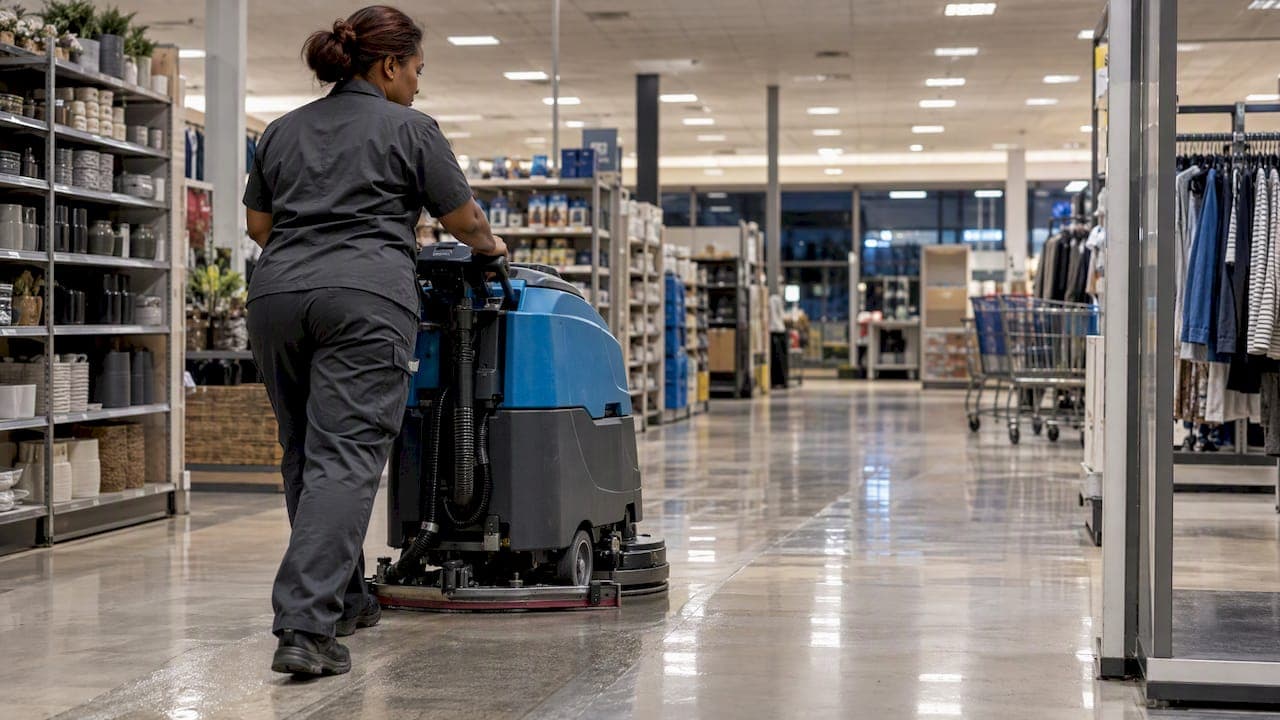
Retail after-hours cleaning is scheduled work done once the doors are locked and customers are gone. That lets crews strip floors, reset restrooms, and detail fixtures without working around shoppers. Done well, the store opens each morning clean, dry, safe to walk and ready to sell. Done badly, it brings security gaps, chemical odors, missed tasks and insurance disputes. This guide is for property managers, facility managers and building owners who hire the work. It covers what to put in the scope, how to build the schedule, how to control access and alarms, what safety rules apply, and how to check the results.
TL;DR
- Write the scope task by task, and list the exclusions too (stockrooms, display cases, exterior glass, floor restoration). Vague scopes cause most disputes.
- Build the schedule around traffic, layout and trading hours: daily, weekly and periodic tasks, each with an owner, all documented.
- Treat access as a security control: named crew members, individual credentials, alarm and lock procedures, and a sign-off log.
- Require chemical training, labels and safety data sheets, full disinfectant contact times, and a certificate of insurance you have actually read.
- Inspect on a fixed rhythm and revise the plan when traffic, layout or merchandise changes.
Table of Contents
- Why retailers clean after close
- What belongs in an after-hours retail scope
- Building the schedule
- Access, alarms and security
- Safety: chemicals, floors and disinfectants
- Insurance and liability
- Choosing a provider
- Our perspective
- How we handle retail after-hours cleaning
- Inspecting quality and revising the plan
- FAQ
- Sources
Why retailers clean after close
Cleaning during trading hours is useful for spills and restroom checks, but it can't do the heavy work. Wet floors are a slip hazard with customers present. Machines are loud. Carts and ladders block aisles. A crew that arrives after close can put machines on the whole floor, pull back displays, and let surfaces dry before the first shopper walks in.
Food retail adds another reason. The Food Marketing Institute's U.S. food-retail guide recommends scheduling detailed deep cleaning when food production is not occurring, and that includes nighttime. Grocery, convenience, bakery and deli operations get the most from this, but apparel, big-box, pharmacy and mall tenants all use the same window for the same reasons.
The other side is that no one is watching. A store full of inventory, a cash office, a live alarm system and a crew with keys is a trust arrangement. Most of this guide is about making that arrangement verifiable instead of assumed.

What belongs in an after-hours retail scope
A workable scope names tasks, areas and frequencies. A guide to retail store cleaning from a janitorial supplier lists the usual nightly tasks: vacuuming carpets, sweeping or scrubbing hard floors, emptying waste, dusting fixtures, cleaning entrance glass, fully cleaning and restocking restrooms, and cleaning break rooms where they are included. It also says display cases, restricted stockrooms, exterior windows and restorative floor work should be expressly included or excluded.
That last point deserves attention. ISSA's overview of commercial cleaning separates routine janitorial work (dusting, trash removal, restroom sanitation, sweeping and mopping) from floor maintenance, carpet cleaning, stripping, buffing, waxing, window washing, pressure washing and specialty cleaning. If those items are not in the contract, you should not expect them in the nightly price.
Retail-specific areas to name
Retail has spaces an office does not. A scope template for retail includes after-close floor care, entrance mats, checkout and POS touchpoints, display glass, fitting rooms, restrooms, back-of-house floors and waste. The same source recommends listing exclusions such as exterior windows, extraction, stripping and refinishing, biohazard work and any service you did not list.
A practical way to write it:
- Sales floor: dust mop, then damp mop or auto-scrub hard floors; vacuum carpet and entrance mats; spot-clean spills and marks.
- Front end: wipe checkout counters, card terminals' exterior housings only if the retailer approves, cart handles and entrance glass.
- Fitting rooms: empty trash, wipe benches and mirrors, vacuum or mop, check for items left behind and report them rather than moving them.
- Restrooms: the full reset described below.
- Back of house: break room, receiving-area floors, trash and recycling, compactor-area sweep.
- Exclusions: stockroom shelving, locked areas, cash office, display cases with merchandise, exterior glass, floor stripping.
What a restroom reset means
Use a written definition. ISSA's task-time example defines restroom cleaning as emptying trash, cleaning and disinfecting fixtures, mirrors and partitions, replacing supplies, dusting, sweeping and wet-mopping floors. If your scope says only "clean restrooms," you will argue about whether partitions, dispensers and floor drains were included.
Touchpoints and disinfection
CDC guidance reproduced by OSHA names counters, shopping carts, doorknobs, handles, toilets, faucets and other frequently touched surfaces as examples for routine cleaning and, when appropriate, disinfection. For a store, that translates into a short touchpoint list: entrance handles, cart and basket handles, checkout counters, fitting-room hardware, restroom fixtures and break-room surfaces. Cleaning and disinfecting are different tasks, and the second one has rules covered in the safety section.
Building the schedule
A schedule is more than a start time. A retail cleaning best-practices article says to base the plan on traffic, operating hours, layout, cleaning requirements, and how customers and employees use the space. It then splits the work into daily tasks (debris, floors, trash, spills, restrooms, frequently touched surfaces), weekly tasks (less-accessible floors, fixture detailing, carpet spots, areas beneath movable displays) and periodic deep cleaning. The same source recommends assigning who does each activity and when, and documenting it.
A sample frequency map
| Task | Nightly | Weekly | Periodic |
|---|---|---|---|
| Sales floor sweep and mop or scrub | Yes | Deep scrub or machine burnish as the finish requires | |
| Carpet vacuuming | Yes | Spot treatment | Extraction on a set cycle |
| Restrooms, full reset | Yes | Detail partitions and drains | Deep clean of grout and fixtures |
| Entrance glass and mats | Yes | Exterior glass if contracted | |
| Fixture and shelf dusting | High-touch areas | Full detailing | Upper fixtures and vents |
| Under movable displays | Yes | During resets and seasonal changes | |
| Trash and recycling | Yes | ||
| Break room | Yes | Appliance interiors |
Treat the table as a starting point. A high-traffic store near an entrance with rain or snow needs mat and floor attention every night. A boutique with low traffic might move some tasks to a twice-weekly pattern.
Food retail needs a sanitation system
If the store handles food, nightly cleaning is part of food safety. FMI's guide recommends a master sanitation schedule covering every department and equipment component, with attention to high-risk areas including drains, floor-wall junctions, grocery-cart wheels, deli slicers and buffet trays. Its Listeria guidance says retail food operations should clean floors and drains daily, eliminate standing water, and keep floor-wall junctions and hard-to-reach areas free of debris. It also advises cleaning and sanitizing tools so they do not spread contamination.

The practical point: who cleans deli slicers, and who cleans the floor around them, should be decided in writing. Many stores keep food-contact equipment with their own trained staff and give the cleaning contractor floors, restrooms and general areas. Either split can work if it is explicit.
Access, alarms and security
This is the part most guides skip, and it is where after-hours work differs most from daytime service. Crews often work alone or in small teams, with keys or codes, inside a building full of inventory.
A facilities security article describes what on-site audits of cleaning crews can reveal, including crews that fail to lock doors or reset alarm codes when they leave. It also tells security practitioners to take part in the selection of a cleaning contractor. That is sound advice for retail: the person who owns loss prevention should read the access section of any proposal.
Controls to require
- Named crew. Ask for the names of everyone assigned to the store, and require notice before anyone new is added. Rotating strangers defeat every other control.
- Individual alarm codes and key logs. Shared codes make it impossible to know who entered. Individual codes, where your system supports them, give you an entry and exit record.
- Screening. Ask what background and identity checks the provider runs, and who is responsible when a subcontractor is used.
- Opening and closing procedure. Write down who arrives first, how doors are secured during the shift, whether the crew may prop doors for trash runs, and how the alarm is reset at the end.
- Restricted areas. Cash office, pharmacy counter, server closet and stockroom with high-value goods stay locked and outside the scope unless you decide otherwise.
- Incident reporting. Damage, broken merchandise, alarms triggered, found property and safety hazards go into a log or a message the same night.
- Door-lock handoff. If your store gets deliveries or early staff, specify who is last out and who is first in, so no one assumes someone else locked up.
A sign-off sheet or digital checklist at the end of each shift completes the picture. It records the time in, time out, tasks done, anything not done and why, and confirmation that the alarm is set.
Safety: chemicals, floors and disinfectants
Night crews handle concentrated chemicals around merchandise that customers will touch the next day. Safety here is both a worker issue and a store issue.
Hazard communication
OSHA's guidance describes communicating chemical hazards through labels, safety data sheets and employee training. OSHA has also said that using consumer cleaning products at greater frequency or duration than normal household use can bring them under Hazard Communication requirements, and that employers must assess exposure and provide hazard information when the standard applies. Ask your contractor to show its training records and to keep safety data sheets accessible on site. Our own explainer on what OSHA requires for cleaners' hazard communication goes further.
Disinfectant contact time
A quick wipe is not disinfection. EPA's List N page explains that contact time is the period the treated surface must remain visibly wet for the product to work, and that labels specify the surface types and use sites. An EPA-registered product label shows what this looks like in practice: preliminary cleaning of visibly soiled surfaces, product-dependent wet contact times, and powering off electronic equipment and letting it dry before power is restored.
For retail, this matters most at checkout counters, card terminals and fitting-room hardware. Tell the crew which products are allowed on electronics and which surfaces to leave alone. For a deeper look at timing mistakes, see our guide to dwell time rules for facility managers.
Floors and wet-area control
The night crew's last job is often the most important: leaving floors dry and safe. Specify wet-floor signs, a drying time before opening, and a walk-through at the end of the shift. If scrubbed floors are still damp when the first employee arrives, the store has taken on a slip risk that the cleaning contract was supposed to prevent.
Insurance and liability
Do not accept "fully insured" as an answer. Ask for the certificate and read what it covers. The California Department of Insurance explains that commercial general liability commonly addresses premises liability, products liability and completed operations, while exclusions, including care, custody and control, pollution, and damage to one's work, must be reviewed with a broker. That guide comes from one state, but the policy concepts are widely used.
For retail after-hours work, ask your broker how the policy treats three scenarios: a crew member damaging merchandise or fixtures, a chemical spill or fumes affecting stock, and a theft allegation. Also ask whether workers' compensation covers every person who will be on site, and whether the store owner and landlord can be named as additional insureds. Your lease may set insurance minimums for contractors on top of that.
Choosing a provider
When you compare proposals for retail work, the differences usually sit in a few places:
- Written scope with exclusions. A one-line price for "nightly cleaning" is a warning sign.
- Site visit before quote. Layout, floor type, fixture density and restroom count drive time and price. A quote without a visit is a guess.
- Crew model. Is the crew employed by the company or subcontracted? Is it the same team each night?
- Response time. What happens when a night is missed or a spill is reported at 6 a.m.?
- Multi-location consistency. For chains and portfolios, ask how the standard is held across different markets.
- Specialty capability. Floor restoration, post-construction cleaning, grand-opening cleans, and disinfecting rarely sit in the nightly price, so ask whether the same provider can do them.
If you are preparing a new store, our guide on what to ask a retail grand opening cleaner covers the launch phase before the nightly program starts.
Our perspective
We clean for property managers, building owners and facility managers across the United States, and the retail jobs that go wrong have the same root cause: the scope lived in someone's head. Nightly cleaning should be a written program with named tasks, named exclusions, an access procedure and a sign-off record. Price follows from that: square footage, frequency and scope, which is why we start with a quote and a site visit instead of a flat number over the phone.
We use local crews, we are not a franchise, and we carry license and insurance, so the people responsible for your store are the people who know it. We aim to respond within 24 hours when something needs attention. We also tell managers when part of the work, such as food-contact equipment sanitation, may be better kept with the store's own trained staff.
— Sales
How we handle retail after-hours cleaning
We offer janitorial services, day porter services, deep cleans, disinfecting services, eco-friendly options, tenant turn and move-out cleans, and post-construction cleaning. For retail, that means a nightly janitorial program, periodic deep cleans, and one-time work when a space changes tenants or finishes a build-out. Our process has four steps: a quote, a site visit, scheduled cleaning, and your approval of the work.
If you manage one store or a portfolio, request a quote for commercial cleaning and we will schedule the walk-through. For build-outs and tenant improvements, our guide to tenant improvement cleaning explains how the final clean fits the project.
Inspecting quality and revising the plan
A documented schedule is also your audit tool. The same retail cleaning article advises reassessing tasks and scheduling as store conditions change, and using the documented schedule to identify gaps. Here is a rhythm that works without making inspection a full-time job.
- Morning spot checks. Walk the entrance, checkout, one fitting room, and one restroom before opening. Take a photo if something is missed.
- Weekly review. Compare the sign-off log with what you saw. Missed tasks should appear in the log, not just in your notes.
- Monthly walk-through with the account lead. Review the weekly and periodic tasks that nobody sees nightly: under displays, vents, grout and floor finish.
- Change triggers. Revisit the scope after a remodel, seasonal reset, new product category, longer trading hours, a new food department or a change in foot traffic.
- Corrective action. Ask for a written response to repeated misses, with a date for the fix.
Keep score simply. Record whether each inspection passed, which task failed, and whether it was fixed by the next visit. A pattern is more useful than a single bad night.
FAQ
How much does after-hours retail cleaning cost?
Price depends on square footage, cleaning frequency, floor types, restroom count and scope. For that reason, reputable providers quote after a site visit. We do not publish a flat rate. Compare proposals line by line, including exclusions, rather than only the bottom number.
What time do after-hours cleaners usually work?
They usually start once the store is closed and finish before opening, so the window varies by store. Food retail sometimes uses overnight hours for deep work. Agree on a start time, end time and a drying buffer before opening, and document who locks up.
Should the cleaning crew have keys and alarm codes?
If the crew works alone after close, yes, but in a controlled way. Use named individuals, individual codes where the system allows, a key log, and a written lock-up procedure. Keep cash offices and high-value stockrooms outside the scope.
Can after-hours cleaners disinfect the store?
Yes, but disinfection follows the product label: the right product for the surface and the full wet contact time. Ask your provider which products it uses and how it keeps electronics and checkout equipment safe. If a store has special requirements, such as a pharmacy or a food department, put them in the scope.
Is retail cleaning different from office cleaning?
Yes. Retail has more floor area per person, public restrooms, entrance mats, fitting rooms, checkout touchpoints and merchandise to work around. Retail cleaning also carries more security and brand-presentation considerations than an office does.
Sources
- Cleaning & Sanitation Guide for Food Retail (FMI)
- Listeria guidance (FMI)
- Retail Store Cleaning Guide
- What is Commercial Cleaning? (ISSA)
- Janitorial Scope of Work Template
- How to Calculate Cleaning Times (ISSA)
- CDC's Cleaning and Disinfecting Guidance (OSHA)
- 5 Retail Store Cleaning Best Practices
- Do Your Cleaning Crews Pass Security Scrutiny?
- Hazard Communication Guidance (OSHA)
- Hazard Communication and Consumer Products (OSHA)
- List N Advanced Search Page (EPA)
- EPA Pesticide Product Label, 2023
- Commercial Insurance Guide (California Department of Insurance)