
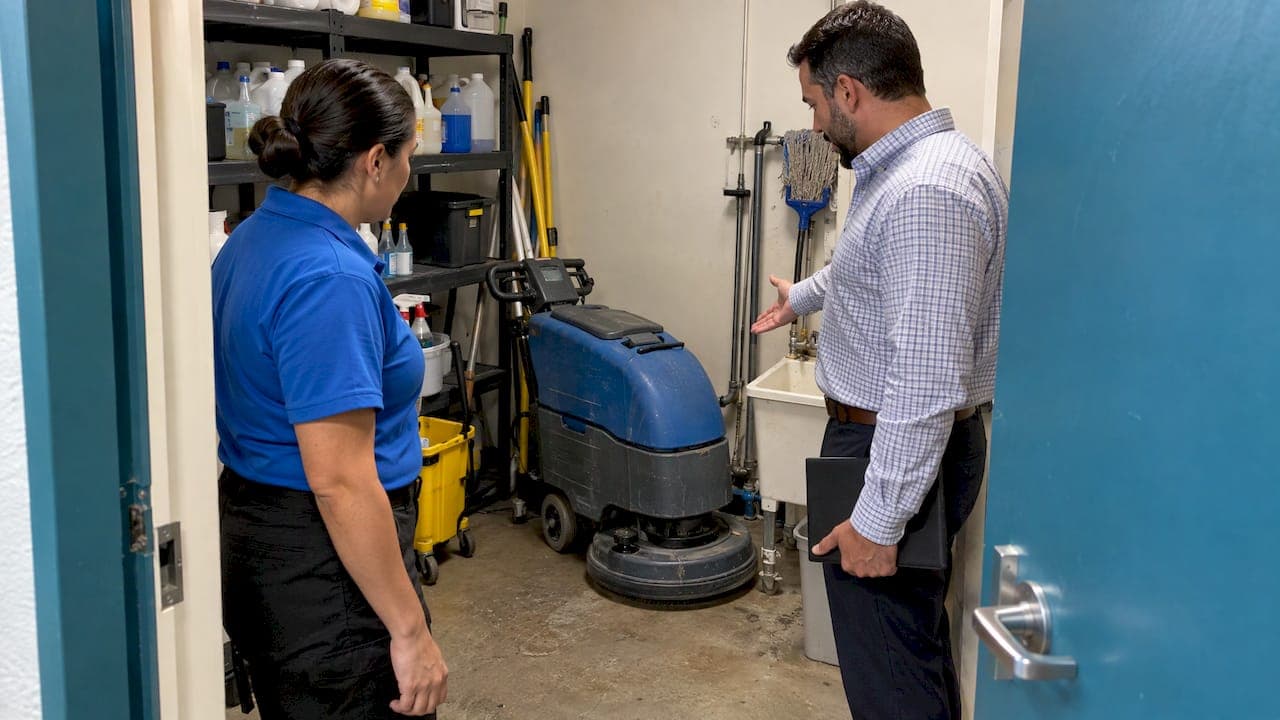
A vendor transition cleaning plan is a written schedule for moving a building from one cleaning contractor to another without a missed night, a lost key or a flood of tenant complaints. The plan that works starts before you give notice, overlaps the two vendors for a short handoff, controls every key and code, and scores the new vendor's first 30 to 60 days against a baseline you set yourself. This guide walks property managers and facility directors through each stage.
TL;DR
- Read the termination and renewal clauses first. The contract, not the calendar, sets your timeline.
- Photograph the building area by area before the old vendor leaves. That baseline settles later arguments.
- Plan a short overlap, a written scope, and a single owner for keys, badges, alarm codes and safety data sheets.
- Tell tenants and on-site staff who is cleaning and who to call before the first night.
- Run daily check-ins with a punch list in month one, then move to weekly reviews.
Table of Contents
- Start before you give notice
- What a transition plan should contain
- Build the scope of work and service standards
- How long a transition should take and when to overlap
- Keys, badges, codes and supplies
- Set a baseline before the old vendor leaves
- Tell tenants and staff
- Monitor quality in the first 30 to 60 days
- Multi-site transitions
- Our perspective
- Hand your building to a crew built for transitions
- FAQ
- Sources
Start before you give notice
The most common transition mistake is sending a termination letter before you know what it triggers. Pull the signed agreement and find four things: the termination clause (how much notice, in what form), the automatic renewal date, the initial term, and any language about transferring keys, equipment or supplies at exit.
Notice periods vary by contract. Commercial cleaning agreements commonly ask for written notice somewhere in the range of 30 to 90 days, and many renew automatically if that window is missed. Your own agreement is the only number that counts, so have your legal or procurement contact confirm it. Send notice by a method that leaves a dated record, such as certified mail or a tracked email the contract recognizes.
If you are leaving over performance, document it before you act. List specific failures with dates and photos, and check whether the contractor was told in writing and given a chance to correct them. A clean paper trail protects you if the outgoing vendor disputes the termination.
Then work backward. If the notice period is 60 days and you want the new vendor starting on the first of the month, notice goes out before that month even begins. Meanwhile, run your selection process in parallel so the replacement is signed before the old contract ends.

What a transition plan should contain
Public-sector procurement offices have already written down what a clean handoff needs. Washington State's Exit Management Plan Checklist says an exit plan should identify the transition period, roles and duties, timelines, knowledge transfer, service-continuity arrangements, stakeholder communications, security tasks, transferred items and risks, with progress and issue reporting. That list was written for government contracts, but it maps cleanly onto a building.
For a commercial property, translate it into one document with these parts:
| Plan section | What it settles | Owner |
|---|---|---|
| Timeline | Notice date, overlap dates, first night of new service, review dates | Property manager |
| Scope of work | Areas, tasks, frequencies, exclusions, special rooms | Property manager and new vendor |
| Schedule | Which nights or shifts, start and finish times, day porter hours | New vendor |
| Access and security | Keys, fobs, alarm codes, badge levels, escort rules | Building security or manager |
| Supplies and equipment | Who supplies paper, liners, soap, machines, and where they are stored | New vendor |
| Safety and compliance | Safety data sheets, training, insurance certificates | New vendor, verified by you |
| Communication | Notices to tenants and staff, escalation contacts | Property manager |
| Quality control | Baseline, inspection forms, scoring, punch list | Both parties |
One person should own the whole document. When three people each hold a piece, keys go missing and nobody notices until a Monday morning.
Build the scope of work and service standards
Do not copy the old scope. It was written for a building that may no longer exist: tenants have moved, floors have been renovated, and half the tasks were verbal agreements. Use the transition as a reason to rewrite it.
Walk the building with the incoming vendor's site lead. For each area, write down the task, the frequency and the standard. "Restrooms cleaned nightly" is a hope. "Restrooms restocked, fixtures disinfected, floors mopped and mirrors cleaned each night, checked by a supervisor before sign-off" is a standard.
Cover at least these items:
- Area types: lobbies, offices, restrooms, kitchens, stairwells, elevators, loading docks, exterior entries.
- Frequencies: nightly, weekly, monthly and quarterly tasks, such as carpet extraction, floor finish and high dusting.
- Special environments: medical suites, server rooms, labs and cleanrooms need their own protocols and trained crews.
- Exclusions: anything the vendor will not touch, such as tenant desks or secured rooms.
- Day porter coverage: whether you need daytime restroom checks, lobby upkeep and spill response.
- Periodic work: who handles floor care and deep cleans, and when they are scheduled around tenant hours.
- Green requirements: if the property pursues LEED or a similar program, specify the product requirements in writing.
Put the standards in a one-page inspection form that you will use in month one. A standard you cannot inspect is not a standard.
How long a transition should take and when to overlap
Most transitions run 30 to 60 days from signed agreement to stable service, though the right length depends on building size and complexity. A single small office can move in two weeks. A multi-tenant tower, a medical building or a multi-site portfolio needs closer to 60 days, or longer when sites are staged. Our own 30 to 60 day janitorial transition plan lays out a version you can adapt.
A typical sequence looks like this:
- Days minus 60 to minus 30: review the contract, confirm notice requirements, and select the new vendor.
- Days minus 30 to minus 14: send notice, complete the joint site walk, finalize scope and schedule, collect insurance certificates.
- Days minus 14 to 0: photograph the baseline, notify tenants, prepare access credentials, deliver supplies and equipment.
- Overlap week: the new crew shadows the old one, or works the first nights with a supervisor present.
- Day 1 to 30: daily check-ins, punch list, a joint formal inspection.
- Day 31 to 60: weekly check-ins, scoring against the standards, a formal review at day 60.
The overlap week
An overlap lets the incoming crew learn the building's quirks: the door that sticks, the tenant who needs the conference room cleared by 6 a.m., the closet where the floor machine lives. Whether you can have one depends on the outgoing contract. If the old vendor is under notice and unhappy, a full overlap is rarely realistic. In that case, ask for a single walkthrough day and rely on your written scope and baseline photos instead.
Do not pay for two full crews for weeks. A short, targeted overlap, a few nights at most, gives you most of the benefit.
Keys, badges, codes and supplies
Security is where a casual handoff turns into a real problem. Treat it as its own work stream with a log.
Before the handoff
- Build an access log listing every physical key, fob and badge the outgoing vendor holds, with serial numbers.
- Decide what the new crew needs by area and shift. Give each person the minimum access for their route.
- Confirm background-check and ID expectations, and let your security or front desk know the names and start dates.
On the last day of the old contract
- Collect every key and fob and check them against the log. Chase any missing item the same day.
- Delete outgoing alarm codes and fob credentials, and change any shared codes.
- Retrieve any company-owned equipment left in your storage rooms, and note what the outgoing vendor leaves behind for you.
For supplies and equipment
- Agree in writing who provides paper goods, liners, soap and chemicals, and confirm delivery schedules if the vendor handles supplies.
- Decide where machines and chemical stock will be stored, and confirm the storage is lockable and ventilated.
- Have the new vendor give you a product list before the first night.
Safety data sheets and hazard communication
Chemicals are the part of a handoff most managers overlook. OSHA's Hazard Communication standard requires hazard communication programs that include container labeling, safety data sheets and employee training. Ask the new vendor for the safety data sheets for every product it will bring on site, and confirm its crew is trained to use them. Keep a copy in your own files.
The cost of skipping this is real. OSHA has cited a contractor for failing to evaluate a chemical wash task and determine exposure, and for not performing a PPE assessment. Our guides on hazard communication for cleaners and on an SDS audit for cleaning compliance go deeper on what to request.
Set a baseline before the old vendor leaves
In the last week of the outgoing contract, walk the building and photograph its condition area by area. Date-stamp the photos and note issues: stained carpet, scuffed floor finish, dusty vents, broken dispensers.

This baseline does three jobs. It shows the new vendor the condition they inherit, so they cannot be blamed for old problems. It shows you what the old vendor left behind, which matters for any final-payment dispute. And it gives you an objective yardstick when someone says the building "was cleaner before."
If the building needs a reset, schedule a deep clean in the first two weeks of the new contract, and agree who pays for it before it happens.
Tell tenants and staff
A transition fails publicly when an occupant finds a stranger in the hallway at 9 p.m. with no warning. The Washington checklist asks for communication plans for every stakeholder affected by the exit process, and in a building that means more than the tenant contact.
Notify these groups:
- Tenants and occupants: tell them who is cleaning, the start date, the service hours, and who to contact with a problem. A notice about a week ahead is a sensible lead time.
- Front desk and security: names, photos if possible, shift times and badge levels.
- Your maintenance team: who handles trash staging, loading dock access and after-hours issues.
- The outgoing vendor's crew: a courteous, factual message about the last day and equipment pickup keeps the final nights professional.
Keep the message short and give one phone number and one email. Expect a small bump in complaints in the first month: new crews take time to learn a building. Decide in advance how you will log and score them rather than reacting to each one.
Monitor quality in the first 30 to 60 days
The first weeks decide whether the new relationship holds. Build a rhythm:
Days 1 to 30
- Hold a short daily check-in with the vendor's supervisor.
- Keep a shared punch list with date, location, issue, owner and fix-by date.
- Complete a joint formal inspection near the end of the first month, using your one-page standards form.
Days 31 to 60
- Move to weekly check-ins.
- Re-inspect any area that failed in month one.
- Hold a formal review at day 60: what has been corrected, what keeps recurring, and whether the scope needs adjusting.
Score the building by area against the baseline and standards, not by impressions. A repeated failure in one area usually points to a scope or staffing problem you can fix with the vendor, while scattered misses across the building point to a supervision issue.
For industrial and construction-adjacent sites, the safety side of monitoring matters as much as appearance. See our guide to industrial cleaning safety for an OSHA-ready checklist.
Multi-site transitions
If you manage several buildings, do not switch them all on the same night. Start with one representative site, learn what the plan missed, then roll out in waves. Keep one master schedule and a single point of contact for the portfolio, with a local supervisor at each site.
Buildings differ, so standardize the plan template but not the scope: a medical office needs different protocols than a retail center or a warehouse. Keep a shared tracker of keys, credentials and safety data sheets by property so nothing depends on one person's memory.
Our perspective
We run these transitions across property types, and the pattern is consistent: buildings go wrong when the handoff is treated as a signature, not a project. The contract is signed, the old crew leaves, and nobody has walked the building, written the scope or logged the keys.
Our approach follows the four steps we use with every client: a quote, a site visit, scheduled cleaning and customer approval. The site visit is where a transition is won. We walk each area with you, write the scope room by room, and agree on what "done" looks like before the first night, so approval is based on a standard rather than a feeling.
We are licensed and insured, we use local crews rather than a franchise model, and we aim for a 24-hour response when something needs attention. For healthcare spaces, cleanrooms, LEED properties and complex multi-tenant sites, we bring the specialized protocols and eco-friendly options the plan calls for. That is what lets a property manager hand over a building and focus on tenants instead of chasing a cleaning crew.
Sales
Hand your building to a crew built for transitions
If you are planning a changeover, we handle routine janitorial, day porter and facility services, tenant turn and move-out cleans, deep cleans, disinfecting and environmental services for offices, retail, multifamily, industrial and healthcare facilities. Pricing depends on property size, frequency and scope, which is why we start with a quote and a site visit.

Request a quote for your property and we will build the transition plan with you before the first night of service.
FAQ
How early should I start a vendor transition cleaning plan?
Start before you send notice, ideally 60 to 90 days before you want the new vendor in place. That gives you time to review the termination clause, run a selection process, schedule a site walk and brief tenants. Your contract's notice period sets the earliest exit date.
Do I need the old and new vendors to overlap?
A short overlap helps, because the new crew learns access routes, quirks and tenant needs. It is not always possible when the relationship is ending badly. In that case, rely on a written scope, a joint walkthrough and your baseline photos.
What should I collect from the outgoing cleaning company?
Collect every key, fob and badge against your access log, and retire alarm codes and credentials on the last day. Also take back any property-owned equipment and gather the product and safety data sheet records you need for compliance. Change shared codes even if you trust the crew.
How do I judge the new vendor in the first month?
Use the baseline photos and your one-page standards form. Hold daily check-ins, keep a punch list, and run a joint inspection near day 30. Expect some early complaints and score them by area rather than reacting one by one.
Sources
- Exit Management Plan Checklist, Washington State Department of Enterprise Services
- 1910.1200 Hazard Communication, OSHA
- U.S. Department of Labor cites Georgia contractor, OSHA news release