

Cleaning due diligence in commercial settings is the systematic process of vetting cleaning service providers before you hire or renew, covering contract terms, financial health, workforce compliance, and service quality. Property managers and business owners who skip this step often inherit problems they never saw coming: contracts that evaporate after a vendor change, workers misclassified as 1099 contractors, or insurance gaps that leave the property owner holding liability.
The core elements of commercial cleaning due diligence include:
- Legal contract review: Checking for anti-assignment clauses that require client consent before a contract transfers to a new owner
- Financial verification: Reviewing payroll records, revenue quality, and client concentration to confirm the vendor's stability
- Compliance checks: Confirming insurance coverage, workforce classification, and documented background check programs
- Service quality assessment: Evaluating certifications such as GBAC STAR (from the Global Biorisk Advisory Council, a division of ISSA), track record, and client references
What does the cleaning due diligence process actually involve?
The process breaks into four practical phases, each targeting a different layer of risk.
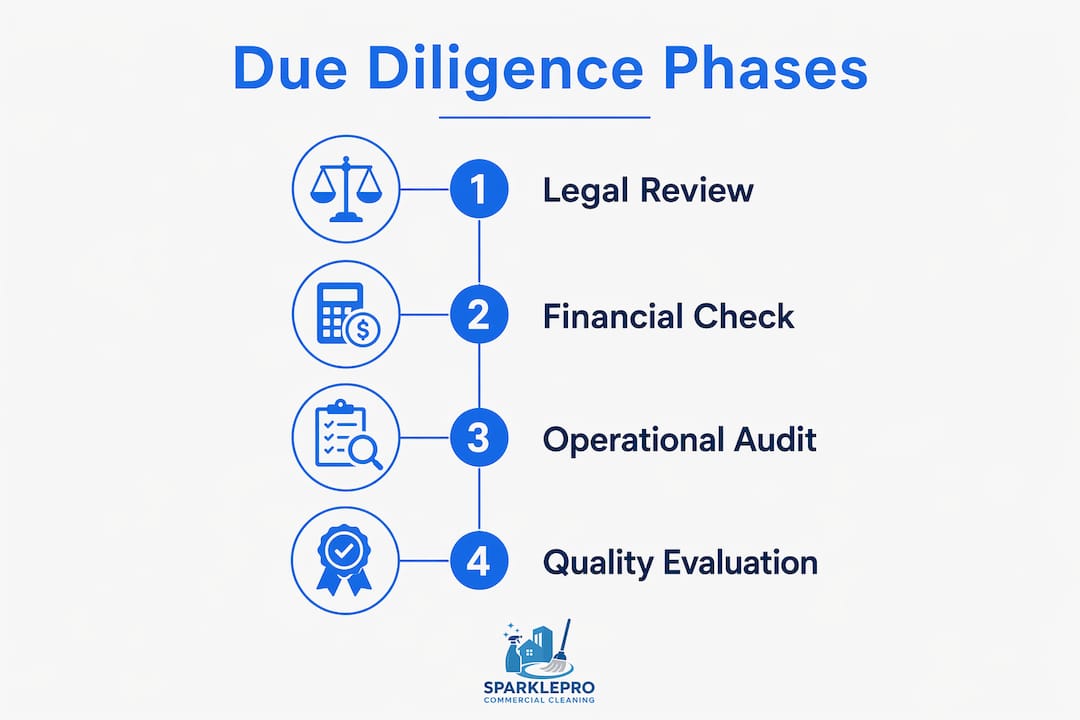
Legal contract review is where most property managers underinvest. Every active client contract needs scrutiny for cancellation notice periods, price escalation provisions, and auto-renewal terms. The most consequential clause to find: language requiring written client consent before the contract can be assigned. Without that consent, a client has no legal obligation to honor the agreement under a new vendor or ownership structure.
Financial assessment means requesting at least three years of profit and loss statements, tax returns, and payroll registers. Flag any vendor whose labor costs look unusually low. That pattern often signals worker misclassification, where cleaning staff are paid as 1099 independent contractors rather than W-2 employees. Also check client concentration: when the top 3–5 accounts represent 50–70% of a vendor's revenue, a single lost contract can destabilize their entire operation.
Operational and insurance review covers certificates of insurance, workers' compensation policies, and loss history. Reviewing five years of insurance claims reveals safety patterns that a clean-looking proposal will never disclose. Verify that coverage limits meet your facility's requirements and that no policy has been canceled for cause.
Service quality evaluation goes beyond a reference call. Look for documented background check programs, especially if your facility serves healthcare, government, or financial clients. GBAC STAR accreditation from ISSA signals a vendor has implemented verified infection prevention protocols. You can also review the vendor's cleaning compliance checklist against your facility's specific regulatory requirements.
Pro Tip: Focus your legal review on contract assignability first. Identify every contract with an anti-assignment clause, then get written consent from each affected client before any transition closes. Discovering this after the fact is not a renegotiation opportunity.
Why cleaning due diligence matters for your property
The client contract portfolio is the real asset in any commercial cleaning relationship, not the equipment. Property managers who treat due diligence as optional often find out the hard way when a vendor change triggers contract losses they could have prevented.
Worker misclassification carries direct financial exposure for property owners. The IRS applies specific tests to determine whether a cleaning worker is truly an independent contractor. Workers who operate under a company's supervision, use its equipment, and depend on it economically are almost always employees under applicable law, regardless of how they are paid. Liability for back payroll taxes and penalties can follow the work, not just the vendor.

Documented background check compliance is mandatory for cleaning staff in regulated facilities. Failure to maintain those records constitutes a breach-of-contract risk with real legal consequences, not a paperwork technicality. For healthcare, government, or financial services sites, buyers and property managers increasingly require this documentation before a contract is signed.
The benefits of professional cleaning extend well beyond appearance. Proper vendor vetting protects property value, reduces operational disruptions, and keeps your facility compliant with industry regulations.
How to conduct commercial cleaning due diligence effectively
A structured approach covers the ground without wasting time.
- Request all active client contracts and review each for term length, cancellation rights, and assignment language
- Analyze three years of financial and payroll documents to confirm revenue quality and workforce classification
- Obtain insurance certificates and five years of loss runs; verify coverage limits meet your facility's standards
- Evaluate background check programs and ask for documentation of compliance for any regulated accounts
- Engage legal counsel to review contract language and assess labor classification defensibility
- Set a timeline of 4–6 weeks before service start or renewal to complete the full review
- For flooring and surface care standards, cross-reference vendor practices against current flooring compliance standards
Pro Tip: Document all client consents for contract assignment in writing before any transition. Verbal agreements do not hold up, and discovering a missing consent after a vendor change has already happened leaves you with no leverage.
Common pitfalls in cleaning due diligence and how to avoid them
Rushing due diligence is the most expensive mistake. Property managers who focus only on price and skip the contract review often lose key agreements when a vendor changes ownership or structure.
- Ignoring anti-assignment clauses: Clients can legally walk away when contracts transfer without their written consent
- Skipping payroll verification: Misclassified workers create ongoing liability, not just a historical one
- Overlooking insurance gaps: Insufficient general liability or workers' compensation coverage shifts risk directly to the property owner
- Missing background check documentation: For regulated facilities, undocumented compliance is a contract breach waiting to happen
- Accepting verbal agreements: Month-to-month or verbal-only arrangements offer no contractual protection and are a red flag in any vendor evaluation
- Underweighting client concentration: A vendor whose top three to five clients represent more than half of revenue carries fragility that affects service reliability
How to choose the right commercial cleaning provider
Selecting a vendor goes beyond comparing price sheets. The criteria that actually predict reliability:
- Licensing and insurance: Fully licensed and insured providers protect you from liability; always verify certificates directly, not from a vendor-supplied summary
- Workforce classification: W-2 employees with documented payroll are a cleaner risk profile than a 1099-heavy workforce
- Certifications: GBAC STAR accreditation and ISSA membership signal adherence to recognized commercial cleaning standards
- Contract terms: Multi-year agreements with clear pricing and defined cancellation terms reduce uncertainty
- References and tenure: Average client tenure and documented renewal history matter more than a list of logos
Questions to ask potential cleaning providers during due diligence
Direct questions cut through polished proposals fast. Ask every candidate:
- Are your cleaning staff classified as W-2 employees or 1099 contractors?
- Can you provide five years of insurance loss runs and current certificates?
- Do your contracts include anti-assignment clauses, and have you obtained client consents for past transitions?
- What background check program do you run for employees entering regulated facilities?
- What percentage of your revenue comes from your top three clients?
- Which certifications does your company hold, and are they current?
Reviewing how a vendor evaluates cleaning contracts internally also tells you a lot about how seriously they take compliance.
Red flags that signal a poor cleaning service provider
Some warning signs are easy to miss until they become problems.
- Reluctance to share payroll records or insurance loss history
- A workforce that is predominantly 1099 contractors with no clear classification rationale
- Contracts that are month-to-month or verbal with no written terms
- No documented background check program for employees in sensitive facilities
- Client concentration where one or two accounts dominate revenue
- Certifications that are expired or unverifiable through the issuing body
Cost considerations in the cleaning due diligence process
Due diligence has real costs, and skipping it to save time is almost always more expensive. Legal counsel for contract review, payroll analysis, and insurance verification typically run as professional service fees, but they are a fraction of the liability exposure from a misclassified workforce or a lost anchor contract.
Budget for attorney time to review assignment clauses and labor classification. Factor in the cost of background check programs if your facility requires them. And account for the transition costs if a vendor change triggers client consent requirements that delay service start. A 4–6 week due diligence window, done properly, prevents months of remediation later.
Sparkleprocommercialcleaning operates as a fully licensed and insured commercial cleaning provider serving property managers and business owners across the United States. Whether you need routine janitorial services, post-construction cleanouts, or specialized disinfection for healthcare or industrial facilities, Sparkleprocommercialcleaning brings verified credentials and a transparent service process to every engagement. Get a quote for Delaware or explore services in your region to start your vendor evaluation with a provider built for commercial-grade accountability.
Key Takeaways
Cleaning due diligence in commercial settings protects property managers from contract loss, workforce liability, and insurance gaps by systematically vetting vendors before hiring or renewal.
| Point | Details |
|---|---|
| Contract assignability is the priority | Anti-assignment clauses require written client consent; missing this can void contracts after a vendor change. |
| Payroll records reveal classification risk | Three years of payroll documents confirm whether workers are properly classified as W-2 employees. |
| Client concentration signals fragility | A small number of top accounts representing a large portion of a vendor's revenue creates instability that affects your service. |
| Insurance review requires loss history | Five years of loss runs expose safety patterns that certificates alone will not show. |
| Allow 4–6 weeks for full review | A complete due diligence cycle before service start or renewal prevents costly surprises post-hire. |