
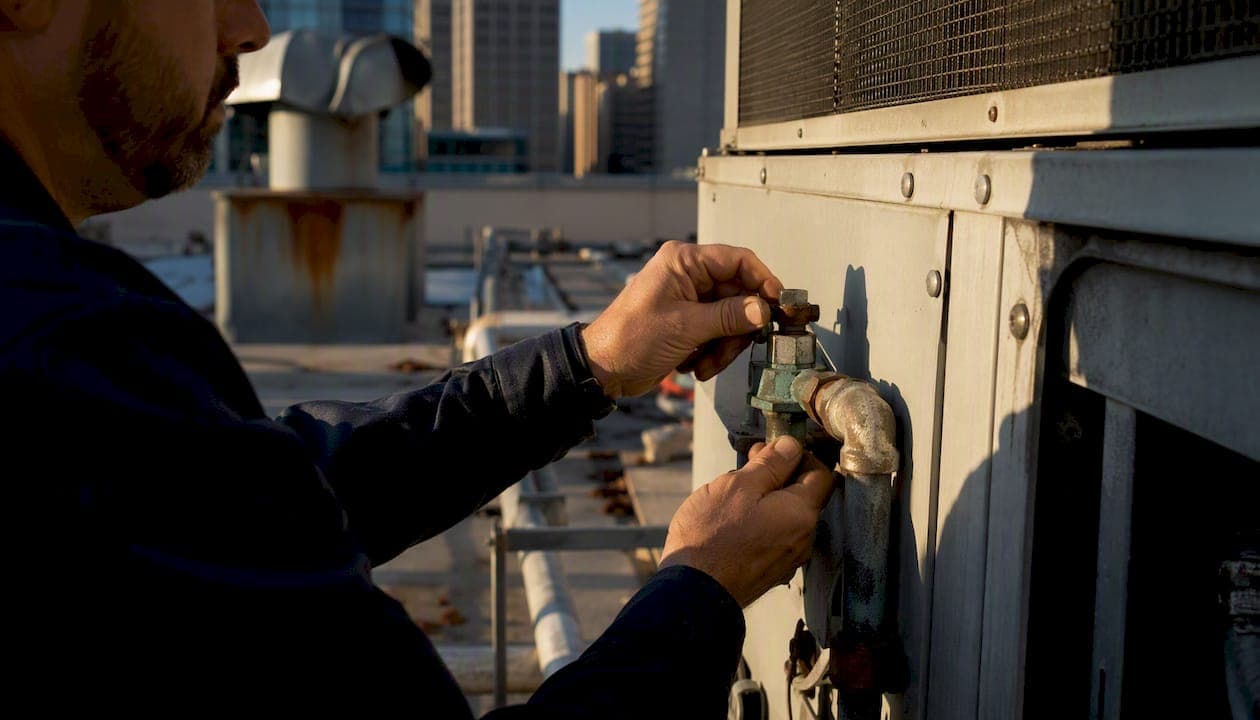
Start this week with six actions that will cut emergency spend, protect your lease renewals, and keep you compliant: run daily janitorial and safety checks, schedule one critical system inspection (HVAC or roof drain), send a tenant communication on any open work orders, log your top 20 assets into a CMMS or spreadsheet, compile a vendor emergency contact list, and verify your maintenance reserve covers at least three months of planned spend.
Each action maps directly to a real cost or risk:
- Daily janitorial and safety walk-through (facility manager or day porter): catches slip hazards, overflowing drains, and HVAC filter alerts before they become liability claims.
- One critical inspection this week (licensed vendor or in-house tech): ASHRAE recommends aligning inspection cadences with manufacturer protocols; skipping a single seasonal HVAC check can cascade into a chiller failure costing many times a planned service.
- Tenant communication on open work orders (property manager): responsive communication is one of the top drivers of lease renewal decisions.
- CMMS or asset log quick-start (facility manager): even a 10–20 asset pilot in a maintenance management platform reduces missed PMs and makes compliance audits retrievable in seconds.
- Vendor emergency contact list (property manager): a single missing after-hours number during a pipe burst can add hours of water damage.
- Reserve fund check (building owner or CFO): confirm your maintenance reserve covers 3–6 months of planned spend before the next budget cycle.
Pro Tip: Set a recurring Monday morning 15-minute walk-through on your calendar and assign it to a named staff member, not a role. Accountability by name cuts missed checks by a wide margin compared to generic duty assignments.
Key Takeaways
A structured preventive maintenance program, supported by a CMMS and documented vendor contracts, is the single most effective way to protect asset value and reduce unplanned repair costs in commercial properties.
| Point | Details |
|---|---|
| Shift spend from reactive to planned | A structured PM program can free 40–60% of prior reactive maintenance spending within 12 months. |
| Use per-sq-ft benchmarks to budget | Class A office maintenance typically runs $2.50–$4.00/sf annually; use this as a planning floor. |
| Start your CMMS with 10–20 critical assets | A 90-day pilot on critical assets proves value before you scale to the full inventory. |
| Document everything with photos and certificates | Timestamped photos and stored compliance certificates protect against warranty denials and AHJ audit failures. |
| Sparkleprocommercialcleaning covers the cleaning layer | Routine janitorial, post-construction cleanouts, and tenant turnover cleaning integrate directly with your maintenance schedule. |
Table of Contents
- Why proactive commercial maintenance saves money and protects asset value
- What are the main commercial maintenance strategies and when should you use each?
- Which building systems need the most attention from your facility team?
- How to handle cleaning, janitorial standards, and tenant turnover
- Sample maintenance schedule and checklist you can use this week
- How should you budget for commercial property maintenance?
- How do you manage vendors, service contracts, and emergency repairs?
- How does a CMMS move you from reactive to data-driven maintenance?
- What safety inspections and compliance checks can you not skip?
- Sources
Why proactive commercial maintenance saves money and protects asset value
Reactive maintenance is expensive in a way that rarely shows up cleanly on a budget line until it's too late. A chiller compressor emergency can run $18,000–$28,000; a planned seasonal service for the same unit costs $2,400–$4,000, according to OxMaint's cost comparison data.
The budget impact compounds across a portfolio. OxMaint reports that a 250,000 sq ft office shifting from reactive to a structured preventive-maintenance program can free 40–60% of prior reactive spending, potentially $60,000–$90,000 annually on a $310,000 maintenance budget, within 12 months.
Beyond direct repair costs, deferred maintenance erodes net operating income in three ways:
- Asset value: lenders and appraisers discount properties with deferred maintenance backlogs; a well-documented PM history supports higher valuations.
- Tenant retention: visible deterioration, slow work-order response, and recurring system failures are among the most cited reasons tenants decline to renew.
- Liability exposure: slip-and-fall incidents, fire code violations, and elevator non-compliance all trace back to missed inspection cycles, and the legal costs dwarf the inspection fees.
Treating maintenance as asset optimization rather than a cost center is the frame that separates properties that hold value from those that quietly erode it. Building owner cleaning tips that address surface deterioration early are one concrete example of how small, consistent actions prevent capital expenditure down the road.
What are the main commercial maintenance strategies and when should you use each?
The ASHRAE Handbook defines three core maintenance strategies, and most well-run facilities use all three simultaneously, matched to asset criticality and failure consequence.
| Strategy | Trigger | Cadence | Cost Profile | Best Use Case |
|---|---|---|---|---|
| Routine / Janitorial | Calendar (daily/weekly) | Continuous | Low, predictable | Common areas, restrooms, waste, high-touch surfaces |
| Preventive (PM) | Calendar or usage hours | Scheduled intervals | Moderate, planned | HVAC filters, belts, lubrication, roof drain clearing |
| Condition-Based / Predictive | Performance measurement or sensor alert | As-needed, data-driven | Variable; avoids over-service | Chillers, elevators, electrical panels with IoT monitoring |
| Corrective / Run-to-Failure | Asset failure | Unplanned | High, unpredictable | Low-criticality assets where failure has no safety or tenant impact |
A few practical rules for choosing:
- HVAC: preventive PM (filter changes, coil cleaning, belt checks) on a fixed schedule; condition-based monitoring for central plant chillers and cooling towers where sensor data is available.
- Elevators: statutory inspections are non-negotiable; layer in condition-based monitoring for high-use units in Class A buildings.
- Roofing: semi-annual preventive inspections plus post-storm corrective walk-throughs; never run-to-failure on a roof.
- Low-critical assets (interior door hardware, non-life-safety lighting): run-to-failure is acceptable when replacement is fast and failure has no safety consequence.
NAI Global's maintenance schedule framework categorizes tasks by frequency across these same system families, which makes it a useful cross-reference when building your own cadence matrix.
Which building systems need the most attention from your facility team?
System-by-system, here are the checks that matter most and the red flags that require immediate escalation.
HVAC
- Replace or inspect filters monthly in high-occupancy buildings; quarterly minimum for low-traffic spaces.
- Clean evaporator and condenser coils annually; inspect belts and bearings every six months.
- Test economizer dampers and controls at seasonal transitions.
- Check refrigerant levels and inspect for leaks annually by a certified technician.
Red flag: unusual cycling, warm air from supply registers, or ice on refrigerant lines. Any of these warrants same-day vendor contact, not a work-order queue.
For post-construction or renovation projects, HVAC cleaning after construction is a separate, specialized task that should precede occupancy.
Plumbing
- Inspect all visible supply and drain lines quarterly for corrosion, staining, or slow drainage.
- Test backflow preventers annually (required in most jurisdictions; document for AHJ).
- Flush low-use fixtures monthly to prevent Legionella growth in standing water.
- Check water heater anode rods and pressure relief valves annually.
Electrical
- Inspect panel boards and switchgear annually; look for heat discoloration, corrosion, or tripped breakers with no logged cause.
- Test GFCI and AFCI outlets quarterly in wet areas and older buildings.
- Thermographic (infrared) scanning of electrical panels every 1–3 years catches hot spots before they become fires.
- Verify emergency generator load tests monthly and full-load tests annually.
Roof and drainage
- Clear roof drains and gutters at minimum twice annually: once before winter, once after spring debris accumulation.
- Walk the roof surface after any major storm; look for membrane punctures, standing water, and flashing separation.
- Inspect roof penetrations (HVAC curbs, pipe boots, skylights) annually.
A clogged roof drain is one of the most preventable and most expensive failures in commercial buildings. A single blocked drain during a heavy rain event can push water under membrane seams and into the building envelope, turning a $200 drain-clearing job into a $50,000 interior remediation. Inspect drains before every rainy season, not after.
Elevators
- Statutory annual inspections by a licensed elevator inspector are required in every U.S. state; certificates must be posted in the cab.
- Monthly in-house checks: door operation, emergency phone function, cab lighting, and floor leveling.
- Modernization assessments every 10–15 years for high-use units.
Fire and life-safety
- Monthly: visual inspection of fire extinguishers and exit signs.
- Quarterly: sprinkler system inspection per NFPA 25.
- Annual: fire alarm system test, fire pump flow test, emergency lighting test.
- Every 5 years: standpipe hydrostatic testing.
Store all certificates in your CMMS or a dedicated compliance folder. An Authority Having Jurisdiction (AHJ) inspector who cannot find a certificate treats it as a missed inspection. For a detailed fire compliance checklist, the linked resource covers operational requirements by system type.
Exterior, landscaping, and parking
- Inspect parking lot surfaces for cracking and trip hazards quarterly; seal coat every 2–3 years.
- Check exterior lighting monthly; dark parking areas are a liability exposure.
- Inspect building façade and caulking annually; water infiltration at window frames is a common source of interior mold.
- Trim vegetation away from the building envelope and HVAC equipment seasonally.
Pro Tip: Photograph every exterior condition issue with a timestamped photo on your phone and attach it to the work order in your CMMS. If a tenant or visitor later claims a hazard existed for months, your documentation shows the date you identified and addressed it.
How to handle cleaning, janitorial standards, and tenant turnover
Cleaning is not a soft maintenance task. Dirty common areas accelerate surface deterioration, create slip hazards, and are the first thing a prospective tenant notices during a tour. A structured cleaning frequency schedule by area and occupancy type is the foundation.
Daily and weekly janitorial scope
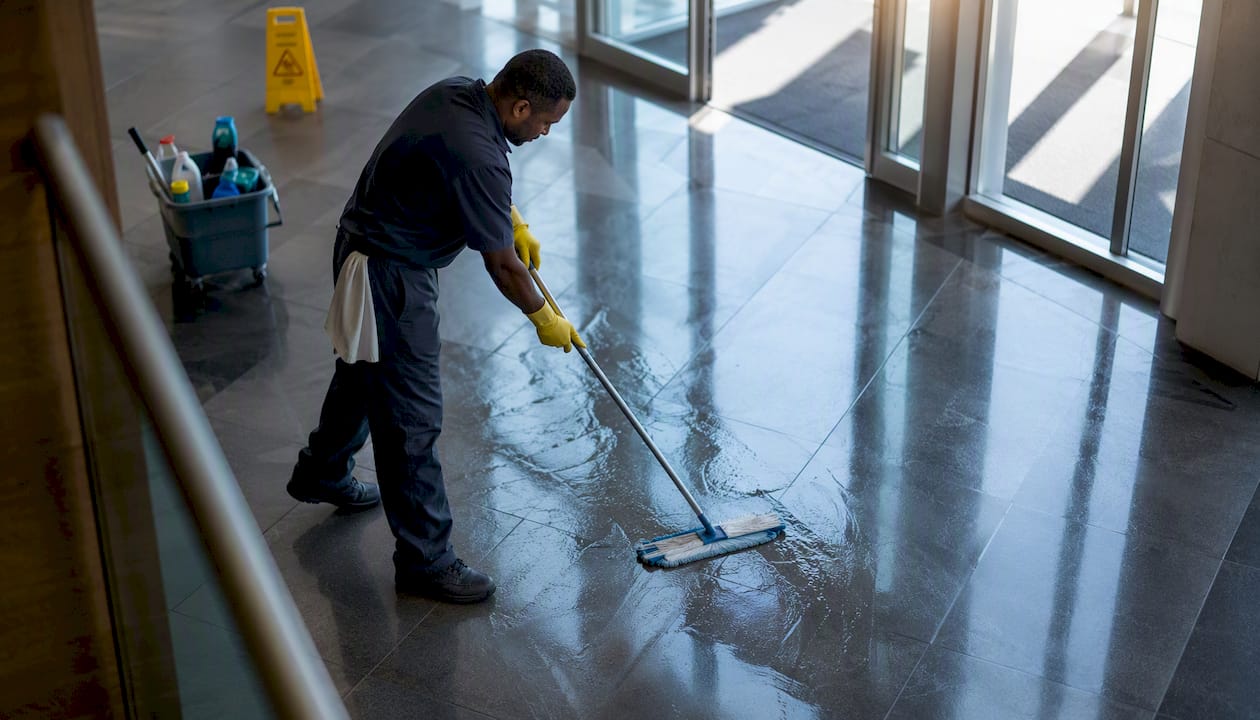
Daily (common areas, restrooms, high-touch surfaces):
- Vacuum or mop lobby, corridors, and elevator cabs.
- Disinfect restroom fixtures, counters, and door handles.
- Empty trash and replace liners in all common areas.
- Wipe down elevator buttons, stair railings, and entry door hardware.
- Spot-clean glass entry doors and lobby surfaces.
Weekly:
- Damp-mop hard-surface floors throughout.
- Clean interior glass partitions and mirrors.
- Dust horizontal surfaces in common areas and conference rooms.
- Inspect and restock restroom supplies (soap, paper towels, seat covers).
Tenant move-out and turnover checklist
A fast, thorough turnover directly shortens vacancy periods. Work through this sequence:
- Conduct a pre-move-out walk-through with the outgoing tenant; photograph every surface.
- Remove all tenant fixtures, signage, and personal property.
- Deep-clean all flooring: extract carpets, strip and refinish hard floors.
- Clean HVAC diffusers, grilles, and any tenant-installed equipment.
- Wash all interior windows and window tracks.
- Wipe down all walls, baseboards, and door frames; touch up paint where needed.
- Clean and sanitize restrooms and break rooms to move-in standard.
- Test all light fixtures, outlets, and plumbing fixtures; log any deficiencies.
- Photograph completed condition before handing to leasing team.
Practical guides recommend completing a 30-day action plan at turnover: site walk, prioritize urgent repairs, confirm vendors and emergency procedures, and set KPIs before the next tenant takes occupancy.
Pro Tip: Schedule deep cleaning and any noisy restoration work during off-hours or on weekends, and notify adjacent tenants 5–10 business days in advance. Tenants who feel respected during disruptions renew leases at higher rates than those who feel blindsided.
Sample maintenance schedule and checklist you can use this week
The table below maps tasks to frequency, system family, and owner type. Paste it into your CMMS or print it as a standing assignment sheet.
| Frequency | Task | System | Owner |
|---|---|---|---|
| Daily | Janitorial walk-through, trash, high-touch disinfection | Cleaning / Common Areas | In-house / Day Porter |
| Daily | Safety walk: trip hazards, spills, exit sign status | Life-Safety / Grounds | Facility Manager |
| Weekly | HVAC filter visual check; note any unusual odors or noise | HVAC | In-house Tech |
| Weekly | Parking lot and exterior lighting check | Exterior / Electrical | Facility Manager |
| Monthly | Fire extinguisher and exit sign visual inspection | Life-Safety | In-house Tech |
| Monthly | Generator test run (no-load) | Electrical | In-house Tech or Vendor |
| Monthly | Flush low-use plumbing fixtures | Plumbing | In-house Tech |
| Quarterly | HVAC filter replacement; belt and bearing inspection | HVAC | Vendor (licensed) |
| Quarterly | Sprinkler system inspection per NFPA 25 | Life-Safety | Licensed Vendor |
| Quarterly | Parking lot surface and lighting inspection | Exterior | Facility Manager |
| Semi-Annual | Roof drain clearing and membrane walk | Roof / Drainage | Vendor or In-house |
| Semi-Annual | Backflow preventer test | Plumbing | Licensed Vendor |
| Annual | Full HVAC coil cleaning, refrigerant check | HVAC | Licensed Vendor |
| Annual | Elevator statutory inspection | Vertical Transport | Licensed Inspector |
| Annual | Fire alarm system test; fire pump flow test | Life-Safety | Licensed Vendor |
| Annual | Electrical panel thermographic scan | Electrical | Licensed Vendor |
| Annual | Roof and façade inspection; caulking assessment | Building Envelope | Vendor |
NAI Global's schedule framework organizes these same system families by frequency, which is a useful cross-check when customizing for your property type.
Minimum fields for a downloadable checklist
Whether you use a CMMS, Excel, or a printed sheet, every task record should capture:
- Task name and system family
- Frequency and next due date
- Assigned owner (name, not role)
- SOP or manufacturer protocol link
- Compliance document required (yes/no) and storage location
- Date completed and technician sign-off
A maintenance cleaning schedule process that integrates cleaning tasks with mechanical PMs prevents the common gap where janitorial and engineering teams operate on separate, uncoordinated calendars.
How should you budget for commercial property maintenance?
Start with a per-square-foot benchmark. Class A office maintenance typically runs $2.50–$4.00 per square foot annually; retail properties fall in the $2.00–$3.50 range; industrial sits lower at $1.00–$2.00 per square foot, according to OxMaint's practitioner estimates.
Use it as a floor, not a target.
Cost-saving tactics that actually work
- Shift spend from reactive to planned: the 40–60% reactive-to-planned shift described above is achievable within 12 months with a structured PM program. Every dollar moved from emergency repairs to scheduled service buys more work per dollar.
- Consolidate vendors: a single mechanical contractor handling HVAC, plumbing, and electrical often costs less per visit than three separate vendors, and response time improves when one firm knows your building.
- Maximize warranties: track install dates and warranty expiration for every major asset. A $15,000 chiller repair covered under a manufacturer warranty costs you nothing; the same repair one month after warranty expiry costs everything.
- Energy-efficiency upgrades: LED retrofits, programmable thermostats, and variable-frequency drives on HVAC motors reduce utility spend and extend equipment life simultaneously. These are maintenance-adjacent capital investments with measurable payback.
- Reserve fund discipline: set aside a dedicated maintenance reserve covering 3–6 months of planned spend. Properties without a reserve fund consistently defer maintenance when cash is tight, which compounds costs over time.
For a deeper look at building maintenance cleaning cost reduction, the linked resource covers specific line items where cleaning-program changes produce measurable savings.
How do you manage vendors, service contracts, and emergency repairs?
A vendor who shows up without the right license, insurance, or commercial experience can void your warranties, create liability exposure, and leave work half-done. Vet every vendor before they set foot on your property.
Vendor vetting checklist
- Verify current state contractor license and specialty certifications (e.g., EPA 608 for HVAC refrigerants, elevator mechanic license).
- Confirm general liability insurance ($1M per occurrence minimum) and workers' compensation coverage; request certificates naming your entity as additional insured.
- Check references from at least two comparable commercial properties (similar size, asset class, system complexity).
- Confirm the vendor has commercial-scale experience, not just residential.
- Review scope of work in writing before any visit; verbal agreements create disputes.
SLA fields to require in every service contract
- Response time: maximum hours to respond for emergency vs. routine calls (e.g., 2 hours for life-safety, 24 hours for routine).
- Remedy window: maximum time to complete the repair or provide a temporary fix.
- Performance metrics: PM completion rate, callback rate, and documentation turnaround.
- Escalation path: named contacts at the vendor for after-hours emergencies.
- Warranty on labor and parts: minimum 90 days on completed work.
Emergency contact template
Keep a one-page sheet posted in your facility management office and stored in your CMMS:
- HVAC vendor (24/7 emergency line)
- Plumbing/drain vendor (24/7)
- Electrical contractor (24/7)
- Elevator service company (24/7)
- Roofing contractor (emergency tarping)
- Fire alarm monitoring company
- Property insurance carrier (claims line)
- Local utility emergency numbers (gas, electric, water)
Pro Tip: Batch all disruptive vendor work (drilling, HVAC shutdowns, elevator outages) into a single scheduled window and notify tenants 5–10 business days ahead. Tenants who feel informed tolerate disruption; tenants who feel surprised escalate to ownership.
For guidance on hiring commercial cleaners specifically, the linked resource covers contract terms, scope definition, and vetting steps tailored to janitorial and cleaning vendors.
How does a CMMS move you from reactive to data-driven maintenance?
A spreadsheet works for a single building with a handful of assets. Once you're managing multiple systems, compliance certificates, and vendor histories across a portfolio, it breaks down fast. MRI Software recommends maintenance management software to automate scheduling, track work orders, and maintain records that reduce missed PMs and simplify reporting.
Asset inventory template fields
Every asset record in your CMMS should capture:
- Asset ID and location (building, floor, room)
- Manufacturer, model, and serial number
- Install date and expected useful life
- Warranty expiration date and terms
- Last service date and technician
- Next scheduled PM date
- SOP or manufacturer protocol link
- Compliance document type and storage location
KPIs worth tracking
- PM completion rate: percentage of scheduled PMs completed on time. Target 90%+ for critical assets.
- Mean time between failures (MTBF): rising MTBF means your PM program is working.
- Cost per square foot: track monthly to catch cost drift before it becomes a budget problem.
- Emergency work order ratio: the share of total work orders that are unplanned. A healthy ratio is below 20% for a mature PM program.
- Response time: average time from work-order submission to technician on-site.
CMMS adoption steps
- Identify your 10–20 most critical assets (chillers, main electrical panels, elevators, fire suppression).
- Enter those assets with full inventory fields and attach any existing service records.
- Create PM schedules for each asset based on manufacturer protocols and ASHRAE Guideline 4 recommendations.
- Train technicians to close work orders in the system, not on paper, and attach photos and compliance documents.
- Run the pilot for 90 days; measure PM completion rate, MTBF, and cost-per-asset.
- Scale to the full asset inventory once the workflow is proven.
Why documentation matters in cleaning services applies equally to mechanical maintenance: a work-order history with attached photos and certificates is the difference between a warranty claim that gets honored and one that gets denied.
What safety inspections and compliance checks can you not skip?
Non-negotiable compliance items have fixed cadences set by NFPA, your state AHJ, and OSHA. Missing them isn't just a fine risk; it's a liability exposure that can void your insurance coverage.
Life-safety compliance checklist
Monthly:
- Visual inspection of all fire extinguishers (pressure gauge, pin, condition).
- Test emergency exit signs and battery-backed emergency lighting.
- Check fire alarm panel for any fault or trouble indicators.
Quarterly:
- Sprinkler system inspection per NFPA 25.
- Inspect fire doors for proper latching and no obstructions.
- Test elevator emergency phone and cab lighting.
Annual:
- Fire alarm system full test (pull stations, smoke detectors, notification devices).
- Fire pump flow test.
- Emergency generator full-load test.
- Backflow preventer test and certification.
- Elevator statutory inspection by licensed inspector; post certificate in cab.
Every 5 years:
- Standpipe hydrostatic testing.
Store every certificate in your CMMS the day it's issued. An AHJ inspector who cannot locate a certificate during an audit treats it as a missed inspection, regardless of whether the work was done. For fire-safety certification processes, this fire safety guidance covers documentation and certification workflows in detail.
Emergency preparedness actions
For each of the three most common commercial building emergencies, have a written response plan posted in your facility office:
Chiller failure: identify backup cooling source or portable unit vendor; notify tenants within 2 hours; escalate to HVAC vendor emergency line immediately.
Flooding or pipe burst: locate and mark all main shut-off valves on your as-built drawings; train in-house staff to operate them; have a water extraction vendor on your emergency contact list.
Power loss: test generator monthly; confirm critical loads (fire alarm, emergency lighting, elevator) are on generator circuits; notify tenants within 30 minutes of any extended outage.
Seasonal preparation matters too. Before winter, drain and blow out irrigation systems, inspect roof drains, and test heating systems under load. Before summer, service cooling towers, check refrigerant levels, and verify economizer controls are calibrated for warm-weather operation.
What commercial cleaning teams see that property managers often miss
The most consistent gap we see at Sparkleprocommercialcleaning isn't a missed HVAC filter or a skipped sprinkler test. It's the accumulation of small, undocumented conditions that quietly compound into expensive problems: roof drains that were never cleared after the last cleaning crew finished a post-construction job, warranty claims that can't be filed because no one photographed the original condition, and tenant move-outs where the damage baseline was never established.
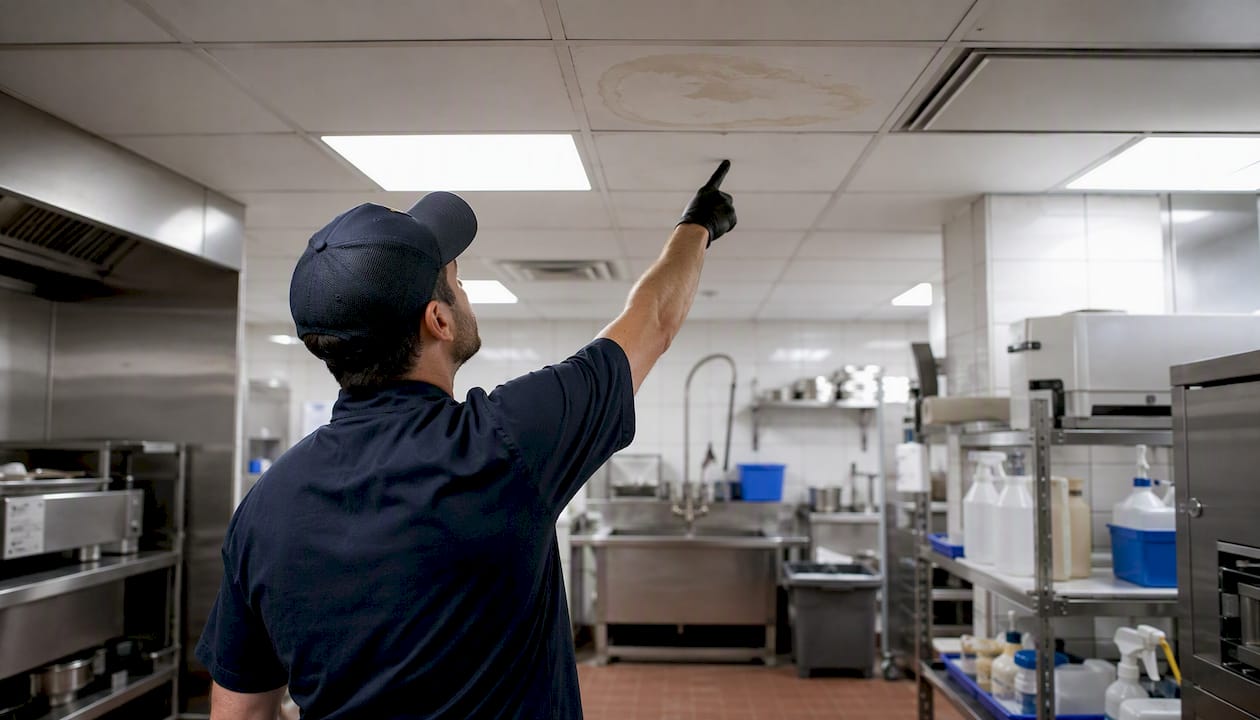
Cleaning teams are often the first eyes on a building after hours. A day porter who notices a slow drain, a ceiling tile with a water stain, or a parking lot light that's been out for two weeks is an early-warning system, but only if there's a process for reporting and logging those observations. Without documentation, those observations disappear.
The practical fix is simple: require your cleaning vendor to submit a brief condition report with every visit, attach photos to any flagged item, and route those reports into your work-order system. A commercial building sanitation workflow that includes a condition-reporting step costs nothing extra and has prevented more than a few expensive surprises.
Pro Tip: Before any deep clean or tenant turnover, photograph every surface in the space with timestamps. After the work is complete, photograph again. That before-and-after record is your proof of condition for security deposit disputes, warranty claims, and insurance documentation.
When outsourcing cleaning makes sense for your maintenance program
Most facility teams are stretched across mechanical systems, vendor coordination, compliance tracking, and tenant communications. Cleaning and janitorial work is often the first task to slip when the team is short-staffed, and the visible results of that slip affect tenant satisfaction faster than almost any other maintenance failure.
Sparkleprocommercialcleaning provides nationwide commercial cleaning services that slot directly into a property maintenance program: routine janitorial contracts for daily and weekly common-area cleaning, post-construction cleanouts that prepare spaces for occupancy, tenant move-out and turn cleaning that shortens vacancy periods, and day porter services that keep high-traffic buildings presentable throughout the day. For healthcare facilities and LEED-certified properties, specialized disinfecting and eco-friendly cleaning programs are available.
The process is straightforward: a quote, a site visit, a scheduled cleaning program, and sign-off on completed work. If your property is in Massachusetts, get a quote for commercial cleaning services and have a program in place within days, not weeks.
Sources
The following sources informed the recommendations in this article. Each is worth bookmarking for ongoing reference.
- Commercial Property Maintenance Explained: Services, Schedules and Cost Control - NAI Global
- ASHRAE Handbook chapter on maintenance strategies and documentation
- Commercial Building Maintenance: Costs & Checklists | MRI Software
- Commercial Office Building Preventive Maintenance Program - OxMaint blog