
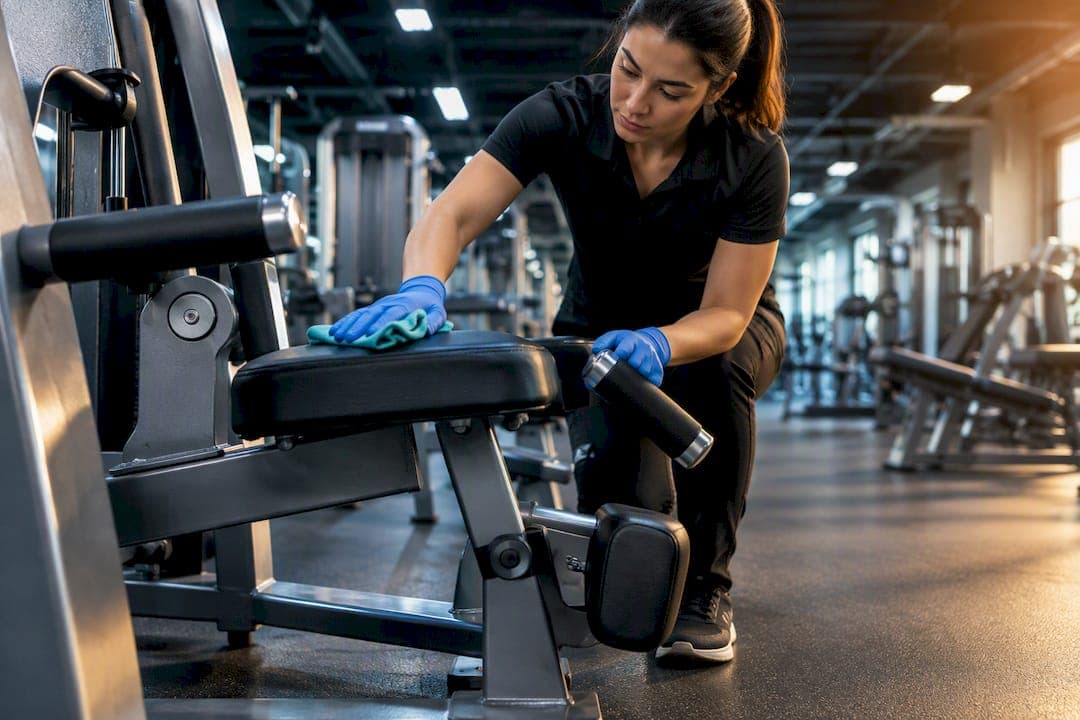
Pre-clean high-touch, skin-contact surfaces, then disinfect daily using an EPA-registered product applied for its full label contact time, and document every step. This protocol draws on guidance from the CDC, EPA List N, and OSHA, and mirrors the documented workflow commercial cleaning providers like Sparkleprocommercialcleaning use with facility clients.
TL;DR:
- High-touch, skin-contact surfaces such as cardio consoles, free weights, and locker room fixtures require frequent disinfection, especially during peak hours.
- A comprehensive cleaning schedule should include immediate wipe-downs after use, daily full disinfection, weekly deep cleaning of drains and crevices, and monthly inspections of equipment joints.
- Proper product selection involves matching disinfectants to pathogens and surfaces, ensuring full wet contact time, and avoiding damage to electronics with suitable low-residue products.
- Wet areas like showers, lockers, and drains demand more frequent cleaning and biofilm-targeted disinfectants, with porous items being laundered after each use at high temperatures.
- Consistent staff training, documented procedures, proper PPE use, and routine ventilation checks are essential for maintaining a safe, compliant gym disinfection program.
Table of Contents
- High-risk areas in fitness facilities
- Cleaning and disinfection cadence: daily, weekly, and monthly tasks
- Equipment-specific cleaning protocols and application techniques
- Locker rooms, showers, and drains: special considerations
- Choosing and using disinfectants correctly
- Staff PPE, training, SDS, and documentation: building a compliant program
- Ventilation and non-chemical hygiene controls
- Special scenarios: spills, suspected MRSA, and outbreak response
- Provider perspective: operationalizing gym disinfecting protocols
- How Sparkleprocommercialcleaning can help with disinfecting protocols
- Sources
- FAQ
High-risk areas in fitness facilities
Not every surface in a gym carries equal risk. Prioritize cleaning resources where skin contact, moisture, and shared use overlap, since those conditions favor pathogens like MRSA and other skin infections. The CDC ties MRSA prevention in athletic settings directly to routine hygiene and equipment disinfection, which is why the zones below deserve the most frequent attention.
- Cardio consoles and handlebars: touched with bare or sweaty hands every few minutes during peak hours.
- Free weights, benches, and mats: direct skin contact combined with sweat creates a durable film for bacteria.
- Lockers, showers, and sinks: shared, wet, and rarely dried between users.
- Drains and drain grates: moisture pools here constantly, allowing biofilm to build undetected.
- Hidden crevices: console seams, cable pulleys, and the undersides of benches are frequently skipped during routine wipe-downs.
Outbreak investigations reviewed by the CDC found that shared items excluded from routine cleaning, including sensor wires and shared pads, were linked to MRSA clusters. Undersides, seams, and grates are worth naming explicitly on every checklist because staff tend to clean what is visible and skip what is not.
Cleaning and disinfection cadence: daily, weekly, and monthly tasks
A working schedule needs four tiers: per-use, per-shift, daily, and periodic. Members and staff share responsibility for the first tier, while your cleaning team owns the rest.
- After each use: members wipe down equipment with a provided disinfectant wipe or spray, following posted instructions.
- Per shift: staff spot-check and re-wipe consoles, handlebars, and bench pads in high-traffic zones, especially during morning and evening rushes.
- Daily: a full disinfection pass covers all cardio and strength equipment, mats, locker room surfaces, and restrooms, using an EPA-registered product at its full contact time.
- Weekly: deep clean under and around equipment, disinfect drains, and launder any reusable towels or loaner mats.
- Monthly: inspect and disinfect crevices, cable housings, and equipment joints that daily wiping does not reach.
Volume changes the math. A low-volume studio may satisfy daily requirements with a single evening pass, while a high-volume club needs the per-shift tier to avoid gaps between cleanings. Every completed task should be logged on a checklist with initials and a timestamp, since CDC guidance on facility cleaning treats a documented record as part of the protocol, not an add-on. A routine cleaning schedule built around these tiers also simplifies staff training, since new hires learn one repeatable structure instead of ad hoc habits.
Pro Tip: Laminate a per-shift checklist and hang it near the equipment it covers, so staff can sign off without walking back to an office.
Equipment-specific cleaning protocols and application techniques
Different materials call for different handling, and the sequence matters as much as the product. The order is always pre-clean, apply disinfectant, hold wet contact time, then dry or air out.
- Cardio machines: wipe consoles and handlebars with a low-residue or alcohol-based product safe for electronics, avoiding oversaturation near buttons and screens.
- Strength equipment and free weights: pre-clean visible sweat or chalk, then disinfect handles, grips, and padded contact points.
- Rubber flooring and mats: pre-clean with a neutral cleaner, disinfect, and allow full contact time before foot traffic resumes.
- Foam pads and cushions: check for tears or saturation; porous foam that stays damp can trap moisture and should be replaced rather than repeatedly soaked.
- Cables, pulleys, and joints: disinfect monthly at minimum, since daily wiping rarely reaches these seams.
Manufacturer guidance usually restricts electronics to alcohol-based or low-moisture products, since standard disinfectants can damage screens and wiring over time. A high-touch surface cleaning guide can help staff match products to materials without guessing. Any item with cracked padding, exposed foam, or persistent odor should be pulled from the floor until it is repaired or replaced, since damaged surfaces are harder to disinfect effectively and easier for pathogens to colonize.
Locker rooms, showers, and drains: special considerations
Wet areas carry the highest biofilm risk in any fitness facility, and they need a tighter cleaning frequency than the gym floor.
- Benches and lockers: wipe down at least once daily, twice per shift in high-volume clubs.
- Shower stalls: disinfect a minimum of twice daily where usage is heavy, focusing on floors, walls, and fixtures.
- Drains and grates: treat weekly with a product formulated to break down biofilm, since standing moisture allows it to rebuild quickly.
- Sinks and countertops: disinfect each shift alongside restroom fixtures.
Biofilm forms fastest where water sits, so drains deserve a dedicated step rather than an afterthought during general mopping. Left untreated, that buildup becomes a reservoir that daily surface disinfection never reaches.
Porous items like shared towels, loaner mats, and robes need laundering after each use, using hot water cycles consistent with commercial laundry equipment specifications, since heat plus detergent does more to break down organic residue than any spray-on product applied to fabric.

Choosing and using disinfectants correctly
Product selection starts with matching the claim to the pathogen and surface, not grabbing whatever is on the shelf. The EPA's List N identifies products expected to be effective against SARS-CoV-2 when used exactly as labeled, and the label itself specifies surface type, application method, and contact time.
- Check the label first: confirm the product is registered for the pathogens and surfaces you need to cover.
- Pre-clean before disinfecting: OSHA and CDC guidance both state that visible soil reduces disinfectant effectiveness, so cleaning always comes before disinfecting.
- Respect contact time: a surface must stay visibly wet for the full duration listed on the label, often one to three minutes depending on the product.
- Match application method: some products require spraying and wiping, others require a longer soak, per their own instructions.
Consumer wipes rarely hold a surface wet long enough to meet label contact time, according to CDC guidance on athletic facility disinfection, which means a quick swipe often does less than staff assume. Re-wetting the surface or using a spray-and-dwell method closes that gap.
Staff PPE, training, SDS, and documentation: building a compliant program
A protocol only works if staff are trained to follow it and records prove they did. OSHA guidance places responsibility on employers to provide Safety Data Sheets for every product in use and to train staff on the PPE each one requires.
- PPE by task: gloves for all disinfecting tasks, eye protection when spraying, and masks when working in poorly ventilated areas.
- SDS access: keep a current binder or digital folder covering every product on site, reviewed with staff during onboarding.
- Training cadence: retrain quarterly and after any product change, with a brief competency check each time.
- Documentation: maintain SDS inventory, training logs, completed cleaning checklists, and incident logs in one accessible system.
A construction cleaning safety guide covers PPE and SDS handling in more detail and translates well to gym environments. Providers that run a documented four-step engagement, quote, site visit, scheduled cleaning, and client approval, give facility managers a template for building their own sign-off chain.
Pro Tip: Store SDS sheets by product name, not by brand, so staff can find the right sheet fast during an incident.
Ventilation and non-chemical hygiene controls
Surface disinfection only covers half the risk picture, since airborne particles need separate handling. CDC-issued guidance recommends avoiding dry sweeping and high-pressure cleaning because both methods re-aerosolize settled particles.
- HVAC checks: confirm filters meet an adequate MERV rating and increase outdoor air intake where the system allows it.
- Run times: extend HVAC operation before opening and after closing to boost air changes during low-occupancy hours.
- Cleaning method: use HEPA-filtered vacuums and wet cleaning methods instead of dry sweeping.
- Electrostatic spraying: reserve for appropriate conditions, with operator PPE and a clearance period before reopening the space, as outlined in guidance on safe electrostatic disinfection.
Special scenarios: spills, suspected MRSA, and outbreak response
Contamination events need a faster, more deliberate response than routine cleaning.
- Contain the area: block off the space immediately to prevent foot traffic across a spill or exposed surface.
- Don PPE: gloves and, for blood or body fluids, eye protection before any contact.
- Pre-clean and disinfect: remove visible material, then apply an EPA-registered disinfectant rated for the relevant pathogens at full contact time.
- Dispose of waste properly: bag contaminated materials and PPE separately, following local biohazard disposal rules.
- Escalate when warranted: close the area for deep disinfection if MRSA is suspected, and notify local health authorities per your jurisdiction's requirements.
Reopen only after the area has been disinfected, dried, and inspected, and let members know the space was closed for a health and safety measure rather than leaving them to guess.
Provider perspective: operationalizing gym disinfecting protocols
Most gyms do not fail on knowledge, they fail on consistency: dwell time gets rushed during busy shifts, supply runs low without anyone noticing, and members skip the wipe-down step entirely. A structured quote, site visit, scheduled service, and approval cycle catches those gaps before they become patterns, which is the same logic behind any documented facility protocol.
— Sales
How Sparkleprocommercialcleaning can help with disinfecting protocols
Building and maintaining a compliant schedule takes staff hours that many facility managers would rather spend elsewhere. Professional commercial cleaning providers handle that work directly, matching services to the job at hand rather than asking you to piece together a program yourself.
- Disinfecting Services: routine and event-based disinfection using EPA-registered products applied to label contact time.
- Day Porter Services: on-site coverage for per-shift wipe-downs and spot cleaning during peak hours.
- Janitorial services: recurring contracts covering daily and weekly cleaning tiers.
- Deep cleans: periodic service for crevices, drains, and equipment joints that routine cleaning misses.
A quote and site visit map your facility's specific risk zones, and the engagement includes documentation such as SDS records, written protocols, and training logs, the same paperwork auditors and insurers expect to see. Learn more about choosing the right disinfecting services for your facility, or request a quote to schedule a site visit.
Sources
- Athletic Facilities: MRSA Prevention and Control | CDC
- Cleaning and disinfecting | OSHA
- List N: Disinfectants for Coronavirus (COVID-19) | US EPA
FAQ
What do gyms use to disinfect equipment?
Most gyms use EPA-registered disinfectants drawn from List N, applied to equipment handles, consoles, and pads after a pre-clean step. The specific product depends on the surface material and the pathogens the label targets.
What is the recommended cleaning frequency for gym equipment?
Daily disinfection is generally sufficient when no known illness cases are present, according to CDC facility guidance. High-touch items like handlebars and consoles often need per-shift spot cleaning on top of the daily pass, especially in busy facilities.
What are basic gym hygiene etiquette rules?
Common etiquette rules include wiping down equipment after use, avoiding shared towels, and washing hands regularly, all of which the CDC ties directly to MRSA prevention. Posting these expectations near equipment reinforces staff-led disinfection efforts.
Can disinfecting wipes be used on gym equipment?
Wipes can be used, but they must keep the surface visibly wet for the product's full label contact time to be effective. Many consumer wipes dry out before that time is reached, which is why CDC guidance recommends re-wetting the surface or switching to a spray-and-dwell method for consistent results.
How should gyms handle a blood or body fluid spill?
Contain the area, don gloves and eye protection, pre-clean the visible material, then disinfect with an EPA-registered product rated for the relevant pathogens at full contact time. Dispose of contaminated waste and PPE separately, following the OSHA and CDC guidance on cleaning and disinfecting procedures.