

The most reliable way to assess cleaning needs for a commercial facility is a five-step method: prepare your compliance baseline, conduct a room-by-room site visit, define tasks and exclusions, set frequencies tied to occupancy, and lock in contract terms with measurable KPIs. Skip any step and you get mismatched bids, scope creep, and vendor disputes. Industry bodies like ISSA and BSCAI have built their guidance around exactly this sequence, and Sparkleprocommercialcleaning uses the same framework on every site engagement nationwide.
- Step 0 — Prepare: Gather parties, facility boundaries, contract term, and compliance documents before the walkthrough.
- Step 1 — Site visit: Capture zone-by-zone measurements, photos, fixture counts, and traffic patterns.
- Step 2 — Task definition: Convert the inventory into line-item tasks with explicit exclusions.
- Step 3 — Frequency and staffing: Map tasks to a calendar and estimate crew hours using ISSA production rates.
- Step 4 — Contract and QA: Price the job, draft contract clauses, and define inspection KPIs.
A repeatable method prevents scope creep, enables accurate bids, and creates measurable performance benchmarks every vendor must meet.
Key Takeaways
A contractor-ready cleaning scope requires a completed zone matrix, a task matrix with frequencies, a staffing estimate from ISSA production rates, defined equipment ownership, an inspection rubric with KPI thresholds, and signed contract clauses covering COI, change orders, and termination terms.
| Point | Details |
|---|---|
| Start with the contract foundation | Identify parties, facility boundaries, and compliance requirements before the walkthrough. |
| Build a zone-by-zone matrix | Capture square footage, soil level, fixture counts, and labor drivers for every area. |
| Define tasks and exclusions explicitly | A task matrix with frequencies prevents scope creep and makes bids directly comparable. |
| Set KPIs before signing | Inspection score minimums, response times, and escalation paths belong in the contract, not a side agreement. |
| Sparkleprocommercialcleaning | Conducts the full site assessment and delivers a contractor-ready scope for offices, retail, multifamily, industrial, and healthcare facilities nationwide. |
Table of Contents
- What should you do before the walkthrough?
- How to conduct the site visit and capture what matters
- How do you turn the inventory into a task-level scope?
- How do you set a cleaning frequency schedule?
- How do you estimate staffing and equipment requirements?
- What contract terms and pricing models protect you?
- How do you measure and enforce cleaning quality?
- Special cases: how do assessments differ by facility type?
- What questions should you ask vendors during the bid process?
- What the assessment process looks like in practice
- Sparkleprocommercialcleaning handles the assessment for you
- Sources
What should you do before the walkthrough?
Establishing the contract foundation before you set foot on site is the step most facility teams skip. Vague language like "clean all office areas" is the single most common source of disputes once a contract is signed.
Collect these before the walkthrough:
- Parties and contacts: Owner, property manager, tenant points of contact, and after-hours security contacts.
- Facility boundaries: Street addresses, floor numbers, suite exclusions, and service hours (day porter vs. night crew).
- Contract term options: Month-to-month, one-year, or multi-year. Term length affects pricing assumptions and equipment amortization.
- Compliance baseline: OSHA safety rules for cleaning crews, EPA-registered product restrictions, and CDC infection-control expectations for any healthcare or food-service spaces.
- Documents to bring: Prior scope of work, floorplans, maintenance logs, and access or security instructions.
Pro Tip: Request a certificate of insurance from every prospective vendor before the walkthrough, not after. A COI that names your facility as additional insured is more informative than any self-attestation and should arrive with the proposal, not at contract signing.
| Document | Why you need it before the site visit |
|---|---|
| Prior scope of work | Reveals gaps and tasks the last vendor quietly dropped |
| Floorplans with square footage | Feeds production-rate calculations for labor hours |
| Maintenance logs | Flags recurring problem areas before you walk the floor |
| Access and security instructions | Prevents scheduling conflicts and crew lockouts |
| Compliance requirements | Shapes product selection and PPE requirements from day one |
How to conduct the site visit and capture what matters
A commercial cleaning site walkthrough should capture total square footage, area types, fixture counts, occupancy patterns, and access details. Those fields feed ISSA-based production-rate calculations directly. Miss them and your labor estimate is a guess.
Work zone by zone and record:
- Zone name, square footage, area type (open office, restroom, kitchen, lobby, stairwell)
- Soil level (light, medium, heavy) and surface types (VCT, carpet, polished concrete, tile)
- Fixture counts in restrooms and kitchens — toilets, sinks, urinals, stalls — because these are the primary labor drivers that slow production rates
- High-touch surfaces, damaged finishes, and inaccessible windows (photo-log each one)
- Peak traffic windows, cleaning access hours, and seasonal occupancy shifts
Pro Tip: Ask the facilities contact when the building is at its busiest and when cleaning crews can actually get in. A 24/7 call center and a standard 9-to-5 office require completely different shift structures, and that difference shows up in the price.
Hard-to-see labor drivers deserve their own column in your notes: double-height lobbies, stairways, specialty equipment, matting, and remote storage areas all add time that flat square-footage estimates ignore.
How do you turn the inventory into a task-level scope?
Every scope of work needs six core sections: property details, task lists by area, cleaning frequencies, product and equipment requirements, exclusions, and sign-off conditions. Missing any one of them creates gaps that produce disputes.
Build a task matrix with areas as rows and tasks as columns. Each cell states the frequency and the standard. That structure means every vendor pricing against it is pricing the same job, not their own interpretation of it.
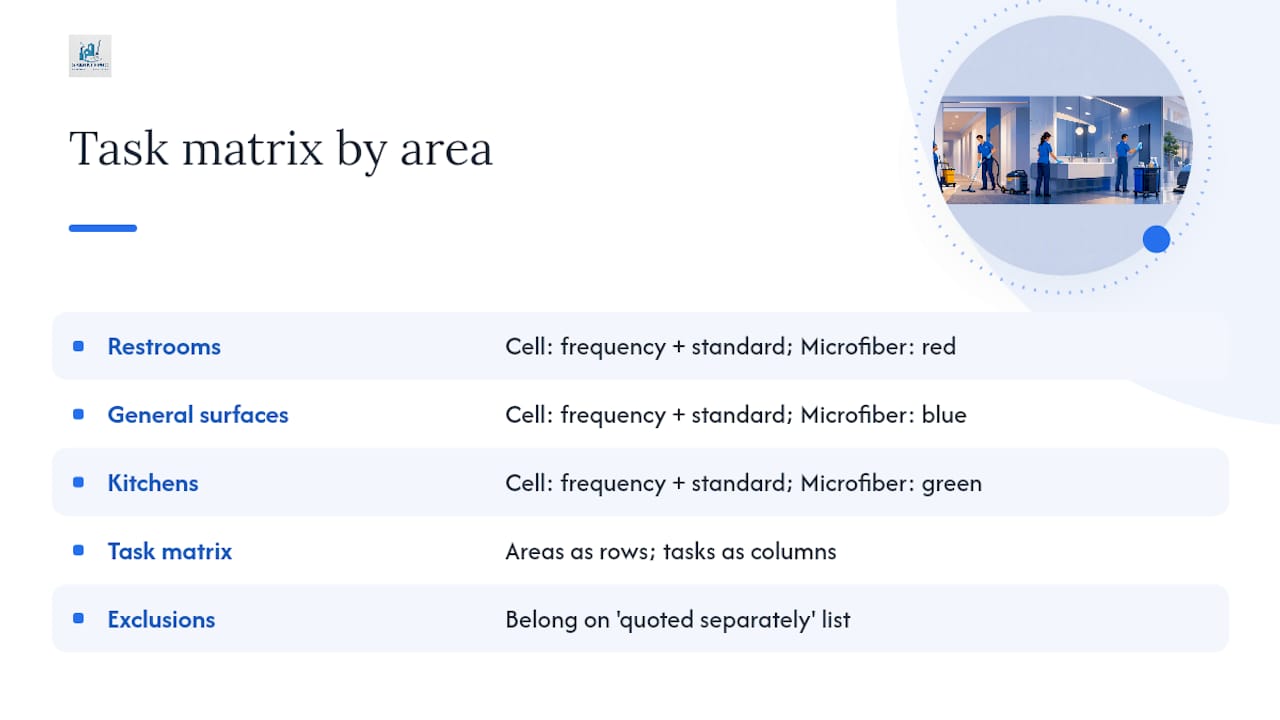
Define exclusions with equal precision. Exterior grounds, window washing above 12 feet, major floor refinishing, and hazardous waste removal belong on a "quoted separately" list, not buried in a catch-all clause. BSCAI's cleaning and disinfecting scope of work guide provides benchmark language for task specificity and disinfecting protocols that holds up in contract disputes.
Pro Tip: Require vendors to submit a product SDS list and specify color-coded microfiber protocols by zone. Red for restrooms, blue for general surfaces, green for kitchens. It costs nothing to specify and prevents cross-contamination that creates liability.
How do you set a cleaning frequency schedule?
Classify tasks by urgency and visibility first. Restrooms and trash removal are daily non-negotiables. Detail dusting is weekly. Carpet extraction is periodic, typically monthly or quarterly depending on traffic. Floor stripping and refinishing is annual.
- Map each zone to its task list from the matrix above.
- Assign a frequency using precise calendar language: "Monday through Friday" not "weekdays," "first Monday of each month" not "monthly."
- Flag zones that shift with occupancy: a conference center before a major event needs a different schedule than the same space on a quiet Tuesday.
- Build hand-off notes for night vs. day shifts so crews know which tasks belong to which window.
| Zone | Task | Frequency | Shift |
|---|---|---|---|
| Restrooms | Full clean and restock | Daily, Mon–Fri | Night |
| Open office | Vacuum and trash | Daily, Mon–Fri | Night |
| Lobby | Mop and glass | Daily, Mon–Fri | Day porter |
| Carpeted areas | Extraction | Quarterly | Weekend |
| Hard floors | Strip and refinish | Annual | Weekend |
For routine facility cleaning processes, the schedule is the contract's backbone. A vendor who prices without seeing it is pricing a different job than you're buying.
How do you estimate staffing and equipment requirements?
The staffing formula runs like this: estimated hours per visit (from ISSA production rates applied to your zone matrix) multiplied by visits per period equals monthly hours. Divide by available hours per crew member to get crew size, then apply a supervisor ratio.
- Pull ISSA production rates for each surface type and soil level.
- Multiply rate by square footage per zone to get minutes per zone per visit.
- Sum all zones for total hours per visit.
- Multiply by monthly visit count for total monthly hours.
- Divide by 160 hours (standard monthly FTE) for crew size.
- Apply a 1:6 to 1:8 supervisor-to-crew ratio for quality control.
Pro Tip: A 50,000 sq ft office building at a light soil level might run 8–10 hours per night visit. Add a heavy-traffic restroom block and a full kitchen and that same building can jump to 12–14 hours. Soil level changes the math more than square footage does.
Specify equipment ownership in the contract. Vendor-supplied equipment (vacuums, auto-scrubbers, pressure washers) should be inventoried by make, model, and serial number. Client-supplied consumables (paper products, soap) need a reorder threshold and a named responsible party.

For post-construction sites, OSHA compliance adds PPE requirements and disposal protocols that change crew composition and cost. Specify W-2 employees vs. 1099 subcontractors in the contract and require background check documentation aligned to ISSA training standards.
What contract terms and pricing models protect you?
A defensible janitorial RFP evaluates every vendor against the same criteria. Ask vendors to submit pricing in all three models so you can compare apples to apples.
- Per-square-foot: Predictable for large open spaces; can obscure labor intensity in restroom-heavy buildings.
- Flat monthly: Clean for budgeting; requires a detailed scope matrix or vendors will price conservatively.
- Hourly with crew-size transparency: Best for variable-occupancy facilities; requires clear minimum-hour commitments.
| Contract clause | What it must specify |
|---|---|
| Change order process | Written request, 5-business-day response window, signed approval before work begins |
| Termination for convenience | written notice minimum; specify cure period for performance failures |
| COI and insurance | General liability minimums, workers' comp per state law, facility named as additional insured |
| Renewal terms | Auto-renew window with contractor-specified notice period, rate adjustment cap |
| Supply responsibilities | Who orders, who pays, reorder threshold, approved product list with SDS |
Pro Tip: Require vendors to break out labor, supplies, supervision, consumables, and any one-time project fees as separate line items. A single monthly number tells you nothing about where costs will shift when scope changes.
How do you measure and enforce cleaning quality?
Set KPIs before the contract is signed, not after the first complaint.
Inspection cadence: daily sign-off by the night supervisor, weekly walkthroughs by the account manager, monthly formal audits with a written scorecard, and quarterly client scorecards. Supervision cadence guidance for crew-to-supervisor ratios applies here as well.
Escalation path: deficiency logged → vendor notified within 24 hours → re-inspection within 48 hours → financial credit after third repeat → termination trigger after fifth.
Special cases: how do assessments differ by facility type?
Post-construction sites
Debris removal happens in phases: rough clean, final clean, and punch-list touch-up. Each phase has different PPE requirements and disposal protocols. Post-construction cleaning processes and commercial steel building considerations both affect how you stage access and crew sequencing.
Healthcare facilities
Infection control zones require EPA-registered disinfectants and CDC-aligned protocols. Document every product used for regulatory audits. Frequency is higher across all zones and the task matrix needs a separate column for disinfection vs. cleaning.
Industrial and warehouse sites
Heavy soil, equipment cleaning, and floor-care strategies dominate the assessment. Coordinate lockout/tagout procedures with operations before any crew enters equipment zones. OSHA compliance is non-negotiable and must be written into the scope.
Multifamily properties
Common-area frequency is the baseline. Unit turnover cleaning runs on lease-turn timelines, which can compress dramatically at end-of-month. Tenant-access logistics require a separate protocol in the scope, and restroom and kitchen fixture counts per unit drive the per-turn labor estimate.
What questions should you ask vendors during the bid process?
Run every vendor through the same filter before you accept a proposal.
- Will you walk the site before submitting pricing? (Vendors who decline should be disqualified.)
- What is your supervisor-to-crew ratio and how often does the account manager visit?
- Can you provide references from facilities of comparable size and type?
- Submit your product SDS list and describe your color-coded microfiber protocol.
- Break out your pricing by labor, supplies, supervision, and consumables.
Request these documents with every bid:
- Sample scope matrix from a comparable site
- Staffing plan with named supervisor
- Sample inspection report from an active account
- COI naming your facility as additional insured
What the assessment process looks like in practice
Most facility teams underestimate how much a single walkthrough changes the final price. Sparkleprocommercialcleaning's four-step engagement process (quote, site visit, scheduled cleaning, customer approval) is built around the principle that no accurate bid exists without a physical walkthrough. On one recent multifamily engagement, a pre-bid walkthrough revealed an unreported commercial kitchen on the ground floor. That single discovery added meaningful hours per visit that the initial square-footage estimate had missed entirely. The scope was corrected before contract signing, not after the first invoice dispute.
The trust signals that matter most to facility directors are not marketing claims. They are a signed scope matrix, a named supervisor, a COI on file, and an inspection rubric with teeth. Credentials and case studies from BSCAI and ISSA-aligned operations reinforce that the method is industry-standard, not proprietary.
Sparkleprocommercialcleaning handles the assessment for you
Property managers and facility directors who have worked through this guide know the assessment is detailed work. Sparkleprocommercialcleaning takes that work off your plate. The team conducts a full site visit, builds the zone and task matrix, and delivers a contractor-ready scope of work before a single cleaning shift begins. Fully licensed and insured, with nationwide coverage across offices, retail, multifamily, industrial, and healthcare facilities, the process moves from quote to scheduled service without the back-and-forth that stalls most RFPs.
If you are in Massachusetts, Washington, or Delaware, regional service pages are ready with local contacts. Have your floorplans, site contact, and service hours ready, and request a site visit today.
Sources
- BSCAI | Building Service Contractors Association International > Resources > Cleaning & Disinfecting SOW Guide
- How To Clearly Define The Scope Of Work In Your Janitorial Contracts - Janitorial Manager