
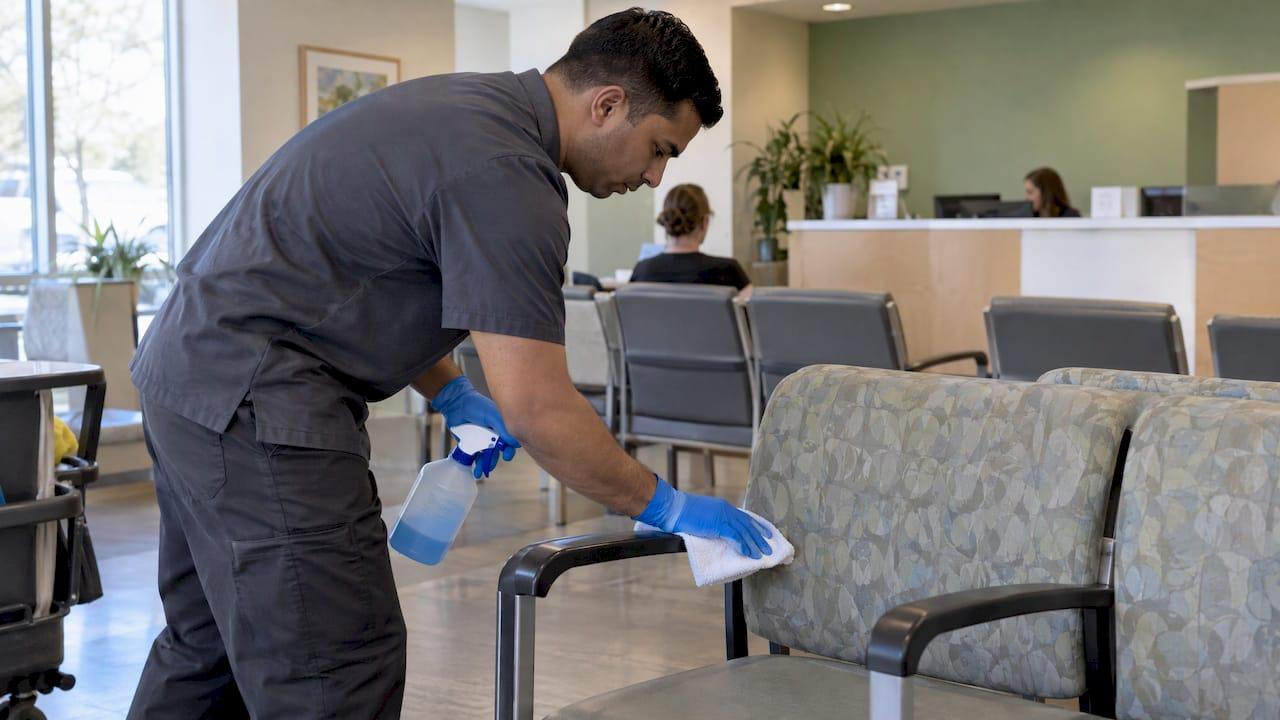
A healthcare waiting room should be cleaned at least once a day on every high-touch surface and floor. Spills and soiling need cleaning right away. The method matters as much as the schedule: clean with detergent first, then disinfect, work from clean to dirty and from high to low, and do floors last. This guide covers what to clean, how often, which products and protective gear to use, and how to set a schedule that fits your traffic and patient risk. It is written for property managers, facility directors and building owners who hire and oversee cleaning vendors.
TL;DR
- Clean waiting areas at least daily, high-touch surfaces and floors included. Increase the frequency when patient vulnerability, traffic or an outbreak raises the risk.
- Detergent and water come first. Disinfectant only works properly on a surface that is already visibly clean, and only if it stays wet for the full contact time on the label.
- Work from clean to dirty and from high to low, and clean floors last, with fresh cloths and fresh solutions each shift.
- Blood or body-fluid spills need PPE, containment, cleaning and then a facility-approved disinfectant. Employers must supply the PPE at no cost to workers.
- Write the schedule down, task by task, based on risk rather than habit.
Table of Contents
- What needs cleaning in a waiting room
- How often to clean a healthcare waiting room
- The cleaning method, step by step
- Disinfectants, equipment and protective gear
- Responding to blood and body-fluid spills
- Worker safety and training
- Building a schedule around risk
- Our perspective on waiting room cleaning
- Get a waiting room cleaning plan for your facility
- FAQ
- Sources
What needs cleaning in a waiting room
Most of the germ transfer in a waiting room happens through hands, so the priority list follows what people touch. Washington State's Department of Health lists door handles, elevator buttons, handrails, telephones, computer equipment and administrative areas as high-touch surfaces in shared spaces. In a typical waiting room that translates into:
- Chair armrests and seat edges, side tables and any shared counters
- Reception desk, sign-in clipboards, pens, kiosks and payment terminals
- Entry door handles, push plates and automatic door buttons
- Light switches, thermostats and elevator call buttons
- Restroom door handles, faucets and flush controls near the waiting area
- Hand sanitizer dispensers and water fountains
A University of South Carolina checklist for lobbies and reception areas goes further for enhanced cleaning. It covers all vertical and horizontal surfaces: walls, baseboards, blinds, windows, tables, chairs and kiosk stations.
For a deeper look at how to rank these surfaces, see our guide to high-touch surface cleaning.
Furniture, toys and shared items
Materials make cleaning easier or harder. The American Academy of Ophthalmology recommends replacing porous, non-wipeable furniture in waiting areas with wipeable, non-porous alternatives where possible, because soft materials are hard to clean and disinfect. The same statement suggests minimizing shared items such as magazines, or disinfecting them between uses.
If the practice treats children, toys need their own routine. The same guidance says to choose toys that can be cleaned and disinfected easily and to keep shared stuffed toys out. It also says to clean and disinfect large stationary toys at least weekly and whenever they are visibly soiled. Toys likely to be mouthed should be rinsed with water after disinfection or run through a dishwasher. The American Academy of Pediatrics' Project FirstLine resources set a tighter standard for toys: clean and disinfect after each use, and at least daily or when soiled with dirt or bodily fluid, saliva included.
How often to clean a healthcare waiting room
The CDC's cleaning procedure summaries say adult waiting and admission areas in general outpatient settings should be cleaned at least daily by cleaning staff. That applies to high-touch surfaces and floors, using neutral detergent and water. Low-touch surfaces can be cleaned on a schedule such as weekly. The CDC's environmental cleaning procedures page agrees: waiting and admission areas at least once per 24 hours, while consultation and examination areas need cleaning at least twice daily.
Professional bodies add specifics for their settings. The AAO recommends that horizontal surfaces in waiting areas and bathrooms be cleaned and disinfected once daily and as needed when soiled, including door knobs, elevator buttons and light switches. The AAP says waiting areas should be cleaned and disinfected daily and as needed.
| Situation | Minimum frequency | Source |
|---|---|---|
| Adult waiting area, high-touch surfaces and floors | At least once per 24 hours | CDC |
| Low-touch surfaces | On a schedule, for example weekly | CDC |
| Consultation and exam areas | At least twice daily | CDC |
| Pediatric toys | After each use and at least daily, or when soiled | AAP |
| Large stationary toys | At least weekly and when visibly soiled | AAO |
| Norovirus outbreak, care areas | Twice daily | Washington DOH |
| Norovirus outbreak, high-touch surfaces | At least three times daily | Washington DOH |
The outbreak figures come from the Washington State Department of Health's norovirus guidance. It says care areas should be cleaned and disinfected twice daily and high-touch surfaces at least three times daily, or more often if possible. It also says EPA-registered chlorine wipes should be readily available.
These are minimums. A busy urgent care waiting room that sees hundreds of visitors a day is not the same as a small specialty office. Use the minimums as the floor and add midday touch-ups where traffic justifies it. Our article on cleaning frequency in large commercial buildings covers how to scale schedules by building type.

The cleaning method, step by step
Products get the attention, but order of work is what prevents cross-contamination. These steps combine CDC, WHO and published checklist guidance.
- Prepare the cart. Load EPA-registered cleaner or detergent, EPA-registered disinfectant, disposable microfiber cloths, a microfiber mop and duster, an extension pole, gloves, anti-microbial soap, hand sanitizer and a HEPA vacuum. That is the cart contents in the South Carolina lobby checklist.
- Post floor signage and put on PPE. Safety signs should mark floor hazards while cleaning is under way, per the same university guidance.
- Clean before you disinfect. The WHO says staff should always clean with soap and water before applying disinfectant. Physical friction is the most important step in removing infectious reservoirs, and organic material left on a surface reduces how well disinfectants work.
- Go clean to dirty, high to low. The WHO also advises cleaning less-soiled areas first to avoid spreading contamination, and moving from high surfaces to low ones. In a waiting room that means light switches and desk first, chairs and tables next, restrooms last.
- Apply disinfectant and respect contact time. The Washington DOH guidance defines contact time as the time a disinfectant must stay wet on the surface to disinfect effectively. Wiping it off early is the most common error we see on checklists. Our piece on dwell time errors in daily disinfection explains how to plan around it.
- Clean floors last. The CDC specifies that floors in general inpatient and outpatient areas be cleaned last, after other surfaces. Use neutral detergent and water in a clean-to-dirty pattern, a figure-eight motion, and rinse the mop regularly in a rinse bucket. Floors may need more frequent cleaning or a disinfectant depending on the risk level of the area. The South Carolina checklist adds that mopping should begin in the far corner, away from the exit.
- Handle used textiles correctly. Used cloths and mop heads go into a dirty-laundry bag for laundering and drying at the end of the shift, per the same checklist.
Fresh cloths and solutions every shift
A bucket of solution does not stay effective all day. A peer-reviewed review of cleaning in health care settings explains that detergent and disinfectant solutions used from a bucket with a cloth or mop become contaminated and progressively less effective. Continued use may carry microbes to each following surface. The authors recommend fresh cloths and freshly prepared solutions for each cleaning shift, with mops and buckets rinsed and dried between shifts. Disposable microfiber, as in the university checklist, removes much of that risk.

Disinfectants, equipment and protective gear
Routine cleaning in waiting areas calls for neutral detergent and water, according to the CDC. A facility-approved intermediate-level disinfectant is the CDC's choice for spills.
Disinfectants used in patient-care areas should be EPA-registered and applied per the manufacturer's instructions. The AAO statement also says high-level disinfectants should not be used on noncritical devices or environmental surfaces. Diluted bleach, one part bleach to nine parts water, may be used on environmental surfaces after cleaning. For infection-control questions with specific pathogens, the CDC points to EPA's List Q disinfectants used according to label instructions.
OSHA treats EPA-registered tuberculocidal disinfectants, diluted bleach solutions, and EPA-registered products labeled effective against both HIV and HBV as appropriate for cleaning contaminated surfaces under the Bloodborne Pathogens Standard, as long as the contamination does not call for a higher-level disinfectant.
Whatever the product, always use the chemicals and procedures your supervisor or infection-prevention lead specifies, and let the disinfectant dwell as the manufacturer directs. The university's terminal cleaning checklist spells this out, with dilution instructions that depend on the specific product.
Protective gear. The CDC says environmental services staff should wear recommended PPE to protect against skin and mucous membrane exposure to cleaning chemicals, contamination and splashes. At a minimum, plan for gloves, and add eye protection and a gown or apron for spill response and chemical mixing.
Responding to blood and body-fluid spills
Waiting rooms see nosebleeds, vomiting and the occasional accident. Train every cleaner on the response before it happens. The CDC's spill procedure has four steps:
- Wear appropriate PPE.
- Confine the spill and wipe it up right away with absorbent paper towels or cloths, or spread absorbent granules to solidify it. Dispose of all of it as infectious waste.
- Clean thoroughly with a neutral detergent and warm water solution.
- Disinfect with a facility-approved intermediate-level disinfectant.
Two refinements are worth building into your protocol. AHRQ's infection-control guidance says to clean blood spills promptly with an EPA-registered tuberculocidal hospital disinfectant, then apply a second round of the same product with a new cloth for the label's contact time. And the CDC's guidance on body-fluid spills says not to spray disinfectant directly onto the spill. Remove excess liquid with a cloth or absorbent towel, clean with soap and water, then disinfect. That document specifies a 0.5% chlorine solution kept wet for at least 15 minutes for Marburg response, so follow your facility's own product and pathogen guidance for routine events.
The full employer obligations are in our guide to bloodborne pathogen cleanup and OSHA rules.
Worker safety and training
Cleaners in healthcare settings are covered by OSHA's Bloodborne Pathogens Standard, 29 CFR 1910.1030. OSHA's FAQ says housekeeping workers in healthcare facilities may have occupational exposure during tasks like cleaning blood spills and handling regulated waste. The employer must provide appropriate PPE at no cost to the employee. PPE counts as appropriate only if it does not let blood or other potentially infectious material pass through to skin, clothing, eyes, mouth or other mucous membranes under normal conditions of use.
Training is part of safety. The CDC stresses that environmental services staff must be trained and evaluated in recommended protocols, including correct use of PPE and how to remove it without contaminating themselves or others. When you hire a contractor, ask who trains the crew and how that training is documented. Our overview of federal rules for healthcare cleaning standards lists the obligations that fall on facility managers.
Building a schedule around risk
A fixed rule does not fit every waiting room. The CDC says frequency, method and process should be based on risk of pathogen transmission. That risk is a function of the probability of contamination, the vulnerability of patients to infection, and the potential for exposure, meaning high-touch versus low-touch surfaces. Combined, these produce low, moderate and high risk, and higher-risk areas need more frequent and more rigorous cleaning.
OSHA makes a related point. The disinfectant used and how often depends on the location in the facility, the surface type, the type of soil and the tasks performed. The employer's written schedule should spell those details out task by task.
Put that into practice with a short worksheet:
- Traffic: Count daily visitors. A waiting room that turns over every 20 minutes needs midday high-touch passes.
- Patient vulnerability: Oncology, dialysis, pediatrics and immunology practices call for the upper end of the range.
- Services: Procedures that involve blood or bodily fluids raise the contamination probability.
- Season and outbreaks: Build in an escalation plan, such as the three-times-daily high-touch cycle used in norovirus outbreaks.
- Documentation: Record each task, product, dilution, contact time and who performed it.
If you manage several medical suites in one building, our daily commercial cleaning routines article shows how to separate common-area and tenant-suite scopes.
Our perspective on waiting room cleaning
Waiting rooms are where a facility's first impression and its infection-control record meet. Patients judge the practice by what they see and touch within seconds of walking in, and property managers carry the liability when cleaning slips.
In our experience, the failures are rarely about effort. They are about unclear scope: nobody wrote down which surfaces get disinfected, with what, and for how long. That is why our process starts with a quote, then a site visit, then a scheduled cleaning plan and customer approval. We walk the space with you, map the high-touch points and agree the frequency before the first shift.
We are a nationwide, non-franchised company with local crews, licensed and insured, and we aim to respond within 24 hours. Our environmental and disinfecting services are designed for healthcare settings, and we offer eco-friendly options for properties with LEED requirements. Day porter service can also cover the midday touch-ups that a busy waiting room needs between nightly cleans.
Sales
Get a waiting room cleaning plan for your facility
If you manage a medical office, clinic or healthcare building, we can take this from checklist to contract. Our janitorial, disinfecting, environmental and day porter services cover recurring waiting-room cleaning as well as deep cleans, tenant turns and move-outs for medical suites. Pricing depends on property size, frequency and scope, and we confirm it after a site visit.
Request a quote on our site and we will schedule a walkthrough of your waiting areas.
FAQ
How often should a doctor's office waiting room be cleaned?
At a minimum, once a day for high-touch surfaces and floors, which is the CDC's baseline for outpatient waiting areas. Soiled surfaces should be cleaned as needed. Busy or high-risk practices often add a midday pass, and outbreaks call for more frequent cycles.
What should I use to disinfect waiting room chairs and tables?
Clean first with detergent and water, then apply an EPA-registered disinfectant according to its label. Keep the surface wet for the full contact time. Wipeable, non-porous furniture is easier to clean than fabric, so it is the better choice when you replace seating.
Do waiting room floors need disinfectant?
Routine floor cleaning in outpatient areas uses neutral detergent and water, done last and at least daily. A disinfectant may be needed depending on the risk level of the area, or after a spill. Fresh mop heads and solution each shift keep the floor from being re-contaminated.
What do cleaners do when someone vomits or bleeds in the waiting room?
They put on PPE, confine and absorb the spill with towels or absorbent granules, and dispose of the waste as infectious waste. Then they clean with detergent and warm water and disinfect with a facility-approved product. Employers must provide the PPE at no cost.
Sources
- CDC: Appendix B1, cleaning procedure summaries
- CDC: Environmental cleaning procedures
- Washington State DOH: Environmental cleaning resource for healthcare settings
- WHO: Cleaning and disinfection, Step 4
- Cleaning and disinfection in health care settings (PMC)
- AAO: Infection control recommendations
- AAP: Project FirstLine cleaning and disinfecting resources
- OSHA: Bloodborne pathogens standard FAQ
- CDC: Environmental infection control in hospitals
- CDC: Waste management, cleaning and disinfecting
- AHRQ: Infection control and prevention
- University of South Carolina EHS: Lobby and reception enhanced cleaning