
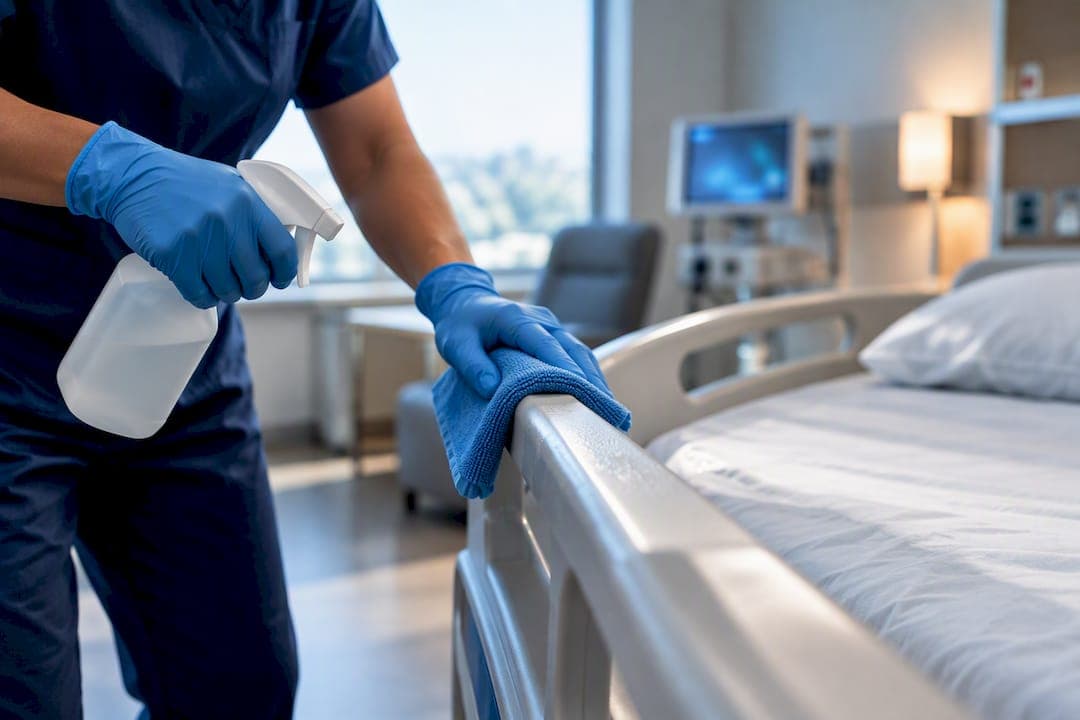
Meeting U.S. healthcare cleaning standards means satisfying four overlapping requirements at once: CMS Conditions of Participation, CDC infection prevention practices, OSHA worker safety rules, and EPA disinfectant registration. Facilities need documented SOPs and cleaning schedules, EPA-registered disinfectants applied exactly per label, proper PPE and exposure controls for staff, and a working audit program that produces evidence. Surveyors do not take your word for any of it. They want the paperwork.
TL;DR:
- Facilities must strictly document cleaning policies, staff training, monitoring data, and corrective actions to meet surveyor expectations and avoid citations.
- EPA-registered disinfectants applied according to label instructions and proper PPE use are essential to maintain compliance and effective pathogen control.
- High-touch surfaces require more frequent cleaning, with protocols and frequency justified by the surface’s infection risk and patient population.
- Worker safety relies on OSHA's exposure control plans, PPE, and immediate spill decontamination, with compliance confirmed through documentation.
- Regular, randomized audits using objective tools like ATP or fluorescent markers help verify actual cleaning performance and prevent common compliance gaps.
Table of Contents
- Which agencies actually govern healthcare cleaning?
- What do surveyors and auditors actually check?
- How should cleaning crews sequence their work?
- How does the Spaulding classification set cleaning frequency and method?
- How do you select and apply disinfectants correctly?
- What does OSHA require to protect cleaning staff?
- How do you build a monitoring program that actually works?
- What records and contract terms do you need in place?
- How Sparkleprocommercialcleaning fits into a compliant cleaning program
- What surveyors actually catch, and why it keeps happening
- Get a compliant cleaning program without building it from scratch
- Sources
- FAQ
Which agencies actually govern healthcare cleaning?
Four federal bodies define what "clean" means in a U.S. medical environment, and each one owns a different piece of the puzzle.
The Centers for Medicare & Medicaid Services (CMS) survey and certification guidance sets the Conditions of Participation that hospitals must meet to bill Medicare and Medicaid. Among other things, CoPs require a sanitary physical environment, an active infection prevention program, and integration of housekeeping performance into the facility's Quality Assessment and Performance Improvement (QAPI) plan. Surveyors reviewing CMS compliance look for documentation and monitoring records, not just a clean-looking floor.
The CDC's Core Infection Prevention and Control Practices lay out the clinical logic behind cleaning: use EPA-registered disinfectants according to their label instructions, and apply risk-based frequency, meaning high-touch surfaces get cleaned more often than low-touch ones.
OSHA governs the people doing the cleaning. Its Bloodborne Pathogens standard requires exposure control plans, PPE provided at no cost to staff, and specific procedures for handling contaminated materials. This is a worker-protection framework, but it directly shapes cleaning operations because it dictates how spills and contaminated surfaces must be handled.
The EPA does not write cleaning protocols. It registers disinfectant products and approves the claims on their labels, which is why an EPA registration number and its label instructions function as regulatory text, not marketing copy.
Together, these four frameworks form the backbone of what an environmental cleaning program needs to cover:
- A written infection prevention and environmental cleaning policy tied to CMS CoPs.
- Disinfectant selection and use governed by EPA registration and label directions.
- Staff protection and exposure controls governed by OSHA.
- Monitoring and QAPI integration that ties the first three together with evidence.
Accreditation bodies like the Joint Commission layer additional survey expectations on top of these, but they generally track the same core requirements: documented policy, correct product use, and monitoring evidence.
What do surveyors and auditors actually check?
Agency language is abstract until you translate it into what an inspector will ask to see. CMS interpretive guidelines and recent QSO memos to hospitals point to a consistent set of checkpoints.
- Written cleaning policies and schedules that match actual practice on the unit.
- Training records showing staff completed cleaning and infection control education.
- Surveillance and monitoring data, including how the facility identifies and corrects gaps.
- Documented corrective action when an audit or incident reveals a failure.
- Evidence that housekeeping performance feeds into the facility's QAPI process.
OSHA's Bloodborne Pathogens standard, 29 CFR 1910.1030, adds a parallel set of obligations specific to worker exposure. Surfaces contaminated with blood or other potentially infectious materials (OPIM) must be decontaminated immediately, not at the end of a shift. Employers must maintain a written exposure control plan, supply appropriate PPE at no cost, and follow specific rules for labeling and handling contaminated laundry and waste. An auditor checking OSHA compliance will ask for the exposure control plan itself, not a verbal description of it.
EPA-registered disinfectant labels turn into enforceable instructions the moment a product is applied off-label. If the label specifies a 10-minute wet contact time and staff wipe a surface dry after two minutes, the product has not done its job, and that gap shows up in monitoring data long before it shows up in a survey citation. This is why verifying EPA List N registrations before purchase matters as much as the cleaning itself.
Facilities pursuing Joint Commission accreditation will notice heavy overlap with CMS requirements: infection control surveillance, environment of care rounds, and documented staff competency. Meeting CMS and OSHA baseline requirements typically covers most of what an accreditation surveyor will also ask about.
How should cleaning crews sequence their work?
Technique matters as much as frequency, and the sequencing rules are simple enough to put on a laminated card for frontline staff.
- Work clean to dirty: start with the least contaminated areas and move toward the most contaminated, so tools and cloths do not spread soil backward.
- Work high to low: clean elevated surfaces first, since dust and debris fall onto lower surfaces and floors get addressed last.
- Identify and prioritize high-touch surfaces: door handles, bed rails, call buttons, IV poles, light switches, and shared equipment controls need more frequent attention than walls or ceilings, per CDC's environmental cleaning procedures. A dedicated high-touch cleaning protocol with explicit frequency targets closes a common survey gap.
- Perform terminal cleaning at discharge or transfer: strip and clean the full room, including curtains, mattress surfaces, and equipment left behind, following a documented terminal cleaning checklist rather than an abbreviated turnover clean.
- Respond to spills immediately: don appropriate PPE, remove gross soil with absorbent material, apply an EPA-registered disinfectant for its full wet contact time, and log the event per the facility's exposure control plan.
The step most often skipped under time pressure is the wait. Staff apply disinfectant and move on before the label's required dwell time has elapsed, which the CDC's disinfection and sterilization guidance flags as a frequent and consequential failure. A visibly wet surface for the labeled duration is the only reliable sign the product actually worked, not the wipe itself.
Construction and renovation projects inside occupied facilities add another layer: dust containment, infection control risk assessments, and a documented handoff before the space reopens, covered in more detail in construction cleaning safety guidance for healthcare settings.
How does the Spaulding classification set cleaning frequency and method?
The Spaulding classification sorts items and surfaces by infection risk, and that risk level dictates the required cleaning method, not the other way around.
- Critical items contact sterile tissue or the bloodstream (surgical instruments, implants) and require sterilization, full stop.
- Semicritical items contact mucous membranes or nonintact skin (endoscopes, respiratory equipment) and require high-level disinfection at minimum.
- Noncritical items and surfaces contact intact skin or nothing at all (bed rails, floors, countertops) and require low to intermediate-level disinfection with an EPA-registered product.
Most environmental cleaning, meaning the work performed by housekeeping and janitorial staff rather than sterile processing, falls into the noncritical category. That still leaves plenty of room for frequency decisions that need justification.
Operating rooms and intensive care units warrant the highest frequency and the most rigorous terminal cleaning between patients, since the population is more vulnerable and procedures create more contamination. Patient rooms generally follow a daily cleaning schedule with high-touch surfaces addressed more often, plus a full terminal clean at discharge. Ambulatory clinics and waiting areas can run on a lighter daily schedule, but high-touch points such as check-in counters and shared pens still need frequent attention given the volume of different people touching them.
When a surveyor asks why a given area is cleaned on a particular schedule, the defensible answer ties back to the item or surface's Spaulding category and the population it serves, not "that's how we've always done it."
Outbreaks change the calculus. A confirmed C. difficile case, for example, requires switching to a sporicidal disinfectant and increasing frequency in the affected area until the outbreak is resolved, an escalation that should be written into policy in advance rather than improvised in the moment.

How do you select and apply disinfectants correctly?
Product selection starts with the EPA's registered disinfectant lists, which enumerate products tested against specific organisms such as MRSA or C. difficile. A product not registered for the pathogen a facility is managing is the wrong product, regardless of what the label's general claims imply.
- Confirm the product's EPA registration number and pathogen-specific claims before adding it to procurement, not after it is already on the cart.
- Precleaning removes gross soil first, since disinfectants applied over visible debris cannot make full surface contact.
- Follow the label's dilution ratio exactly. A more concentrated mix is not more effective, and an under-diluted one may fail entirely.
- Apply enough product to keep the surface visibly wet for the labeled contact time, then let it air dry rather than wiping it off early.
- Check surface compatibility before rotating in a new product. Some disinfectants degrade certain floor finishes or plastics over repeated use.
Procurement should require manufacturer instructions for use (IFUs) as part of the purchasing packet, not as an afterthought staff track down later. A step-by-step check of EPA List N products before a purchase order goes out catches mismatches before they become a survey finding.
Some tasks need more than standard low-level disinfection. Semicritical equipment requires high-level disinfection or sterilization through instrument reprocessing, a distinct process from environmental surface cleaning and one that should never be substituted with a standard surface wipe. Facilities evaluating outside help for disinfecting, including electrostatic application, should understand what conditions make electrostatic disinfection appropriate before adding it to a protocol, since it works as a supplement to manual cleaning, not a replacement for it.
What does OSHA require to protect cleaning staff?
Cleaning staff face direct exposure to blood, body fluids, and chemical hazards, and OSHA's Bloodborne Pathogens standard sets the baseline for protecting them.
- Employers must provide PPE at no cost to employees and ensure it is readily accessible where cleaning tasks occur.
- A written exposure control plan must be in place, reviewed annually, and updated when tasks or exposures change.
- Staff need training on bloodborne pathogen exposure risks, PPE use, and post-exposure procedures, documented at the time of training.
- Contaminated laundry must be bagged at the point of use, labeled appropriately, and never sorted or rinsed in patient care areas.
Practical PPE combinations vary by task. Routine surface cleaning typically calls for gloves and eye protection; blood or body fluid spills call for gloves, a fluid-resistant gown, and a face shield or mask depending on splash risk. Chemical safety runs alongside biological safety here. Staff need access to safety data sheets (SDS) for every product in use, clear labeling on diluted solutions in secondary containers, and periodic refresher training, typically annually, on the hazards of the specific chemicals they handle.
Laundry handling deserves its own line in policy. Contaminated linens moved through the wrong path, such as through clean supply corridors, create both an infection control problem and an OSHA violation, and it is one of the easier fixes once staff know the designated route.
How do you build a monitoring program that actually works?
Visual inspection catches obvious problems, like a stain or a full trash bin, but it does not measure whether a disinfectant made contact with a surface or whether a high-touch point was actually wiped down. That gap is why the AHRQ's environmental cleaning toolkit recommends objective measurement methods alongside observation.
Fluorescent gel markers, applied invisibly to high-touch surfaces before cleaning and checked with UV light afterward, show whether a surface was physically wiped at all. ATP (adenosine triphosphate) testing measures organic residue left behind, giving a different signal: how much biological material remains, regardless of whether the surface was touched. Because these two methods measure different things, mechanical removal versus residual biological load, combining them gives a fuller picture than either alone, a point supported by research comparing environmental monitoring technologies. Culture-based sampling adds a third layer, confirming whether specific organisms persist, but it is slower and better suited to outbreak investigation than routine monitoring.
- Randomize which rooms and surfaces get sampled so staff cannot predict and prepare for an audit.
- Set a consistent audit cadence, weekly or monthly depending on facility size and risk level, rather than sporadic spot checks.
- Return results to frontline staff quickly. Feedback delayed by weeks loses its power to change behavior.
- Feed audit data into the facility's QAPI process, including root-cause analysis and documented corrective action for repeat failures.
Pro Tip: Rotate auditors and keep audits blinded to the cleaning staff's schedule. A rotating, unpredictable audit design produces far more representative data than the same person checking the same rooms on the same day every week.
Programs built around consistent cleaning practices tend to catch drift early, before it becomes a pattern a surveyor flags.
What records and contract terms do you need in place?
Surveyors do not just check whether cleaning happened. They check whether the facility can prove it happened, consistently, by trained people, using the right products.
- Maintain task-specific SOPs for each cleaning function, referencing the manufacturer IFU for every disinfectant in use.
- Keep training logs showing initial and refresher competency checks for every staff member performing cleaning duties.
- Retain audit logs and corrective action records, since a monitoring program without documented follow-up looks incomplete to a reviewer.
- Keep the OSHA exposure control plan current and accessible, not archived somewhere no one can find it during a survey.
- Compile the full package into a survey-ready documentation set before survey season, not during it.
When contracting with an outside cleaning vendor, the contract itself becomes part of the compliance record. Specify the exact scope of work by area and frequency, monitoring and reporting requirements the vendor must meet, corrective action timelines for any failure identified, and current proof of insurance and any relevant certifications. A guide to evaluating disinfecting service vendors is worth reviewing before signing, since vague scope language is the single biggest source of disputes when a survey finding traces back to a contracted service.
Staffing levels matter too. A facility that cuts housekeeping hours without adjusting cleaning frequency targets is setting up a documentation mismatch that surveyors notice immediately: the schedule says one thing, the staffing roster says another.
How Sparkleprocommercialcleaning fits into a compliant cleaning program
A nationwide commercial cleaning provider operating under licensed and insured standards offers local crews in many states and a straightforward quote, site visit, and scheduling process. Relevant service lines for healthcare compliance include environmental services, disinfecting services, deep cleans, and facility and day porter services, delivered under a client-centric process.
For a facility manager building or auditing a compliance program, the practical questions to bring to any proposal are the same regardless of vendor: what SOPs will the provider follow, what monitoring or audit reporting will they supply, what insurance and certification documents can they produce, and how quickly will corrective action happen when a problem surfaces. A provider that can answer those questions in writing, before a contract is signed, is one that can actually support a facility through survey season rather than becoming a liability during one.
What surveyors actually catch, and why it keeps happening
The failures I see repeated across facilities are rarely about effort. They are about proof.
The first is missing audit evidence: cleaning happens, but no one wrote down that it happened or what was found. The fix is a randomized audit schedule with corrective actions logged in writing, every time.
The second is disinfectant misuse, usually a product purchased for general cleaning applied where a pathogen-specific EPA registration was actually required. Reconciling the purchasing list against EPA registrations and manufacturer IFUs closes that gap fast.
The third is training gaps that surface only when a surveyor asks a staff member to explain a procedure they were never formally trained on. Tie every SOP to a documented competency check, and the gap disappears.
— Sales
Get a compliant cleaning program without building it from scratch
Building a fully documented, survey-ready cleaning program from zero takes months most facility teams do not have. Sparkleprocommercialcleaning offers a faster path: a nationwide provider that already operates under licensed, insured service standards, with local crews who understand the operational demands of medical environments.
- Environmental Services and Disinfecting Services cover routine and terminal cleaning needs across patient rooms, common areas, and specialty units.
- Facility Services and Day Porter Services provide ongoing coverage for high-touch and high-traffic areas between deep cleans.
- A proposal includes documented scope, cleaning frequency by area, and the reporting structure your facility needs for survey preparation.
The process starts the same way it does for any commercial client: request a quote, schedule a site visit, and get a written scope before anything is signed. Facilities in specific states, such as those served through the New Jersey service page, can see local operational examples during that site visit conversation. Start by requesting a site visit and a documented quote for your facility's cleaning scope.
This article is general information, not a substitute for advice from a qualified doctor. Consult a qualified healthcare professional about your own circumstances before acting on anything here.
Sources
- Occupational Safety and Health Administration — Bloodborne Pathogens standard (29 CFR 1910.1030)
- Centers for Disease Control and Prevention — Core Infection Prevention and Control Practices
- CMS — Survey and Certification guidance (interpretive guidelines — attachment)
- Agency for Healthcare Research and Quality — Environmental cleaning tools and toolkit
- U.S. Environmental Protection Agency — Registered disinfectants (List N and related lists)
FAQ
What are the cleaning standards for healthcare facilities?
Healthcare facilities must meet CMS Conditions of Participation for a sanitary environment, follow CDC infection prevention practices for disinfectant use and high-touch surfaces, comply with OSHA's Bloodborne Pathogens standard for staff safety, and use only EPA-registered disinfectants applied per label instructions. Documentation of SOPs, training, and monitoring ties all four requirements together during a survey.
What are the national standards for healthcare cleanliness?
There is no single national cleanliness standard. Instead, facilities operate under the combined framework of CMS Conditions of Participation, CDC core practices, OSHA's bloodborne pathogens rule, and EPA disinfectant registrations, with Joint Commission accreditation adding overlapping requirements for facilities that pursue it.
What are the CDC cleaning guidelines for healthcare facilities?
CDC guidance calls for cleaning sequences that move clean to dirty and high to low, prioritizing high-touch surfaces for more frequent attention, and using EPA-registered disinfectants exactly as their labels direct, including dilution and wet contact time. Terminal cleaning at discharge and immediate spill response with appropriate PPE round out the core recommendations.
What are the major healthcare standards in the United States?
The major frameworks are CMS Conditions of Participation, CDC infection prevention and environmental cleaning guidance, OSHA's Bloodborne Pathogens standard, and EPA disinfectant registration requirements. Facilities pursuing Joint Commission accreditation follow additional survey criteria that largely mirror these same four pillars.
How often should high-touch surfaces be cleaned in a hospital?
Frequency depends on the area's risk level and patient population, with intensive care and operating rooms requiring the most frequent attention and terminal cleaning between uses. CDC guidance recommends risk-based frequency rather than a single fixed interval, so facilities typically set their own schedules and document the reasoning behind them.